Grocery Procurement Management: A Complete Guide to Supplier Selection, Purchasing and Cost Control

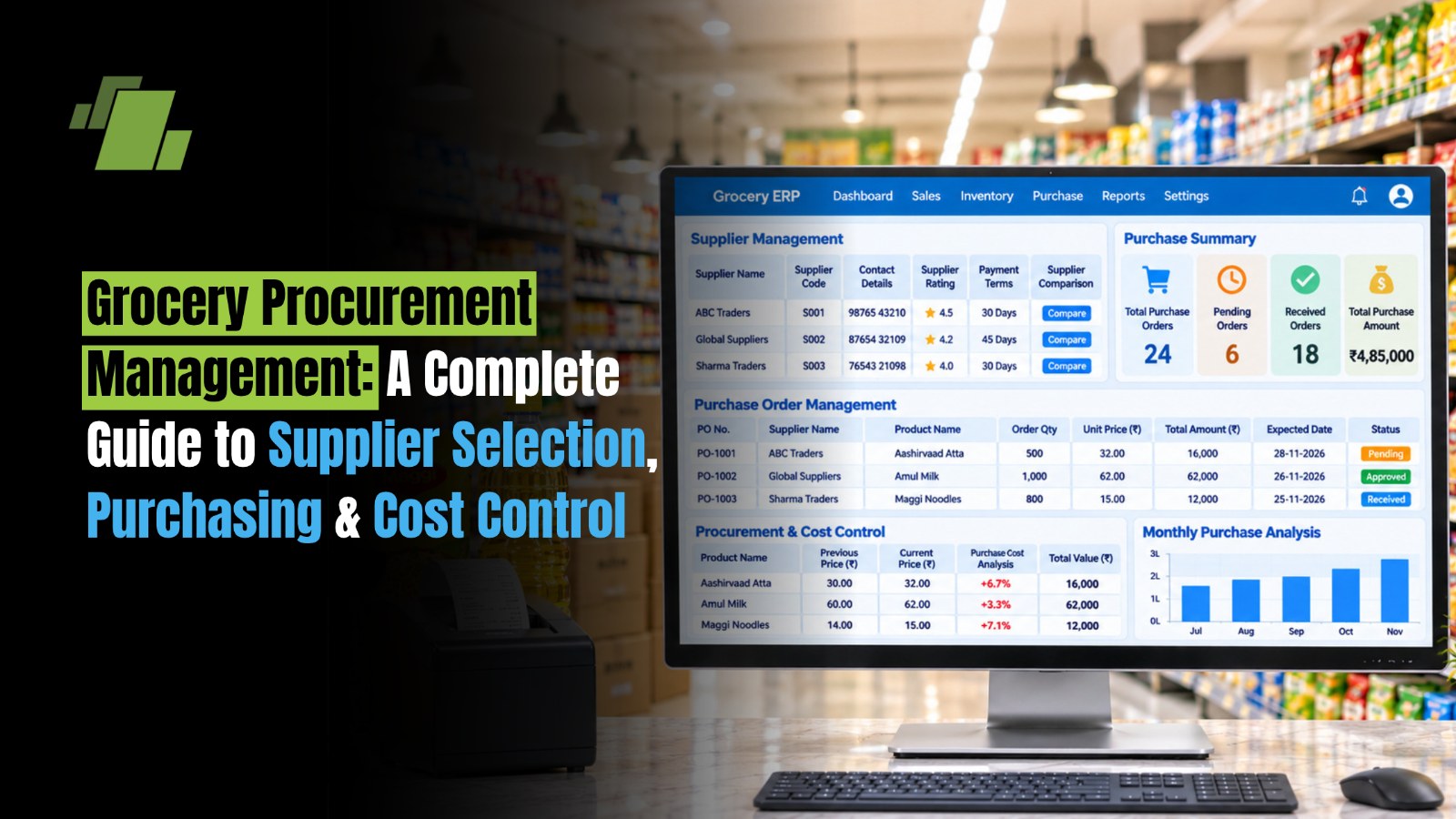
Grocery procurement management plays a critical role in maintaining product availability, controlling purchasing costs and protecting profit margins in grocery stores, supermarkets and retail chains. With thousands of SKUs, multiple suppliers, fluctuating market prices and products with different shelf lives, purchasing the right products at the right time and price is a continuous operational challenge.
For grocery retailers, procurement is not simply about buying products at the lowest available price. It involves evaluating suppliers, negotiating commercial terms, planning purchase quantities, monitoring delivery performance, controlling landed costs and ensuring that purchased inventory translates into sales rather than excess stock, expiry losses or blocked working capital.
A supermarket purchasing products in bulk may receive attractive supplier discounts but still lose money if those products remain unsold or expire before customers purchase them. Similarly, a grocery store relying on a single supplier may face stock shortages when deliveries are delayed.
An effective grocery procurement management strategy connects supplier selection, purchase planning, inventory management, warehouse operations, sales analysis and financial reporting. Integrated grocery ERP software helps retailers manage these activities through connected business processes and accurate purchasing information.
This guide explains how grocery businesses can improve supplier selection, streamline purchasing, reduce procurement costs and build a more profitable purchasing operation.
Contact Us
Free Demo Request
What is Grocery Procurement Management?
Grocery procurement management is the systematic process of identifying suppliers, evaluating products, negotiating prices, purchasing merchandise, receiving goods and monitoring procurement costs to maintain sufficient inventory at competitive prices.
It covers the complete purchasing lifecycle, from identifying replenishment requirements to verifying supplier invoices and evaluating vendor performance.
For grocery stores and supermarkets, procurement management typically includes:
-
Supplier Identification and Selection: Finding reliable suppliers for food products, beverages, household essentials, personal care products and other grocery categories.
-
Purchase Planning: Determining what to purchase, how much to order and when to replenish stock.
-
Price Negotiation: Negotiating purchase rates, quantity discounts, promotional schemes and payment terms.
-
Purchase Order Management: Creating and approving purchase orders with accurate product, quantity and pricing information.
-
Goods Receiving: Verifying delivered quantities, product quality, batch details and expiry dates.
-
Purchase Invoice Verification: Comparing supplier invoices with purchase orders and actual goods received.
-
Procurement Cost Control: Monitoring purchase prices, transportation costs, discounts and additional expenses.
-
Supplier Performance Evaluation: Measuring supplier reliability, product quality, delivery timelines and commercial performance.
The objective is to ensure that grocery stores purchase the right products in the right quantities, at the right time and at the most commercially beneficial cost.
Why is Effective Procurement Management Important for Grocery Stores?
Grocery retailers operate with relatively tight margins, high inventory turnover requirements and frequent replenishment cycles. Inefficient purchasing can increase operating expenses, create inventory imbalances and reduce profitability.
Effective procurement management helps grocery businesses address these challenges.
1. Prevents Stockouts and Lost Sales
Stockouts occur when products are unavailable despite customer demand. In grocery retail, even a temporary shortage of essential products such as milk, cooking oil, rice, packaged food and beverages can affect customer satisfaction.
Procurement planning based on sales trends, stock availability and supplier lead times helps retailers replenish products before inventory reaches critical levels.
2. Reduces Excess Inventory and Working Capital Blockage
Purchasing large quantities to obtain supplier discounts can create excess inventory, especially for slow-moving grocery products.
Excessive purchasing increases storage requirements, ties up working capital and exposes retailers to expiry, damage and markdown losses.
Demand-based procurement helps maintain a balance between product availability and inventory investment.
3. Improves Supplier Negotiation and Purchase Prices
Retailers working with multiple suppliers can compare product rates, discounts, payment terms and delivery conditions.
Historical purchase records also help purchasing managers identify suppliers offering competitive rates and negotiate better commercial arrangements.
4. Minimises Expiry and Wastage
Grocery products have different shelf lives. Fresh produce, dairy products, packaged foods and other perishable items require careful purchasing and receiving controls.
Purchasing quantities based on sales velocity, shelf life and remaining stock helps reduce expiry-related losses.
5. Improves Cash Flow and Cost Visibility
Supplier credit periods, advance payments, outstanding invoices and purchase commitments directly affect working capital.
A structured procurement process gives business owners better visibility into supplier liabilities, upcoming payments and purchasing expenditure.
6. Supports Multi-Store Purchasing Decisions
Supermarket chains need to coordinate purchases across multiple outlets and warehouses.
Centralised procurement helps retailers consolidate purchasing requirements, negotiate bulk rates and distribute inventory according to individual store demand.
What are the Major Challenges in Grocery Procurement Management?
Grocery purchasing becomes increasingly complex as the number of products, suppliers, stores and daily transactions increases.
|
Procurement challenge |
Impact on grocery business |
Recommended solution |
|
Unreliable suppliers |
Delayed deliveries and stockouts |
Maintain supplier performance records |
|
Unplanned purchasing |
Excess or insufficient inventory |
Use sales-based purchase planning |
|
Frequent price changes |
Reduced product margins |
Monitor supplier rates and purchase history |
|
Incorrect order quantities |
Inventory imbalance |
Calculate reorder requirements |
|
Expiry and damaged goods |
Financial losses |
Verify batch and expiry information |
|
Manual purchase records |
Data discrepancies |
Centralise procurement records |
|
Uncontrolled discounts |
Miscalculated purchasing costs |
Verify actual purchase and scheme benefits |
|
Poor invoice reconciliation |
Payment discrepancies |
Match POs, GRNs and invoices |
|
Multiple store requirements |
Uneven inventory distribution |
Use centralised procurement planning |
Addressing these problems requires a procurement process that connects purchasing decisions with actual inventory movement and business demand.
How to Select the Right Suppliers for a Grocery Store?
Supplier selection is one of the most important parts of grocery procurement management. A supplier offering the lowest purchase price may not necessarily be the most profitable choice if deliveries are inconsistent, product quality is poor or payment terms are unfavourable.
Grocery retailers should evaluate suppliers using a combination of commercial, operational and quality-related parameters.
1. Evaluate Product Quality and Consistency
Product quality directly influences customer satisfaction, repeat purchases and inventory wastage.
Before finalising a supplier, evaluate:
-
Product freshness and quality.
-
Packaging condition and labelling.
-
Manufacturing and expiry dates.
-
Batch consistency.
-
Storage and transportation conditions.
-
Compliance with applicable food safety requirements.
For fresh fruits, vegetables, dairy and other perishable products, retailers should pay particular attention to freshness, temperature control and delivery frequency.
2. Compare Supplier Pricing and Commercial Terms
Compare quotations from different suppliers instead of selecting vendors based only on their quoted purchase prices.
Evaluate the following:
-
Basic purchase price.
-
Quantity-based discounts.
-
Cash discounts.
-
Promotional schemes.
-
Transportation and handling charges.
-
Minimum order quantities.
-
Credit periods.
-
Return and replacement policies.
For example, Supplier A may offer cooking oil at ₹150 per unit, while Supplier B offers it at ₹147. However, if Supplier B charges additional transportation costs and does not provide credit, Supplier A may offer better overall commercial value.
3. Check Delivery Reliability and Lead Time
Supplier delivery performance affects inventory availability and replenishment planning.
Evaluate whether suppliers:
-
Deliver orders within committed timelines.
-
Fulfil the quantities mentioned in purchase orders.
-
Handle urgent replenishment requests.
-
Maintain consistent delivery schedules.
-
Provide advance information about delays or shortages.
A supplier with slightly higher prices but reliable deliveries may be more valuable for essential and fast-moving grocery products.
4. Assess Supplier Capacity and Market Reputation
Suppliers should have sufficient infrastructure and operational capacity to meet your purchasing requirements.
Check their:
-
Warehousing and storage facilities.
-
Transportation capabilities.
-
Product availability.
-
Geographic coverage.
-
Financial stability.
-
Existing customer relationships.
-
Ability to support seasonal demand.
For multi-store supermarkets, suppliers should also be capable of servicing multiple delivery locations.
5. Evaluate Payment Terms and Credit Facilities
Payment conditions influence cash flow and purchasing flexibility.
Compare suppliers based on:
-
Advance payment requirements.
-
Cash-on-delivery arrangements.
-
Credit periods.
-
Early payment discounts.
-
Outstanding payment limits.
-
Invoice settlement procedures.
Retailers should negotiate payment terms that support their cash conversion cycle without compromising supplier relationships.
6. Maintain Alternative Suppliers
Depending entirely on one supplier for essential products creates procurement risks.
Maintain alternative vendors for critical categories such as packaged food, dairy, beverages, cooking essentials and household products.
A multiple-supplier strategy provides flexibility when prices fluctuate, products become unavailable or deliveries are delayed.
Supplier Evaluation Scorecard
Grocery retailers can use a weighted supplier evaluation model to compare vendors objectively.
|
Evaluation parameter |
Suggested weight |
|
Product quality |
25% |
|
Purchase pricing |
20% |
|
Delivery reliability |
20% |
|
Product availability |
15% |
|
Payment terms |
10% |
|
Return and replacement support |
10% |
|
Total |
100% |
These are suggested illustrative weights, not an industry-wide standard. Retailers should adjust them according to product category and business requirements.
For example, a dairy supplier may receive a higher quality and delivery reliability weighting, whereas a supplier of non-perishable household products may be evaluated more heavily on pricing and payment terms.
A supplier scorecard also helps purchasing managers identify declining vendor performance and make data-backed sourcing decisions.
How to Create an Effective Grocery Procurement Process?
A standardised procurement process reduces purchasing errors, improves accountability and ensures that purchase decisions are based on actual business requirements.
The following steps provide a practical framework for managing grocery purchasing.
Step 1: Analyse Inventory Requirements
Start by reviewing current stock levels, sales history, pending purchase orders and expected demand.
Identify:
-
Fast-moving grocery products.
-
Slow-moving and non-moving products.
-
Products approaching minimum stock levels.
-
Near-expiry inventory.
-
Seasonal and promotional requirements.
-
Stock available across other warehouses and stores.
For example, a supermarket selling 40 packets of a particular breakfast cereal daily should consider its current stock, supplier lead time and expected demand before placing the next order.
Purchasing managers should avoid placing orders simply because a supplier offers a temporary discount.
Step 2: Calculate Reorder Quantities
Reorder quantities should consider sales velocity, available inventory, pending orders and supplier lead time.
A basic reorder point formula is:
Reorder Point = Average Daily Sales × Supplier Lead Time + Safety Stock
For example:
-
Average daily sales: 40 units.
-
Supplier lead time: 4 days.
-
Safety stock: 50 units.
Reorder point:
40 × 4 + 50 = 210 units.
When inventory reaches approximately 210 units, the purchasing team should initiate replenishment.
A simple purchase quantity calculation is:
Purchase Quantity = Target Stock Level − Available Stock − Confirmed Incoming Stock
For example:
-
Target stock level: 600 units.
-
Available stock: 210 units.
-
Confirmed incoming stock: 90 units.
Required purchase quantity:
600 − 210 − 90 = 300 units.
These calculations should be adjusted for minimum order quantities, case-pack sizes, shelf life, storage capacity and expected demand changes.
Step 3: Generate Purchase Requisitions
Once replenishment requirements are identified, the purchasing team should prepare a purchase requisition.
A purchase requisition should include:
-
Product name and SKU.
-
Required quantity.
-
Current stock availability.
-
Preferred supplier.
-
Last purchase price.
-
Expected delivery date.
-
Store or warehouse requirement.
-
Reason for purchase.
For grocery chains, purchase requisitions should consolidate requirements from individual outlets wherever centralised purchasing is appropriate.
Step 4: Compare Supplier Quotations
Request quotations from shortlisted suppliers and compare their actual commercial terms.
A quotation comparison should cover:
|
Parameter |
Supplier A |
Supplier B |
|
Basic unit price |
₹150 |
₹147 |
|
Quantity discount |
2% |
1% |
|
Freight per unit |
₹2 |
₹5 |
|
Effective price before applicable taxes |
₹149 |
₹150.53 |
In this example, Supplier A has a lower effective purchasing cost despite having a higher quoted price.
This demonstrates why retailers should evaluate total procurement costs instead of comparing basic supplier prices alone.
Step 5: Create and Approve Purchase Orders
After selecting the supplier, generate a purchase order (PO).
A purchase order is a formal document specifying the products, quantities, agreed rates, delivery conditions and payment terms for a purchase.
A grocery purchase order should include:
-
PO number and date.
-
Supplier details.
-
Product descriptions and item codes.
-
Ordered quantities and units.
-
Agreed purchase rates.
-
Applicable discounts and schemes.
-
GST details, wherever applicable.
-
Delivery location and expected date.
-
Payment terms.
-
Authorised approval.
An approval workflow helps prevent duplicate orders, unauthorised purchases and unnecessary expenditure.
Step 6: Receive and Inspect Goods
When products arrive, verify the delivered goods against the purchase order.
The receiving team should check:
-
Whether the correct products have been delivered.
-
Whether actual quantities match ordered quantities.
-
Whether packaging is intact.
-
Whether product quality meets specifications.
-
Whether batch numbers and expiry dates are recorded where applicable.
-
Whether damaged, missing or excess items are documented.
A Goods Receipt Note (GRN) records the products and quantities actually received.
If a purchase order contains 500 units but the supplier delivers only 450, the GRN should record the actual accepted quantity rather than automatically treating the full order as received.
Step 7: Verify Supplier Invoices
Before processing payment, compare the supplier invoice with the purchase order and GRN.
This three-way matching process helps identify:
-
Rate differences.
-
Quantity discrepancies.
-
Duplicate billing.
-
Incorrect discounts.
-
Additional charges.
-
Tax calculation errors.
-
Unauthorised purchases.
Only verified invoices should proceed for payment approval.
Step 8: Monitor Supplier Performance
After completing the procurement cycle, record supplier performance.
Track:
-
On-time delivery percentage.
-
Order fulfilment rate.
-
Product rejection percentage.
-
Purchase price variations.
-
Quantity discrepancies.
-
Return frequency.
-
Invoice accuracy.
Regular reviews help purchasing managers improve supplier selection and negotiate better terms.
How to Control Grocery Procurement Costs?
Procurement cost control involves reducing unnecessary purchasing expenditure while maintaining product availability and quality.
Simply negotiating lower prices is not sufficient. Retailers must evaluate the complete cost of purchasing, receiving, storing and managing products.
1. Calculate the Actual Landed Cost
Landed cost represents the total cost of bringing purchased products to the intended inventory location, including applicable additional procurement expenses.
A simplified formula is:
Landed Cost = Purchase Cost − Eligible Discounts + Freight + Handling + Other Allocable Expenses
Consider a grocery retailer purchasing 1,000 units of packaged food.
|
Cost component |
Amount |
|
Basic purchase value |
₹1,00,000 |
|
Supplier discount |
₹5,000 |
|
Freight charges |
₹3,000 |
|
Handling charges |
₹1,000 |
|
Total landed cost |
₹99,000 |
Landed cost per unit:
₹99,000 ÷ 1,000 = ₹99.
The retailer should use the appropriate accounting treatment for GST and input tax credit rather than automatically including recoverable GST as an inventory cost.
Calculating landed cost helps purchasing managers understand the actual cost of acquiring products and make better supplier comparisons.
2. Consolidate Purchases Across Stores
Retail chains often purchase similar products independently for different outlets.
Consolidating requirements can help businesses:
-
Negotiate bulk purchase rates.
-
Reduce transportation expenses.
-
Improve supplier coordination.
-
Standardise procurement terms.
-
Reduce duplicate purchasing.
-
Optimise warehouse replenishment.
However, centralised buying should still consider individual store demand, local preferences and available storage capacity.
3. Avoid Unnecessary Bulk Purchasing
Bulk purchasing is beneficial only when the discount justifies the additional inventory investment and associated risks.
Before accepting a bulk purchase offer, evaluate:
-
Expected sales during the holding period.
-
Product shelf life.
-
Existing stock.
-
Storage capacity.
-
Working capital availability.
-
Risk of damage and expiry.
-
Actual savings after additional expenses.
For example, purchasing 1,000 units at a 10% discount may not be beneficial if the store can sell only 400 units before the product approaches expiry.
4. Monitor Purchase Price Variance
Purchase price variance measures the difference between the actual purchase price and the standard or expected purchase price.
Purchase Price Variance = (Actual Purchase Price − Standard Purchase Price) × Purchased Quantity
Suppose:
-
Standard purchase price: ₹100 per unit.
-
Actual purchase price: ₹105 per unit.
-
Purchased quantity: 500 units.
Purchase price variance:
(₹105 − ₹100) × 500 = ₹2,500.
The business has incurred an additional ₹2,500 compared with its standard purchasing benchmark.
Tracking purchase price variance helps identify suppliers increasing rates, ineffective negotiations and unexpected procurement expenditure.
5. Negotiate Supplier Schemes Carefully
Grocery suppliers frequently provide quantity discounts, free units, promotional schemes and seasonal offers.
However, retailers should calculate the effective benefit of each scheme before accepting it.
For example, a buy-10-get-1-free scheme reduces the effective cost per unit, provided that the additional stock can be sold profitably and within its shelf life.
Purchasing teams should also verify scheme eligibility, credit notes and invoice adjustments.
6. Reduce Procurement-Related Wastage
Expiry, damage, incorrect storage and excessive inventory can eliminate the savings achieved through supplier negotiations.
Use the following practices:
-
Purchase perishables in smaller, more frequent quantities.
-
Follow FEFO (First Expiry, First Out) for expiry-sensitive products.
-
Review near-expiry stock before generating new purchase orders.
-
Record damaged and rejected deliveries.
-
Monitor category-wise inventory ageing.
-
Coordinate purchasing with sales and promotional plans.
7. Establish Purchase Approval Limits
Define purchasing authority according to transaction value and business hierarchy.
For example:
-
Store managers approve routine purchases within assigned limits.
-
Category managers review larger purchasing requirements.
-
Procurement heads approve high-value supplier contracts.
-
Senior management reviews exceptional purchases.
The limits should reflect the organisation's size, risk exposure and internal control requirements.
What is the Role of Grocery ERP Software in Procurement Management?
Managing procurement through spreadsheets, phone calls and disconnected billing systems becomes difficult as grocery businesses expand their product catalogues, supplier networks and store locations.
Grocery ERP software integrates purchasing, inventory, supplier management, warehouse operations, accounting and sales information into a centralised business management system.
This gives purchasing managers access to relevant business information before making procurement decisions.
1. Centralised Supplier Management
Grocery ERP software maintains supplier information in a centralised database.
Retailers can maintain:
-
Supplier names and contact details.
-
GSTIN and billing information.
-
Product-wise supplier associations.
-
Agreed purchase rates.
-
Payment and credit terms.
-
Purchase history.
-
Outstanding balances.
This makes it easier to compare suppliers, review historical transactions and manage vendor relationships.
2. Automated Purchase Planning and Reordering
ERP-based inventory management helps identify products requiring replenishment using stock levels, sales movement and predefined reorder parameters.
Purchasing managers can review low-stock products, calculate required quantities and prepare purchase orders accordingly.
For example, if a grocery store sells 100 packets of a particular product daily and has only two days of stock remaining, its purchasing team can prioritise replenishment based on supplier lead time.
3. Purchase Order Management
A grocery ERP system helps businesses create, track and manage purchase orders.
Purchasing teams can maintain product-wise quantities, agreed rates, supplier details, expected delivery dates and approval status.
This improves purchasing accountability and helps prevent unauthorised or duplicate orders.
4. Goods Receipt and Inventory Updates
When purchased products arrive, the receiving team can record actual quantities against the purchase order.
The system can update inventory based on accepted goods and maintain relevant transaction records.
For grocery products requiring additional tracking, businesses should capture batch numbers, manufacturing dates and expiry dates.
5. Purchase Price and Cost Analysis
Historical purchase data helps retailers compare supplier rates and monitor changes in procurement costs.
Purchase reports can help identify:
-
Products with increasing purchase prices.
-
Supplier-wise purchasing expenditure.
-
Purchase quantity variations.
-
Category-wise procurement costs.
-
Discount and scheme benefits.
-
Additional purchase expenses.
These insights help management improve purchasing decisions and protect margins.
6. Integration with Retail POS and Sales Data
When procurement information is connected with Retail POS, purchasing managers can use actual sales movement to plan replenishment.
For example, if a particular brand of packaged snacks experiences higher sales during weekends, the purchasing team can adjust order quantities to meet expected demand.
This reduces dependence on manual estimates and disconnected sales reports.
7. Multi-Store and Warehouse Procurement Control
For grocery chains, integrated ERP software helps coordinate purchasing across stores and warehouses.
Management can review location-wise stock, consolidate purchase requirements and plan internal stock transfers before placing additional orders.
This prevents unnecessary purchasing when sufficient inventory is already available elsewhere in the business.
8. Integrated Accounting and Supplier Outstanding Reports
Connecting purchasing with accounting helps maintain visibility into supplier invoices, payments, debit notes, credit notes and outstanding balances.
This makes it easier to reconcile procurement transactions and plan supplier payments.
Grocery Procurement Management: Manual Purchasing vs ERP-Based Purchasing
As grocery businesses grow, manual procurement processes can create operational bottlenecks.
The following comparison highlights how an integrated ERP system can improve purchasing operations.
|
Business Activity |
Manual Procurement |
ERP-Based Procurement |
|
Supplier records |
Separate files and registers |
Centralised supplier database |
|
Purchase planning |
Manual stock checking |
System-assisted replenishment |
|
Price comparison |
Spreadsheet-based |
Historical purchase analysis |
|
Purchase orders |
Manual preparation |
Structured PO management |
|
Goods receiving |
Manual entry |
GRN linked to purchase orders |
|
Inventory updates |
Delayed or separate entry |
Integrated stock updates |
|
Batch and expiry tracking |
Manual registers |
System-supported tracking |
|
Cost analysis |
Manual calculations |
Purchase and cost reports |
|
Multi-store purchasing |
Separate store-level coordination |
Centralised visibility |
|
Supplier payments |
Separate reconciliation |
Integrated accounting records |
ERP software does not eliminate the need for purchasing judgement. Instead, it gives purchasing managers better information, transaction visibility and control over the procurement lifecycle.
Key Grocery Procurement KPIs Every Supermarket Should Track
Measuring procurement performance helps retailers understand whether their purchasing strategies are improving product availability, supplier reliability and profitability.
The following KPIs are particularly useful.
|
KPI |
Calculation |
Business purpose |
|
On-Time Delivery Rate |
On-time deliveries ÷ Total deliveries × 100 |
Measures supplier reliability |
|
Order Fulfilment Rate |
Quantity received ÷ Quantity ordered × 100 |
Measures order completeness |
|
Purchase Price Variance |
Actual cost − Standard cost |
Tracks purchasing cost differences |
|
Supplier Rejection Rate |
Rejected quantity ÷ Delivered quantity × 100 |
Measures delivery quality |
|
Inventory Turnover |
Cost of Goods Sold ÷ Average Inventory |
Measures inventory movement |
|
Stockout Rate |
Stockout occurrences ÷ Total product observations × 100 |
Measures product availability |
|
Procurement Cost per Order |
Total Procurement Expenses ÷ Number of Orders |
Evaluates purchasing efficiency |
Retailers should review these KPIs by supplier, product category, store and purchasing period.
For example, a supplier may offer competitive prices but consistently deliver incomplete orders. Analysing order fulfilment and delivery reliability alongside purchase prices provides a more accurate assessment of supplier value.
Common Grocery Procurement Mistakes and How to Avoid Them
Even established supermarkets can experience procurement inefficiencies because of inconsistent purchasing practices.
1. Selecting Suppliers Only on the Basis of Price
Problem: The lowest-priced supplier may offer inconsistent quality or delayed deliveries.
Solution: Evaluate quality, reliability, commercial terms and total landed cost before finalising suppliers.
2. Purchasing Without Checking Available Stock
Problem: Purchasing teams may order products already available in another warehouse or store.
Solution: Review location-wise inventory and pending purchase orders before generating new orders.
3. Ignoring Product Shelf Life
Problem: Excessive purchasing of perishable products increases expiry and wastage risks.
Solution: Consider product shelf life, sales velocity and FEFO-based stock rotation.
4. Not Comparing Purchase Prices Regularly
Problem: Suppliers may revise rates without purchasing managers identifying the financial impact.
Solution: Maintain historical supplier rates and review purchase price variance.
5. Accepting Supplier Schemes Without Calculating Actual Benefits
Problem: Free quantities and bulk discounts may encourage purchases beyond actual demand.
Solution: Calculate effective unit costs and compare the benefits against inventory holding and expiry risks.
6. Skipping Purchase Order and Invoice Verification
Problem: Incorrect quantities, rates and additional charges can lead to excess payments.
Solution: Follow PO, GRN and supplier invoice matching before payment approval.
7. Managing Multiple Stores Without Centralised Procurement Visibility
Problem: Different outlets may purchase the same products at different prices or maintain unnecessary inventory.
Solution: Use centralised purchasing information, store-wise stock reports and coordinated replenishment planning.
Best Practices for Improving Grocery Procurement Management
Grocery retailers can establish a more efficient purchasing operation by following these practical recommendations:
-
Maintain an updated supplier database with product-wise vendor information.
-
Develop supplier evaluation criteria for every major product category.
-
Review sales and stock movement before creating purchase orders.
-
Establish minimum, maximum and reorder stock levels.
-
Compare supplier prices and calculate actual landed costs.
-
Negotiate payment terms, delivery schedules and return conditions.
-
Consolidate purchases wherever bulk buying provides genuine savings.
-
Track partial deliveries, rejected goods and supplier discrepancies.
-
Monitor batch-wise and expiry-wise inventory for applicable products.
-
Implement purchase approval workflows.
-
Reconcile purchase orders, GRNs and supplier invoices.
-
Analyse supplier performance and purchasing KPIs regularly.
-
Integrate procurement with inventory, warehouse, POS and accounting operations.
An effective procurement strategy should be reviewed continuously because customer demand, supplier prices, product availability and seasonal purchasing requirements change throughout the year.
How LOGIC ERP Helps Streamline Grocery Procurement Management
Managing multiple suppliers, thousands of grocery SKUs, frequent purchases and changing market prices requires accurate information across purchasing, inventory, warehouse and accounting operations.
LOGIC ERP provides an integrated business management platform that connects procurement with inventory management, warehouse operations, Retail POS, accounting and business reporting.
For grocery stores, supermarkets and multi-location retail chains, relevant capabilities include:
Supplier and Purchase Management
-
Maintain supplier records and product-wise purchasing information.
-
Manage purchase transactions and supplier-related records.
-
Maintain visibility into purchase rates and historical transactions.
-
Improve control over purchasing activities.
Inventory-Based Purchase Planning
-
Monitor stock availability across products and locations.
-
Identify fast-moving, slow-moving and non-moving products.
-
Use minimum and maximum stock levels to support replenishment decisions.
-
Review pending purchases and stock requirements before ordering.
Warehouse and Goods Receiving
-
Manage stock across warehouses and godowns.
-
Track inventory using relevant batch and expiry information.
-
Maintain stock movement and goods receipt records.
-
Improve coordination between procurement and warehouse operations.
Integrated Retail POS and Accounting
-
Connect purchase and inventory information with retail billing operations.
-
Maintain visibility into supplier-related financial transactions.
-
Review purchasing expenditure and business performance.
-
Reduce discrepancies caused by disconnected operational records.
Business Insights and Reporting
-
Analyse sales and inventory performance.
-
Review product-wise and category-wise business information.
-
Identify purchasing trends and inventory imbalances.
-
Support more informed procurement and replenishment decisions.
By connecting purchasing with actual stock movement, sales performance and financial information, LOGIC ERP helps grocery retailers improve procurement visibility, strengthen inventory control and make more informed purchasing decisions.
Conclusion
Effective grocery procurement management is essential for maintaining product availability, controlling purchasing expenditure and improving supermarket profitability. From selecting reliable suppliers and negotiating competitive prices to planning purchase quantities and monitoring supplier performance, every procurement decision influences inventory efficiency and business margins.
Grocery retailers should move beyond price-based purchasing and adopt a structured approach that connects procurement with inventory, warehouse operations, sales performance and financial reporting.
LOGIC ERP grocery software helps grocery stores, supermarkets and retail chains streamline purchasing operations through integrated ERP, inventory management, warehouse management, Retail POS and business reporting capabilities.
Looking to improve supplier management, control procurement costs and optimize grocery inventory?
Call at +91-73411-41176/75 or send us an email at sales@logicerp.com to book a free demo today!
Frequently Asked Questions About Grocery Procurement Management
1. What is Grocery Procurement Management?
Grocery procurement management is the process of sourcing, purchasing and receiving grocery products from suppliers while controlling purchasing costs, maintaining product availability and managing inventory efficiently.
2. What are the Five Steps of Grocery Procurement?
The five major steps are:
-
Identify purchasing requirements based on sales and inventory.
-
Evaluate suppliers and compare quotations.
-
Create and approve purchase orders.
-
Receive and inspect goods against purchase orders.
-
Verify supplier invoices and evaluate procurement performance.
3. How do Grocery Stores Select the Right Suppliers?
Grocery stores should evaluate suppliers based on product quality, purchase prices, delivery reliability, product availability, payment terms, minimum order quantities and return policies. Comparing suppliers using a weighted evaluation scorecard helps businesses make objective purchasing decisions.
4. How can Supermarkets Reduce Procurement Costs?
Supermarkets can reduce procurement costs by negotiating competitive prices, consolidating purchases, comparing supplier quotations, calculating landed costs, avoiding unnecessary bulk purchases and monitoring purchase price variations.
5. What is the Difference Between Procurement and Purchasing?
Procurement is a broader business process covering supplier identification, evaluation, negotiation, purchasing, delivery management and supplier performance analysis.
Purchasing is one part of procurement that focuses primarily on ordering and acquiring products or services from suppliers.
6. What is a Purchase Order in Grocery Procurement?
A purchase order is an official document issued by a grocery retailer to a supplier specifying the products, quantities, agreed prices, delivery conditions and payment terms for a purchase.
It helps maintain purchasing accountability and provides a reference for goods receiving and invoice verification.
7. What is a GRN in Grocery Procurement?
A Goods Receipt Note (GRN) is a document recording the products and quantities received from a supplier. It helps grocery businesses verify actual deliveries against purchase orders and maintain accurate inventory records.
8. How do Grocery Stores Calculate Reorder Quantities?
Grocery stores calculate reorder quantities by considering target stock levels, current inventory, pending purchase orders, sales demand and supplier lead times.
A basic formula is:
Purchase Quantity = Target Stock − Available Stock − Confirmed Incoming Stock
Retailers should also consider minimum order quantities, shelf life and storage capacity.
9. How does ERP Software Improve Grocery Procurement Management?
Grocery ERP software connects supplier management, purchase orders, inventory, goods receiving, warehouse operations, accounting and reporting. It improves purchasing visibility, supports replenishment planning and helps retailers monitor procurement costs across multiple locations.
10. Which KPIs Should Grocery Retailers Track for Procurement Management?
Important procurement KPIs include:
-
Supplier on-time delivery rate.
-
Purchase price variance.
-
Order fulfilment rate.
-
Supplier rejection rate.
-
Procurement cost per order.
-
Inventory turnover.
-
Stockout rate.
-
Supplier payment performance.
11. What is the Landed Cost in Grocery Procurement?
Landed cost is the total cost of acquiring and bringing products to the intended inventory location. It generally includes purchase value, freight, handling and other allocable expenses, adjusted for applicable discounts and accounting treatment.
12. Why is Supplier Performance Evaluation Important for Supermarkets?
Supplier performance evaluation helps supermarkets identify reliable vendors, monitor delivery delays, assess product quality, compare purchase prices and reduce supply chain disruptions. It also provides a factual basis for supplier negotiations and future purchasing decisions.

Author
Gurbir Singh
Co-founder & Managing Director | LOGIC ERP Solutions Pvt. Ltd.
With 30+ years of experience in the tech industry, I took the helm of technology & product development, ensuring LOGIC ERP’s continuous innovation & leadership in the evolving tech landscape.

