Kirana Store Customer Management: A Complete Guide to Customer Credit, Purchase History and Loyalty

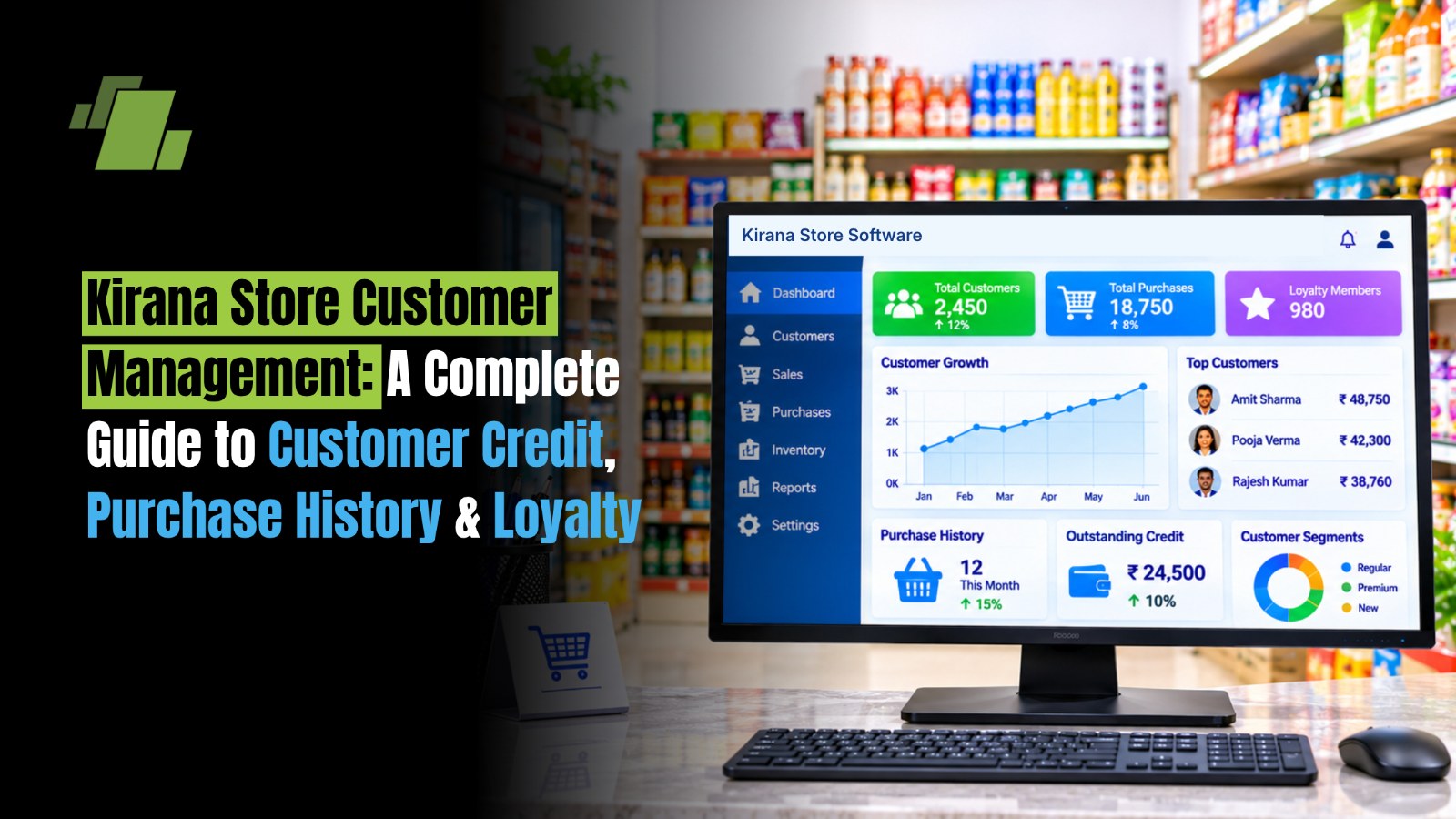
Strong customer relationships are a key driver of success for kirana stores. Regular customers often rely on neighbourhood grocery shops for everyday essentials, monthly purchases on credit, home delivery and personalised service. While these familiar interactions encourage repeat visits, keeping track of customer details, credit transactions and preferences manually can become increasingly challenging as the business expands.
A kirana store owner may remember regular customers, but keeping track of outstanding balances, payment dates, purchase preferences, monthly spending and loyalty rewards across hundreds of customers is a different challenge. Paper registers, informal credit notes and scattered billing records can lead to missed payments, inaccurate balances and lost opportunities to increase repeat purchases.
Kirana store customer management brings these activities together through a structured process for maintaining customer records, tracking credit transactions, analysing purchase history and rewarding repeat customers. With the right processes and kirana retail management software, kirana stores can improve payment collection, offer more relevant service and build stronger customer relationships.
This guide explains how to manage customer credit, maintain purchase history, improve customer loyalty and use technology to make customer management more organised and profitable.
Contact Us
Free Demo Request
What is Customer Management in a Kirana Store?
Kirana store customer management is the process of recording, organising and analysing customer-related information to improve service, manage credit transactions, understand buying behaviour and encourage repeat purchases.
It involves more than maintaining a customer contact list. A structured customer management system connects the customer's billing activity with their purchase history, payment records, outstanding credit and loyalty benefits.
A typical customer profile may contain:
|
Customer information |
What the store can track |
|
Basic details |
Name, mobile number and address |
|
Purchase history |
Previous bills, products purchased and transaction dates |
|
Credit details |
Credit limit, outstanding amount and due date |
|
Payment history |
Cash, UPI and other payments received |
|
Buying preferences |
Preferred brands, pack sizes and product categories |
|
Shopping behaviour |
Visit frequency and average bill value |
|
Loyalty information |
Points earned, rewards redeemed and special offers |
|
Service preferences |
Home delivery, preferred contact method and special requests |
For example, a retailer may identify that a customer purchases monthly groceries worth approximately ₹5,000, prefers a particular rice brand, regularly buys milk and bread, and usually clears their credit balance by the 5th of each month.
This information helps the retailer provide faster service, plan relevant offers and manage the customer's account more accurately.
Why is Customer Management Important for Kirana Stores?
Kirana stores compete not only through product prices but also through convenience, familiarity, availability and personal relationships. A customer who receives consistent service is more likely to return.
However, when customer information is scattered across notebooks, billing records and WhatsApp conversations, it becomes difficult to maintain the same level of service as the business grows.
Here are the key reasons why customer management matters.
Better Control Over Customer Credit
Credit purchases, commonly known as udhaar or khata, are a familiar part of many neighbourhood grocery stores. Regular customers may purchase essential items throughout the month and settle their accounts later.
Without proper records, retailers may struggle to identify:
-
How much each customer owes.
-
Which credit bills are still unpaid.
-
How much payment has been received.
-
Which customers have crossed their credit limits.
-
How long an outstanding amount has been pending.
A customer-wise digital ledger helps retailers track these details and reduce disputes over payments.
Understand Customer Purchase Behaviour
Purchase history helps retailers understand what customers buy, how frequently they visit and how much they generally spend.
For example, a customer who regularly purchases cooking oil, flour, rice and pulses may be a monthly grocery buyer. Another customer may visit several times a week for milk, bread, snacks and beverages.
Recognising these patterns helps retailers anticipate customer requirements and provide more relevant recommendations.
Increase Repeat Purchases
Customer retention is important because regular customers contribute to recurring sales. Instead of relying entirely on new customer acquisition, kirana stores can encourage existing customers to return through personalised service, timely product availability, relevant offers and convenient ordering.
Improve Customer Service
A retailer who can quickly check a customer's previous purchases, preferred brands or pending balance can resolve queries faster.
For instance, if a customer asks for the same detergent purchased last month, the retailer can refer to the transaction history rather than asking the customer to recall the exact product.
Make Better Business Decisions
Customer data can help store owners identify high-value customers, popular product categories, frequent buyers and customers who have not visited recently.
These insights can support decisions related to product assortment, promotional offers, home delivery and customer retention.
How to Manage Customer Credit in a Kirana Store
Customer credit can strengthen relationships with regular buyers, but it must be managed carefully. Uncontrolled credit can tie up working capital, delay supplier payments and create collection difficulties.
A systematic credit management process should include the following practices.
Maintain a Separate Customer-Wise Credit Ledger
Every customer who purchases on credit should have a separate account. The ledger should record each credit sale, payment, return and adjustment.
Important information includes:
-
Customer name and mobile number.
-
Invoice number and transaction date.
-
Total bill amount.
-
Amount paid immediately.
-
Credit amount.
-
Subsequent payments.
-
Remaining outstanding balance.
Consider this example:
|
Date |
Transaction |
Debit |
Payment |
Outstanding balance |
|
2 November |
Grocery purchase |
₹1,800 |
— |
₹1,800 |
|
8 November |
Household products |
₹1,200 |
— |
₹3,000 |
|
15 November |
Payment received |
— |
₹1,500 |
₹1,500 |
|
22 November |
Grocery purchase |
₹900 |
— |
₹2,400 |
|
28 November |
Payment received |
— |
₹1,000 |
₹1,400 |
The retailer can immediately identify the customer's remaining outstanding amount as ₹1,400.
A digital ledger also makes it easier to retrieve old transactions and share account statements when customers have questions about their balances.
Set Individual Credit Limits
Giving every customer the same credit limit may not be practical. A customer's limit should depend on their purchase frequency, payment history, average monthly spending and existing outstanding balance.
For example:
|
Customer category |
Illustrative credit limit |
Suggested review |
|
New customer |
No credit or a small limit |
After initial payment history |
|
Regular household |
Based on typical monthly purchases |
Monthly |
|
Frequent buyer with timely payments |
Higher limit, subject to affordability |
Quarterly |
|
Customer with overdue payments |
Restrict additional credit |
Before extending more credit |
These are examples, not universal limits. Each retailer should establish a policy that matches their cash flow and customer relationships.
Monitor Outstanding Payments and Credit Ageing
Knowing the total amount of credit outstanding is not enough. Retailers also need to know how long each amount has remained unpaid.
Credit ageing classifies outstanding balances according to the time elapsed since the due date or transaction date, depending on the store's reporting method.
|
Credit ageing period |
Outstanding amount |
Follow-up priority |
|
0–7 days |
₹8,000 |
Routine monitoring |
|
8–15 days |
₹5,000 |
Monitor and remind |
|
16–30 days |
₹3,500 |
Follow up |
|
More than 30 days |
₹7,500 |
Priority review |
This helps the store owner identify accounts requiring attention rather than treating every outstanding amount equally.
Record Partial Payments Accurately
Customers may not always clear their entire balance in one transaction. A customer might pay ₹500 against a bill of ₹1,200 and settle the remaining amount later.
The system should record the payment received and update the outstanding balance.
Outstanding=Total Credit - Payments Received - Adjustments
For example:
-
Total credit purchase: ₹1,200
-
Payment received: ₹500
-
Remaining outstanding: ₹700
Returns, credit notes and approved adjustments should also be recorded separately so the balance remains accurate.
Send Timely Payment Reminders
Following up on payments manually can be uncomfortable and time-consuming. A fixed reminder process helps retailers communicate professionally.
A simple reminder schedule could include:
-
A reminder before the agreed settlement date.
-
A follow-up when payment becomes overdue.
-
A customer statement showing bills, payments and the remaining balance.
-
A payment confirmation after settlement.
Reminders should be polite, accurate and sent through the customer's preferred communication channel. Where digital messaging is used, obtain appropriate consent and avoid sending unnecessary promotional messages.
Reconcile Credit and Daily Collections
Credit sales and cash collections should be tracked separately. A credit sale increases the customer's outstanding balance, but it does not increase the cash physically available in the store.
For example, if a store records ₹20,000 in total sales, of which ₹4,000 is on credit, the cash and digital payment collections should be reconciled against the remaining ₹16,000, subject to any split payments and other adjustments.
This distinction helps prevent confusion during daily cash closing and improves visibility into the store's actual collections.
How to Use Customer Purchase History to Improve Sales
Customer purchase history is one of the most useful sources of information for a kirana retailer. It helps identify recurring needs, preferred products and shopping patterns.
Instead of treating every transaction as an isolated sale, retailers can use historical data to understand customer behaviour.
Track Frequently Purchased Products
Identify the products that individual customers buy repeatedly.
For example:
|
Customer |
Frequently purchased products |
Possible buying pattern |
|
Customer A |
Milk, bread, eggs |
Frequent daily purchases |
|
Customer B |
Rice, flour, pulses, oil |
Monthly grocery shopping |
|
Customer C |
Snacks, biscuits, beverages |
Frequent convenience purchases |
|
Customer D |
Detergent, soap, cleaners |
Periodic household replenishment |
This information can help store staff provide faster service and recommend relevant products.
Identify Purchase Frequency
Purchase frequency indicates how often a customer visits the store or places an order within a specific period.
Purchase Frequency = Total Orders Number of Customers
For an individual customer, retailers can track the number of purchases made over a month, quarter or year.
For example, if a customer makes 12 purchases in a month, the retailer can identify them as a frequent buyer and assess which products contribute most to their purchases.
Calculate Average Customer Purchase Value
Average purchase value helps retailers understand how much customers spend per transaction.
Average Purchase Value=Total Sales Value Number of Transactions
Suppose a customer makes five purchases worth ₹4,000 in total during a month.
Average purchase value = ₹4,000 ÷ 5 = ₹800.
The retailer can use this information to understand customer spending patterns and evaluate whether relevant product bundles or offers could increase basket value.
Identify Customers Who Have Reduced Their Visits
A customer who previously visited every week but has not purchased for several weeks may be at risk of becoming inactive.
Retailers can review purchase history to identify:
-
Customers whose purchase frequency has declined.
-
Customers who have not purchased within their usual buying cycle.
-
Customers who have reduced their average bill value.
-
Customers who have shifted some purchases to other stores.
A personalised message about new stock, a relevant offer or a convenient ordering option may encourage them to return. However, the retailer should avoid assuming why a customer has stopped visiting.
Identify Products Frequently Purchased Together
Purchase history can also reveal product combinations.
For example, customers who purchase tea may frequently purchase sugar and biscuits. Customers purchasing flour may also purchase cooking oil or pulses.
These patterns can help retailers create practical product bundles, counter recommendations and promotional combinations.
Customer Segmentation Strategies for Kirana Stores
Not all customers have the same shopping habits or requirements. Customer segmentation allows retailers to group customers based on their purchase behaviour and serve them more effectively.
|
Customer segment |
Characteristics |
Suggested approach |
|
Regular customers |
Frequent visits and recurring purchases |
Prioritise product availability and service |
|
Monthly grocery buyers |
Larger planned baskets |
Share monthly grocery offers |
|
High-value customers |
Higher overall purchase value |
Provide personalised service and relevant benefits |
|
Credit customers |
Purchase on credit |
Monitor limits, balances and due dates |
|
Occasional customers |
Infrequent purchases |
Share relevant store updates |
|
Home delivery customers |
Prefer doorstep delivery |
Maintain delivery preferences and order history |
|
Category-focused buyers |
Prefer specific brands or categories |
Notify them about relevant product arrivals |
Segmentation should be based on useful business information, not assumptions about customers. Retailers should also keep customer information accurate and restrict access to authorised staff.
How to Build Customer Loyalty in a Kirana Store
Customer loyalty is not created through discounts alone. Customers often return because the store is convenient, remembers their preferences, maintains product availability and provides dependable service.
Here are practical ways kirana stores can strengthen customer loyalty.
Introduce a Simple Loyalty Points Programme
A loyalty programme rewards customers for repeat purchases.
For example, a store may offer one point for every ₹100 spent. Customers can accumulate points and redeem them against eligible future purchases.
An illustrative programme could look like this:
|
Purchase value |
Points earned |
|
₹100 |
1 point |
|
₹500 |
5 points |
|
₹1,000 |
10 points |
|
₹2,000 |
20 points |
The store should clearly communicate the earning and redemption rules, including expiry dates, exclusions and minimum redemption requirements, if applicable.
Offer Personalised Discounts
Instead of offering the same discount to everyone, retailers can use purchase history to share relevant offers.
Examples include:
-
A discount on a customer's frequently purchased detergent brand.
-
A special offer on monthly grocery bundles.
-
A promotion on a product category the customer regularly buys.
-
A seasonal offer on festive grocery essentials.
Personalised offers can make promotions more relevant while helping retailers avoid unnecessary discounts on products customers may not purchase.
Provide Convenient Home Delivery
Home delivery can strengthen customer relationships, particularly for households purchasing heavy grocery items or placing monthly orders.
Retailers can maintain customer delivery details, preferred delivery timings and previous order records to make repeat orders easier.
Remember Customer Preferences
Small service improvements can have a meaningful impact.
For example, a retailer may remember that a customer prefers a particular brand of tea, a specific rice variety or a certain pack size. Keeping this information available helps staff offer a more convenient shopping experience.
Communicate New Arrivals and Relevant Offers
Customers may appreciate updates about products they regularly purchase, new brands, seasonal products and special offers.
WhatsApp or SMS communication can be useful, provided messages are relevant and customers have agreed to receive them.
Resolve Complaints and Returns Quickly
A loyalty programme cannot compensate for poor service. Retailers should maintain a clear process for handling damaged products, billing errors, incorrect deliveries and customer complaints.
Quick resolution builds trust and reduces the risk of losing regular customers.
How to Measure Customer Loyalty and Retention
Kirana retailers should track a few practical metrics to understand whether their customer management activities are improving repeat business.
Customer Retention Rate
Customer retention rate measures the percentage of existing customers who continue purchasing during a particular period.
Retention Rate=(Customers at End - New Customers / Customers at Start) X 100
For example:
-
Customers at the beginning of the month: 500
-
Customers at the end of the month: 550
-
New customers acquired: 100
Retention rate = (550 − 100) ÷ 500 × 100 = 90%.
Repeat Purchase Rate
This measures the percentage of customers who have purchased more than once during a selected period.
Repeat Purchase Rate=(Customers with Repeat Purchases / Total Customers) x 100
Average Customer Spend
This metric measures the average amount a customer spends during a specific period.
Average Customer Spend=Total Customer Sales / Number of Active Customers
Outstanding Credit Percentage
This metric helps retailers understand how much of their sales value remains outstanding as customer credit.
Customer Lifetime Value
Customer Lifetime Value (CLV) estimates the revenue a customer generates over their relationship with the store.
A simplified estimate is:
CLV=Average Purchase Value x Purchase Frequency x Customer Lifespan
For example, if a customer spends an average of ₹800 per purchase, makes four purchases per month and remains active for 24 months:
Estimated CLV = ₹800 × 4 × 24 = ₹76,800.
This is a revenue estimate, not profit. A more detailed calculation should account for gross margin, discounts and service costs.
Common Customer Management Challenges in Kirana Stores
As the number of customers and daily transactions increases, manual customer management can become difficult.
|
Common challenge |
Business impact |
|
Maintaining credit in notebooks |
Risk of missed entries and incorrect balances |
|
No individual customer ledger |
Difficult to identify outstanding dues |
|
Delayed payment updates |
Customer account discrepancies |
|
No purchase history |
Limited understanding of buying preferences |
|
No credit ageing report |
Older dues may remain unnoticed |
|
Generic promotions |
Discounts may not reach relevant customers |
|
No loyalty tracking |
Difficult to measure reward points and redemption |
|
Multiple customer records |
Duplicate or incomplete information |
|
No customer segmentation |
Same offers and service approach for everyone |
|
Disconnected billing and customer records |
Repeated manual work and inconsistent information |
The solution is not simply to collect more customer data. Retailers need a reliable way to record useful information, keep it updated and use it to improve daily store operations.
Manual Customer Management vs Digital Customer Management
A manual system may be sufficient for a small store with a limited number of customers. However, as transaction volumes increase, digital customer management can make records easier to maintain and analyse.
|
Management activity |
Manual approach |
Digital approach |
|
Customer records |
Paper registers |
Centralised customer database |
|
Credit tracking |
Handwritten khata |
Customer-wise digital ledger |
|
Payment updates |
Manual calculations |
Updated account balances |
|
Purchase history |
Searching old bills |
Quick transaction lookup |
|
Credit ageing |
Manual review |
Ageing reports |
|
Customer segmentation |
Personal memory |
Purchase-based customer groups |
|
Loyalty points |
Manual calculation |
System-based earning and redemption |
|
Payment reminders |
Individual calls |
Scheduled or supported digital reminders |
|
Customer reports |
Manual preparation |
Report-based analysis |
|
Customer service |
Depends on staff memory |
Access to recorded preferences and history |
Digital systems can reduce repetitive work, but the quality of the information still depends on accurate billing, timely payment entries and consistent store processes.
How Kirana Store Software Improves Customer Management
Kirana store software connects customer records with billing, sales, payments and inventory information. Instead of maintaining separate records, retailers can access relevant customer information through a central system.
The following capabilities can support a more organised customer management process.
Centralised Customer Database
A digital customer database allows retailers to maintain customer details in one place. Staff can retrieve customer information while generating bills or reviewing previous transactions.
Customer-Wise Billing and Credit Management
When a credit sale is recorded against a customer account, the transaction can be reflected in their outstanding balance. Subsequent payments and adjustments can be recorded to maintain an updated account.
Purchase History and Transaction Tracking
Retailers can refer to previous bills and customer transactions to understand buying preferences, identify frequently purchased products and resolve billing queries.
Customer Outstanding and Ageing Reports
Reports showing customer-wise balances and ageing categories help retailers identify overdue amounts and plan follow-ups.
Loyalty and Promotional Management
Where supported by the selected software configuration, retailers can manage customer rewards, offers and promotional activities through a more structured process.
Integrated Billing, Inventory and Reporting
Connecting customer transactions with billing and inventory data helps retailers understand which products sell frequently, what customers purchase and how sales patterns change over time.
Business Insights and Customer Analysis
Reporting tools can help store owners review sales performance, customer transactions and outstanding balances. This supports more informed decisions about customer service, credit policies and promotional activities.
How LOGIC ERP Supports Kirana Store Customer Management
Managing customer relationships becomes more challenging when a kirana store expands its product range, customer base, billing volume or number of outlets. LOGIC ERP brings retail billing, inventory and business reporting processes together to support more organised store operations.
With LOGIC ERP's kirana retail management capabilities, grocery retailers can connect customer-related transactions with day-to-day billing and business operations.
Key areas to evaluate include:
-
Customer-Wise Transaction Records: Maintain customer-linked billing information for better transaction visibility.
-
Credit and Outstanding Tracking: Review customer balances and payment-related records to support credit control.
-
Purchase History: Refer to transaction records to understand customer buying patterns.
-
Retail POS Integration: Connect customer purchases with retail billing operations.
-
Inventory Visibility: Use sales and stock information to support product availability and replenishment decisions.
-
Business Insights: Review business reports and dashboards to monitor sales and operational performance.
The exact availability of customer credit, loyalty, reminder and reporting functions depends on the selected LOGIC ERP modules, configuration and implementation scope. Retailers should confirm the required workflows during a product demonstration.
Explore LOGIC ERP Retail POS Software to understand how integrated retail operations can support grocery and kirana businesses.
Best Practices for Effective Kirana Store Customer Management
A structured approach can help retailers improve customer relationships without making daily operations complicated.
-
Create a Customer Record at the First Relevant Interaction: Capture only the information needed for billing, service and account management.
-
Link Every Credit Sale to the Correct Customer: Avoid unidentified or informal credit entries.
-
Update Payments Immediately: Record cash, UPI and other settlements against the correct account.
-
Set Clear Credit Limits: Establish individual limits and review them periodically.
-
Check Outstanding Balances Regularly: Review overdue accounts and follow up respectfully.
-
Maintain Accurate Purchase History: Keep customer transactions linked to their profiles.
-
Identify Regular Buying Patterns: Use purchase data to understand recurring product requirements.
-
Keep Loyalty Programmes Simple: Make rewards easy to understand, earn and redeem.
-
Personalise Customer Communication: Share relevant updates instead of sending generic promotions.
-
Protect Customer Information: Restrict access, maintain appropriate consent and avoid collecting unnecessary personal data.
-
Review Customer Performance Monthly: Monitor repeat purchases, average spending and credit outstanding.
-
Train Store Employees: Ensure that customer details, bills, payments and returns are recorded consistently.
Conclusion
Customer relationships are one of the strongest assets of a kirana store. However, maintaining those relationships becomes difficult when credit records, purchase history, payment details and customer preferences are managed manually.
A structured customer management process helps retailers maintain accurate credit accounts, monitor outstanding payments, understand buying behaviour and offer more relevant customer experiences. By connecting customer information with billing, inventory and business reporting, kirana stores can improve operational control while building stronger relationships with regular buyers.
Turn customer relationships into long-term business growth with LOGIC ERP. Explore how LOGIC ERP can help streamline retail billing, customer transactions and store operations.
Call at +91-73411-41176/75 or send us an email at sales@logicerp.com to book a free demo today!
Frequently Asked Questions About Kirana Store Customer Management
1. What is Customer Management in a Kirana Store?
Customer management in a kirana store involves maintaining customer details, tracking purchases, managing credit transactions, recording payments and building customer loyalty. It helps retailers improve service and understand customer buying behaviour.
2. How can a Kirana Store Maintain Customer Credit Records?
A kirana store can maintain customer-wise credit ledgers containing purchase dates, invoice amounts, payments received, adjustments and outstanding balances. Digital billing or retail management software can help keep these records updated.
3. How can I Track Udhaar in a Kirana Store?
To track udhaar, record every credit sale against the customer's account and update the balance whenever a payment is received. Maintain individual credit limits and review overdue amounts regularly.
4. How can Kirana Stores Set Customer Credit Limits?
Retailers can set credit limits based on purchase frequency, average monthly spending, previous payment behaviour and existing outstanding amounts. Limits should be reviewed periodically to prevent excessive credit exposure.
5. Why is Customer Purchase History Important for Kirana Stores?
Customer purchase history helps retailers identify frequently purchased products, preferred brands, shopping frequency and average spending. This information supports personalised service, product recommendations and relevant promotions.
6. How can a Kirana Store Improve Customer Loyalty?
Kirana stores can improve loyalty by maintaining product availability, offering personalised service, providing convenient home delivery, resolving complaints quickly and introducing simple reward programmes.
7. What is a Customer Loyalty Programme in Grocery Retail?
A customer loyalty programme rewards customers for repeat purchases through points, discounts, cashback or other benefits. Customers earn rewards based on defined rules and redeem them against eligible future purchases.
8. How can Kirana Stores Identify Their Most Valuable Customers?
Retailers can analyse customer purchase frequency, average bill value, total spending, purchase consistency and payment history. These indicators help identify customers who contribute significantly to recurring sales.
9. How can a Kirana Store Reduce Customer Credit Defaults?
Retailers can reduce credit risk by setting individual limits, recording transactions immediately, reviewing ageing reports, communicating payment expectations and restricting additional credit when accounts become overdue.
10. Can Kirana Store Software Track Customer Purchase History?
Yes. Kirana Retail management software can link customer profiles with billing transactions, making it easier to review previous purchases, transaction values and buying patterns, depending on the software's capabilities.
11. How can Customer Data Help Increase Kirana Store Sales?
Customer data can help retailers identify frequently purchased products, understand shopping patterns, create relevant product bundles and share personalised offers. It can also help identify customers whose purchase frequency has declined.
12. What is the Difference Between Customer Credit Management and Customer Loyalty Management?
Customer credit management focuses on recording credit sales, monitoring outstanding balances and collecting payments. Customer loyalty management focuses on encouraging repeat purchases through good service, rewards, personalised offers and customer engagement.

Author
Gurbir Singh
Co-founder & Managing Director | LOGIC ERP Solutions Pvt. Ltd.
With 30+ years of experience in the tech industry, I took the helm of technology & product development, ensuring LOGIC ERP’s continuous innovation & leadership in the evolving tech landscape.

