Grocery Pricing and Margin Management: A Complete Guide to Product Pricing, Discounts and Profitability

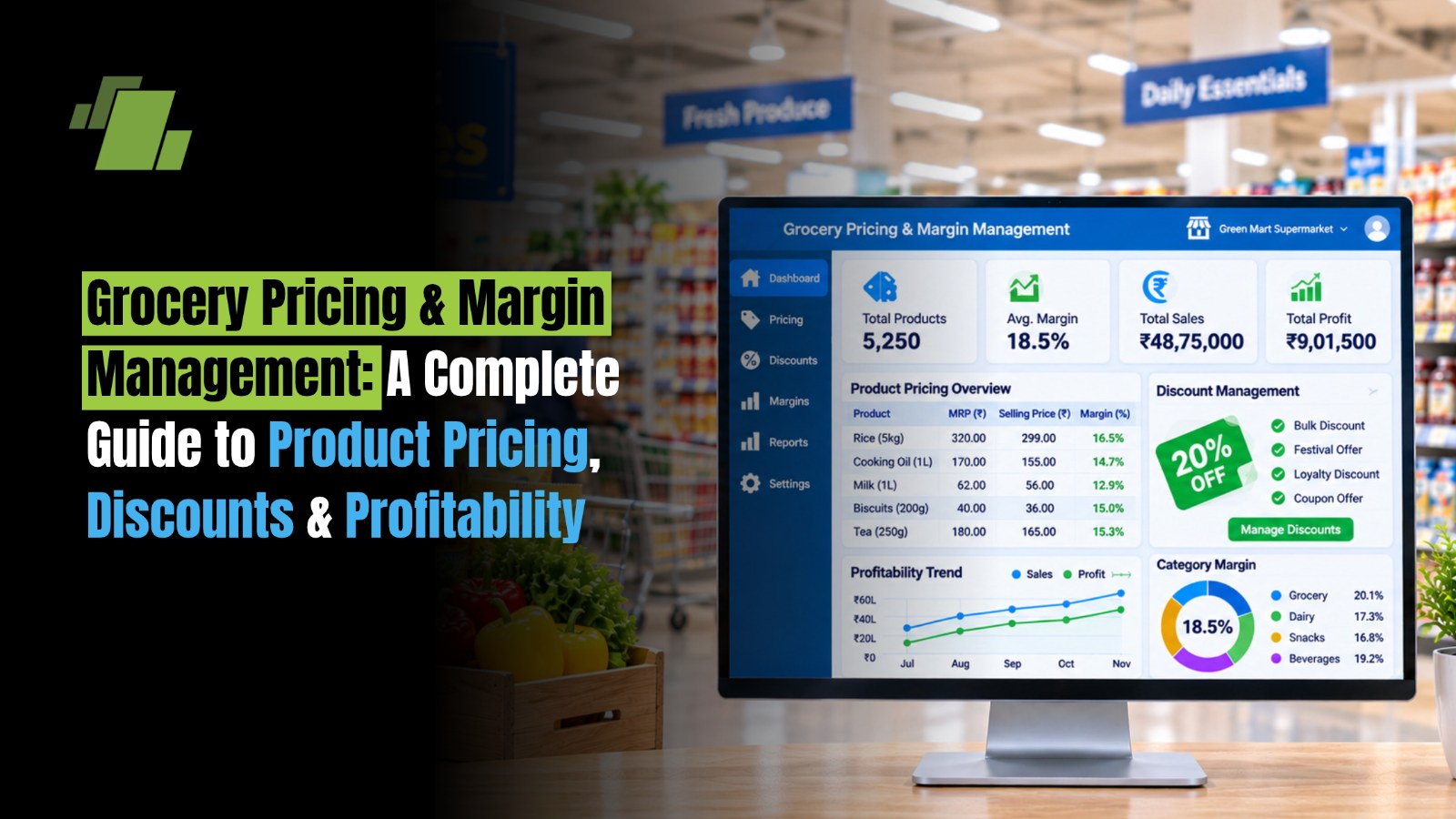
Grocery pricing and margin management directly influence how much revenue a supermarket generates, how effectively it competes with other retailers and how much profit it retains from every product sold. With changing supplier prices, competitive pressure, promotional offers and customer price sensitivity, setting the right selling price across thousands of grocery SKUs is a continuous business challenge.
A grocery store may sell hundreds of packets of cooking oil, rice, biscuits, beverages and household essentials every day, but high sales volumes do not necessarily translate into higher profitability. If products are priced too low, the retailer may lose potential margins. If prices are too high, customers may switch to competing stores or online grocery platforms.
Discounts create another challenge. While promotional offers can increase sales volume and attract customers, poorly planned discounts can reduce gross margins without generating enough additional sales to compensate for the loss.
For grocery retailers, pricing decisions must therefore consider more than purchase cost and competitor prices. They require a clear understanding of product-level margins, category profitability, customer demand, promotional effectiveness, inventory movement and operating expenses.
An integrated grocery retail ERP software helps businesses connect purchase prices, selling prices, discounts, sales transactions and inventory information to improve pricing visibility and profitability analysis.
This guide explains how grocery stores and supermarkets can develop effective pricing strategies, calculate product margins, manage discounts, prevent profit leakage and improve overall retail profitability.
Contact Us
Free Demo Request
What is Grocery Pricing and Margin Management?
Grocery pricing and margin management is the process of setting, monitoring and optimising product selling prices, discounts and promotional offers to maintain competitive pricing while achieving targeted profitability.
It involves evaluating product acquisition costs, customer demand, competitor prices, category performance and promotional expenses before making pricing decisions.
The main components include:
-
Product pricing: Determining the selling price of each grocery SKU based on purchase cost, target margin and market conditions.
-
Margin calculation: Measuring the difference between selling prices and product costs.
-
Discount management: Controlling product-level discounts, promotional offers and special pricing.
-
Category pricing: Setting pricing strategies for different grocery categories such as staples, dairy, packaged food, beverages and personal care.
-
Competitor price monitoring: Comparing product prices with competing supermarkets and grocery retailers.
-
Promotional profitability: Evaluating whether discounts generate sufficient additional sales to justify reduced margins.
-
Profitability analysis: Reviewing product-wise, brand-wise and category-wise gross margins.
The objective is to establish a pricing structure that attracts customers, supports sales growth and protects the financial performance of the grocery business.
Why is Pricing and Margin Management Important for Grocery Stores?
Grocery retailers manage a large assortment of products with different demand patterns, purchase costs and competitive positioning. A single pricing strategy may not work equally well for every product category.
Effective pricing and margin management helps businesses achieve several operational and financial objectives.
1. Protects Gross Profit Margins
Every product contributes differently to overall profitability.
For example, a retailer may generate high sales volumes from packaged staples but earn relatively higher margins from selected household essentials or personal care products.
Monitoring product-wise margins helps identify items that generate revenue but contribute less to gross profit.
2. Maintains Competitive Product Pricing
Customers frequently compare the prices of commonly purchased grocery products.
If a supermarket consistently charges more for essential items such as milk, rice, cooking oil and branded packaged food, customers may perceive it as an expensive shopping destination.
Retailers should monitor competitor pricing for important products while considering their overall category profitability.
3. Prevents Uncontrolled Discounting
Discounts can encourage customers to purchase more, but excessive price reductions directly affect gross profit per unit.
A structured discount management strategy helps businesses identify which products should be discounted, how much discount should be offered and whether the promotion is commercially viable.
4. Improves Category-Level Profitability
Not all grocery categories have the same pricing requirements.
Fresh produce may require frequent price adjustments due to changing availability and perishability, while packaged household products may have more stable pricing.
Category-wise margin analysis helps retailers establish suitable pricing targets for different product groups.
5. Reduces Pricing Errors and Revenue Leakage
Incorrect product rates, unauthorised discounts, outdated price lists and billing discrepancies can result in lost revenue.
Centralised price management helps maintain consistency between product master records, promotional offers and POS billing.
6. Supports Better Business Decisions
Pricing reports help management understand:
-
Which products generate the highest gross profit.
-
Which categories have declining margins.
-
Which discounts improve sales.
-
Which products are frequently sold below target margins.
-
How supplier price changes affect profitability.
-
Whether sales growth is translating into higher gross profit.
What are the Different Grocery Pricing Strategies?
Grocery retailers should use different pricing strategies according to product demand, customer expectations, competition and business objectives.
1. Cost-Plus Pricing
Cost-plus pricing involves calculating the product selling price by adding a predetermined markup to its purchase cost.
Formula:
Selling Price = Purchase Cost × (1 + Markup Percentage)
For example:
-
Product purchase cost: ₹100.
-
Desired markup: 20%.
Selling price:
₹100 × 1.20 = ₹120.
This method is straightforward and useful for establishing initial product prices.
However, retailers should also consider freight, handling, eligible discounts, applicable taxes and other relevant costs when determining the appropriate pricing basis.
2. Target Margin-Based Pricing
Unlike markup-based pricing, target margin pricing determines the selling price using a desired gross margin percentage.
Formula:
Selling Price = Product Cost ÷ (1 − Target Gross Margin Percentage)
Example:
-
Product cost: ₹100.
-
Target gross margin: 20%.
Selling price:
₹100 ÷ 0.80 = ₹125.
The difference between markup and margin is important. A 20% markup on ₹100 produces a selling price of ₹120, but the gross margin is only 16.67%.
Target margin pricing helps grocery retailers maintain more consistent profitability across product categories.

3. Competitor-Based Pricing
Competitor-based pricing involves setting product prices after evaluating the prices charged by other grocery retailers.
For example, if competing supermarkets sell a particular branded cooking oil at ₹150, a retailer may position its price at ₹149, ₹150 or ₹152 depending on its cost structure and pricing strategy.
This approach is particularly relevant for Key Value Items (KVIs).
KVIs are products that customers frequently purchase and use to form perceptions about a retailer's overall price competitiveness.
Common grocery KVIs include:
-
Rice.
-
Wheat flour.
-
Milk.
-
Cooking oil.
-
Sugar.
-
Packaged drinking water.
-
Popular biscuits.
-
Everyday household essentials.
Retailers should avoid automatically matching every competitor price. Competitor comparisons should consider pack size, brand, product specifications, promotional conditions and actual selling prices.
4. Psychological Pricing
Psychological pricing uses familiar price points to influence customer perceptions.
Examples include:
-
₹99 instead of ₹100.
-
₹199 instead of ₹200.
-
₹499 instead of ₹500.
This strategy can make prices appear more attractive, particularly for packaged grocery products and household essentials.
However, psychological pricing should be tested against actual sales performance rather than assumed to increase conversions automatically.
5. Promotional Pricing
Promotional pricing involves temporarily reducing selling prices to encourage purchases, increase product movement or attract customers.
Common examples include:
-
Buy One Get One Free.
-
Buy 2 Get 1 Free.
-
Flat 10% discount.
-
₹20 off on selected products.
-
Category-wise promotional offers.
-
Weekend grocery discounts.
-
Festival shopping offers.
Promotions should be evaluated using incremental sales and gross profit rather than sales volume alone.
6. Bundle Pricing
Bundle pricing combines multiple products into a single promotional offer.
For example, a supermarket may offer a combination of cooking oil, packaged spices and pulses at a combined price.
Bundle offers can encourage customers to purchase complementary products and increase basket value.
Retailers should calculate the combined product cost and promotional discount before approving the offer.
7. Markdown Pricing
Markdown pricing involves reducing the selling price of products to clear excess, slow-moving, seasonal or near-expiry inventory.
For example, a retailer may reduce the price of a packaged product approaching its expiry date to encourage faster sales.
Markdown decisions should consider:
-
Remaining shelf life.
-
Current inventory quantity.
-
Expected sales.
-
Original product margin.
-
Discount required to improve sell-through.
-
Potential expiry or disposal losses.
The objective is to recover as much product value as commercially possible without unnecessary discounting.
Accenture's grocery pricing research highlights the importance of combining margin objectives, competitive price gaps, customer behaviour and product portfolio positioning rather than relying solely on cost-plus pricing.
Accenture+1
How to Calculate Gross Profit Margin in Grocery Retail?
Gross profit margin measures the percentage of net sales revenue remaining after deducting the cost of goods sold.
It is one of the most important indicators of product and category profitability.
Gross Profit = Net Sales Revenue − Cost of Goods Sold
Gross Profit Margin (%) = (Gross Profit ÷ Net Sales Revenue) × 100
Consider a grocery store selling a packaged food product.
|
Particulars |
Amount |
|
Selling price |
₹150 |
|
Product cost |
₹120 |
|
Gross profit |
₹30 |
|
Gross profit margin |
20% |
Calculation:
(₹150 − ₹120) ÷ ₹150 × 100 = 20%.
This means the retailer earns ₹30 in gross profit for every unit sold at ₹150, before operating expenses.
Difference Between Markup and Gross Margin
These two terms are often confused in grocery pricing calculations.
|
Parameter |
Markup |
Gross margin |
|
Calculation basis |
Product cost |
Selling price |
|
Formula |
Profit ÷ Cost × 100 |
Profit ÷ Selling Price × 100 |
|
Product cost |
₹100 |
₹100 |
|
Selling price |
₹125 |
₹125 |
|
Gross profit |
₹25 |
₹25 |
|
Percentage |
25% |
20% |
A retailer targeting a 25% markup should not assume that it is achieving a 25% gross margin.
How to Calculate Net Profit Margin?
Gross profit does not represent the final profit earned by a supermarket.
Retailers must also account for expenses such as:
-
Employee salaries.
-
Rent.
-
Electricity.
-
Transportation.
-
Packaging.
-
Technology expenses.
-
Marketing.
-
Maintenance.
-
Administrative costs.
Net Profit Margin (%) = (Net Profit ÷ Net Sales Revenue) × 100
For example:
-
Net sales: ₹10,00,000.
-
Cost of goods sold: ₹8,00,000.
-
Operating and other expenses: ₹1,50,000.
-
Net profit: ₹50,000.
Net profit margin:
₹50,000 ÷ ₹10,00,000 × 100 = 5%.
This distinction helps retailers understand why a product category with a healthy gross margin may still contribute less to the business's final profitability.
How to Set the Right Selling Price for Grocery Products?
Setting the right selling price requires balancing product costs, desired margins, customer expectations and competitive positioning.
A structured pricing process helps grocery retailers avoid arbitrary price changes and maintain consistent profitability.
Step 1: Calculate the Actual Product Cost
Begin by identifying the actual cost of acquiring each product.
Consider:
-
Basic supplier purchase price.
-
Applicable purchase discounts.
-
Freight and transportation expenses.
-
Handling charges.
-
Other allocable procurement costs.
-
Applicable GST and input tax credit treatment.
For example, if a supermarket purchases a product for ₹100 and incurs ₹3 in freight and ₹2 in handling charges, its acquisition cost before applicable tax adjustments is ₹105.
Using only the supplier's basic purchase price may result in an inaccurate margin calculation.
Step 2: Define Category-Wise Margin Targets
Different grocery categories have different pricing structures and customer expectations.
Retailers should establish appropriate margin targets based on product costs, competition, demand and operating requirements.
Illustrative pricing considerations include:
|
Grocery category |
Pricing considerations |
|
Rice, pulses and staples |
Price competitiveness and purchase volume |
|
Dairy products |
Shelf life, replenishment frequency and local competition |
|
Packaged food |
Brand positioning and promotional schemes |
|
Beverages |
Seasonal demand and multi-buy offers |
|
Fruits and vegetables |
Freshness, wastage and daily market prices |
|
Personal care |
Brand preference and product differentiation |
|
Household essentials |
Competitor pricing and basket contribution |
There is no universal margin percentage that applies to every grocery category. Targets should be calculated using actual business costs and historical performance.
Step 3: Analyse Competitor Prices
Compare prices of equivalent products sold by nearby supermarkets, kirana stores and online grocery platforms.
For accurate comparisons, verify:
-
Same brand and product variant.
-
Same pack size.
-
Same quantity or unit of measurement.
-
Applicable promotional discounts.
-
Actual checkout price.
-
Delivery charges, where relevant.
For example, comparing a 1-litre cooking oil pack with a 900-ml pack without normalising the price per litre can lead to incorrect pricing decisions.
Step 4: Calculate the Selling Price
Once the acquisition cost and desired margin are established, calculate the appropriate selling price.
Suppose:
-
Actual product cost: ₹105.
-
Target gross margin: 20%.
Selling price:
₹105 ÷ (1 − 0.20) = ₹131.25.
The retailer can evaluate an appropriate customer-facing price point while checking applicable MRP and legal requirements.
Step 5: Review Customer Demand and Price Sensitivity
Some grocery products experience significant changes in demand when prices increase, while others have relatively stable demand.
For example:
-
Customers may be highly price-sensitive for cooking oil and branded staples.
-
Premium packaged foods may have more brand-driven purchasing behaviour.
-
Certain household essentials may have fewer close substitutes.
-
Seasonal products may experience fluctuating demand.
Retailers should review historical sales after price changes to understand customer responses.
Step 6: Update Selling Prices Across Billing Channels
After approving price changes, ensure that the revised rates are reflected in the relevant product master records and billing systems.
For multi-store retailers, centralised price management helps maintain consistency across outlets while allowing authorised location-specific pricing where required.
The updated prices should also be checked against promotional offers, barcode records and applicable product MRP.
How to Manage Grocery Discounts Without Losing Profit Margins?
Discount management is one of the most important aspects of grocery pricing because even small reductions can significantly affect profitability when applied across high-volume products.
The objective should not be to offer the maximum discount. It should be to generate profitable incremental sales.
1. Calculate Discount Impact Before Approving Offers
Suppose a product has:
-
Regular selling price: ₹200.
-
Product cost: ₹150.
-
Gross profit: ₹50.
-
Regular gross margin: 25%.
The retailer introduces a 10% discount.
|
Particulars |
Before Discount |
After Discount |
|
Selling price |
₹200 |
₹180 |
|
Product cost |
₹150 |
₹150 |
|
Gross profit |
₹50 |
₹30 |
|
Gross margin |
25% |
16.67% |
A 10% selling-price discount reduces gross profit per unit by 40%.
This is why retailers must calculate discount impact before approving promotional pricing.
2. Determine the Additional Sales Required to Justify a Discount
A promotional offer should generate enough additional sales to compensate for the lower gross profit per unit.
Using the previous example:
-
Regular gross profit per unit: ₹50.
-
Discounted gross profit per unit: ₹30.
To earn the same gross profit after discount:
₹50 ÷ ₹30 = 1.67.
The retailer must sell approximately 67% more units to generate the same gross profit, assuming the product cost remains unchanged and other relevant costs are excluded.
This calculation helps purchasing and marketing teams assess whether a proposed discount is commercially viable.
3. Use Quantity-Based Discounts Strategically
Quantity-based promotions encourage customers to purchase additional units.
Examples:
-
Buy 2 and get 5% off.
-
Buy 3 and save ₹20.
-
Buy 5 packets at a special price.
These offers work best when customers have a genuine reason to purchase additional quantities and the retailer has sufficient inventory.
4. Use Category-Based Promotions
Category promotions help supermarkets increase sales across selected product groups.
Examples:
-
Weekend discounts on packaged food.
-
Festival offers on dry fruits and sweets.
-
Household cleaning product bundles.
-
Personal care promotional campaigns.
-
Special offers on breakfast essentials.
Retailers should track category-wise sales and gross profit during promotional periods.
5. Plan Near-Expiry Discounts
Products approaching expiry may require controlled markdowns to recover their value.
A retailer should evaluate the remaining shelf life, current stock, expected sales and possible markdown percentage.
Discounting too early can unnecessarily reduce margins, while discounting too late may leave insufficient time to sell the inventory.
6. Track Supplier-Funded Promotions
Suppliers may offer promotional support through discounts, rebates, free quantities or credit notes.
Retailers should record the applicable scheme conditions and verify the actual benefit received.
Promotional profitability should be evaluated after accounting for eligible supplier funding rather than assuming every promotional discount is fully reimbursed.
7. Prevent Unauthorised POS Discounts
Unauthorised cashier discounts can create significant revenue leakage.
Retailers should establish:
-
Role-based discount permissions.
-
Maximum discount limits.
-
Approval requirements for exceptional discounts.
-
Cashier-wise discount reports.
-
Product-wise promotional rules.
-
Audit trails for manual price overrides.
These controls help maintain pricing consistency and reduce billing irregularities.
What is Category-Wise Margin Management in Grocery Retail?
Category-wise margin management involves analysing the profitability of different grocery product categories instead of evaluating all products using a single margin target.
A supermarket may generate substantial sales from staples but earn a greater percentage margin from selected packaged food, personal care or household products.
Therefore, category-level pricing decisions should consider each category's contribution to overall gross profit.
How to Analyse Category-Wise Profitability
Retailers should evaluate:
-
Total sales revenue by category.
-
Cost of goods sold by category.
-
Gross profit and gross margin.
-
Discount and promotional expenditure.
-
Inventory turnover.
-
Expiry and wastage losses.
-
Sales contribution.
-
Stock holding and replenishment requirements.
For example:
|
Category |
Net sales |
Gross profit |
Gross Margin |
|
Grocery staples |
₹5,00,000 |
₹50,000 |
10% |
|
Packaged food |
₹3,00,000 |
₹60,000 |
20% |
|
Beverages |
₹2,00,000 |
₹30,000 |
15% |
|
Personal care |
₹1,00,000 |
₹30,000 |
30% |
|
Total |
₹11,00,000 |
₹1,70,000 |
15.45% |
In this example, grocery staples generate the highest sales, while personal care generates the highest gross margin percentage.
However, packaged food contributes the highest gross profit in absolute terms among the individual categories.
This demonstrates why retailers should analyse sales, margin percentages and gross profit together rather than prioritising only high-margin products.
What is the Difference Between Gross Margin, Contribution Margin and GMROI?
These three metrics provide different perspectives on grocery retail profitability.
|
Metric |
Meaning |
Formula |
|
Gross margin |
Profit remaining after product cost |
Gross Profit ÷ Net Sales × 100 |
|
Contribution margin |
Revenue remaining after variable costs |
(Net Sales − Variable Costs) ÷ Net Sales × 100 |
|
GMROI |
Gross margin earned relative to average inventory cost |
Gross Margin Value ÷ Average Inventory Cost |
Gross Margin
Shows how much of the net sales revenue remains after deducting the cost of goods sold.
Contribution Margin
Helps determine how much revenue remains to cover fixed expenses and generate operating profit after variable costs are deducted.
For example, if a supermarket earns ₹100 in net sales and incurs ₹75 in product and other relevant variable costs, its contribution is ₹25, or 25%.
Gross Margin Return on Investment (GMROI)
GMROI measures how effectively inventory investment generates gross profit.
GMROI = Gross Profit ÷ Average Inventory Cost
For example:
-
Annual gross profit: ₹12,00,000.
-
Average inventory at cost: ₹4,00,000.
GMROI:
₹12,00,000 ÷ ₹4,00,000 = 3.
This means the retailer generates ₹3 in gross profit for every ₹1 invested in average inventory cost during the measurement period.
GMROI is useful because a product with a high gross margin percentage may still perform poorly if it sells very slowly and occupies substantial inventory investment.
What are the Most Important Grocery Pricing and Margin KPIs?
Retailers should regularly monitor pricing and profitability KPIs to understand whether their pricing strategies are delivering the expected results.
|
KPI |
Formula |
Business purpose |
|
Gross Profit Margin |
Gross Profit ÷ Net Sales × 100 |
Measures product profitability |
|
Average Selling Price |
Net Sales ÷ Units Sold |
Tracks actual selling price |
|
Discount Percentage |
Discount Value ÷ Original Selling Value × 100 |
Monitors discount levels |
|
Category Margin |
Category Gross Profit ÷ Category Net Sales × 100 |
Measures category profitability |
|
Sales Growth |
(Current Sales − Previous Sales) ÷ Previous Sales × 100 |
Measures sales performance |
|
GMROI |
Gross Profit ÷ Average Inventory Cost |
Evaluates inventory profitability |
|
Promotion Uplift |
(Promotional Units − Baseline Units) ÷ Baseline Units × 100 |
Measures additional sales |
|
Markdown Percentage |
Markdown Value ÷ Original Selling Value × 100 |
Tracks price reductions |
For more meaningful insights, these metrics should be reviewed product-wise, brand-wise, category-wise, store-wise and period-wise.
How does Grocery ERP Software Improve Pricing and Margin Management?
Managing selling prices, purchase rates, promotional discounts and product margins through separate spreadsheets creates data inconsistencies and delays business decisions.
Grocery ERP software integrates product pricing with purchasing, inventory, POS billing and business reporting, helping retailers maintain better control over pricing and profitability.
1. Centralised Product Pricing Management
ERP software helps maintain product-wise pricing information within a centralised product master.
Retailers can manage:
-
Product purchase rates.
-
Selling prices.
-
Product and category classifications.
-
Barcode and SKU information.
-
MRP details.
-
Applicable tax information.
-
Pricing changes.
This improves price consistency and reduces dependence on manually maintained price lists.
2. Purchase Cost and Selling Price Visibility
When purchasing and sales transactions are integrated, retailers can review product costs alongside selling prices.
This helps identify products where supplier price increases may be reducing gross margins.
For example, if the purchase cost of a packaged food product increases from ₹80 to ₹85 while its selling price remains ₹100, its gross margin decreases from 20% to 15%.
Identifying these changes helps management review pricing decisions before margin erosion becomes significant.
3. Discount and Promotional Management
A grocery ERP system can support the management of applicable promotional schemes, product discounts and billing offers.
Depending on the configured system capabilities, retailers can define offer conditions, monitor promotional transactions and review discount-related reports.
4. Retail POS Integration
Integrated Retail POS ensures that product prices and authorised promotional offers are reflected during billing.
This helps reduce discrepancies between product master pricing and actual checkout prices.
For multi-store retailers, connected POS operations also improve centralised visibility into store-level sales and discount performance.
5. Category-Wise Sales and Margin Reporting
Business reporting helps retailers analyse sales performance and product movement.
Relevant reports can help management review:
-
Product-wise sales.
-
Brand-wise performance.
-
Category-wise revenue.
-
Discount-related transactions.
-
Purchase and sales price differences.
-
Inventory movement.
-
Store-wise performance.
These insights support more informed pricing and merchandising decisions.
6. Inventory and Expiry-Based Markdown Decisions
When inventory information is connected with sales and pricing records, retailers can identify slow-moving and near-expiry products.
This supports better decisions about promotional offers, clearance pricing and inventory reduction.
7. Multi-Store Pricing Visibility
Grocery chains can monitor product pricing and sales performance across multiple stores.
Management can identify pricing differences, compare category performance and review store-level discount patterns.
This helps maintain better pricing governance across the retail network.
How LOGIC ERP Helps Grocery Stores Improve Pricing and Margin Management
Managing product prices, supplier costs, promotional schemes and margins across thousands of grocery SKUs requires accurate and connected business information.
LOGIC ERP provides an integrated ERP platform connecting grocery purchasing, inventory management, Retail POS, warehouse operations, accounting and business reporting.
For grocery stores, supermarkets and multi-location retail chains, relevant capabilities include:
Product-Wise Pricing and Purchase Cost Management
-
Manage purchase and selling price records.
-
Maintain product categories, brands and pricing information.
-
Review historical purchase transactions.
-
Monitor changes in procurement costs.
Discount and Promotional Management
-
Manage applicable product-level discounts and promotional schemes.
-
Support configured promotional offers at the retail billing level.
-
Maintain visibility into discount-related transactions.
-
Review sales and discount performance.
Integrated Retail POS
-
Access product pricing information during billing.
-
Support barcode-based grocery billing.
-
Manage cashier and shift-wise billing operations.
-
Improve consistency between product records and retail transactions.
Inventory and Stock Management
-
Monitor stock movement across products and locations.
-
Identify fast-moving, slow-moving and non-moving products.
-
Track batch and expiry information where applicable.
-
Review inventory availability before planning clearance offers.
-
Support stock replenishment and inter-location inventory management.
Business Insights and Reporting
LOGIC ERP's Business Insights capabilities help retailers analyse operational and business performance through dashboards and reporting.
Retailers can use relevant reports to review:
-
Product-wise and category-wise sales.
-
Purchase and sales performance.
-
Inventory movement.
-
Discount-related transactions.
-
Store-wise business performance.
-
Purchasing and inventory trends.
By connecting procurement, product pricing, billing and inventory information, LOGIC ERP helps grocery businesses improve pricing visibility, identify margin-related issues and make informed retail management decisions.
Common Grocery Pricing and Margin Management Mistakes
Even when supermarkets have established purchasing and billing processes, certain pricing mistakes can affect their overall profitability.
1. Using the Same Margin Target for Every Product
Problem: Different grocery categories have different costs, competitive conditions and demand patterns.
Solution: Establish category-wise and product-wise margin targets based on actual business performance.
2. Confusing Markup with Gross Margin
Problem: Applying a 20% markup and assuming the business earns a 20% gross margin results in incorrect pricing calculations.
Solution: Use the correct margin-based selling price formula and distinguish between markup and gross margin.
3. Offering Discounts Without Calculating Their Impact
Problem: Discounts may increase sales volume while reducing total gross profit.
Solution: Calculate the additional quantity required to compensate for reduced per-unit profitability before approving promotions.
4. Ignoring Competitor Pricing
Problem: Products may become overpriced compared with competing stores, affecting customer retention.
Solution: Regularly monitor comparable products and prioritise important Key Value Items.
5. Not Updating Prices After Supplier Rate Changes
Problem: Increased purchase costs can gradually reduce product margins when selling prices remain unchanged.
Solution: Review supplier price revisions and their impact on product-level profitability.
6. Running Promotions Without Measuring Results
Problem: Retailers may continue promotional campaigns that generate sales but fail to improve profitability.
Solution: Compare promotional performance against a realistic baseline, including incremental sales, gross profit and supplier funding.
7. Ignoring Inventory Holding and Expiry Costs
Problem: High-margin products may still generate poor inventory returns if they remain unsold.
Solution: Evaluate GMROI, inventory turnover, expiry exposure and sell-through rates alongside gross margins.
Best Practices for Grocery Pricing and Margin Optimisation
Grocery retailers can improve pricing performance by following these recommendations:
-
Establish category-wise pricing strategies.
-
Calculate actual product acquisition costs before setting selling prices.
-
Distinguish between markup and gross margin.
-
Identify Key Value Items and monitor competitor prices.
-
Review product-wise and brand-wise profitability.
-
Set discount limits and approval workflows.
-
Calculate promotional profitability before launching offers.
-
Track supplier-funded discounts and promotional benefits.
-
Review price changes after supplier negotiations.
-
Monitor slow-moving and near-expiry products.
-
Use markdowns strategically to reduce inventory losses.
-
Analyse gross margin and GMROI together.
-
Maintain consistent product pricing across stores and POS terminals.
-
Review pricing and margin reports regularly.
The most effective pricing strategy is one that balances customer affordability, competitive positioning, inventory movement and sustainable business profitability.
Conclusion
Grocery pricing and margin management is essential for supermarkets that want to remain competitive while maintaining sustainable profitability. Setting the right selling prices, monitoring supplier costs, controlling discounts and analysing category-wise margins helps retailers make better commercial decisions.
Rather than relying on fixed markups or frequent promotional offers, grocery businesses should adopt a data-driven pricing approach that considers purchase costs, customer demand, competitor pricing, inventory movement and actual gross profit contribution.
LOGIC ERP helps grocery stores and supermarkets connect purchasing, inventory, POS, promotional transactions and business reporting to improve pricing visibility and business control.

Struggling to control grocery discounts, monitor product-wise margins and maintain profitable pricing across multiple stores?
Streamline your grocery pricing and profitability management with LOGIC ERP. Call at +91-73411-41176/75 or send us an email at sales@logicerp.com to book a free demo today!
Frequently Asked Questions About Grocery Pricing and Margin Management
1. What is Grocery Pricing and Margin Management?
Grocery pricing and margin management is the process of setting product selling prices, managing discounts and monitoring gross profit margins to maintain competitive pricing and improve supermarket profitability.
2. How do Grocery Stores Calculate Product Selling Prices?
Grocery stores can calculate selling prices using product acquisition costs and targeted gross margins.
The formula is:
Selling Price = Product Cost ÷ (1 − Target Gross Margin Percentage)
For example, if a product costs ₹100 and the target gross margin is 20%, its selling price should be ₹125.
3. What is a Good Profit Margin for a Grocery Store?
There is no universal profit margin applicable to every grocery store. Margins vary according to product categories, purchase costs, competition, operating expenses and business models.
Retailers should monitor gross margins and net profit margins separately to understand actual profitability.
4. What is the Difference Between Markup and Margin in Grocery Pricing?
Markup is calculated as a percentage of product cost, whereas gross margin is calculated as a percentage of selling price.
For example, a product purchased for ₹100 and sold for ₹125 has a 25% markup but a 20% gross margin.
5. How can Grocery Stores Improve their Gross Profit Margins?
Grocery stores can improve gross margins by negotiating better supplier rates, optimising selling prices, controlling discounts, reducing inventory losses, monitoring competitor pricing and reviewing product-wise profitability.
6. How do Discounts Affect Grocery Store Profitability?
Discounts reduce the gross profit earned per unit unless the retailer receives sufficient supplier funding or cost savings.
To remain profitable, promotional offers should generate enough incremental sales to compensate for reduced margins and any additional promotional expenses.
7. What is Category-Wise Margin Management?
Category-wise margin management involves analysing sales, product costs and gross profits across grocery categories such as staples, dairy, beverages, packaged food and personal care.
It helps retailers identify profitable categories and improve product pricing decisions.
8. What are Key Value Items (KVIs) in Grocery Retail?
Key Value Items are frequently purchased products whose prices customers often remember and compare across retailers.
Common examples include milk, rice, cooking oil, sugar and popular packaged food products.
Retailers monitor KVI prices to maintain a competitive price perception.
9. What is GMROI in Grocery Retail?
Gross Margin Return on Investment (GMROI) measures the gross profit generated relative to the average inventory investment.
GMROI = Gross Profit ÷ Average Inventory Cost
It helps retailers understand how effectively their inventory investment generates gross profit.
10. How can Supermarkets Manage Promotional Discounts Effectively?
Supermarkets should establish discount limits, calculate promotional profitability, identify target products, monitor incremental sales and evaluate supplier-funded schemes.
They should also compare promotional gross profit against normal sales performance.
11. What is the Difference Between Gross Profit Margin and Net Profit Margin?
Gross profit margin measures profitability after deducting the cost of goods sold from net sales.
Net profit margin measures the percentage of revenue remaining after deducting all applicable business expenses, including operating and other expenses.
12. How does Grocery ERP Software Help with Pricing and Margin Management?
Grocery ERP software connects product pricing, purchase costs, inventory, promotional transactions, billing and business reporting.
It helps retailers monitor product performance, review discount transactions, analyse category sales and improve pricing-related business decisions.

Author
Gurbir Singh
Co-founder & Managing Director | LOGIC ERP Solutions Pvt. Ltd.
With 30+ years of experience in the tech industry, I took the helm of technology & product development, ensuring LOGIC ERP’s continuous innovation & leadership in the evolving tech landscape.

