Understanding the GST Bill Format Essentials

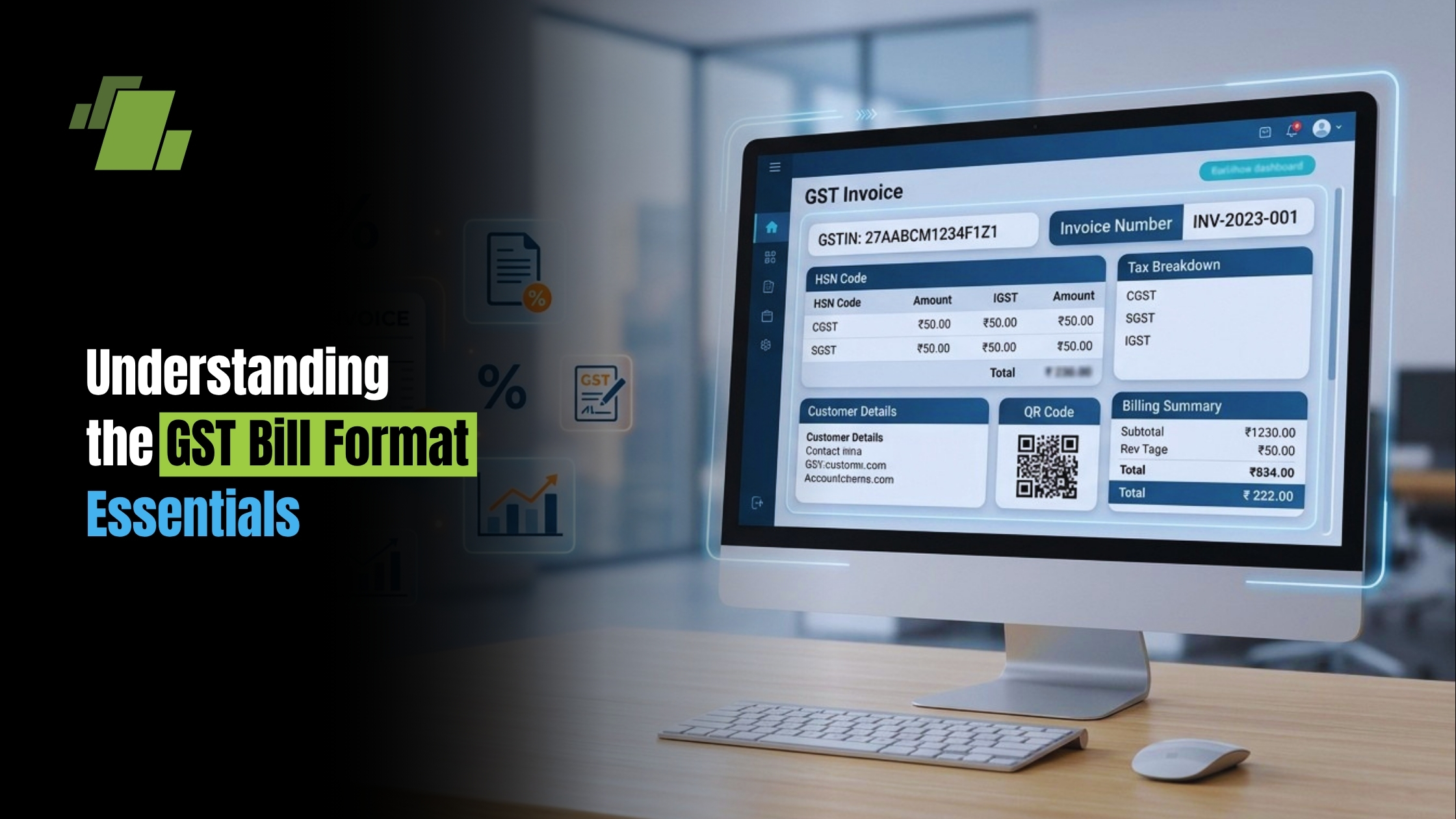
Understanding the GST bill format is crucial for businesses in India. It ensures compliance with tax regulations and smooth operations. If you’re new to gst invoicing meaning and process, this guide explains it clearly.
A GST bill, or tax invoice, is a key document in the GST regime. It records the supply of goods and services. In practice, a tax invoice issued by the supplier documents every sale, and the tax invoice meaning under GST covers both goods and services.
This guide will help you grasp the essentials of GST invoicing. You’ll learn about different invoice types and their uses, sometimes referred to as a gst invoice bill or a tax invoice bill in everyday business language.
Contact Us
Free Demo Request
We’ll also explore mandatory details and new rules under GST, including the new invoice rules under gst and practical tips for implementation. Downloadable formats and examples will be provided for practical understanding, including a gst invoice format download, a gst invoice sample, and a gst bill sample.
Stay informed and compliant with our comprehensive guide on GST bill formats.
What is a GST Bill? Meaning and Importance
A GST bill, also known as a tax invoice, is crucial in the Goods and Services Tax framework. It ensures that the supply of goods and services is legally documented.
This document serves multiple purposes. It is proof of supply, basis for tax liability, and a tool for claiming input tax credit. Accurate and timely issuance is essential for compliance. When prepared correctly, the original tax invoice supports the buyer’s input tax credit claims and establishes a clear audit trail.
Key components of a GST bill include:
- Supplier’s GSTIN and invoice date
- Unique invoice number
- Description of goods or services
- Tax rates and amounts
These elements form the backbone of a valid tax invoice and a compliant gst tax invoice. Understanding the gst invoice number format early helps set up robust internal controls.
Understanding the GST bill’s role helps businesses manage tax responsibilities efficiently. Compliance minimizes potential penalties and supports smooth financial operations.
Types of GST Invoices and When to Use Them
Understanding different GST invoices is crucial for compliance. Each has a specific purpose and applies to various transaction scenarios.
The three main types are:
- Tax Invoice: For taxable supply of goods/services.
- Bill of Supply: For exempt goods or composition scheme dealers.
- Receipt Voucher: For advance payments.
Choosing the right invoice type is important. It depends on the nature of goods/services and tax implications.
A tax invoice contains detailed tax information. Conversely, a bill of supply excludes tax details, suitable for non-taxable supplies.
Receipt vouchers confirm advance payments. They are essential for businesses taking payments upfront.
Accurate invoice selection ensures regulatory adherence and clear financial reporting.
Tax Invoice vs. Bill of Supply
A tax invoice records sales of taxable goods/services, crucial for tax credit claims. It includes extensive tax details.
In contrast, a bill of supply applies to exempt supplies. It’s used by composition scheme dealers who don’t collect taxes.
Key differences:
- Tax Invoice: Includes taxes, used for taxable goods/services.
- Bill of Supply: No taxes listed, used for exempt items.
Each serves different business needs and compliance requirements.
IGST Invoice Format for Inter-State Transactions
When selling between states, the IGST invoice format comes into play. It accounts for Integrated GST on inter-state sales. Many businesses refer to this as the igst invoice format or igst bill format.
Such invoices must specify the place of supply. They capture IGST rates and amounts distinctively.
Features of IGST invoice:
- Place of Supply: Indicated to determine tax applicability.
- IGST Details: Clearly listed to reflect applicable charges.
These ensure correct tax distribution between states and union territories.
Rent and Purchase Bill Formats with GST
Rent invoices include GST when rent exceeds a certain threshold. They list the GST rate applied to rental services. Use the rent invoice format with gst to ensure consistency.
A purchase bill helps buyers claim input tax credit. It details the purchase transaction and applicable GST rates. Maintaining a purchase bill with gst supports accurate ITC claims.
Essential elements:
- Rent Invoice: Lists rental value and applicable GST rate.
- Purchase Bill: Facilitates input credit claims with detailed purchase info.
These formats ensure proper tax treatment for rental and buying transactions.
Mandatory Details in a GST Invoice
A GST invoice must include specific details for compliance. These details ensure legal validity and facilitate tax processes.
Key elements in a GST invoice are:
- Supplier’s GSTIN: Identifies the supplier in the tax system.
- Invoice Number & Date: Unique identifier for the transaction.
- Description of Goods/Services: Details what is sold.
- HSN/SAC Codes: Classify goods or services.
- Quantity & Rate: Clarifies the amount and price per unit.
- Tax Amounts: Clearly separates CGST, SGST, and IGST.
- Buyer’s Details: Includes name, address, and GSTIN.
Each element plays a crucial role in tax calculations and record-keeping. Including precise information avoids discrepancies and facilitates audits. These fields apply to a gst tax invoice and the broader tax invoice gst bill format, and they align with any gst tax invoice format you choose.
Incorrect or missing details can lead to penalties. Thus, double-checking all fields before issuing is essential.
GST Invoice Number Format and Rules
The GST invoice number must be unique for effective tracking and compliance. It aids in maintaining organized financial records.
Key rules for numbering include:
- Sequential Order: Ensures clear transaction history.
- Alphanumeric Structure: Allows flexibility in numbering conventions.
- Financial Year Reset: Starts afresh each year.
Invoices require a clear and consistent numbering approach. Consistency helps in auditing and simplifies referencing. Adopt a consistent gst invoice number format that meets these rules and your internal controls.
Adhering to these rules provides transparency and accuracy. Ensuring these numbers conform to GST regulations is crucial for legal adherence.
Step-by-Step Guide: How to Create a GST Bill
Creating a GST bill is an essential skill for businesses. Proper invoicing ensures compliance and smooth transactions. This walkthrough shows how to create gst bill and how to make gst bill using any standard gst invoice format.
First, gather the necessary information. This includes details like your business GSTIN, customer information, and invoice date. Accurate data entry is crucial at this stage.
Next, document all goods or services provided. Specify the quantity, unit price, and the applicable GST rate. Calculate the total amount inclusive of GST.
Ensure all mandatory details are added, such as invoice number, place of supply, and tax split between CGST, SGST, or IGST. Verify that each entry is accurate and clear.
Finally, verify everything and sign the invoice. A signature validates the document as authentic and complete. Issue the original tax invoice to the buyer and retain copies for records.
This structured approach simplifies the invoicing process. For visual assistance, refer to the image below.
GST Invoice Format Samples and Downloads
For businesses, having access to GST invoice format samples is invaluable. These templates offer a clear, standardized layout that aids compliance.
You can download GST invoice formats in various file types like Word, Excel, or PDF. Each offers unique benefits: Word is easily editable, while PDF maintains formatting integrity. Excel is excellent for calculations with built-in formulas. Look for a gst invoice format download that matches your needs, including a gst invoice sample for reference and a gst bill pdf for quick sharing. Popular options include the gst invoice format in word for easy customization.
Here’s a list of downloadable GST invoice formats you might find useful:
- GST Invoice Format in Word (gst invoice format in word)
- GST Invoice Format in Excel
- GST Invoice PDF for Quick Use (gst bill pdf)
Utilizing these resources ensures your invoices meet regulatory standards. The templates serve as guides to include all necessary information, whether you call it a gst invoice bill or a standard GST invoice.
GST Bill Format in Word, Excel, and PDF
Businesses find flexibility in choosing the format that suits their needs. Word allows easy edits and customization. This is ideal for personalized invoicing.
Excel formats offer functionality for detailed calculations and automatic tax computations. They save time and reduce errors in data entry.
PDF formats are preferred for their ease of sharing and uniform appearance across devices. They ensure your invoices always look professional.
Each gst invoice format can be adapted to your branding and sector-specific requirements.
To suit various needs, consider these format options:
- Customizable Word Format
- Calculative Excel Template
- Consistent PDF Template
Selecting the right format enhances efficiency and ensures that your GST invoices are both accurate and compliant.
GST Bill Online: Tools and Software for Easy Invoicing
Managing GST invoices can be time-consuming without the right tools. Fortunately, online platforms simplify the process of billing under GST. They save both time and effort. Many solutions let you create a gst bill online, share it securely, and store it for future reference.
These tools offer automated features for invoice creation, ensuring compliance with GST norms. Users can generate, share, and store invoices digitally. This adds convenience to business operations.
Popular invoicing software often includes:
- Automated tax calculations
- Customizable invoice templates
- Real-time data tracking
Embracing online tools not only enhances accuracy but also streamlines your invoicing process, ensuring peace of mind.

New Invoice Rules Under GST: What’s Changed?
The Goods and Services Tax (GST) invoicing rules have evolved. It’s crucial to understand these changes to stay compliant. Recent updates have added new requirements. Stay updated with invoicing rules under gst so your documents remain valid.
Businesses must now include specific details in their GST invoices. This ensures accurate tax reporting and compliance. Important changes focus on clarity and uniformity.
Key rule updates include:
- Mandatory display of HSN/SAC codes.
- Specification of unique invoice numbers.
- Clear identification of supply type, such as inter or intra-state.
These new invoice rules under gst are designed to enhance transparency and facilitate easy compliance for businesses across India.
Common Mistakes to Avoid in GST Invoicing
Mistakes in GST invoicing can lead to serious compliance issues. Even minor errors might result in penalties. A clear understanding helps prevent these pitfalls.
Common mistakes include:
- Incorrect HSN/SAC codes.
- Non-sequential invoice numbering.
- Missing supplier or buyer GSTIN.
- Omission of terms of supply.
Being mindful of these errors can save time and avoid complications. Ensure your GST invoices are accurate and complete to streamline compliance and reporting.
GST Bill Examples: Real-World Scenarios
Understanding GST bill examples can clarify the invoicing process. Real-world scenarios provide valuable insights into how GST bills are used. Such examples illustrate the practical application of GST rules. The following gst bill example highlights typical entries and calculations.
Consider a local shop issuing a tax invoice for a sale. The invoice must detail the item, GST rate, and total amount. This ensures correct tax collection and compliance for a sales bill with gst.
Another scenario involves interstate supply, requiring an IGST invoice. Here, the invoice will indicate IGST levied instead of CGST and SGST, using the igst invoice format where applicable.
Key aspects to look for in GST bills include:
- Accurate GST rates applicable.
- Proper tax calculation.
- Complete vendor and buyer information.
A real-world GST bill example helps businesses align their invoices with legal standards, reducing errors and enhancing compliance.
Conclusion
Understanding the GST bill format is essential for businesses to maintain accurate records and comply with GST regulations. A properly prepared GST invoice ensures transparency, supports input tax credit claims, and helps avoid compliance issues.
From selecting the correct invoice type to including mandatory details like GSTIN, HSN/SAC codes, tax rates, and invoice numbers, every element plays an important role in smooth tax management. Using billing software can further simplify invoice generation by automating calculations, reducing errors, and ensuring compliance with the latest GST rules.

By following the correct GST invoice format and adopting efficient digital invoicing solutions, businesses can streamline their billing process, improve accuracy, and manage GST requirements effectively.
Call at +91-73411-41176/75 or send us an email at sales@logicerp.com to book a free demo today!
Frequently Asked Questions (FAQs)
1. What is a GST bill format?
A GST bill format is a structured invoice template used by businesses to record sales of goods or services under the GST regime. It includes essential details such as GSTIN, invoice number, date, product details, HSN/SAC codes, tax rates, and GST amounts.
2. What details are mandatory in a GST invoice?
A GST invoice must include the supplier’s GSTIN, invoice number, invoice date, buyer details, description of goods or services, HSN/SAC codes, quantity, taxable value, GST rates, CGST, SGST/UTGST or IGST details, and total invoice value.
3. What is the difference between a GST invoice and a bill of supply?
A GST invoice is issued for taxable supplies and includes GST details, while a bill of supply is issued for exempt supplies or by composition scheme taxpayers and does not show tax amounts separately.
4. How can I create a GST bill?
You can create a GST bill by adding business details, customer information, invoice number, product/service details, applicable GST rates, tax calculations, and verifying all mandatory fields before issuing the invoice.
5. What are the different types of GST invoices?
The major types of GST invoices include tax invoices for taxable supplies, bills of supply for exempt supplies, and receipt vouchers for advance payments received from customers.
6. What is the GST invoice number format?
A GST invoice number must be unique and follow a sequential numbering system. Businesses can use an alphanumeric format, but invoice numbers should not repeat within the same financial year.
7. What is an IGST invoice format?
An IGST invoice format is used for interstate transactions where Integrated GST is applicable. It includes details such as place of supply, IGST rate, and IGST amount.
8. Can I download a GST invoice format in Word, Excel, or PDF?
Yes, GST invoice formats are available in Word, Excel, and PDF formats. Businesses can choose editable Word files, calculation-friendly Excel templates, or professional PDF formats based on their requirements.
9. What are the common mistakes to avoid while creating GST invoices?
Common GST invoicing mistakes include incorrect GSTIN details, wrong HSN/SAC codes, missing invoice numbers, incorrect tax calculations, and incomplete buyer information.
10. How does GST billing software help businesses?
GST billing software automates invoice creation, tax calculations, GST compliance, and record management. It reduces manual errors, saves time, and helps businesses maintain accurate financial records.

Author
Gurbir Singh
Co-founder & Managing Director | LOGIC ERP Solutions Pvt. Ltd.
With 30+ years of experience in the tech industry, I took the helm of technology & product development, ensuring LOGIC ERP’s continuous innovation & leadership in the evolving tech landscape.