Benefits of ERP and Why Your Business Needs it?

Summary
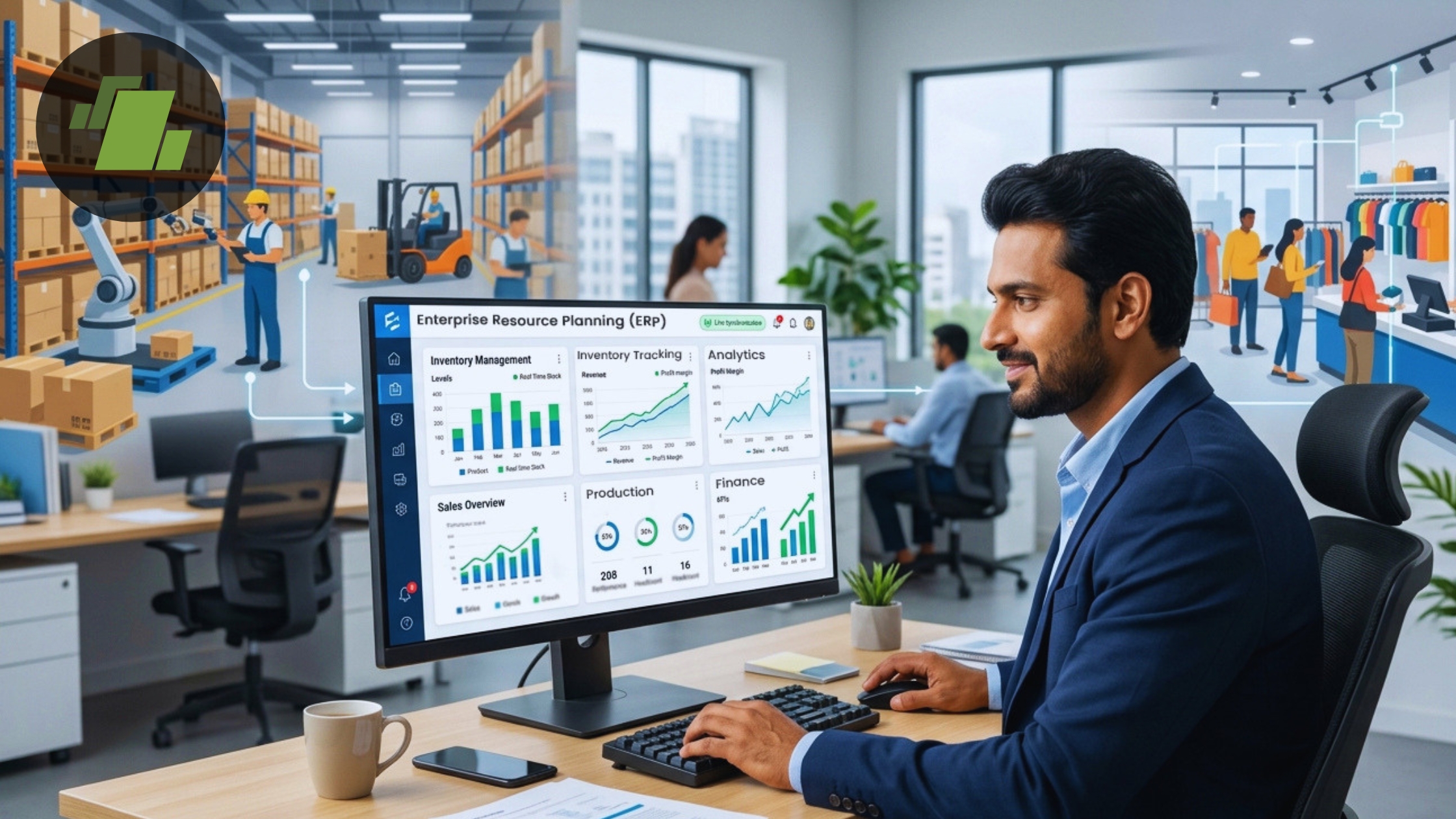
ERP (Enterprise Resource Planning) is a powerful business management software that automates and integrates core processes like billing, inventory, accounting, and reporting into a single system. It helps businesses improve efficiency, reduce manual work, and gain real-time visibility for better decision-making. With flexible deployment options such as cloud, on-premise, and hybrid, ERP enables organizations to streamline operations, optimize resources, and scale effectively. Overall, ERP is essential for driving digital transformation, improving productivity, and achieving long-term business growth.
Introduction
What is ERP? This is one of the frequently asked business-related subjects that customers are curious about. ERP is nothing but an enterprise acronym for Enterprise Resource Planning. In general, ERP references automation and amalgamation of a company’s central commercial business.
An ERP system automates and integrates central commercial enterprise approaches consisting of taking patron orders, scheduling operations, and keeping stock information and economic data. ERP structures have several benefits to assist with ordinary commercial enterprise overall performance control for any agency providing intelligence, visibility, analytics, and efficiency throughout each factor of a commercial enterprise. Giving you one supply of the reality and permitting the digitalization of your commercial enterprise.
How does it Work?
The predominant motive of an ERP gadget is to boom the organizational performance of an agency through coping with and enhancing how organization sources are utilized. Improving and/or decreasing the number of essential resources without sacrificing quality and overall performance are keys to efficaciously enhancing enterprise boom and profitability.
ERP structures commonly cover all elements of enterprise operations and usually offer an incorporated system, common database, real-time operation, support for all applications/components, common consumer interface throughout application/components, and on-premise, cloud-hosted, or SaaS deployment.
ERP synchronizes reporting and automation by decreasing the need to preserve separate databases and spreadsheets that must be manually merged to generate reviews. This blended information series and reporting give precious insight, including where to reduce fees and streamline processes, presenting the information to make real-time enterprise decisions.
Types of ERP
Types of ERP structures normally check with deployment alternatives and encompass cloud ERP, on-premise ERP, and hybrid ERP (a few structures within the cloud and a few on-premise).
-
On-Premise ERP software program is carried out on-site and maintained in physical work area inside an enterprise, hosted at the company’s very own computer systems and servers for complete control, aid, and possession of the whole gadget as soon as carried out.
-
A Cloud-based ERP software program refers to a web-based solution, called Software as a Service (SaaS), wherein an enterprise accesses and shops information on any tool with a web connection, generally via the acquisition of a subscription. Continual aid, updates, training, and bendy customizations supported through the software program provider.
-
“Hybrid” ERP software program refers to a blended implementation of cloud-based and on-premise ERP gadget solutions. The aggregate of web hosting and deployment offerings ranges through the provider. These models can offer ERP customers the power to migrate among delivery models.
Benefits of ERP and why your business needs it
ERP structures are used to assist agencies of all sizes to triumph over challenges from small agencies to large enterprises. Early enterprise practices may now no longer hold up with developing demand and require extra efficient enterprise tools, like ERP, to efficiently control an enterprise’s structures and resources.
ERP software program structures offer many blessings to the fitness and growth of an enterprise.
1. Readily undertake new and evolving SaaS technology
Latest technologies, like Artificial intelligence (AI), assist cloud-based structures to swiftly enhance their abilities without a need for periodic updates, not like the common legacy system. Now, without an extra or new entry from the end-consumer, ERP structures constantly have come to be substantially less difficult to manage and use.
2. Extend the cost of your current ERP System
Augmenting and combining legacy software programs with cloud packages can supplement, enhance, and complement vital tasks. This method can breathe new existence into legacy ERP structures, giving agencies an extremely good possibility to begin adopting cloud abilities.
3. Approach new technologies
A cloud package that supplements the legacy ERP software program modules helps to right away take advantage of swiftly advancing new technologies and enhancing consumer paradigms. These offer complimentary structures that supply instant enterprise abilities and cost without an essential alternate for the operations.
4. Lessen third-party dependencies
Reporting and analytics for legacy structures generally require involvement from a third-party supplier to generate operational enterprise intelligence. Using cloud packages from the legacy ERP supplier frequently produces identical or higher intelligence with no need for a further supplier relationship.
5. Evolve your monetary structures
Legacy structures were by no means supposed to be a present-day reporting engine. Cloud-based technology was born in the last decade and developed, as a central principle, with a unique mindset and expertise of not only what was possible but what was necessary to achieve success for ERP platforms.
6. More strong safety resources
Cloud solution provider companies have large, full-time groups which might be completely committed to proactively tracking and staying modern with cloud safety problems and threats 24/7.
7. Entice in-demand talent
The subsequent era of younger employees has grown up with seamless technologies that are mobile, smooth, and always-on. No organization that keeps purely relying upon on-premise technology might be capable to recruit pinnacle talent, irrespective of age.
ERP join every component of an enterprise. An ERP software program gadget permits for higher overall performance and mission control that facilitates plan, budget, predict, and appropriately report on an organization’s monetary fitness and techniques. Access to new technologies assists corporations in the speedy enhancement of their business best practices as the ERP software evolves.
Read More: What Is ERP Software? Enterprise Resource Planning Explained
Conclusion
ERP software has become a vital solution for businesses aiming to improve efficiency, streamline operations, and achieve sustainable growth. By bringing together key functions like billing, inventory, accounting, and reporting into one unified system, ERP reduces manual work and ensures accurate, real-time data across the organization.
With flexible deployment options such as on-premise, cloud, and hybrid models, ERP systems help businesses stay agile and responsive to changing market needs. As technology continues to advance, modern ERP solutions are becoming more intelligent, scalable, and easy to use.
Implementing the right ERP system not only enhances operational visibility and control but also enables businesses to make informed decisions, optimize resources, and build a strong foundation for long-term success.
Call at +91-73411-41176 or send us an email at sales@logicerp.com to book a free demo today!
Frequently Asked Questions & Answers
1. What is ERP software?
ERP (Enterprise Resource Planning) software is a centralized system that integrates core business processes like billing, inventory, accounting, and reporting into one platform for better efficiency and control.
2. How does ERP improve business efficiency?
ERP automates routine tasks, reduces manual errors, and provides real-time data, helping businesses streamline operations, save time, and make faster, data-driven decisions.
3. What are the different types of ERP systems?
The main types of ERP systems are cloud-based ERP, on-premise ERP, and hybrid ERP, each offering different levels of flexibility, control, and scalability.
4. Which industries can benefit from ERP software?
ERP software is widely used across retail, distribution, and manufacturing industries to manage operations, track inventory, optimize supply chains, and improve overall productivity.
5. Why is ERP important for business growth?
ERP provides real-time insights, improves resource utilization, enhances decision-making, and supports scalability, making it essential for long-term business growth and digital transformation.