Retail Promotion Planning: A Complete Guide to Discounts, Bundles, Offers and Sales Performance

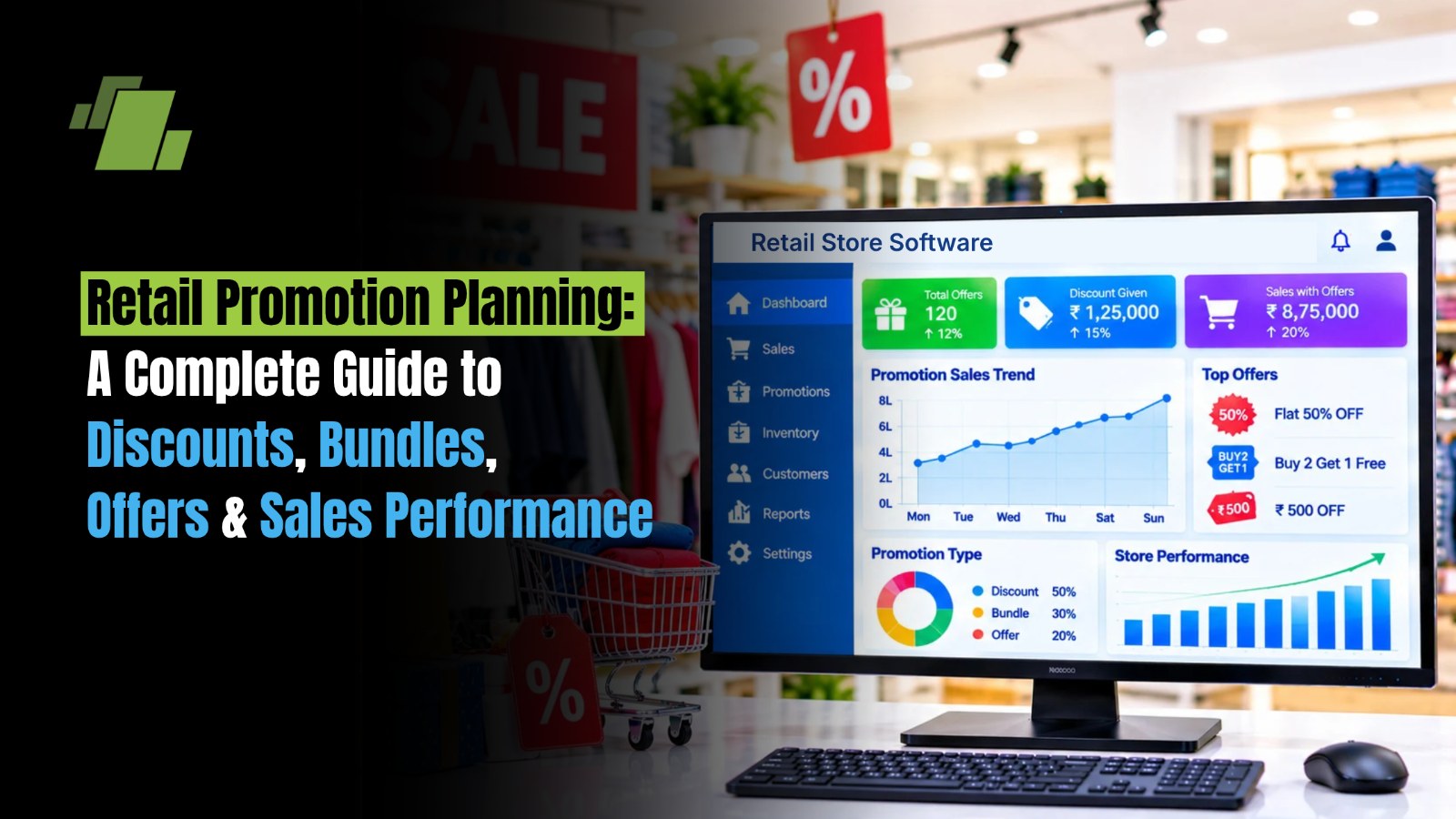
Retail promotions play an important role in attracting customers, increasing product sales, improving inventory movement and strengthening customer loyalty. From festive discounts and seasonal sales to Buy One Get One (BOGO) offers and product bundles, retailers use different promotional strategies to influence purchasing decisions.
However, running frequent promotions does not necessarily translate into higher profitability. A discount may increase sales volume but reduce product margins. A bundle may improve basket size but leave retailers with slow-moving inventory in another category. Similarly, an attractive offer can create additional demand that a store may struggle to fulfil because of insufficient stock.
Effective retail promotion planning requires more than deciding which products to discount. Retailers must identify the right products, understand customer purchasing behaviour, calculate promotional costs, coordinate inventory and evaluate the actual financial impact of every campaign.
For supermarkets, grocery stores, apparel retailers, electronics stores and multi-store retail chains, a structured promotion management process helps balance customer acquisition, sales growth and profitability.
This guide explains how to plan retail promotions, choose the right discount strategies, create effective product bundles, manage promotional offers and measure sales performance using retail data and technology.
Contact Us
Free Demo Request
What is Retail Promotion Planning?
Retail promotion planning is the process of developing, scheduling, executing and evaluating promotional campaigns to achieve specific business objectives, such as increasing sales, attracting customers, improving inventory turnover, increasing average transaction value and enhancing customer loyalty.
It involves selecting products, determining discount levels, defining offer conditions, allocating promotional budgets, coordinating stock availability and measuring campaign performance.
Retail promotion planning typically covers:
-
Discount Planning: Defining percentage discounts, flat-price offers and seasonal markdowns.
-
Bundle Promotions: Combining complementary or related products at attractive prices.
-
Quantity-Based Offers: Creating deals such as Buy 2 Get 1 Free or Buy 3 at a special price.
-
Customer-Specific Offers: Providing targeted promotions based on purchase history and loyalty.
-
Seasonal Campaigns: Planning promotions around festivals, holidays and shopping seasons.
-
Clearance Promotions: Moving excess, ageing and discontinued inventory.
-
Performance Measurement: Analysing promotional sales, margins, customer response and return on investment.
The objective is to create promotions that deliver measurable business value rather than simply generating temporary increases in sales.
Why is Retail Promotion Planning Important?
Retail promotion planning helps businesses make informed decisions about discounts, product combinations, campaign timing and promotional investments.
Without a structured approach, retailers may experience reduced margins, poor stock availability, ineffective discounts and difficulty measuring campaign performance.
Here are the major reasons why promotion planning matters.
1. Increase Sales and Customer Footfall
Attractive offers can encourage customers to visit a store, explore additional products and make purchases they might otherwise postpone.
For example, a supermarket offering discounts on selected grocery essentials during a weekend may attract more shoppers. Once inside, customers may also purchase snacks, beverages, personal care products and household items.
A well-planned promotion should therefore consider not only the sales of discounted products but also the additional purchases generated across the store.
2. Improve Average Transaction Value
Retailers can use product bundles, quantity-based discounts and cross-category offers to encourage customers to purchase more items per transaction.
For example:
-
Buy two shirts and get 20% off the third.
-
Purchase a shampoo and conditioner together at a special price.
-
Buy groceries worth ₹2,000 and receive a ₹150 shopping voucher.
These offers encourage customers to increase their basket value while giving retailers opportunities to sell complementary products.
3. Improve Inventory Movement
Promotions can help retailers move products that have accumulated excess inventory or are approaching their seasonal selling deadlines.
For example, an apparel retailer can introduce end-of-season discounts on winter jackets to reduce unsold stock before the next season.
Similarly, grocery retailers can offer discounts on products with shorter remaining shelf lives, subject to applicable food safety and quality requirements.
4. Strengthen Customer Loyalty
Consistent and relevant promotional offers can encourage repeat purchases.
Retailers can use customer purchase history, membership information and loyalty programme data to provide offers based on individual preferences.
For example, a customer who regularly purchases baby care products may receive a targeted offer on related products rather than a generic discount on unrelated merchandise.
5. Protect Retail Profitability
Promotion planning allows retailers to calculate the impact of discounts before launching a campaign.
By considering product cost, selling price, supplier funding, discount percentage and expected sales volume, businesses can determine whether a proposed promotion is financially viable.
This helps prevent situations where higher sales volumes result in lower overall profits.
What are the Different Types of Retail Promotions?
Retailers use different promotional techniques depending on their objectives, product categories, customer segments and inventory requirements.
The following table explains commonly used retail promotion strategies.
|
Promotion Type |
How It Works |
Example |
Primary Objective |
|
Percentage discount |
Reduces the regular selling price by a percentage |
Flat 20% off |
Increase product sales |
|
Flat discount |
Offers a fixed amount off |
₹200 off on purchases above ₹1,500 |
Increase basket value |
|
Buy One Get One (BOGO) |
Provides an additional product with a purchase |
Buy 1 Get 1 Free |
Increase product movement |
|
Quantity-based offer |
Provides discounts for purchasing multiple units |
Buy 3 at ₹499 |
Increase units per transaction |
|
Product bundling |
Combines related products at a special price |
Shampoo + Conditioner |
Increase basket size |
|
Seasonal promotion |
Offers discounts during specific seasons |
Winter collection sale |
Improve seasonal sales |
|
Clearance sale |
Discounts ageing or discontinued inventory |
Up to 50% off |
Reduce excess inventory |
|
Loyalty promotion |
Rewards repeat customers |
Double loyalty points |
Improve retention |
|
Cross-category offer |
Links products from different categories |
Buy a mixer and get a discount on kitchen accessories |
Encourage additional purchases |
|
Threshold promotion |
Offers benefits after reaching a purchase value |
Free gift above ₹2,000 |
Increase average order value |
Choosing the right promotional mechanic is important because different offers influence customer behaviour differently. A clearance discount may help reduce excess inventory, whereas a product bundle may be more suitable for increasing average transaction value.
How to Plan Retail Promotions Step by Step
An effective retail promotion strategy requires coordination between merchandising, marketing, purchasing, inventory management, store operations and finance teams.
The following steps provide a practical framework for planning and managing promotional campaigns.
Step 1: Define Clear Promotional Objectives
Start by identifying what the business wants to achieve through the promotion.
Different campaigns require different objectives. A retailer trying to attract new customers may choose a different promotional strategy from one trying to clear ageing inventory.
Common retail promotion objectives include:
-
Increasing sales of selected products.
-
Improving store footfall.
-
Increasing average transaction value.
-
Promoting newly launched products.
-
Reducing excess and slow-moving inventory.
-
Improving category-wise sales performance.
-
Encouraging repeat purchases.
-
Increasing customer engagement.
For example, a grocery retailer may want to increase sales of packaged beverages during summer. An apparel retailer may want to clear previous-season collections before introducing new merchandise.
Defining the objective first makes it easier to select appropriate products, discounts and performance indicators.
Step 2: Identify the Right Products for Promotion
Not every product requires a discount. Retailers should evaluate product performance, inventory position, margins and customer demand before selecting promotional items.
Important factors include:
Sales velocity: Products with high customer demand may benefit from quantity-based offers or cross-selling campaigns.
Inventory ageing: Products remaining unsold for extended periods may require clearance promotions.
Gross margin: Products with sufficient margins may provide more flexibility for discounts.
Seasonality: Products associated with specific seasons or occasions can be promoted before demand declines.
Customer preferences: Frequently purchased products and complementary items can be selected using customer transaction data.
For example, a fashion retailer may identify slow-moving styles in specific sizes or colours and offer targeted markdowns instead of discounting the entire collection.
Similarly, a supermarket may select selected personal care products for a bundle promotion based on their purchase frequency and stock availability.
Step 3: Analyse Product Costs and Profit Margins
Before finalising a discount, retailers must understand how much margin will remain after the promotional price is applied.
Consider the following example:
|
Particulars |
Amount |
|
Product cost |
₹600 |
|
Regular selling price |
₹1,000 |
|
Regular gross profit |
₹400 |
|
Regular gross margin |
40% |
|
Promotional discount |
20% |
|
Promotional selling price |
₹800 |
|
Promotional gross profit |
₹200 |
|
Promotional gross margin |
25% |
The discount increases price attractiveness, but the gross margin falls from 40% to 25%.
This calculation demonstrates why retailers should evaluate promotional profitability rather than focusing exclusively on discounted sales volume.
Retailers should also account for supplier-funded discounts, promotional expenses, payment charges and other variable costs when calculating the actual contribution from a campaign.
Step 4: Select the Right Discount Strategy
The next step is deciding how the offer should be structured.
Different discount strategies serve different purposes.
-
Percentage Discounts: Suitable for seasonal sales, category promotions and selected merchandise.
-
Flat Discounts: Useful for encouraging purchases above a specified transaction value.
-
Quantity Discounts: Suitable for increasing the number of units sold.
-
Tiered Discounts: Offer increasing benefits as purchase value increases.
-
Clearance Markdowns: Help reduce ageing and discontinued inventory.
-
Customer-Specific Discounts: Encourage repeat purchases through personalised offers.
For example, a retailer can introduce the following tiered offer:
|
Purchase Value |
Promotional Benefit |
|
₹1,000 |
5% discount |
|
₹2,000 |
10% discount |
|
₹3,000 |
15% discount |
However, the discount structure should be evaluated against the gross margin of products likely to be purchased. Otherwise, customers may qualify for higher discounts without generating sufficient incremental revenue.
Step 5: Create Relevant Product Bundles
Product bundling involves combining two or more products and selling them together at a special price.
It can increase basket value, encourage cross-category purchases and improve the movement of selected inventory.
For example:
-
Grocery: Rice + Dal + Cooking Oil.
-
Personal Care: Shampoo + Conditioner + Hair Serum.
-
Electronics: Laptop + Mouse + Laptop Bag.
-
Apparel: Shirt + Trousers + Belt.
-
Home Furnishing: Bedsheet + Pillow Covers.
A successful bundle should offer genuine customer value while maintaining acceptable profitability.
Retailers should consider product compatibility, individual selling prices, combined product costs and inventory availability before creating bundles.
For instance, a supermarket may combine frequently purchased breakfast products into a breakfast essentials pack. This makes shopping convenient while encouraging customers to purchase multiple categories together.
Step 6: Set Promotion Duration and Scheduling
Promotional timing can significantly influence campaign performance.
Retailers should consider customer demand patterns, seasonal buying behaviour, festivals, weekends, payday periods and competitor activity when scheduling promotions.
Indian retailers commonly plan promotional campaigns around:
-
Diwali and Dhanteras.
-
Holi and other festive occasions.
-
Independence Day and Republic Day.
-
Wedding and festive shopping seasons.
-
Summer and winter sales.
-
End-of-season clearance periods.
-
New product launches.
-
Weekend and month-end campaigns.
Each promotion should have a clearly defined start date, end date and applicable conditions.
Retailers should also consider whether the campaign will apply across all stores, selected locations, specific product categories or particular customer segments.
Step 7: Ensure Inventory Availability Before Launch
A successful promotion can create additional demand. If sufficient stock is unavailable, customers may face out-of-stock situations, resulting in lost sales and poor shopping experiences.
Before launching a promotion, retailers should:
-
Check current inventory across stores and warehouses.
-
Review historical sales and expected promotional demand.
-
Identify products requiring replenishment.
-
Coordinate with suppliers and purchasing teams.
-
Allocate stock across participating outlets.
-
Monitor inventory movement during the campaign.
For multi-store retailers, centralised inventory visibility is particularly important.
For example, if a retailer launches a discount on a popular footwear collection across 20 stores, it must ensure that participating outlets have the right sizes and styles available.
Integration between retail POS, inventory management, procurement and warehouse management systems can help maintain stock visibility throughout the promotional period.
Step 8: Communicate Offers Across Sales Channels
Once the promotion is finalised, retailers must communicate it consistently across customer touchpoints.
Common promotional communication channels include:
-
In-store displays and banners.
-
Retail POS displays.
-
SMS and WhatsApp campaigns.
-
Email marketing.
-
Website and e-commerce platforms.
-
Mobile applications.
-
Social media advertising.
-
Customer loyalty programmes.
For businesses operating both physical stores and online channels, promotional conditions should remain consistent wherever the campaign applies.
This includes discount eligibility, product combinations, offer validity, redemption conditions and applicable exclusions.
Step 9: Monitor and Evaluate Promotion Performance
Promotion management does not end when an offer goes live.
Retailers should monitor campaign performance throughout its duration and compare actual results against predefined targets.
Important metrics include:
-
Promotional sales revenue.
-
Units sold.
-
Discount amount.
-
Gross profit and gross margin.
-
Average transaction value.
-
Units per transaction.
-
Category-wise sales growth.
-
Inventory movement.
-
Customer participation.
-
Repeat purchase rate.
-
Promotional return on investment.
The analysis should identify whether the promotion generated additional business or simply discounted purchases that customers would have made anyway.
This distinction is essential for understanding the actual value of a promotional campaign.
How to Measure Retail Promotion Performance?
Retail promotion performance should be measured through both sales growth and profitability. A campaign that generates higher revenue but significantly reduces gross margin may not be successful.
Retailers should establish baseline performance, track campaign results and evaluate the additional business generated by the promotion.
1. Sales Lift
Sales lift measures the percentage increase in sales during a promotional period compared with the expected baseline sales.
2. Average Transaction Value (ATV)
ATV measures the average amount customers spend per transaction.
Formula:
ATV=Total Sales Revenue / Number of Transactions
For example, if a store generates ₹5,00,000 in sales through 1,000 transactions, its ATV is ₹500.
If a bundle promotion increases ATV to ₹575, the retailer can investigate whether the additional basket value also produces sufficient gross profit.
3. Promotion Redemption Rate
This metric measures how many eligible customers actually use a promotional offer.
Formula:
Redemption Rate = (Offers Redeemed / Offers Distributed) x 100
For example, if a retailer distributes 2,000 discount coupons and 400 are redeemed, the redemption rate is 20%.
This helps evaluate customer response to different promotional campaigns.
4. Gross Margin During Promotion
Gross margin indicates how much revenue remains after deducting the cost of goods sold.
Retailers should compare promotional gross margins with regular selling margins to understand the financial impact of discounts.
5. Promotional Return on Investment (ROI)
ROI evaluates whether the additional profit generated by a promotion justifies its associated investment.
Formula:
ROI = {(Incremental Profit - Promotion Cost) / Promotion Cost} x 100
For example:
|
Particulars |
Amount |
|
Incremental gross profit |
₹30,000 |
|
Promotional expenses |
₹10,000 |
|
Net incremental profit |
₹20,000 |
|
Promotional ROI |
200% |
Illustrative calculation. Incremental profit should account for relevant product, discount and campaign costs.
6. Inventory Sell-Through Rate
Sell-through rate indicates how much of the inventory allocated to a promotion has been sold.
Formula:
Sell - Through Rate = (Units Sold Units / Available for Sale) x 100
For example, if a retailer allocates 500 units for a clearance campaign and sells 350 units, the sell-through rate is 70%.
This metric is particularly useful for apparel, footwear, electronics and seasonal merchandise.
7. Incremental Sales and Margin
One of the most important aspects of promotion evaluation is distinguishing incremental sales from sales that would have occurred without the promotion.
For example, a supermarket normally sells 100 units of a product each week. During a discount campaign, sales increase to 150 units.
The additional 50 units represent the apparent sales uplift. However, retailers must also consider whether the promotion reduced sales of similar products, encouraged customers to purchase in advance or increased future promotional costs.
Boston Consulting Group highlights the importance of evaluating discounts, supplier funding, cannibalisation, complementary purchases, stock-up effects and campaign expenses when calculating the real incremental value of a promotion.
Common Retail Promotion Planning Challenges and How to Solve Them
Despite the potential benefits of promotional campaigns, retailers often face operational and financial challenges when planning and executing offers.
|
Common Challenge |
Business Impact |
Recommended Solution |
|
Excessive discounting |
Reduced gross margins |
Establish product-wise discount limits |
|
Poor product selection |
Low customer response |
Analyse sales history and inventory ageing |
|
Insufficient stock |
Lost sales and customer dissatisfaction |
Plan replenishment before promotions |
|
Incorrect offer configuration |
Billing errors and customer disputes |
Centralise promotion rules and validation |
|
Overlapping discounts |
Unplanned margin reduction |
Define offer eligibility and stacking rules |
|
Poor supplier coordination |
Delayed procurement and funding |
Coordinate promotional plans with suppliers |
|
Limited performance visibility |
Difficulty identifying successful offers |
Track sales, margins and redemption data |
|
Inconsistent multi-store execution |
Different offers across outlets |
Centralise promotional control and updates |
|
Manual reporting |
Delayed campaign decisions |
Automate sales and promotion reports |
How can Retailers Prevent Unprofitable Promotions?
Retailers can reduce promotional losses by following these practices:
-
Calculate product-wise gross margins before approving discounts.
-
Avoid applying identical discounts to products with different margin structures.
-
Check inventory availability before launching offers.
-
Set clear promotional budgets and discount limits.
-
Monitor sales and margins during the campaign.
-
Analyse whether the offer generates additional purchases.
-
Evaluate supplier-funded promotions separately.
-
Compare results across stores, categories and promotional periods.
Promotional planning should be treated as an ongoing process involving planning, execution, monitoring and performance evaluation.
How does Retail Promotion Management Software Improve Promotion Planning?
Retail promotion management software helps businesses organise promotional activities, configure offers, control discounts, manage product pricing and analyse campaign performance.
For retailers managing multiple products, outlets, warehouses and sales channels, software-based promotion management reduces dependency on spreadsheets and manual coordination.
An integrated ERP and Retail POS solution can connect promotional activities with inventory, purchasing, billing, accounting and reporting.
1. Centralised Discount and Offer Management
Retailers can manage different promotional schemes through a centralised system.
Depending on the software configuration, this can include:
-
Percentage-based discounts.
-
Flat-price offers.
-
Product-wise promotional pricing.
-
Quantity-based schemes.
-
Buy One Get One offers.
-
Combo and bundle promotions.
-
Customer-specific offers.
-
Date-based promotional validity.
Centralised configuration helps maintain consistent promotional rules across participating stores.
2. Automated Promotional Pricing at POS
Integration between promotion management and Retail POS helps ensure that applicable offers are reflected during billing.
For example, when a customer purchases qualifying products under a bundle offer, the billing system can apply the configured promotional pricing.
This reduces manual discount calculations and helps improve billing accuracy.
Retailers should also configure offer priorities, eligibility conditions and restrictions to prevent unintended discount combinations.
3. Real-Time Inventory Visibility
Promotional demand can change inventory requirements quickly.
An integrated inventory management system helps retailers monitor stock availability across stores and warehouses, identify replenishment requirements and track product movement.
This is particularly useful for businesses running promotions across multiple locations.
4. Product-Wise and Category-Wise Sales Analysis
Retail analytics helps businesses identify which products, brands and categories perform well during promotional campaigns.
Retailers can analyse:
-
Product-wise sales.
-
Category-wise revenue.
-
Store-wise promotional performance.
-
Discount values.
-
Gross profit and margins.
-
Fast-moving and slow-moving products.
-
Customer purchase patterns.
These insights help retailers identify which promotional strategies deserve to be repeated, modified or discontinued.
5. Supplier and Procurement Coordination
Supplier-funded promotions require coordination between purchasing, finance and merchandising teams.
An ERP system can connect purchase information, supplier rates, product costs and inventory data to support more informed promotional decisions.
Retailers can also evaluate supplier contributions and compare procurement costs before finalising promotional prices.
6. Multi-Store Promotion Control
Retail chains need consistent promotional execution across outlets.
A centralised ERP system can help businesses manage product pricing, promotional schemes and sales information across multiple locations.
Management can compare store-wise performance and identify outlets where campaigns are underperforming.
7. Business Intelligence and Management Reporting
Retail management teams need timely information to evaluate campaign effectiveness.
Business intelligence dashboards and management reports can help present important business indicators, including sales, inventory, margins and store performance.
Instead of manually consolidating reports from different outlets, management can use integrated business information to make faster decisions.
How LOGIC ERP Supports Retail Promotion Planning
LOGIC ERP, an ERP solution established in 1993, provides integrated business management capabilities for retailers, distributors and manufacturers.
For retail businesses, its ERP and Retail POS capabilities help connect sales, inventory, pricing, purchasing and business reporting.
When planning and executing retail promotions, relevant capabilities include:
Promotion and Scheme Management: Manage configured promotional schemes, discounts and product offers to support different retail selling requirements.
Retail POS Integration: Apply eligible pricing and promotional schemes during billing, helping streamline checkout operations.
Product and Inventory Management: Monitor product-wise stock, inventory movement and availability across locations.
Multi-Store Management: Coordinate retail operations and access consolidated business information across multiple outlets.
Purchase and Supplier Management: Access purchasing and product cost information to support pricing and promotional decisions.
Business Insights: Analyse sales, inventory and profitability information through business reports and dashboards.
By connecting these operational functions, LOGIC ERP helps retailers improve visibility across promotional activities and make more informed business decisions.
The specific promotional rules and automation available depend on the selected modules and configuration.
Best Practices for Effective Retail Promotion Planning
Retailers should follow a consistent approach to ensure promotional activities support long-term business objectives.
-
Set Measurable Targets: Define whether the campaign aims to increase revenue, improve margins, clear inventory or attract new customers.
-
Use Historical Sales Data: Analyse previous promotional performance before selecting products and discounts.
-
Consider Product Profitability: Evaluate margins and promotional expenses before approving offers.
-
Avoid Unnecessary Discounting: Use bundles, loyalty rewards and threshold offers where appropriate.
-
Plan Stock Availability: Coordinate purchasing, warehousing and store-level inventory before launching promotions.
-
Maintain Offer Consistency: Ensure promotional conditions are correctly configured across participating stores and channels.
-
Monitor Campaign Performance: Track sales, redemption, inventory movement and margins throughout the campaign.
-
Review Every Campaign: Document results and use the findings to improve future promotional decisions.
Conclusion
Effective retail promotion planning is about creating the right offers for the right products, customers and business objectives. Whether retailers are using percentage discounts, quantity-based offers, product bundles or seasonal markdowns, every promotion should contribute to measurable business outcomes.
However, successful execution requires more than attractive offers. Businesses must coordinate promotional pricing with inventory availability, purchasing, billing, customer behaviour and financial performance.
An integrated retail ERP and POS solution can help retailers manage these activities through centralised operations, accurate billing, inventory visibility and sales analytics.
Want to manage retail promotions, discounts and sales performance more efficiently?
With LOGIC ERP, streamline retail operations through integrated Retail POS, inventory management, pricing, purchasing and business analytics.
Plan Smarter Promotions. Control Margins. Improve Retail Profitability.
Call at +91-73411-41176/75 or send us an email at sales@logicerp.com to book a free demo today!
Frequently Asked Questions
1. What is Retail Promotion Planning?
Retail promotion planning is the process of developing and managing promotional campaigns to increase sales, attract customers, improve inventory movement and achieve profitability objectives through discounts, bundles, special offers and seasonal promotions.
2. What are the Different Types of Retail Promotions?
Common types include percentage discounts, flat discounts, Buy One Get One offers, quantity-based schemes, product bundles, seasonal sales, clearance promotions, loyalty rewards and threshold-based discounts.
3. How do Retailers Create an Effective Promotional Strategy?
Retailers should define campaign objectives, identify suitable products, analyse margins, select discount structures, plan inventory, schedule promotions, communicate offers and measure campaign performance.
4. How can Retailers Increase Sales Through Discounts and Offers?
Retailers can increase sales through targeted discounts, quantity-based schemes, bundle offers, seasonal promotions and loyalty rewards. Offers should be based on customer demand, product margins and purchasing behaviour.
5. What is the Difference Between a Discount and a Promotional Offer?
A discount directly reduces the selling price of a product, whereas a promotional offer can include additional benefits such as free products, bundles, loyalty rewards, cashback or purchase-based incentives.
6. How do Product Bundles Help Retailers Increase Sales?
Product bundles combine complementary or related products at an attractive combined price. They encourage customers to purchase multiple items, improve average transaction value and support cross-category sales.
7. How can Retailers Measure Promotion Effectiveness?
Retailers can measure promotional effectiveness using sales lift, gross margin, average transaction value, redemption rate, units sold, inventory sell-through rate and promotional ROI.
8. How can Retailers Prevent Profit Loss During Promotional Campaigns?
Retailers should calculate product-wise margins, establish discount limits, evaluate promotional expenses, check inventory availability and monitor campaign profitability before and during promotions.
9. What is Retail Promotion Management Software?
Retail promotion management software helps businesses configure discounts, manage promotional pricing, coordinate offers, integrate promotions with POS billing and analyse campaign performance.
10. How does ERP Software Help in Retail Promotion Management?
ERP software connects promotional activities with retail POS, inventory, purchasing, accounting and reporting. This helps retailers maintain pricing consistency, monitor stock availability and evaluate promotional sales performance across stores.

Author
Gurbir Singh
Co-founder & Managing Director | LOGIC ERP Solutions Pvt. Ltd.
With 30+ years of experience in the tech industry, I took the helm of technology & product development, ensuring LOGIC ERP’s continuous innovation & leadership in the evolving tech landscape.

