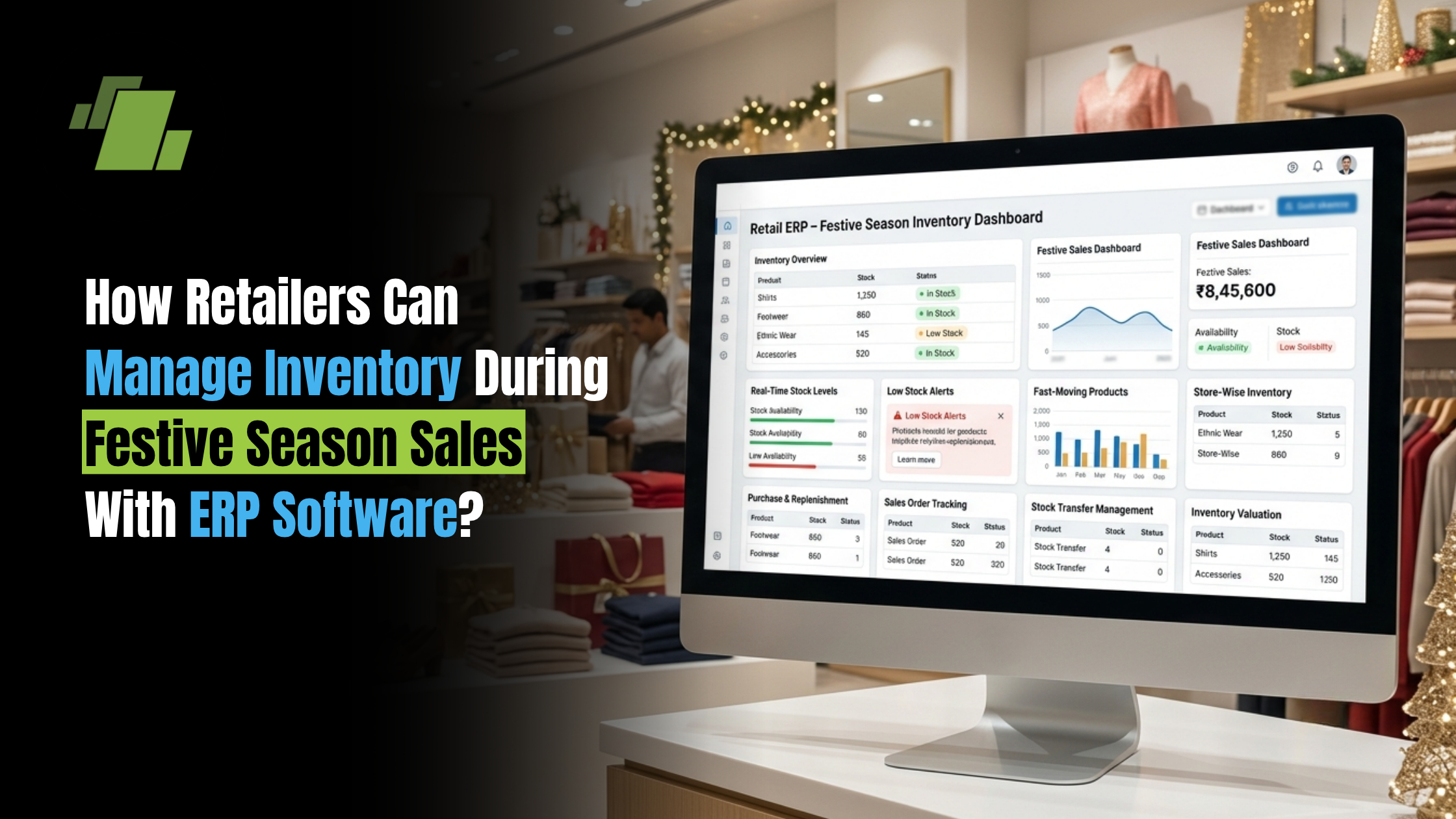
How Retailers Can Manage Inventory During Festive Season Sales With ERP Software?

Introduction
Festive seasons such as Diwali, Dussehra, Navratri, Christmas and Eid create significant sales opportunities for retailers across India. Increased customer demand, promotional campaigns and changing shopping patterns can help businesses increase sales. However, these periods also create inventory management challenges, including stockouts, excess inventory, delayed replenishment and uneven stock distribution across stores.
Retailers must ensure that popular products remain available without purchasing more stock than they can sell. Managing this balance becomes more difficult when businesses operate multiple outlets, handle thousands of SKUs or sell products with different sizes, colours, designs and seasonal demand patterns.
Contact Us
Free Demo Request
ERP software helps retailers manage festive season inventory by connecting sales data, stock availability, purchasing, replenishment and reporting within an integrated system. With better visibility into inventory movement and product demand, retailers can make informed purchasing decisions, allocate stock more effectively and respond to changing sales patterns.
LOGIC ERP retail ERP software helps retailers coordinate inventory management, POS billing, purchasing and business reporting to support more organised festive season operations.
What is Festive Season Inventory Management?
Festive season inventory management is the process of forecasting product demand, planning purchases, maintaining stock availability and monitoring inventory movement before, during and after a festival or seasonal sales period.
It involves identifying products likely to experience increased demand, setting appropriate stock levels, coordinating supplier deliveries, distributing inventory across outlets and monitoring sales performance throughout the season.
For example, an apparel retailer may experience increased demand for ethnic wear before Diwali, while a supermarket may need to replenish sweets, dry fruits, packaged foods and gift hampers more frequently.
Effective festive inventory management helps retailers reduce missed sales opportunities, control excess stock and maintain product availability during peak shopping periods.
Why is Inventory Management Challenging During Festive Season Sales?
1. Unpredictable Demand Fluctuations
Festive demand can vary by product category, location, customer preferences and promotional activity. Products that sold well during the previous festive season may not perform equally well in the current year.
Retailers relying only on intuition or general sales estimates may overstock certain items while understocking popular products.
2. Stockouts of High-Demand Products
Popular products can sell out quickly during festive promotions. When replenishment is delayed, retailers may lose potential sales or disappoint customers who expect immediate product availability.
For businesses selling size- or colour-specific products, such as apparel and footwear, overall stock availability does not necessarily mean the required variant is available.
3. Excess Inventory After the Festival
Retailers may purchase additional stock to prepare for increased demand. However, if actual sales fall below expectations, unsold inventory can remain in warehouses and stores after the festive period.
This may increase storage costs, tie up working capital and create the need for clearance discounts.
4. Uneven Stock Distribution Across Stores
Retail chains may experience different demand patterns across locations. A product selling quickly in one outlet may move slowly in another.
Without consolidated inventory visibility, retailers may continue purchasing additional stock even when suitable inventory is already available at another location.
5. Supplier and Replenishment Delays
Festive demand can place additional pressure on suppliers, transporters and warehouse operations. Delayed deliveries may prevent retailers from replenishing fast-moving products at the right time.
Retailers need to account for supplier lead times and available stock before placing purchase orders.
6. Limited Visibility Into Real-Time Sales and Stock
When billing, purchasing and inventory records are maintained separately, retailers may struggle to determine how much stock is available, which products are selling quickly and which items require replenishment.
An integrated retail ERP system helps bring these records together for more informed decisions.
How Retailers Can Manage Inventory During Festive Season Sales With ERP Software
1. Forecast Festive Demand Using Historical Sales Data
Demand forecasting helps retailers estimate how much stock they may need during a festive period.
Retailers can analyse previous festive season sales, current sales trends, product movement, promotional performance and store-wise demand to prepare more realistic inventory plans.
For example, a grocery retailer can compare previous Diwali sales of dry fruits and gift packs to estimate likely demand for the upcoming season. An apparel retailer can examine the sales performance of ethnic wear, festive collections and individual size-colour combinations.
ERP reporting can help retailers review historical sales and identify patterns that support purchasing decisions.
How LOGIC ERP helps: Retail sales reports and business insights can help retailers review product movement and sales performance when planning seasonal inventory.
2. Identify Fast-Moving and Slow-Moving Products
Not every product experiences the same increase in demand during festivals. Retailers need to distinguish between items that require frequent replenishment and products that are unlikely to sell quickly.
Fast-moving products may require higher stock availability and closer monitoring. Slow-moving products may need more cautious purchasing to avoid unnecessary accumulation.
Retailers can use sales reports, stock movement data and inventory ageing reports to identify these patterns.
For example, a supermarket may need to replenish popular festive gift packs regularly, while a retailer may need to limit purchases of products with consistently low sales.
How LOGIC ERP helps: Inventory and sales reporting can help retailers assess fast- and slow-moving stock and make better-informed replenishment decisions.
3. Maintain Accurate Stock Visibility Across Stores
Multi-store retailers must know how much inventory is available at each outlet and in their warehouses.
A product may be unavailable at one location but readily available at another. Without consolidated visibility, retailers may place unnecessary purchase orders or miss opportunities to redistribute existing stock.
An integrated ERP system helps retailers review inventory across connected locations and make stock allocation decisions based on availability and demand.
Retailers can use this visibility to identify stock shortages, review surplus inventory and coordinate transfers where supported by their operating processes.
How LOGIC ERP helps: Retail inventory management capabilities support stock visibility and coordinated store operations, depending on the system’s configuration.
4. Plan Purchases Before Festive Demand Peaks
Purchasing too late can lead to stock shortages, while purchasing too early or in excessive quantities can increase carrying costs.
Retailers should establish a purchase plan based on expected demand, current stock, outstanding purchase orders, supplier lead times and available storage capacity.
A structured purchasing process can help businesses determine which products need replenishment, how much to order and when to place orders.
For instance, a footwear retailer may need to order popular sizes well before the festive rush because supplier replenishment may take longer than the selling window allows.
How LOGIC ERP helps: Purchase and inventory management functions can help retailers coordinate stock requirements, purchasing activities and available inventory.
5. Set Reorder Levels for Essential Products
Reorder levels help retailers identify when inventory has fallen to a point that requires replenishment.
During the festive season, reorder levels may need to reflect increased sales velocity and supplier lead times rather than normal-period demand alone.
Retailers should consider:
- Average daily sales during peak periods.
- Supplier delivery lead time.
- Current available stock.
- Outstanding purchase orders.
- Expected promotional demand.
- A suitable safety stock allowance.
For example, a product that normally sells five units daily may sell considerably more during a festival promotion. Its replenishment plan should reflect the expected increase rather than relying solely on its regular sales rate.
ERP inventory data can help retailers monitor stock levels and review replenishment requirements. Automated reorder recommendations, where available, should be configured according to actual business requirements.
6. Manage Size, Colour and Variant-Level Inventory
Retailers in apparel, footwear and lifestyle categories often manage products with multiple sizes, colours, designs and styles.
During festive sales, demand may be concentrated in specific variants. A store may have sufficient inventory of a style overall but still run out of the most popular size or colour.
Variant-level inventory management helps retailers understand which combinations are selling quickly and which require replenishment.
For example, an apparel retailer can review the movement of a particular kurta design by size and colour before allocating additional stock to selected outlets.
How LOGIC ERP helps: Retail product and inventory management can support the tracking of product variants where the relevant attributes are configured in the system.
7. Monitor Festive Sales and Stock Movement During the Campaign
Inventory planning should continue after the festive campaign begins. Actual demand may differ from forecasts because of changing customer preferences, promotional performance or local shopping patterns.
Retailers should monitor sales and inventory frequently during peak periods to identify emerging stock shortages and surplus inventory.
Important indicators include:
- Daily sales by product and category.
- Current stock availability.
- Fast-moving and slow-moving items.
- Store-wise sales performance.
- Pending purchase orders.
- Stock ageing and surplus inventory.
These indicators help retailers adjust replenishment and stock allocation decisions while the festive campaign is still underway.
How LOGIC ERP helps: POS transactions, inventory records and business reports can provide retailers with operational information for reviewing sales and stock movement.
8. Coordinate Festival Offers With Inventory Availability
Promotional campaigns can increase demand for selected products, but poorly coordinated offers may create stock shortages or leave retailers with excess inventory in other categories.
Before launching a promotion, retailers should review available stock, expected demand, supplier replenishment timelines and the commercial impact of the offer.
For example, a supermarket planning discounts on festive gift hampers should verify stock availability and replenishment capacity before promoting the products across multiple outlets.
Connecting promotional planning with inventory visibility helps retailers make more informed decisions about product selection, offer duration and stock allocation.
How LOGIC ERP helps: Retail POS and promotion management capabilities can support configured offers and sales transactions, while inventory information helps retailers assess product availability.
9. Prepare for Post-Festival Inventory Management
Inventory management does not end when the festival is over. Retailers must identify unsold products, review seasonal stock performance and determine how to manage remaining inventory.
Excess seasonal stock may require redistribution, revised purchasing plans, markdowns or clearance promotions, depending on the product category and commercial policy.
Retailers should also compare actual sales with forecasts to understand which products were overestimated or underestimated.
This analysis can improve demand planning for the next festive season.
How LOGIC ERP helps: Sales reports and inventory ageing information can help retailers assess unsold stock, review product movement and make better-informed post-festival decisions.
Festive Season Inventory Management Checklist for Retailers
Retailers can use this checklist to prepare for peak festive demand.
- Analyse historical festive season sales.
- Identify high-demand and seasonal products.
- Review stock availability across stores and warehouses.
- Check pending purchase orders and supplier lead times.
- Set appropriate reorder levels for fast-moving products.
- Review size-, colour- and variant-level stock where applicable.
- Coordinate promotional plans with available inventory.
- Monitor daily sales and stock movement during the festival.
- Identify surplus and slow-moving inventory after the season.
- Compare forecast demand with actual sales to improve future planning.
What Features Should Retailers Look for in Festive Inventory Management Software?
Choosing the right inventory management software requires evaluating whether it supports the retailer’s product catalogue, store network, purchasing process and reporting needs.
| Feature | Business Benefit |
|---|---|
| Inventory Visibility | Helps retailers review available stock across connected locations. |
| Sales and Stock Reports | Supports demand analysis and replenishment planning. |
| Purchase Management | Helps coordinate stock procurement and supplier orders. |
| Reorder Level Monitoring | Helps identify products that may need replenishment. |
| SKU and Variant Management | Supports tracking of products by size, colour, style or other configured attributes. |
| POS Integration | Connects billing transactions with recorded inventory movement. |
| Multi-Store Management | Helps retailers coordinate inventory across outlets. |
| Inventory Ageing Reports | Helps identify stock that has remained unsold for extended periods. |
| Promotion Management | Helps retailers coordinate configured offers with product availability. |
| Business Dashboards | Provides visibility into sales and inventory indicators for decision-making. |
Retailers should also verify whether specific functions, such as automated replenishment, inter-store transfers and centralized synchronization, are available in the selected software edition and implementation.
How LOGIC ERP Helps Retailers Manage Festive Season Inventory
Managing festive season inventory requires coordination between sales, purchasing, stock availability and store operations. LOGIC ERP retail ERP software brings key retail processes together to help businesses maintain better visibility into their operations.
Retailers can evaluate LOGIC ERP for the following capabilities:
- Inventory Management: Maintain product and stock records to support inventory control.
- POS Billing: Record retail transactions and connect sales activity with configured inventory workflows.
- Purchase Management: Coordinate purchasing activities and stock requirements.
- Sales and Inventory Reporting: Review product movement, sales performance and inventory ageing.
- Multi-Store Operations: Support stock visibility and operational coordination across connected outlets.
- Promotion Management: Manage configured discounts and promotional offers.
- Business Insights: Use reports and dashboards to support purchasing and inventory decisions.
The specific workflows available depend on the modules selected and how the system is configured for the retailer.
By connecting these processes, LOGIC ERP helps retailers build a more structured approach to festive demand planning, replenishment and inventory monitoring.
Conclusion
Festive season sales create opportunities for retailers, but success depends on having the right products available at the right locations and at the right time. Poor inventory planning can result in missed sales, excess stock, delayed replenishment and unnecessary working capital pressure.
ERP software helps retailers coordinate demand forecasting, purchasing, inventory monitoring, POS billing and sales reporting within an integrated system. By analysing actual sales and stock movement throughout the festive period, retailers can make better-informed decisions before, during and after the season.
LOGIC ERP provides retail ERP, POS, inventory management and reporting capabilities that retailers can use to improve visibility into seasonal operations and manage festive inventory more systematically.
Is your retail business prepared for the festive sales rush? Manage inventory, coordinate purchasing and gain better visibility into retail operations with LOGIC ERP. Call at +91-73411-41176/75 or send us an email at sales@logicerp.com to book a free demo today!
Frequently Asked Questions
How Can Retailers Manage Inventory During Festive Season Sales?
Retailers can manage festive inventory by analysing historical sales, forecasting demand, identifying fast-moving products, setting reorder levels, coordinating supplier deliveries and monitoring stock movement throughout the season. ERP software helps bring sales, purchasing and inventory data together for more informed decisions.
How Does ERP Software Help With Festive Season Inventory Management?
ERP software connects inventory records with sales, purchasing and reporting processes. It helps retailers review stock availability, track product movement, plan replenishment and analyze sales performance across connected stores.
How Can Retailers Avoid Stockouts During Festive Sales?
Retailers can reduce stockout risks by forecasting demand, monitoring fast-moving products, considering supplier lead times, maintaining suitable safety stock and reviewing replenishment requirements regularly during the festive period.
How Can Retailers Prevent Overstocking During Festivals?
Retailers can reduce overstocking by analyzing historical demand, considering current stock and pending orders, setting purchase limits and monitoring actual sales during the campaign. Post-festival inventory reports can help identify products that require corrective action.
How Can Multi-Store Retailers Manage Festive Inventory?
Multi-store retailers should monitor stock availability and sales performance at each outlet, identify differences in local demand and coordinate replenishment or stock transfers where appropriate. An integrated retail ERP system can support this process by consolidating information across connected locations.
Which Retailers Benefit From Festive Season Inventory Management Software?
Supermarkets, grocery stores, apparel retailers, footwear stores, electronics retailers, lifestyle stores and multi-outlet retail chains can benefit from software that helps coordinate seasonal demand, inventory availability, purchasing and sales reporting.
Can Historical Sales Data Help Forecast Festive Demand?
Yes. Historical sales data can help retailers identify seasonal patterns and estimate demand for individual products and categories. Forecasts should also account for changes in pricing, promotions, product assortment, store locations and current market conditions.
How Does Inventory Reporting Help After the Festive Season?
Inventory reporting helps retailers identify slow-moving products, aged stock, surplus inventory and differences between forecast and actual sales. These insights support decisions about clearance, stock redistribution and future purchasing plans.