Discover what Near Field Communication (NFC) technology is, how it works, its key benefits, and practical applications in retail. Learn about NFC payments, NFC tags, and how NFC enhances retail operations.
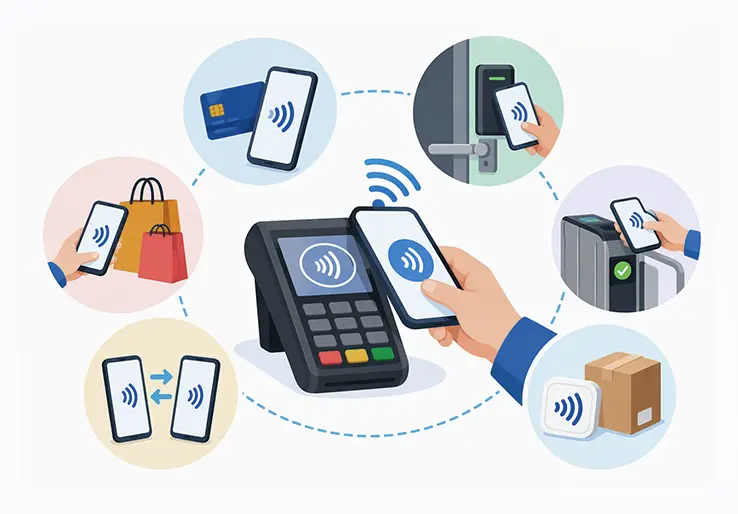
Near field communication (NFC) is a short-range, tap-based wireless technology that lets compatible devices exchange data or complete contactless payments when they are brought within a few centimeters of each other. For retail business owners, technology evaluators, and professionals assessing store systems, NFC matters because it speeds up checkout, supports secure customer interactions, and opens up practical use cases across the sales floor.
This guide explains how NFC works, the main NFC tag types, key benefits and security considerations, and where it fits in retail operations such as POS payments, loyalty programs, product information, authentication, and inventory-related workflows. It also looks at implementation steps, compares NFC with related technologies, and shows how LOGIC ERP supports NFC-enabled retail processes.
Near field communication NFC is the short-range, tap-based wireless technology already built into most modern smartphones, payment cards, and retail terminals. Every time you hold your phone near a checkout reader to pay with Apple Pay or Google Pay, hand a contactless card to a transit turnstile, or tap a badge to enter an office, you are using NFC. It is a technology so seamlessly embedded in daily routines that many people use it multiple times a day without thinking about it.
This article explains what near field communication is, how the underlying field communication works at a technical level, what benefits it delivers, and where it fits inside retail operations. If you run a retail business or are evaluating how LOGIC ERP can support NFC-enabled workflows, this guide covers everything from tag types and security standards to practical implementation steps. By the end, you will understand exactly how NFC payments and NFC-powered experiences can improve your store operations.
Near Field Communication (NFC) is a short-range wireless technology and a specialized subset of radio frequency identification (RFID). It enables two-way data exchange between compatible devices at distances typically up to 4 centimeters — roughly 1.6 inches. NFC operates at a frequency of 13.56 MHz, a band that is globally available and harmonized across regulatory regions. NFC stands for Near Field Communication, and the term "near field" refers to the tightly confined magnetic area close to an antenna where induction-based coupling can occur.
NFC technology is standardized by organizations including ISO/IEC (standards such as 14443-A/B, 15693, and 18092) and the NFC Forum, which ensures interoperable behavior among devices, tags, and chip implementations. The NFC Forum certifies devices under Test Release 13.1 to maintain compatibility across the ecosystem.
Key characteristics of NFC include:
It is worth clarifying the relationship between NFC and "contactless." NFC is the underlying near field radio technology that powers many contactless payment systems, transit cards, and access badges. "Contactless" is the broader consumer-facing term covering the overall tap-to-pay or tap-to-access experience. Unlike Wi-Fi or Bluetooth, NFC has a much shorter range, requires no manual pairing or complex setup, and often involves only one powered device communicating with a passive tag or card.
NFC uses magnetic induction between coils in two electronic devices — for example, a mobile phone and a POS terminal — to exchange data at 13.56 MHz. One device usually acts as an initiator (the reader or active device), generating an electromagnetic field. The other device, which may be a passive tag, a contactless card, or a phone in card emulation mode, responds by modulating the field or powering itself from that field.
NFC supports data rates ranging from 106 to 424 kbit/s. These modest speeds are deliberate: they favor reliability, low energy consumption, and compatibility — especially important when tags are passive and draw all their power from the reader’s field. NFC operates in three modes: reader/writer, peer-to-peer, and card emulation. Each mode serves different use cases, as detailed below.
NFC readers are devices — often built into POS terminals, kiosks, door-access panels, or the phones themselves — that generate the electromagnetic field and initiate field communication. When a tag, card, or receiving device enters the near field (usually within 2–4 cm), the reader modulates the field to send data and listens for changes in the field to receive responses.
In a retail scenario, this works simply: a customer taps an NFC card or mobile wallet on the NFC reader at checkout, and the reader passes the payment data to the payment processor via the POS system. In access control, contactless access systems use NFC-enabled devices to unlock secure areas — a door reader verifies a digital key stored in a card, phone, or wearable before granting entry.
The data transfer sequence follows a predictable pattern: two devices move into the near field, initiate a handshake, select communication parameters (baud rate, protocol), and then exchange framed data packets. NFC uses standardized frame formats such as the NFC Data Exchange Format (NDEF) to store and transmit data like URLs, text records, IDs, or small payloads, ensuring compatibility across vendors.
NFC supports both unencrypted and encrypted sessions. For payments and secure transactions, encryption and tokenization protect sensitive information. In a typical NFC payments example, the phone’s secure element or wallet app generates a one-time payment token and transmits it to the POS — NFC transactions utilizing tokenization to protect bank details, so the actual card number is never exposed. NFC payments use 128-bit or higher encryption for security, adding another layer of protection during data transfer.
NFC can operate in three modes, each enabling different interactions:
The NFC Forum defines five tag types — Type 1 through Type 5 — each built on different underlying standards and offering different memory, speed, security, and cost profiles. Understanding these types helps retailers and solution designers choose the right NFC chips for specific use cases, whether that means inexpensive promotional stickers or tamper-proof authentication labels.
The tag type is not the physical form factor. It is the specification defining what commands the tag responds to, how its memory is organized, and how NDEF is implemented. Compliance with NFC Forum specifications ensures that tags work across compatible devices from different manufacturers.
Type 1 tags are based on ISO/IEC 14443A (Topaz). They offer relatively small memory — roughly 96 to 512 bytes — and basic functionality at about 106 kbps. They are suitable for low-cost marketing campaigns, simple URL redirection, and disposable or single-use retail applications like promotional posters or temporary price labels. Security features are minimal, making them a poor choice for anything requiring authentication.
Type 2 tags are also based on ISO 14443-A and include popular chip families like NTAG213, NTAG215, and NTAG216 as well as MIFARE Ultralight. They support higher memory options — several kilobytes — and can be configured as read-only after content is loaded. Many affordable retail NFC labels and stickers are built on Type 2 technology due to its balance of cost, memory, and broad compatibility with NFC enabled phones running both Android and iOS.
Type 3 tags are based on the Japanese JIS X 6319-4 standard, commonly known as FeliCa. They offer higher memory capacities (1–9 KB) and faster communication at 212 or 424 kbps. They are heavily used in Asian transit systems — for example, cards used in Japanese rail networks. While less common in low-cost retail tags outside Asia, they matter in regions and applications where FeliCa infrastructure is widely deployed.
Type 4 tags support ISO/IEC 14443 A and B standards and can offer advanced security features including encryption, mutual authentication, and per-application access rights. Memory ranges from about 2 KB to 64 KB depending on the chip. These tags are suitable for secure applications such as payment cards, ID documents, and access badges. Retailers and luxury brands may use Type 4 tags for product authentication labels to combat counterfeiting and enable secure product verification.
Type 5 tags are based on ISO/IEC 15693 (Vicinity Cards), enabling longer read ranges — up to about 1 meter with dedicated readers — while still falling under NFC Forum standards. Data rates are lower (approximately 26.5 kbps), and memory ranges from a few hundred bytes to tens of kilobytes. They are useful for logistics, inventory tracking, or shelf-level identification in larger retail spaces. Although the communication range is longer than typical near field communication, it is still designed for controlled, short-range environments.
NFC technology enhances convenience by allowing quick interactions with a simple tap. Here are the practical benefits that matter most for consumers and businesses:
NFC applications in retail extend well beyond payments. Retailers can combine NFC tags, NFC-enabled POS systems, and mobile apps to build connected store experiences — from product discovery through checkout and post-purchase engagement. NFC offers a flexible foundation for bridging the gap between physical shelves and digital content.
NFC enables tap-to-pay contactless transactions at the point of sale using contactless cards or mobile wallets like Apple Pay, Google Pay, and Samsung Pay (formerly Android Pay in some contexts). The customer journey is simple: the cashier enters the amount in the POS, the customer taps the card or phone on the NFC reader, and payment completes in seconds.
NFC payments are especially valuable in high-traffic environments like supermarkets, fashion stores, pharmacies, and quick-service restaurants. How billing automation helps supermarkets cut operational costs is directly supported by faster NFC checkout flows. LOGIC ERP can integrate with compatible NFC-enabled payment terminals through payment partners where such configurations are supported.
Retailers can attach NFC tags or smart labels to products or shelves so shoppers can tap with their mobile phone to view detailed specs, videos, or reviews. Examples include tapping a TV tag to see comparison charts, tapping a wine bottle to read tasting notes, or tapping cosmetic items to check ingredients and tutorial videos.
These experiences can be web-based (opening a mobile landing page) or app-based (deep linking into a retail app pulling product data from systems like LOGIC ERP). NFC technology can be used across smart posters and shelf displays to exchange digital content with customers on demand.
NFC can link loyalty cards and digital coupons to mobile wallets, allowing customers to tap their phone to earn points or redeem rewards at checkout. NFC tags placed near the entrance or at promotional displays can deliver targeted offers or membership sign-up flows when tapped.
Retailers using LOGIC ERP can connect loyalty and promotions in their retail system with NFC-based experiences through compatible integrations. For more on loyalty integration, see Loyalty Program Integration for Supermarkets.
NFC tags on cartons, pallets, or high-value items support item-level identification and quick verification using handheld NFC readers or staff smartphones. Store associates can tap products to check stock levels, price, or location data, pulling information from the central inventory management system.
While RFID is the standard for large-scale warehouse tracking, NFC provides two-way communication that supplements RFID for item authentication and last-mile checks.
Interactive in-store campaigns let customers tap NFC touchpoints to enter contests, subscribe to newsletters, or unlock AR experiences tied to specific products. A customer might tap a poster to watch a product demo, tap a mannequin badge to see the full outfit in all available sizes and colors, or tap to follow a brand’s social media page.
NFC helps bridge offline and online marketing by attributing taps to specific locations or campaigns for analytics in the retailer’s CRM or marketing stack.
Brands can embed secure NFC chips in product packaging to help customers verify authenticity and combat counterfeit goods. The user flow is straightforward: the customer taps the product’s NFC tag, which contacts a brand server to confirm whether the unique ID is valid and not already registered elsewhere. This is especially relevant for luxury goods, pharmaceuticals, cosmetics, and electronics where trust and regulatory compliance are critical.
In modern retail, NFC readers are integrated directly into POS terminals, connecting to retail billing software such as LOGIC ERP-backed POS setups. NFC-enabled POS terminals can read NFC cards, mobile wallets, and sometimes other NFC devices for loyalty identification.
The tap-to-pay transaction process follows a clear workflow:
Mobile wallets (Apple Pay, Google Pay, Samsung Pay) and bank-issued contactless debit and credit cards all operate through this same NFC workflow. NFC payments integrate seamlessly into the retail billing workflow — the transaction is recorded in the POS, inventory is decremented, and sales data syncs with the back office.
NFC payment support in LOGIC ERP environments depends on integration with compatible payment hardware and processors. LOGIC ERP itself does not store or process card credential data.
NFC evolved from RFID and complements Bluetooth, but each wireless technology serves different purposes.
NFC operates at very short range — up to about 4 cm — and supports two-way communication between an active device and passive or active counterparts. It is used for NFC payments, access control, and tap-based interactions. Connection requires no setup: just tap or bring devices into close proximity.
RFID is a broader family of radio technology spanning different frequency bands (LF, HF, UHF) and ranges. UHF RFID can read tags at several meters, making it the standard for supply chain logistics, warehouse, inventory, and asset tracking. RFID is typically one-way: a reader interrogates a tag and receives an ID. NFC is essentially HF RFID with richer functionality — peer-to-peer communication, card emulation, and stricter interoperability standards.
Bluetooth operates at much longer ranges (typically 10+ meters), with Bluetooth Low Energy extending battery life for wearables and IoT sensors. It supports continuous connections for audio streaming, file transfers, and wireless devices communication. However, Bluetooth devices generally require both ends to be powered, and pairing — while simplified over the years — is still more complex than NFC’s instant tap.
NFC can bootstrap Bluetooth or Wi-Fi connections, combining NFC’s simplicity with Bluetooth’s higher throughput. For example, tapping an NFC-enabled speaker to a phone instantly pairs it via Bluetooth without navigating settings menus. This eliminates the need for manual pairing entirely — NFC handles the handshake, and Bluetooth handles the streaming.
The short range of NFC communication reduces the risk of interception. NFC requires devices to be within 4 centimeters for communication, which means an attacker would need to be impractically close to eavesdrop on a transaction. This inherent proximity requirement is a significant security advantage.
NFC payments are protected by multiple layers:
NFC is more secure than magnetic-stripe cards due to dynamic data — each transaction generates unique cryptographic data rather than transmitting static card information.
That said, risks exist. NFC is vulnerable to digital pickpocketing attacks, where specialized equipment attempts to read card data at close range. Relay attacks are feasible due to NFC’s ISO/IEC 14443 protocols, though they require sophisticated setups and extremely close access. Malicious tags with malformed data could potentially exploit vulnerabilities in poorly secured apps.
Best practices include keeping your OS and wallet apps updated, disabling the NFC feature when not needed in high-risk environments, and avoiding tapping unknown tags in public spaces. For most retail scenarios, properly implemented NFC payments are more secure than magstripe transactions and comparable to EMV chip payments.
Every technology has trade-offs. For NFC, these include:
Implementing NFC in a retail environment follows a practical, phased approach. Here is a high-level guide tied to real retail workflows.
Define specific goals: enabling NFC payments at checkout, deploying NFC shelf labels for product information, introducing NFC-based loyalty programs, or securing staff access control. Map customer journeys and store processes to identify where NFC reduces friction. Set measurable KPIs — reduced average checkout time, higher mobile payments share, or increased interaction with NFC product tags.
Select NFC-enabled POS terminals certified for major card schemes and compatible with required mobile wallets. Choose NFC tags (Type 2 for marketing stickers, Type 4 for authentication, Type 5 for inventory) based on memory, durability, and security needs. Verify hardware compliance with NFC Forum specifications and local payment industry requirements. For guidance on POS selection, see Top 10 Must-Have Features in the Best Retail POS Software.
Work with POS vendors and system integrators to connect NFC readers with retail billing and inventory systems such as LOGIC ERP. Common integration points include passing transaction details from POS to ERP, associating loyalty IDs read via NFC with customer profiles, and updating stock levels automatically. Ensure that integration respects PCI DSS and other regulatory requirements, with payment data handled by certified payment gateways rather than the ERP directly.
Configure terminal and payment gateway settings for NFC payments, including allowed card schemes, mobile wallet support, and currency settings. Enable strong authentication mechanisms for card emulation-based access control systems, such as PIN or biometric checks on staff mobile devices. Set appropriate contactless transaction thresholds based on local regulations and risk policies.
Conduct end-to-end testing: from device tap, through authorization, to receipt printing and ERP posting, with multiple card types and mobile wallets. Train staff to help customers use NFC payments and troubleshoot common issues such as misalignment or locked phones. Monitor NFC usage rates, transaction failures, and customer feedback to refine configurations over time.
NFC acts as a catalyst for smoother in-store operations, particularly when integrated with a robust retail management system.
LOGIC ERP is an integrated retail management ERP solution that can support NFC-driven workflows via compatible POS and payment integrations.
Near field communication turns simple taps into secure, context-rich interactions. From mobile payments and access control to product authentication and interactive marketing, NFC has become foundational to how modern retailers connect with customers and manage operations. NFC technology enhances convenience by allowing quick interactions with a simple tap — reducing friction at checkout, improving customer engagement on the shop floor, and enabling seamless omnichannel experiences.
LOGIC ERP complements NFC-enabled technologies by providing centralized sales, inventory, and store operations management across multiple channels and locations. When NFC-powered interactions at the POS, shelf, or entrance feed directly into an integrated ERP, retailers gain real-time visibility and operational control.
Looking to streamline retail billing and inventory operations? Explore how LOGIC ERP helps retailers manage sales, inventory, and store operations through an integrated retail management solution — ready to support your NFC-enabled retail future.
Call at +91-73411-41176 / +91-73411-41175 or send us an email at sales@logicerp.com to book a free demo today!
This FAQ addresses common questions about near field communication NFC in everyday use and retail environments.
NFC stands for Near Field Communication. It is a short-range wireless communication technology for close-proximity data exchange between compatible devices. The term "near field" refers to the area very close to an antenna where magnetic induction enables this type of field communication.
NFC technology is used for contactless payments, mobile wallets, transit and ticketing, access control, product authentication, smart posters, and quick device pairing. In retail, NFC is heavily used at POS terminals, in loyalty programs, and through interactive product information tags. NFC can also connect electronic devices for quick data sharing.
Most modern smartphones have built-in NFC chips which can act as readers, peers, or emulated cards depending on the app in use. For mobile payments, the user unlocks the phone, holds it near the NFC reader, and the wallet app securely transmits a payment token. iPhone NFC setup requires iOS 13 or later, while Android NFC setup is compatible with most modern devices. The first NFC enabled phone was the Nokia 6131, released in 2006.
NFC is a specialized subset of RFID designed for very close-range, bi-directional communication between two devices, often including mobile phones. RFID is commonly one-way and used for long-range identification and tracking in supply chains and warehouses. Both use radio waves, but NFC adds peer-to-peer and card emulation capabilities that standard RFID does not support.
Many contactless card and mobile payments use NFC, but "contactless" is a broader term covering the overall tap-to-pay experience and related standards. Contactless payment systems rely on NFC technology plus payment network standards such as EMV contactless specifications. Not all NFC interactions are payments — NFC also supports data sharing, access, and device pairing.
The NFC link itself does not require internet connectivity — no Wi-Fi, 4G, 5G, or LTE. NFC uses radio waves directly between devices at 13.56 MHz. However, some services using NFC, especially payments or cloud-based authentication, may require internet connectivity on the terminal or backend systems to complete authorization.
Properly implemented NFC payments are considered safe. They use tokenization, 128-bit encryption, and strong customer authentication including biometrics. The short range of NFC communication reduces the risk of interception, and NFC is more secure than magnetic-stripe cards due to dynamic data generated per transaction. Security breaches are rare when devices, apps, and terminals are kept updated.
An NFC tag is a small, usually passive NFC chip with an antenna, embedded in stickers, cards, labels, or objects to store and transmit small data when tapped by an NFC reader or NFC enabled smartphone. Examples include NFC tags on retail shelves, event passes, business cards, and product packaging linking to digital experiences or online services.
NFC is used in POS terminals to accept tap-to-pay contactless transactions from contactless cards and mobile wallets like Apple Pay and Google Pay. POS software posts successful NFC transactions to the sales register and, through integrations, to ERP solutions such as LOGIC ERP for centralized reporting and inventory updates.
NFC can support inventory management by tagging items or containers so staff can identify them with NFC-enabled smart devices at close range. For large-scale, long-distance tracking, RFID remains more common, but NFC adds value for item authentication, last-mile checks, and interactive product information that transfer data directly to staff mobile devices or handheld readers.
NFC payments refer to contactless transactions made using Near Field Communication technology. This allows users to make secure payments by simply tapping their NFC-enabled device, such as a smartphone or contactless card, near a compatible payment terminal. NFC payments are fast, convenient, and widely supported by mobile wallets like Apple Pay and Google Pay.
An NFC chip is a small electronic component embedded in devices such as smartphones, payment cards, or NFC tags. It enables short-range wireless communication by generating and responding to magnetic fields within a few centimeters. The chip facilitates data exchange for applications like mobile payments, access control, and information sharing.
Mobile payments using NFC technology allow users to pay for goods and services by holding their NFC-enabled mobile phone or wearable device close to a payment terminal. The mobile device emulates a contactless card via card emulation mode, transmitting encrypted payment credentials securely to complete the transaction without physical contact.
The NFC Forum is a global industry association that develops standards and promotes the adoption of NFC technology. It ensures interoperability between NFC-enabled devices, tags, and applications by defining specifications, certifying products, and fostering innovation across sectors like retail, transportation, and access control.
Access control systems use NFC-enabled devices, such as smartphones or key cards, to grant or restrict entry to secure areas. When a user taps their NFC device on a reader, the system verifies the credentials stored on the NFC chip and grants access if authorized, providing a convenient and secure alternative to traditional keys or passwords.
Apple Pay is a mobile payment and digital wallet service by Apple that leverages NFC technology to enable contactless payments. Users can store credit and debit cards in the Apple Wallet app and make payments by holding their iPhone or Apple Watch near an NFC-enabled terminal, authenticating with Face ID, Touch ID, or passcode.
Mobile wallets are applications that store digital versions of payment cards, loyalty cards, and tickets on smartphones or wearables. They use NFC technology to facilitate contactless transactions and data exchange, allowing users to tap their device to pay, redeem rewards, or access services securely and conveniently.
Card emulation mode allows an NFC-enabled device to act like a contactless smart card. This mode is essential for mobile payments, transit passes, and secure access systems, where the device mimics a physical card to communicate with NFC readers, enabling seamless transactions and authentication without the need for a physical card.
Mobile phones equipped with NFC chips can run various NFC applications that enable functions such as contactless payments, data sharing, ticketing, and device pairing. These applications utilize NFC communication modes to interact with tags, readers, or other devices, enhancing user convenience and enabling connected device ecosystems.
Gaining access with NFC involves using an NFC-enabled device, such as a smartphone or access card, to communicate with a compatible reader at an entry point. Upon tapping or bringing the device close to the reader, the system authenticates the credentials stored on the NFC chip and grants or denies access based on authorization rules.
Popular Products