How Billing Software Helps Manage Multi-Warehouse FMCG Distribution

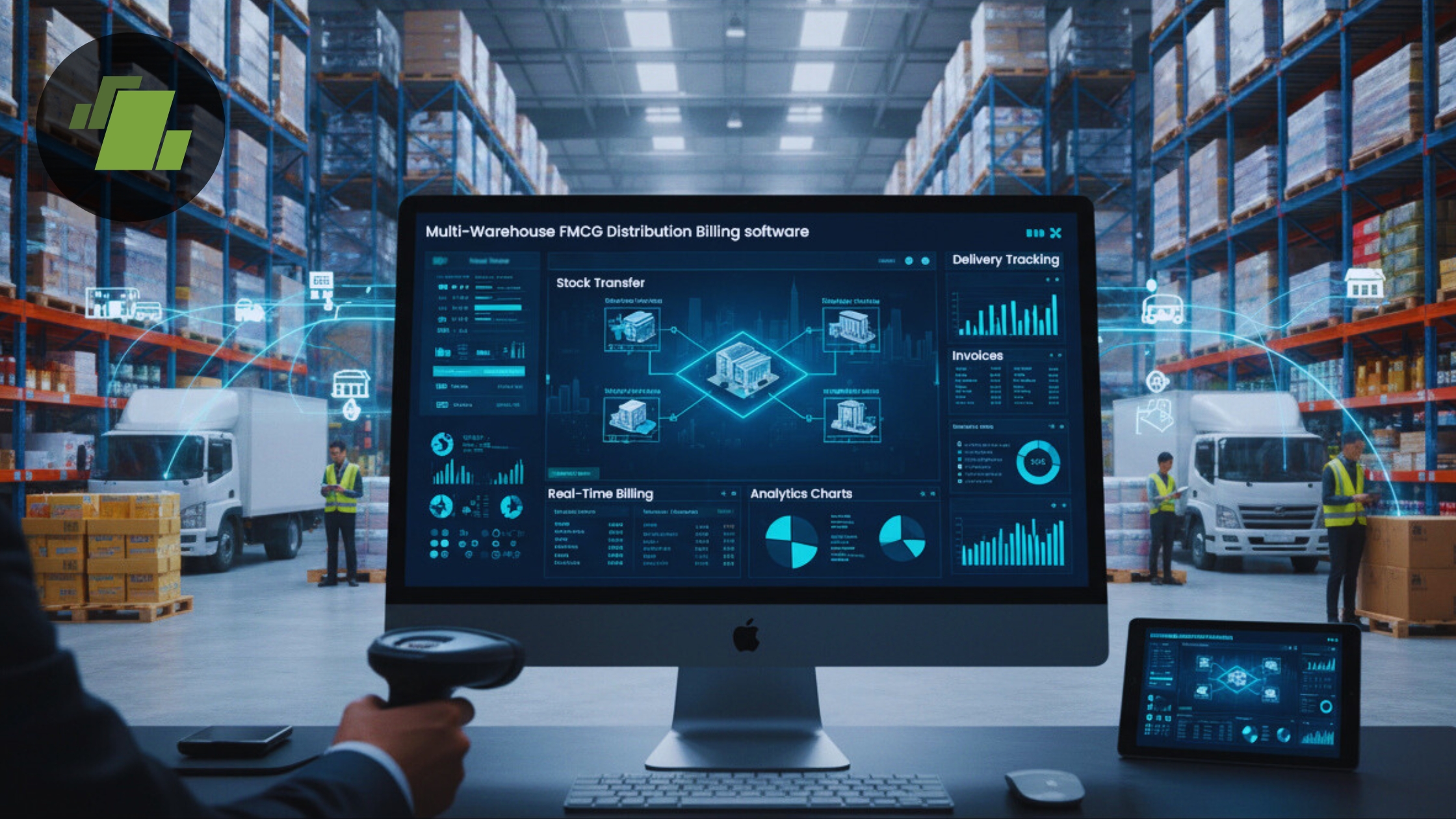
Introduction to Multi-Warehouse FMCG Distribution
Fast-Moving Consumer Goods (FMCG) companies operate within a high-velocity supply chain where products such as food, beverages, personal care, and household essentials move rapidly from manufacturers to distributors and retailers. When businesses expand to manage multiple warehouses, operational complexity increases significantly, as each location must maintain accurate stock levels, ensure timely replenishment, monitor batch numbers and expiry dates, generate precise invoices, comply with tax regulations, and provide real-time performance reporting.
Modern FMCG billing software addresses these challenges by integrating inventory management, accounting, warehouse operations, and distribution logistics into a centralized, automated platform, enabling seamless coordination, improved accuracy, and enhanced operational efficiency across all warehouse locations.
Key Challenges in Multi-Warehouse FMCG Distribution
1. Inventory Mismatch Across Warehouses
The Problem
In multi-warehouse operations, stock is distributed across regions. Without real-time synchronization:
- One warehouse may have excess stock (overstocking)
- Another warehouse may run out of fast-moving items (stockout)
- Inventory data becomes outdated
- Manual reconciliation causes errors
Business Impact
- Lost sales due to stock unavailability
- Increased holding costs
- Expired or damaged goods
- Poor retailer satisfaction
How Distribution Billing Software Solves It
Advanced billing software offers:
- Live stock tracking across all warehouses
- Automatic stock deduction upon invoicing
- Low-stock and reorder alerts
- Real-time dashboard reporting
2. Complex GST & Multi-State Tax Compliance
The Problem
FMCG distributors operating in multiple states must manage:
- GST compliance
- E-invoicing mandates
- E-way bill generation
- HSN code classification
- Tax reconciliation
Manual tax calculation increases risk of:
- Wrong tax rates
- Filing mismatches
- Government penalties
How Wholesale Billing Software Solves It
Modern GST billing software:
- Automatically calculates GST based on product category
- Generates compliant e-invoices
- Integrates e-way bill systems
- Tracks tax input credit
- Maintains audit-ready records
3. High Volume of Daily Transactions
The Problem
FMCG distributors handle:
- Thousands of invoices daily
- Credit notes and debit notes
- Promotional discounts
- Bulk orders
- Retail returns
Manual billing slows down operations and increases errors.
How Distribution Billing Software Solves It
Automated billing systems:
- Generate invoices instantly
- Apply schemes automatically
- Calculate taxes in seconds
- Sync transactions with inventory
This improves operational speed and billing accuracy.
4. Expiry and Batch Management
The Problem
Many FMCG products have limited shelf life. Without tracking:
- Expired goods remain unnoticed
- First-In-First-Out (FIFO) isn’t followed
- Financial losses increase
How Billing Software Solves It
Advanced systems:
- Track batch numbers
- Monitor expiry dates
- Alert for near-expiry stock
- Ensure FIFO dispatch
5. Distributor & Retailer Credit Management
The Problem
FMCG distribution often operates on credit cycles. Tracking credit manually leads to:
- Overdue payments
- Cash flow problems
- Credit limit breaches
How Wholesale Billing Software Solves It
The system:
- Sets credit limits per retailer
- Tracks outstanding balances
- Generates automated payment reminders
- Blocks further billing after limit breach
How Billing Software Optimizes Multi-Warehouse Operations
Real-Time Multi-Warehouse Inventory Visibility
Centralized dashboards allow business owners to:
- View warehouse-wise stock
- Track product movement
- Monitor slow-moving items
- Compare region-wise sales
This supports data-driven decision-making and supply chain optimization.
Inter-Warehouse Stock Transfer Automation
Instead of manual documentation:
- Stock transfer requests are digitally logged
- Inventory automatically updates in both warehouses
- Transfer reports are generated
- Accounting entries are auto-adjusted
This eliminates duplication and reconciliation errors.
Automated Scheme & Discount Management
FMCG companies frequently run:
- Seasonal discounts
- Bundle offers
- Target-based incentives
- Retailer loyalty programs
Wholesale billing software:
- Auto-applies eligible discounts
- Tracks scheme performance
- Prevents unauthorized discounting
This ensures pricing accuracy and profit control.
Route-Wise Sales & Field Force Tracking
Sales teams operate regionally. Billing software for wholesale business enables:
- Salesman-wise billing reports
- Route performance tracking
- Daily collection summaries
- Target vs achievement dashboards
Mobile integration allows field sales representatives to generate invoices instantly.
Centralized Financial Management
Billing software for distribution integrates with accounting modules to:
- Record all transactions automatically
- Maintain ledgers
- Generate profit and loss reports
- Track warehouse-wise profitability
This ensures complete financial visibility.
Core Benefits of Billing Software in Multi-Warehouse FMCG Distribution
1. Operational Efficiency
Operational efficiency is one of the most significant advantages of modern FMCG billing software. Automation minimizes manual data entry, reduces paperwork, and eliminates repetitive administrative tasks such as invoice generation, stock updates, tax calculation, and report preparation. Every transaction is recorded instantly and synchronized across warehouses, departments, and sales teams. This accelerates billing cycles, shortens order processing time, and improves coordination between inventory, accounts, and logistics. As a result, businesses can handle higher transaction volumes with fewer errors while maintaining consistent performance across multiple warehouse locations.
2. Cost Reduction
Advanced billing software directly contributes to cost reduction in several ways. By providing real-time inventory tracking and demand insights, it helps lower inventory holding costs by preventing overstocking and unnecessary capital blockage. Batch and expiry management reduces product wastage, especially for perishable FMCG goods. Automated GST calculations and compliance tools minimize the risk of filing errors and regulatory penalties. Additionally, streamlined operations reduce administrative overhead, saving both time and labor costs. Overall, better inventory control and compliance management translate into improved profit margins.
3. Improved Customer Satisfaction
Customer satisfaction in FMCG distribution depends heavily on speed, accuracy, and product availability. Billing software enables faster invoice generation, allowing retailers to complete transactions quickly. Automated pricing ensures discounts, schemes, and tax calculations are accurate, reducing billing disputes. Real-time stock visibility ensures reliable product availability, preventing order delays or partial deliveries. When retailers receive correct invoices and timely shipments, trust and long-term business relationships strengthen, leading to repeat orders and higher retention rates.
4. Better Demand Forecasting
Effective demand forecasting is critical in FMCG distribution due to fluctuating consumer behavior and seasonal trends. Billing software stores and analyzes historical sales data to identify seasonal demand spikes, regional buying patterns, and fast-moving SKUs. This data-driven approach helps distributors plan procurement and replenishment more accurately. Advanced systems equipped with AI-based forecasting models go a step further by analyzing trends, promotional impacts, and sales velocity to predict future demand with higher precision. Improved forecasting reduces stockouts, minimizes excess inventory, and enhances supply chain responsiveness.
5. Scalability for Growth
Cloud-based billing software supports business expansion without requiring major infrastructure upgrades. As FMCG distributors grow, they can easily add new warehouses, onboard additional users, and expand into new regions within the same centralized system. Remote access allows management to monitor operations from anywhere, ensuring consistent oversight across locations. Automatic updates and scalable storage ensure the system adapts to increasing transaction volumes. This flexibility enables sustainable growth while maintaining operational control and efficiency.
Must-Have Features in Modern FMCG Billing Software
-
Multi-Location Inventory Tracking
This feature allows businesses to monitor stock levels across multiple warehouses in real time from a centralized dashboard. Every sale, return, or stock transfer automatically updates inventory data, ensuring accurate stock visibility. It helps prevent stockouts, overstocking, and inventory mismatches while improving warehouse coordination and faster order fulfillment.
-
GST & e-invoice integration
Modern FMCG billing software automatically calculates GST based on product classification and transaction type. It generates compliant tax invoices, supports e-invoicing requirements, and enables e-way bill creation where applicable. This reduces manual errors, ensures regulatory compliance, and simplifies tax return filing.
-
Batch & expiry management
For perishable FMCG products, tracking batch numbers and expiry dates is essential. This feature ensures FIFO (First-In-First-Out) stock movement, sends alerts for near-expiry items, and minimizes losses due to expired goods. It protects profit margins and maintains product quality standards.
-
Barcode scanning support
Barcode integration speeds up billing and warehouse operations. It improves accuracy in product identification, reduces manual entry errors, accelerates stock audits, and enhances overall operational efficiency in high-volume distribution environments.
- Credit management module
This module tracks retailer and distributor credit limits, monitors outstanding payments, and generates payment reminders. It prevents over-crediting, improves cash flow management, and ensures better financial control across regions.
-
Automated scheme management
FMCG businesses frequently run discounts and promotional offers. Automated scheme management applies eligible discounts during billing, tracks promotional performance, and ensures accurate pricing without manual intervention, boosting sales and retailer satisfaction.
-
Mobile billing app
A mobile billing application allows sales representatives to generate invoices, collect payments, check stock availability, and update orders directly from the field. This improves real-time data synchronization, reduces delays, and enhances sales productivity.
-
Real-time reporting dashboard
Advanced dashboards provide instant access to KPIs such as sales performance, warehouse-wise stock levels, profit margins, and outstanding payments. Real-time analytics support data-driven decision-making and strategic planning.
-
Purchase order automation
This feature automates procurement by generating purchase orders based on low-stock alerts or demand forecasts. It reduces manual paperwork, prevents stock shortages, and ensures timely replenishment across warehouses.
-
Cloud-based data security
Cloud-based systems store data securely with encryption, regular backups, and automatic updates. They provide remote access, scalability, and disaster recovery protection, making them ideal for growing FMCG distributors managing multiple locations.
Future Trends in FMCG Billing & Distribution Technology
AI-Based Demand Forecasting
AI-based demand forecasting leverages predictive analytics, machine learning algorithms, and historical sales data to accurately estimate future product demand across multiple warehouses and regions. In FMCG distribution, where consumer buying behavior changes rapidly due to seasonality, promotions, and market trends, traditional forecasting methods often fail to deliver precision. AI-driven systems analyze past sales patterns, regional demand fluctuations, retailer ordering behavior, and even external factors such as festive seasons or market conditions to recommend optimal replenishment quantities. This helps distributors avoid stockouts of fast-moving SKUs and prevent overstocking slow-moving items. As a result, businesses achieve better inventory turnover, reduced carrying costs, improved cash flow management, and higher service levels across all warehouse locations.
Cloud-Native ERP Systems
Cloud-native ERP systems are modern, internet-based enterprise solutions help to centralize billing, inventory, accounting, and warehouse management into a single digital platform accessible from anywhere. Unlike traditional on-premise systems that require manual updates and physical infrastructure, cloud-based ERP solutions provide real-time remote access for business owners, warehouse managers, and sales teams.
Data is automatically synchronized across multiple warehouses, ensuring accurate and up-to-date inventory visibility. Additionally, cloud systems enhance data security, scalability, and disaster recovery, making them ideal for growing FMCG distributors expanding into new regions or adding warehouses.
Supply Chain Visibility Tools
Supply chain visibility tools provide end-to-end tracking of product movement from procurement to warehouse storage and final delivery to retailers. In multi-warehouse FMCG distribution, lack of visibility often results in delays, miscommunication, and inventory discrepancies. Modern billing and ERP systems integrate logistics tracking, warehouse management, and real-time stock monitoring to create a transparent supply chain ecosystem.
Businesses can monitor shipment status, track stock transfers between warehouses, identify bottlenecks, and measure delivery performance. This transparency enhances coordination between procurement, warehousing, and distribution teams while improving retailer satisfaction through timely order fulfillment and accurate dispatch tracking.
Data Analytics & Business Intelligence
Data analytics and business intelligence tools transform raw operational data into actionable insights through advanced dashboards and performance reports. In FMCG distribution, decision-making must be data-driven due to high transaction volumes and tight profit margins. Modern billing software provides KPI dashboards that track key metrics such as gross margin, inventory turnover ratio, sales growth rate, region-wise profitability, and product performance.
Gross margin analysis helps identify high-profit SKUs, while inventory turnover highlights stock efficiency and potential dead stock issues. Sales growth tracking enables comparison of warehouse or region performance over time. By using real-time analytics, FMCG distributors can optimize pricing strategies, refine inventory planning, improve sales team performance, and drive sustainable business growth with measurable results.
Conclusion
Multi-warehouse FMCG distribution demands exceptional precision, speed, and regulatory compliance, as businesses must manage high transaction volumes, perishable inventory, multi-location stock movement, and complex GST requirements simultaneously. Manual systems and disconnected processes often lead to stock mismatches, delayed invoicing, compliance errors, cash flow disruptions, and increased operational costs. Advanced billing software addresses these challenges by providing real-time inventory synchronization across warehouses, automated GST calculation and e-invoicing, structured credit control management to monitor outstanding payments, accurate batch and expiry tracking to reduce wastage, and AI-powered forecasting to anticipate demand and optimize replenishment cycles.
By integrating inventory, accounting, sales, and warehouse operations into a centralized digital platform, intelligent billing solutions enhance operational efficiency, improve decision-making through data analytics, protect profit margins, and support scalable growth. For FMCG distributors seeking sustainable expansion, stronger financial control, and competitive advantage in a fast-moving supply chain ecosystem, investing in modern billing software is a strategic and future-ready business decision.
Call at +91-73411-41176 or send us an email at sales@logicerp.com to book a free demo of FMCG Distribution ERP Software today!
Frequently Asked Questions
1. What Is Multi-Warehouse Billing Software?
Multi-warehouse billing software is a centralized system that manages invoicing, inventory, accounting, and stock transfers across multiple warehouse locations. It provides real-time inventory updates, reduces stock discrepancies, and automates processes like batch tracking, expiry management, and tax calculation for efficient FMCG distribution.
2. How to Manage FMCG Inventory Across Locations?
FMCG inventory across locations can be managed using centralized billing or inventory software that offers real-time stock visibility, batch and expiry tracking, automated stock transfers, low-stock alerts, and demand forecasting. This ensures balanced inventory, fewer stockouts, and optimized turnover.
3. What is the best billing software for FMCG distributors?
The best solution includes multi-warehouse tracking, GST compliance, mobile billing, scheme automation, and real-time analytics.
4. How does billing software reduce inventory loss?
It tracks stock in real time, monitors expiry dates, and alerts for low or excess stock.
5. Can billing software handle inter-warehouse transfers?
Yes, modern systems automate stock transfer entries and maintain synchronized inventory records.
6. How Does GST Billing Work for Distributors?
GST billing for distributors involves automatic tax calculation based on product HSN codes and transaction type (intra-state or inter-state). Modern billing software generates compliant invoices, supports e-invoicing and e-way bills, tracks input tax credit, and simplifies GST return filing.

Author
Sharanjit Ghuman
Director of Communications | LOGIC ERP Solutions Pvt. Ltd.
Leading and managing the company’s internal and external communication strategies and working closely with senior leadership to develop and execute communication plans.