Multi-Chain Supermarket Management Made Easy with Grocery ERP Software

Introduction
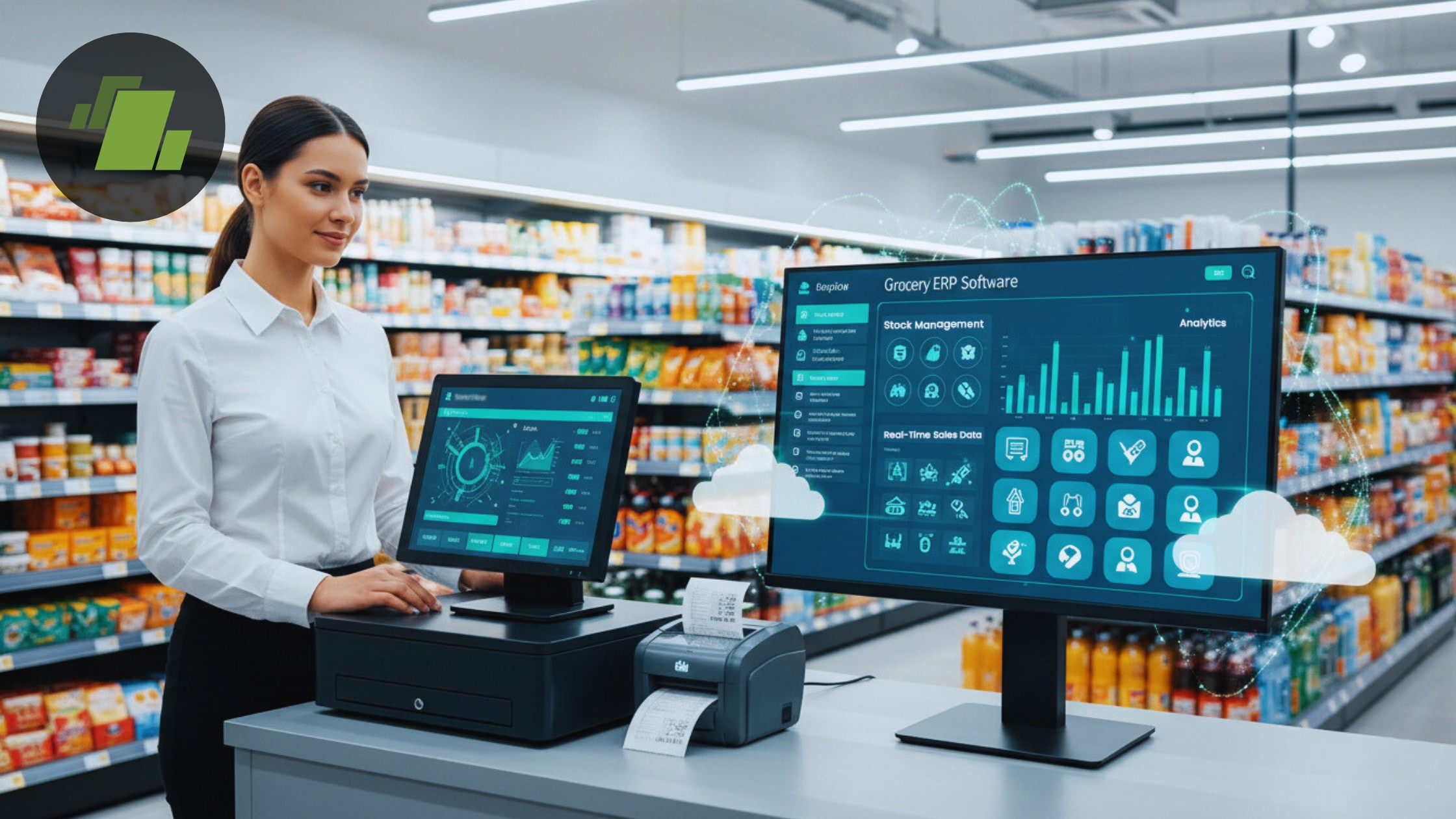
Managing a single supermarket is challenging. Managing multiple supermarket branches across cities or regions? That’s a completely different level of operational complexity.
From inventory synchronization and real-time stock visibility to pricing consistency, financial reporting, and compliance management, multi-chain supermarket operations demand centralized control with localized flexibility. This is where Grocery ERP software becomes essential.
Modern retail ERP solutions for supermarkets streamline operations, improve profitability, and enhance customer experience across all branches while maintaining complete control from a central dashboard.
What Is Grocery ERP Software for Multi-Retail Chain Stores?
Grocery ERP software for multi-retail chain stores is a specialized enterprise resource planning system for supermarkets, hypermarkets, and grocery chains. It integrates:
- Inventory management
- Point of Sale (POS) systems
- Procurement and vendor management
- Finance and accounting
- Warehouse management
- CRM and loyalty programs
- Multi-branch reporting
Key Challenges in Multi-Chain Supermarket Management
Before understanding the solution, let’s examine the core challenges supermarket chains face:
1. Inventory Inconsistency Across Branches
Different stock levels, shrinkage, and inaccurate demand forecasting lead to overstocking or stockouts.
2. Centralized Pricing and Promotion Control
Managing uniform pricing and seasonal offers across multiple stores without errors is complex.
3. Lack of Real-Time Data
Without centralized reporting, decision-making becomes slow and reactive.
4. Supply Chain Inefficiencies
Delayed procurement, vendor mismanagement, and warehouse misalignment increase operational costs.
5. Compliance and Financial Consolidation
Multi-location accounting and tax compliance become complicated without automation.
A robust grocery ERP system addresses all these issues seamlessly.
How Grocery ERP Software Simplifies Multi-Chain Supermarket Operations
Centralized Multi-Store Management
Grocery ERP allows you to manage all branches from a single dashboard:
- Real-time store performance tracking
- Unified pricing control
- Standardized product catalog
- Central master data management
The head office gains full visibility while each store maintains operational flexibility.
Real-Time Inventory Management
Inventory management is the backbone of supermarket success.
With grocery ERP software, you get:
- Real-time stock visibility across all stores
- Automated stock replenishment
- Low-stock alerts
- Batch and expiry tracking
- Inter-branch stock transfer management
This reduces waste, especially for perishable items and prevents lost sales due to stockouts.
Advanced POS Integration
Integrated POS systems ensure:
- Instant sales data synchronization
- Faster checkout processes
- Centralized billing control
- Automatic inventory deduction
- Seamless promotion application
This improves operational efficiency and enhances customer experience.
Smart Demand Forecasting and Analytics
AI-powered analytics in grocery ERP systems enable:
- Sales trend analysis
- Demand forecasting
- Seasonal planning
- Customer behavior insights
- Margin optimization
Data-driven decisions reduce risk and improve profitability across locations.
Procurement and Vendor Management Automation
Managing suppliers for multiple supermarket branches can be overwhelming.
ERP systems simplify procurement through:
- Automated purchase orders
- Vendor performance tracking
- Centralized procurement policies
- Price comparison tools
- Goods receipt verification
This ensures cost control and transparency.
Financial Consolidation Across Branches
Multi-store financial reporting becomes effortless with:
- Centralized accounting
- Automated GST/VAT compliance
- Consolidated profit & loss statements
- Branch-level performance comparison
- Expense tracking
Finance teams gain complete clarity without manual reconciliation.
Benefits of Using Grocery ERP Software for Supermarket Chains
Implementing a grocery ERP software solution is more than a technology upgrade—it is a strategic move that transforms how multi-chain supermarket operations function. From inventory management and financial reporting to customer engagement and expansion planning, ERP systems deliver measurable improvements across every department.
Below is a detailed breakdown of the key benefits supermarket chains gain from adopting a centralized ERP platform.
1. Increased Operational Efficiency
One of the biggest advantages of grocery ERP software is automation.
Supermarkets handle thousands of SKUs, daily transactions, supplier invoices, and inventory updates. Managing these tasks manually leads to delays and human errors.
With ERP automation:
- Purchase orders are generated automatically based on stock levels
- Sales data syncs instantly with inventory
- Tax calculations are automated
- Financial reports are generated in real time
- Inter-branch stock transfers are streamlined
This reduces paperwork, eliminates duplication, and improves workflow coordination across all supermarket branches.
Result: Faster operations, fewer errors, and better resource utilization.
2. Improved Profit Margins
Profitability in supermarket chains depends heavily on inventory turnover and supplier cost control.
Grocery ERP software improves margins by:
- Preventing overstocking and understocking
- Reducing inventory holding costs
- Optimizing reorder levels
- Enabling bulk purchasing strategies
- Tracking vendor performance
- Providing margin analysis by product category
With real-time analytics, management can identify slow-moving items, adjust pricing strategies, and negotiate better supplier contracts.
Result: Higher gross margins and stronger financial performance.
3. Enhanced Customer Experience
Customer experience is a major competitive advantage in retail.
ERP-integrated systems enhance shopping experiences through:
- Faster checkout via POS integration
- Accurate pricing across all stores
- Personalized discounts and loyalty rewards
- Real-time product availability
- Consistent promotions across online and offline channels
Customers value speed, transparency, and personalized engagement. Grocery ERP systems help deliver all three.
Result: Increased customer satisfaction, loyalty, and repeat purchases.
4. Scalability for Expansion
Expanding a supermarket chain without standardized systems leads to operational chaos.
A centralized ERP platform allows businesses to:
- Replicate store setup processes easily
- Standardize pricing and product catalogs
- Implement consistent compliance procedures
- Manage new branches from a central dashboard
- Integrate new locations into existing financial reports
Cloud-based grocery ERP systems make it easier to launch new stores in different cities or regions without rebuilding infrastructure.
Result: Seamless and scalable business growth.
5. Reduced Shrinkage and Waste
Shrinkage and waste are major profit drains in supermarket operations—especially with perishable goods.
Grocery ERP software minimizes losses through:
- Batch and expiry tracking
- Automated stock alerts
- Inventory reconciliation tools
- Real-time warehouse monitoring
- Demand forecasting to avoid excess stock
By identifying discrepancies early and optimizing stock movement, supermarkets reduce spoilage, theft, and stock mismanagement.
Result: Lower operational losses and improved inventory accuracy.
Must-Have Features in Multi-Chain Grocery ERP Software
1. Multi-Location Management
For supermarket chains operating across cities or regions, multi-location management is non-negotiable.
A robust grocery ERP system should:
- Provide centralized control over all branches
- Offer real-time visibility into store-level performance
- Enable inter-branch stock transfers
- Standardize product catalogs and pricing
This ensures operational consistency while allowing store managers to adapt to local demand. Multi-store ERP management reduces duplication, minimizes errors, and simplifies expansion.
2. Cloud-Based Access
Cloud-based grocery ERP systems offer flexibility and scalability for growing retail businesses.
Benefits include:
- Remote access from anywhere
- Faster implementation
- Lower infrastructure costs
- Automatic system updates
- Real-time data synchronization
Cloud ERP is ideal for supermarket chains planning rapid growth or franchise expansion, as it eliminates heavy hardware investment.
3. Mobile Reporting Dashboards
Modern retail management requires instant access to performance data.
Mobile ERP dashboards allow:
- Real-time sales tracking
- Inventory monitoring
- Profit margin analysis
- Branch comparison reports
- Executive-level decision-making on the go
This empowers owners and regional managers to respond quickly to operational challenges.
4. Barcode Integration
Barcode scanning is essential in high-SKU supermarket environments.
Integrated barcode systems enable:
- Faster checkout at POS
- Accurate inventory updates
- Reduced human errors
- Efficient stock audits
Barcode-enabled grocery ERP improves operational speed and ensures accurate stock reconciliation across all stores.
5. Warehouse Management System (WMS)
A built-in or integrated warehouse management system (WMS) enhances supply chain efficiency.
Key capabilities include:
- Real-time warehouse stock tracking
- Automated goods receipt processing
- Batch and expiry management
- Smart picking and packing
- Distribution optimization
For multi-chain supermarket management, ERP + WMS integration ensures seamless inventory flow between central warehouses and retail outlets.
6. CRM and Loyalty Programs
Customer retention drives profitability in supermarket chains.
ERP-integrated CRM systems allow:
- Customer purchase history tracking
- Personalized promotions
- Digital coupons and rewards
- Targeted marketing campaigns
- Loyalty points automation
Real-time customer loyalty personalization increases repeat purchases and improves customer lifetime value.
7. E-Commerce Integration
Modern supermarkets operate in both offline and online environments.
A future-ready grocery ERP should support:
- Real-time online inventory sync
- Click-and-collect functionality
- Home delivery management
- Unified pricing across channels
- Seamless POS and online order integration
Omni-channel integration ensures consistent customer experiences while preventing stock mismatches.
8. Role-Based Access Control
Security and operational discipline are crucial in multi-store environments.
Role-based access control ensures:
- Employees access only relevant modules
- Store managers manage branch-level data
- Finance teams handle accounting modules
- Executives access consolidated dashboards
This enhances data security and reduces operational risks.
9. AI-Powered Forecasting
Artificial intelligence is transforming supermarket inventory planning.
AI-powered forecasting enables:
- Demand prediction based on trends
- Seasonal stock planning
- Waste reduction for perishable goods
- Smart replenishment automation
Predictive analytics improves stock turnover and reduces carrying costs—directly impacting profitability.
10. Data Security and Automated Backup
Retail businesses handle sensitive financial and customer data.
A secure grocery ERP system must include:
- End-to-end encryption
- Automated data backups
- Disaster recovery protocols
- Compliance-ready reporting
- Secure cloud hosting environments
Data protection builds trust and ensures business continuity.
Cloud-Based vs On-Premise Grocery ERP
Choosing between cloud-based grocery ERP and on-premise grocery ERP is a strategic decision for multi-chain supermarket management. Below is a comprehensive comparison to help supermarket chains evaluate the best ERP deployment model based on scalability, cost, security, and operational needs.
| Comparison Factor | Cloud-Based Grocery ERP | On-Premise Grocery ERP |
|---|---|---|
| Initial Investment | Lower upfront costs (subscription-based model) | Higher initial investment (hardware, servers, licenses) |
| Payment Structure | Monthly or annual SaaS subscription | One-time license fee + maintenance costs |
| Infrastructure Requirement | No physical servers required | Requires in-house servers and IT infrastructure |
| Implementation Time | Faster deployment | Longer setup and configuration time |
| Scalability | Easy scalability for new branches or regions | Scaling requires additional hardware and configuration |
| Remote Access | Accessible from anywhere with internet | Limited to internal network unless configured |
| System Updates | Automatic updates handled by provider | Manual updates managed by internal IT team |
| Maintenance Responsibility | Vendor-managed maintenance | Internal IT team responsible |
| Data Security | Cloud encryption, regular backups, disaster recovery | Full internal control over security protocols |
| Customization Level | Moderate customization (depends on provider) | Highly customizable based on business needs |
| Multi-Store Management | Ideal for geographically distributed supermarket chains | Works best for centralized operations |
| Downtime Risk | Dependent on internet connectivity | Less internet dependency but hardware failure risks |
| Disaster Recovery | Built-in backup and cloud redundancy | Requires separate disaster recovery planning |
| IT Staffing Needs | Minimal in-house IT requirement | Dedicated IT team required |
| Long-Term Cost | Predictable recurring costs | Ongoing maintenance and upgrade costs |
| Best For | Growing and expanding supermarket chains | Large enterprises requiring strict internal control |
ERP Software for Regional Supermarket Chains
As supermarket chains expand across cities, states, and international markets, operational complexity increases dramatically. Different tax structures, currencies, customer behaviors, and regulatory requirements can create major inefficiencies without the right system in place.
Modern Grocery ERP software enables geo-optimization, allowing supermarket chains to centralize operations while adapting to regional market demands. This ensures compliance, profitability, and seamless scalability across multiple geographic locations.
Let’s explore how advanced ERP capabilities power regional and cross-border expansion.
Multi-Currency Transactions & Global Financial Consolidation
For supermarket chains operating across countries, handling multiple currencies is critical.
Grocery ERP systems provide:
- Real-time currency conversion
- Automated exchange rate updates
- Consolidated financial reporting in base currency
- Multi-currency supplier payments
- Cross-border transaction tracking
This eliminates manual reconciliation errors and provides unified profit & loss visibility across all regions.
Automated Regional Tax Compliance
Tax regulations vary by country, state, and even city.
Advanced grocery ERP systems support:
- Automated VAT/GST calculation
- State-specific tax configurations
- Digital invoicing compliance
- Tax audit reporting
- Regulatory documentation storage
This ensures legal compliance and reduces financial penalties during audits.
Localized Pricing Strategies Based on Market Demand
Different regions have different purchasing power and competitive landscapes.
Geo-optimized ERP systems allow:
- Region-based pricing models
- Store-level margin adjustments
- Location-specific promotions
- Competitor price benchmarking
- Dynamic pricing by demand zone
For example:
- Urban stores may apply premium pricing strategies.
- Rural stores may focus on volume-driven competitive pricing.
This flexibility maximizes revenue while maintaining brand consistency.
Multi-Language Support for Workforce & Customers
In multi-regional or international operations, language accessibility becomes essential.
Grocery ERP platforms can support:
- Multi-language user interfaces for employees
- Multilingual POS systems
- Customer-facing invoices in local language
- Region-specific product labeling
This improves operational efficiency and enhances customer experience in diverse markets.
Location-Based Inventory Optimization
Demand patterns vary significantly by region.
Geo-optimized ERP systems enable:
- Region-specific demand forecasting
- Seasonal inventory adjustments
- Climate-based product planning
- Automated inter-branch stock transfers
For example:
- Coastal regions may require higher beverage inventory during summer.
- Tourist areas may need seasonal product surges.
This prevents overstocking and stockouts at specific locations.
Centralized Control with Decentralized Flexibility
One of the biggest challenges in multi-chain supermarket management is balancing corporate control with local autonomy.
Geo-enabled ERP systems allow:
- Centralized master data management
- Branch-level operational independence
- Region-based approval workflows
- Local procurement within corporate guidelines
This ensures brand uniformity while empowering regional managers.
Geo-Targeted Promotions & Loyalty Programs
Modern grocery ERP systems integrate CRM and loyalty engines that support:
- Region-specific discount campaigns
- City-level promotional events
- Hyperlocal marketing strategies
- Location-based mobile app notifications
For example:
- A store opening in a new city can run targeted launch promotions.
- Holiday discounts can be customized for regional festivals.
This increases engagement and improves conversion rates.
Regional Performance Analytics & Benchmarking
Data-driven decision-making becomes more powerful when broken down geographically.
Grocery ERP software provides:
- Region-wise sales performance dashboards
- Profitability comparison across cities
- Store benchmarking analytics
- Geo-based customer behavior insights
This helps leadership teams identify high-performing markets and underperforming locations quickly.
Supply Chain Optimization Across Regions
Managing logistics across multiple territories requires advanced coordination.
ERP-driven geo-optimization enables:
- Region-specific supplier mapping
- Centralized procurement with local vendors
- Smart warehouse distribution planning
- Reduced transportation costs
This results in faster replenishment cycles and optimized supply chain efficiency.
Seamless Expansion Across Cities, States, and Countries
With geo-optimized grocery ERP systems, supermarket chains can:
- Launch new stores faster
- Standardize operations globally
- Adapt to local regulations instantly
- Scale without operational chaos
Instead of rebuilding infrastructure for every new market, businesses replicate proven operational frameworks while customizing regional variables within the ERP system.
This makes expansion not just possible, but strategically sustainable.
Future of Multi-Chain Supermarket Management
The future of multi-chain supermarket management is driven by automation, artificial intelligence, data intelligence, and omnichannel retail integration. As customer expectations evolve and competition intensifies, supermarket chains must adopt smarter technologies to stay profitable and scalable.
At the center of this transformation is Grocery ERP software, which acts as the digital backbone connecting stores, warehouses, suppliers, and customers in real time.
Let’s break down each innovation shaping the future of supermarket chain operations.
AI-Powered Dynamic Pricing
Dynamic pricing uses artificial intelligence and machine learning algorithms to automatically adjust product prices based on:
- Demand fluctuations
- Competitor pricing
- Seasonal trends
- Inventory levels
- Customer buying behavior
For example:
- If demand spikes for a product, prices can adjust strategically.
- If stock is nearing expiry, discounts can be triggered automatically.
- If a competitor lowers prices, the system can respond in real time.
This improves:
- Profit margins
- Inventory turnover
- Competitive positioning
With integrated grocery ERP software, pricing updates can be pushed across all branches simultaneously, ensuring centralized control with localized optimization.
Automated Warehouse Robotics Integration
Warehouse automation is becoming critical for large supermarket chains.
Future-ready supermarket management includes:
- Robotic picking systems
- Automated sorting and packaging
- Smart pallet movement
- AI-driven warehouse routing
When integrated with ERP:
- Inventory updates happen instantly
- Stock transfers between branches are optimized
- Human errors are reduced
- Fulfillment speed increases
This results in faster restocking, reduced labor costs, and improved supply chain efficiency across all stores.
Predictive Analytics for Demand Spikes
Traditional inventory planning relies on historical sales data. The future relies on predictive analytics powered by AI.
Predictive systems analyze:
- Past sales trends
- Weather forecasts
- Local events
- Economic indicators
- Seasonal patterns
For example:
- Anticipating higher beverage demand during heatwaves
- Increasing festive stock before holidays
- Adjusting essentials during unexpected demand surges
This helps prevent:
- Stockouts
- Overstocking
- Excessive waste
Multi-chain supermarkets benefit from centralized forecasting models that adjust demand per region while maintaining overall corporate visibility.
Omni-Channel Retail Integration
Customers no longer shop in just one way. They expect:
- In-store purchases
- Online ordering
- Click-and-collect services
- Home delivery
- Mobile app loyalty rewards
Omni-channel retail integration ensures that:
- Inventory syncs in real time across physical stores and e-commerce platforms
- Customers can buy online and return in-store
- Promotions apply consistently across all channels
Grocery ERP software connects POS systems, e-commerce platforms, and mobile apps into one unified ecosystem, eliminating data silos.
This enhances customer experience and increases lifetime value.
Real-Time Customer Loyalty Personalization
Modern supermarket chains use AI-driven customer analytics to personalize:
- Discounts
- Coupons
- Product recommendations
- Promotional campaigns
Using ERP-integrated CRM systems, supermarkets can:
- Track purchase history
- Segment customers by behavior
- Send targeted offers
- Reward repeat purchases automatically
For example:
- A customer who regularly buys organic products receives organic product discounts.
- Frequent bulk buyers get exclusive volume-based offers.
Personalization increases:
- Customer retention
- Basket size
- Brand loyalty
In multi-chain environments, this data is centralized yet applied locally for maximum impact.
Why Choose LOGIC ERP Software for Your Supermarket and Grocery Multi-Chain Retail Business?
Since 1993, LOGIC ERP has proven to be the best software for supermarket and grocery multi-chain retail businesses, purpose-built for high-volume operations and providing end-to-end automation across inventory, POS, finance, warehouse management, CRM, and multi-location management within a single integrated platform.
Developed specifically for supermarkets handling thousands of SKUs and perishable goods, it enables real-time stock visibility, batch and expiry tracking, centralized pricing, automated tax compliance, and consolidated financial reporting across all branches. With cloud and on-premise deployment options, scalable architecture, AI-driven analytics, and seamless e-commerce integration, LOGIC ERP empowers retail chains to improve operational efficiency, reduce shrinkage, increase profit margins, and expand smoothly into new cities or regions, making it a powerful, future-ready ERP solution for growing grocery businesses.
What makes LOGIC ERP #1 Software for Supermarket & Grocery Multi-Chain Retail Stores & Shops:
- 200+ Experienced ERP Experts
- Trusted by 4,000+ Clients
- 10,000+ Successful ERP Implementations
- Personalized Training and Support
- Fast, Easy, and Stress-Free Implementation
- Easy Personalization and Deployment
- Digital-Ready ERP with Third-Party Plug-Ins and API
Top grocery and supermarket multi-chain retail stores streamlining their retail business with LOGIC ERP: 99 Mart, Pure Nutrition, V Bazaar, Store 99, Market 99, Super 99 and many more.
Conclusion
Managing multiple supermarket branches no longer requires fragmented systems and manual tracking. With Grocery ERP software, businesses gain centralized control, operational efficiency, accurate forecasting, and financial transparency. Whether you are operating 3 stores or 300, the right ERP solution simplifies complexity, improves profitability, and prepares your supermarket chain for sustainable growth.
Call at +91-73411-41176 or send us an email at sales@logicerp.com to book a free demo for multi-chain retail store software for grocery shops and supermarkets.
Frequently Asked Questions (FAQs)
1. What is the best ERP software for supermarket chains?
The best grocery ERP software i.e. LOGIC ERP includes multi-store management, real-time inventory control, POS integration, and financial consolidation.
2. What is the best ERP software for supermarket chains?
The best ERP software for supermarket chains is a solution offered by LOGIC ERP that includes multi-store management, real-time inventory tracking, POS integration, financial consolidation, and advanced analytics in one centralized platform.
Top-performing grocery ERP systems typically include:
- Centralized dashboard for all branches
- Automated stock replenishment
- Batch and expiry management
- Integrated POS and barcode systems
- Multi-location financial reporting
- AI-powered demand forecasting
- CRM and loyalty program integration
When choosing the best ERP for supermarket chains, prioritize scalability, cloud access, regional tax compliance, and seamless integration with e-commerce platforms. A future-ready ERP should support expansion across cities, states, and international markets without operational disruption.
3. How to manage multiple grocery stores efficiently?
Managing multiple grocery stores efficiently requires a centralized grocery ERP system that connects all branches in real time.
To improve efficiency:
- Implement centralized inventory management to monitor stock across all locations.
- Use integrated POS systems to sync sales data instantly.
- Automate procurement and vendor management.
- Enable region-based pricing and promotions.
- Consolidate financial reporting for all branches.
- Use predictive analytics to forecast demand accurately.
Cloud-based grocery ERP software allows business owners to monitor store performance, manage pricing, and track profitability from a single dashboard—reducing manual errors and improving operational control.
4. What is an affordable grocery ERP with POS integration?
An affordable grocery ERP with POS integration is a cloud-based retail management solution that combines billing, inventory, accounting, and reporting into one system without high upfront infrastructure costs.
Key features to look for include:
- Built-in POS system with barcode support
- Real-time inventory synchronization
- Automated tax calculations
- Multi-store capability
- Role-based user access
- Scalable pricing plans
- Mobile reporting access
Affordable ERP solutions typically operate on a subscription model (SaaS), reducing hardware investment while providing enterprise-level features for small and mid-sized supermarket chains.
When selecting a cost-effective grocery ERP, evaluate total cost of ownership, ease of implementation, training support, and long-term scalability, not just the base price.
5. Which ERP is best for supermarket chains?
LOGIC ERP is the best ERP for supermarket chains that offers centralized multi-store management, real-time inventory tracking, POS integration, and advanced analytics.
6. How do you control inventory across multiple grocery stores?
You control inventory across multiple grocery stores using cloud-based grocery ERP software that provides real-time stock visibility and automated replenishment.
7. How does ERP improve inventory management in supermarkets?
ERP provides real-time stock tracking, automated replenishment, and expiry management to prevent losses and stockouts.
8. Is grocery ERP suitable for small supermarket chains?
Yes. Cloud-based ERP solutions are scalable and cost-effective for both small and large retail chains.
9. Can grocery ERP integrate with e-commerce platforms?
Most modern ERP systems support omni-channel integration, syncing online and offline inventory and sales.

Author
Sharanjit Ghuman
Director of Communications | LOGIC ERP Solutions Pvt. Ltd.
Leading and managing the company’s internal and external communication strategies and working closely with senior leadership to develop and execute communication plans.