What Is Hypermarket Software? A Complete Guide for Large Retail Chains

Summary
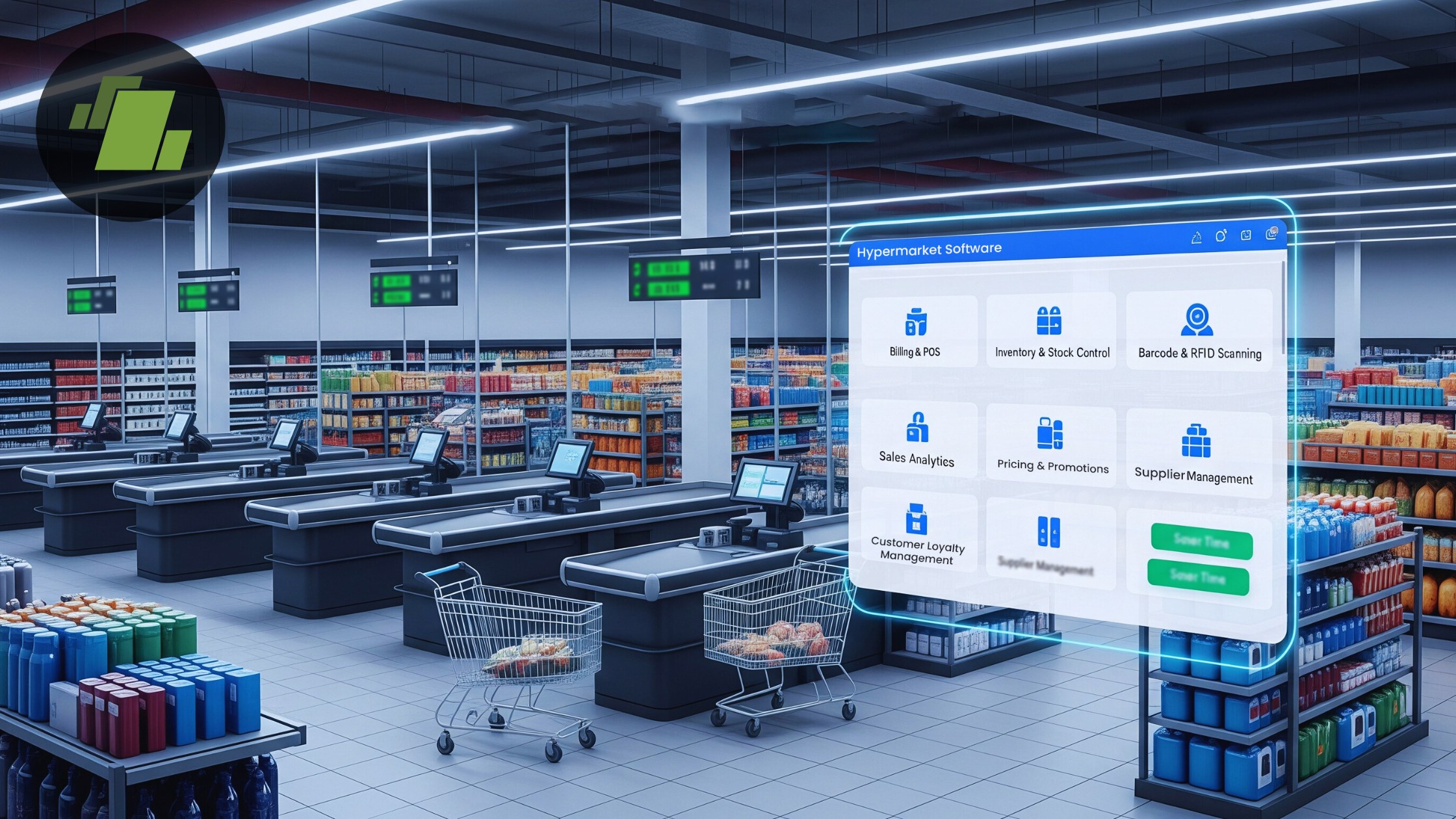
Hypermarket software is an ERP solution that manages inventory, POS billing, wholesale operations, finance, and analytics for large retail chains.
Introduction
Running a hypermarket today requires advanced systems to manage scale, volume, and complexity that regular retail stores do not face. With thousands of SKUs, multiple departments, bulk wholesale transactions, supplier networks, and high customer footfall, hypermarkets require an advanced, and scalable digital system.
Hypermarket software is a complete ERP solution to manage end-to-end operations of large retail chains, including inventory, billing, wholesale distribution, finance, supply chain, analytics, and multi-store control. Modern solutions often come in the form of hypermarket ERP software, integrating all business processes into a single unified platform.
This guide explains what hypermarket software is, how it works, its benefits, features, modules, and why large retail chains increasingly rely on hypermarket store software and hypermarket wholesale software to scale efficiently.
What Is Hypermarket Software?
Hypermarket software is an advanced retail management system built specifically for large-format retail businesses that combine retail, wholesale, and distribution operations under one roof.
Its implementation helps to:
- Handle high transaction volumes
- Manage large and diverse inventories
- Support bulk wholesale orders
- Provide real-time visibility across stores and warehouses
- Integrate finance, GST compliance, and reporting
Most modern hypermarket software solutions operate as hypermarket ERP software, meaning all departments from procurement to billing to accounting work on a single centralized database.
Why Hypermarkets Need Specialized ERP Software
Large retail chains handle massive inventories, high transaction volumes, multiple outlets, and both retail and wholesale operations. These complexities create operational challenges that generic retail systems cannot address effectively.
Common Challenges Faced by Hypermarkets
Large-format retail businesses often struggle with:
- Stock overflows and dead inventory, leading to blocked working capital
- Manual reconciliation errors across billing, inventory, and accounting systems
- Slow billing during peak hours, resulting in long checkout queues and poor customer experience
- Lack of centralized control over multiple stores and warehouses
- Inefficient wholesale and bulk order handling in B2B operations
- Poor demand forecasting due to limited data visibility and reporting
How Hypermarket ERP Software Solves These Challenges
Hypermarket ERP software is purpose-built to manage the complexity of large retail chains that operate across multiple stores, warehouses, and wholesale channels. By integrating every business operation into a single, centralized platform, hypermarket software eliminates silos, reduces inefficiencies, and delivers real-time operational control.
1. Automated Inventory, Billing, and Accounting Workflows
Manual processes often lead to errors, delays, and reconciliation issues. Hypermarket ERP software automates inventory updates, POS billing entries, and accounting postings in real time. This ensures data consistency across departments, reduces human error, and significantly improves operational efficiency.
2. Real-Time Stock Visibility Across Stores and Warehouses
One of the biggest challenges for hypermarkets is managing stock across multiple locations. Hypermarket software provides real-time visibility into inventory levels at every store and warehouse, enabling better stock planning, faster replenishment, and reduced overstocking or stockouts.
3. High-Speed POS Billing with Hypermarket Store Software
Peak hours demand speed and accuracy. Integrated hypermarket store software ensures high-speed POS billing, barcode scanning, and quick checkouts even during heavy customer traffic. This minimizes billing queues, improves customer experience, and increases transaction throughput.
4. Centralized Control Over Pricing, Promotions, and Procurement
With hypermarket ERP software, head offices can centrally manage pricing structures, promotional campaigns, and procurement policies across all outlets. Any changes made centrally are instantly reflected across stores, ensuring pricing consistency and better control over margins.
5. Seamless Bulk and B2B Operations with Hypermarket Wholesale Software
Many hypermarkets operate both retail and wholesale models. Integrated hypermarket wholesale software enables smooth handling of bulk orders, wholesale pricing, credit limits, distributor management, and dispatch planning, all within the same ERP system. This eliminates the need for separate wholesale software.
6. Advanced Reporting, Analytics, and Demand Forecasting
Data-driven decision-making is important for large retail chains. Hypermarket ERP software offers advanced dashboards, MIS reports, and analytics tools that track sales trends, inventory movement, customer behavior, and profitability. Built-in demand forecasting helps retailers plan inventory more accurately and respond proactively to market trends.
Key Types of Hypermarket Software
1. Hypermarket ERP Software
A complete enterprise resource planning system that integrates:
- Inventory
- POS billing
- Procurement
- Wholesale management
- Finance & accounting
- Reporting & analytics
This is the backbone of large retail chains and multi-location hypermarkets.
2. Hypermarket Store Software
Focused on front-end store operations, including:
- POS billing
- Barcode scanning
- Offers & promotions
- Loyalty programs
- Faster checkout experiences
Hypermarket store software ensures speed, accuracy, and customer satisfaction at the point of sale.
3. Hypermarket Wholesale Software
Designed for bulk buyers, distributors, and B2B sales, it supports:
- Bulk pricing and slabs
- Credit limits
- Wholesale invoicing
- Dispatch planning
- Distributor and retailer management
This module is essential for hypermarkets that operate both B2C and B2B models.
Core Features of Hypermarket Software
A modern hypermarket software solution or hypermarket ERP software implementation helps to handle large-scale retail, wholesale, and multi-store operations efficiently. Below are the core features every enterprise-grade hypermarket store software should include:
1. Advanced Inventory Management
Hypermarket ERP software provides intelligent inventory control across stores and warehouses, ensuring accuracy and availability at all times.
- Real-time stock tracking across all hypermarket locations
- Multi-warehouse inventory control with centralized visibility
- Batch, expiry date, and barcode management for FMCG and grocery items
- Automatic reorder level configuration to avoid stockouts
- Stock ageing and dead stock analysis for better inventory optimization
2. Fast & Scalable POS Billing
High-performance hypermarket store software enables seamless checkout even during peak shopping hours.
- High-speed POS billing for large transaction volumes
- Multiple POS counters integrated with centralized ERP
- Barcode and QR code scanning for faster item processing
- Offers, combos, and dynamic discount rule management
- Fully GST-compliant invoicing and tax calculation
3. Centralized Multi-Store Management
Enterprise-ready hypermarket ERP software allows head offices to manage multiple stores from a single system.
- Centralized control over all hypermarket outlets
- Unified pricing, promotions, and product masters
- Real-time sales and inventory visibility across locations
- Store-wise performance comparison and benchmarking
4. Wholesale & Bulk Order Management
Integrated hypermarket wholesale software supports both B2C and B2B retail models efficiently.
- Bulk order processing and wholesale billing
- Flexible wholesale pricing structures and slab rates
- Distributor, reseller, and channel partner management
- Credit limit monitoring and payment tracking
- Integrated logistics, dispatch, and delivery management
5. Procurement & Vendor Management
Smart procurement features within hypermarket ERP software ensure cost efficiency and supplier transparency.
- Automated purchase order generation
- Supplier and vendor performance analysis
- Rate contract and price agreement management
- Cost optimization, margin control, and negotiation insights
6. Finance, Accounting & GST Compliance
Built-in accounting modules make hypermarket software fully compliant and audit-ready.
- Automated accounting entries linked with sales and purchases
- GST-ready reports including GSTR-1, GSTR-3B, and reconciliation
- Input tax credit (ITC) tracking and validation
- Profit & loss statement, balance sheet, and cash flow reports
- Audit-ready financial and compliance reports
7. Reporting, BI & Analytics
Advanced reporting tools in hypermarket ERP software enable data-driven retail decision-making.
- Real-time dashboards and MIS reporting
- Sales trends and AI-driven demand forecasting
- Category-wise and brand-wise performance analysis
- Store-wise and region-wise analytics
- Decision-ready business intelligence reports for management
Benefits of Using Hypermarket ERP Software
Implementing hypermarket ERP software enables large retail chains to manage complex operations efficiently while improving accuracy, scalability, and customer experience. Below are the key benefits of using a modern hypermarket software solution:
1. Improved Operational Efficiency
Automation across billing, inventory, procurement, and accounting significantly reduces manual work, human errors, and reconciliation issues. Hypermarket ERP software streamlines workflows and ensures faster, more accurate day-to-day operations.
2. Accurate & Real-Time Inventory Management
With real-time inventory visibility across stores and warehouses, hypermarket software helps prevent overstocking, stockouts, and dead inventory. This ensures optimal stock levels and better product availability.
3. Faster Billing & Enhanced Customer Experience
High-speed POS billing and barcode scanning powered by hypermarket store software enable quick checkouts, reduced queues, and smoother transactions—leading to higher customer satisfaction and repeat visits.
4. Scalability for Business Growth
Modern hypermarket ERP software implementation helps in scaling business effortlessly. Whether adding new stores, warehouses, users, or wholesale channels, the system supports expansion without increasing operational complexity.
5. Better Decision-Making with Advanced Analytics
Built-in reporting, dashboards, and BI tools provide actionable insights into sales trends, inventory performance, and profitability. Hypermarket software empowers management with data-driven decision-making capabilities.
6. Centralized Control Across Operations
A unified hypermarket ERP software platform allows centralized management of multiple stores, warehouses, and wholesale operations. Pricing, promotions, inventory, and financial data can be monitored and controlled from a single system.
Cloud-Based Hypermarket Software: The Modern Advantage
Modern hypermarket ERP software is increasingly cloud-based, offering:
- Anytime, anywhere access
- Lower IT infrastructure costs
- Automatic updates
- Data security and backups
- Easy scalability for new stores
Cloud-enabled hypermarket store software also supports remote monitoring and centralized governance.
Who Should Use Hypermarket Software?
Hypermarket software is ideal for:
- Large retail chains
- Multi-location hypermarkets
- Retailers with wholesale operations
- Cash-and-carry businesses
- FMCG, grocery, lifestyle, and departmental stores
How to Choose the Right Hypermarket Software
Choosing the right hypermarket software is an important decision for large retail chains, as it directly impacts operational efficiency, scalability, and profitability. When evaluating hypermarket ERP software, businesses should focus on solutions that are purpose-built for high-volume, multi-store retail environments.
Below are the key factors to consider when selecting the best hypermarket store software or hypermarket wholesale software:
When selecting hypermarket ERP software, look for:
1. Industry-Specific Retail Expertise
Always choose hypermarket ERP software developed specifically for large-format retail businesses. Industry-focused solutions understand complex retail workflows such as high SKU management, bulk sales, fast billing, promotions, and multi-department operations, ensuring smoother implementation and faster ROI.
2. Scalability and Performance
Hypermarkets deal with heavy transaction loads and peak-hour billing. The right hypermarket software should easily scale as your business grows, supporting new stores, warehouses, users, and increased transaction volumes without performance issues.
3. Integrated Wholesale & Retail Modules
Modern hypermarkets operate both B2C and B2B models. Ensure the hypermarket wholesale software is fully integrated with retail POS, inventory, and finance modules. This allows seamless handling of bulk orders, wholesale pricing, credit management, and dispatch workflows within one system.
4. GST and Compliance Readiness
GST compliance is non-negotiable for Indian hypermarkets. Reliable hypermarket ERP software should offer automated GST calculations, GST-compliant billing, GSTR reports, input tax credit tracking, and audit-ready financial data to ensure accuracy and regulatory compliance.
5. Strong Reporting and BI Capabilities
Advanced reporting and analytics are essential for data-driven decisions. Look for hypermarket software that provides real-time dashboards, MIS reports, sales trends, inventory ageing analysis, and profitability insights across stores, categories, and regions.
6. Reliable Support and Implementation Experience
Implementation success depends heavily on the vendor’s retail expertise and support quality. Choose a provider with proven experience in deploying hypermarket store software and hypermarket ERP software, along with ongoing training, upgrades, and responsive customer support.
Future of Hypermarket Software
The future of hypermarket software lies in:
- AI-driven demand forecasting
- Smart replenishment systems
- Personalized promotions
- Omnichannel retail integration
- Advanced business intelligence and automation
Retailers adopting modern hypermarket ERP software today are better prepared for tomorrow’s competitive retail ecosystem.
Conclusion
Hypermarket software is a strategic necessity for large retail chains aiming to improve efficiency, profitability, and scalability. Whether it’s hypermarket store software for seamless billing, hypermarket wholesale software for bulk order management, or a full-fledged hypermarket ERP software for end-to-end control, the right solution empowers hypermarkets to operate smarter and grow faster.
Investing in the right hypermarket software ensures centralized operations, real-time insights, and long-term retail success. Call at +91-73411-41176 or send us an email at sales@logicerp.com to book a free demo today!
Frequently Asked Questions (FAQs)
1. What is hypermarket software?
Hypermarket software is an integrated retail management system for large-format retail chains to manage inventory, billing, wholesale operations, finance, and analytics from a single platform. It helps hypermarkets handle high transaction volumes, multiple stores, and bulk sales efficiently.
2. How is hypermarket ERP software different from regular retail software?
Hypermarket ERP software offers centralized control, multi-store management, wholesale integration, advanced inventory tracking, and real-time reporting, while regular retail software is typically limited to basic POS billing and single-store operations.
3. What features should hypermarket store software include?
A robust hypermarket store software should include:
- High-speed POS billing
- Barcode and QR code scanning
- Real-time inventory updates
- Offers, discounts, and loyalty programs
- GST-compliant invoicing
- Integration with ERP and accounting modules
4. What is hypermarket wholesale software used for?
Hypermarket wholesale software is used to manage bulk sales and B2B transactions. It supports wholesale pricing, credit limits, bulk invoicing, distributor management, and dispatch planning for cash-and-carry and wholesale retail models.
5. Can hypermarket software manage multiple stores and warehouses?
Yes. Modern hypermarket ERP software enables centralized management of multiple stores, warehouses, and regions, providing real-time visibility into sales, stock levels, pricing, and performance across all locations.
6. Is hypermarket ERP software suitable for grocery and FMCG hypermarkets?
Yes. Hypermarket ERP software is ideal for grocery, FMCG, and departmental stores as it supports batch tracking, expiry management, fast-moving inventory control, and high-speed POS billing.
7. How does hypermarket software improve inventory management?
Hypermarket software improves inventory accuracy by offering real-time stock tracking, automated reorder levels, batch and expiry management, stock ageing reports, and centralized inventory control across stores and warehouses.
8. Is cloud-based hypermarket software better than on-premise?
Cloud-based hypermarket software offers better scalability, remote access, lower infrastructure costs, automatic updates, and improved data security, making it ideal for large and growing retail chains.
9. Does hypermarket ERP software support GST and compliance?
Yes. Most modern hypermarket ERP software includes built-in GST compliance, automated tax calculations, GSTR reports, input tax credit tracking, and audit-ready financial statements.
10. How does hypermarket store software help improve customer experience?
Hypermarket store software enables faster checkout, accurate billing, personalized offers, loyalty programs, and seamless returns, resulting in reduced wait times and improved customer satisfaction.
11. Can hypermarket software integrate with e-commerce platforms?
Yes. Advanced hypermarket ERP software integrates with e-commerce platforms, enabling omnichannel operations such as online order fulfillment, centralized inventory, and unified customer data.
12. Who should invest in hypermarket ERP software?
Hypermarket ERP software is best suited for:
- Large retail chains
- Multi-location hypermarkets
- Retailers with wholesale operations
- Cash-and-carry businesses
- Grocery, FMCG, and lifestyle hypermarkets
13. What are the key benefits of hypermarket software?
Key benefits include:
- Centralized operations
- Faster billing and reduced errors
- Real-time business insights
- Improved inventory control
- Better scalability and profitability
14. How long does it take to implement hypermarket ERP software?
Implementation time depends on business size and complexity. Typically, hypermarket ERP software can be implemented within a few weeks to a few months, including data migration, customization, and staff training.
15. Is hypermarket software scalable for future growth?
Yes. Modern hypermarket software is highly scalable and supports adding new stores, warehouses, users, and business models without disrupting existing operations.

Author
Sharanjit Ghuman
Director of Communications | LOGIC ERP Solutions Pvt. Ltd.
Leading and managing the company’s internal and external communication strategies and working closely with senior leadership to develop and execute communication plans.