Cloud-Based FMCG Distribution Billing Software: Benefits & Growth Advantages | A Complete Guide

Summary
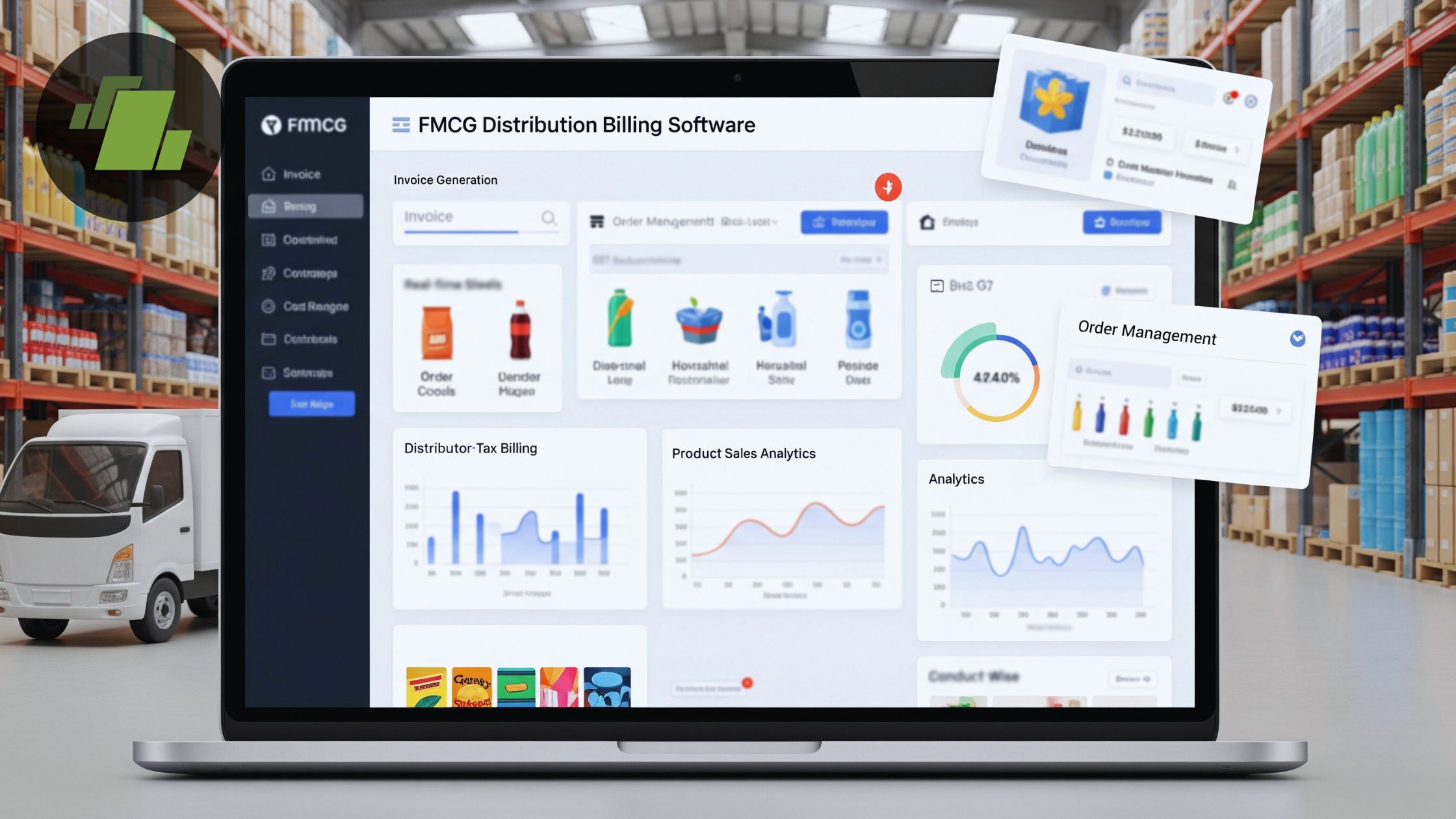
Cloud-based FMCG distribution software helps FMCG distributors streamline billing, inventory, and order management in real-time. With automated invoicing, stock tracking, and analytics, it improves operational efficiency, reduces errors, supports scalability, and optimizes the FMCG supply chain for better customer satisfaction and business growth.
Key Takeaways
- Cloud-based FMCG software allows businesses to access billing, inventory, and reports from anywhere in real-time.
- FMCG distribution billing software streamlines invoicing and reduces errors for faster operations.
- Real-time billing and automated invoicing improve accuracy and efficiency across all transactions.
- Inventory management and order processing features help track stock, prevent shortages, and optimize warehouse operations.
- Data analytics and reporting provide insights for smarter, data-driven business decisions.
- Scalable ERP solutions enable business growth, expansion, and improved competitiveness across multiple locations.
Introduction
The FMCG (Fast-Moving Consumer Goods) industry operates at high speed, high volume, and high competition. Distributors and wholesalers deal with thousands of SKUs, expiry-sensitive inventory, multi-location stock, complex pricing, schemes, and retailer demands. In such a fast-paced sector, billing, disconnected systems, or outdated desktop software can lead to inefficiencies, revenue leakage, delays, and compliance risks.
Cloud-based FMCG distribution and wholesale billing software brings real-time visibility, automation, mobility, and scalability, helping companies operate faster, smarter, and more profitably.
This comprehensive guide dives deep into everything you need to know about cloud FMCG billing software from features to benefits, industry use cases, compliance, technology trends, and growth advantages.
What is Cloud-Based FMCG Distribution & Billing Software?
Core Concept
A cloud-based FMCG (Fast-Moving Consumer Goods) distribution and billing software is a comprehensive digital system hosted on cloud servers (rather than locally on a company’s own hardware) and it helps to centralize and integrate all key business operations: inventory tracking, order management, billing/invoicing, dispatch/van sales, accounting, compliance (taxes, GST, e-invoicing), reporting and analytics, accessible via web browsers or mobile apps from any device.
Because it’s cloud-based, the software doesn’t depend on a single local server or PC. Instead, data and application logic live on remote servers managed by the software provider (or a third-party cloud provider). Users, whether warehouse staff, sales agents, accounts team, or management simply log in to access up-to-date data and perform tasks, from anywhere, anytime.
Detailed Features and Their Business Value
Real-time, Multi-Location Inventory & Stock Management
- Batch-wise / MRP-wise / Expiry-wise stock tracking: For FMCG products, many items are perishable or have expiry dates. Cloud-based software tracks each batch (with manufacturing date, expiry date, MRP, batch code), ensuring that expired or near-expiry products are flagged and managed proactively. It minimizes wastage, prevents stock being sold post-expiry, and helps prioritize older batches first (FIFO / FEFO logic).
- Warehouse / godown / rack / bin level visibility: For distributors with multiple warehouses or locations, cloud-based systems give a consolidated view of stock across all locations, showing where which items are stored, how much quantity remains, and their expiry or batch status. This helps optimize inter-warehouse transfers, reduces over-stocking at some centers while under-stocking at others.
- Automated reorder and replenishment alerts: Based on real-time consumption, demand patterns, and stock thresholds, the system can suggest or automatically trigger replenishment orders. This avoids stockouts (lost sales) and ensures that fast-moving items are always available.
Business Impact: Better stock control, minimal wastage, optimized warehouse utilization, smoother supply, all contributing to cost savings and improved service reliability.
Automated Billing, Order Management & Sales Processing
- Fast, error-free billing: Billing becomes automated with pre-configured price lists, automated calculations (discounts, schemes, taxes, GST), customer-specific rates, and standardized invoices. This reduces human error, speeds up billing (especially critical in high-volume FMCG distribution), ensures consistency, and enables quick issuance of bills.
- Support for multiple units and variable packaging: FMCG distributors often deal in cases, pieces, dozens, cartons not uniform units. The system can handle multi-unit-of-measure conversions automatically (e.g. convert cartons to pieces), making bulk and mixed-order processing seamless.
- Mobile / field order booking and van sales integration: Sales agents or field staff can record orders directly via mobile apps (even at retailer sites), which immediately go into the central system. For van sales (i.e. sales during distribution/delivery), the system tracks stock in the van, generates invoices, updates inventory, and records sales, all in real time.
Business Impact: Faster order-to-cash cycles, reduced billing/ordering delays, improved accuracy, better retailer/distributor relationships, and streamlined operations for field sales teams.
Integrated Accounting, Credit & Payment Management
- Receivables / Payables management: The system tracks which customers/distributors owe money, outstanding payments, aging of receivables, payment terms and credit limits, helping businesses maintain discipline in collections, reduce bad debts, and manage cash flow more effectively.
- GST and tax compliance (where applicable): For countries like India where GST is applicable, a cloud-based solution can automatically calculate taxes, generate GST-compliant invoices, manage e-invoicing and e-way bills, and maintain audit-ready accounting records. This reduces tax errors, ensures compliance, and simplifies filing/reporting.
- Unified financial ledger: Since sales, purchases, inventory, returns, and billing are all integrated in one platform, the accounting module has up-to-date data, reducing reconciliation effort, eliminating duplication, and offering real-time financial visibility (profit/loss, cash flow, outstanding dues, vendor payments, etc.).
Business Impact: Better financial visibility, reduced accounting overhead, fewer compliance-related headaches, and improved control over cash flow and working capital.
Dispatch, Distribution, and Supply Chain Workflow Management
- Van sales, dispatch scheduling, and last-mile tracking: For distributors serving retailers across regions, van sales and distribution logistics are complex. Cloud-based software helps plan dispatch, track what’s loaded on each van, record delivery status, manage returns or damages, and ensure accurate billing and stock deduction, all in one flow.
- Multi-channel and multi-branch support: If a distributor has multiple branches, warehouses, or serves different channels (traditional retail, wholesale, even e-commerce), the software can manage all channels from a central interface, consolidating sales, inventory, and orders, eliminating data silos.
- Real-time synchronization across all teams: Warehouse, sales, accounts, and admin teams all operate on the same live data. When a sale is made, inventory reduces, accounts update, dispatch prepares, and no chance for delayed processes.
Business Impact: Higher operational efficiency, fewer delays or mismatches, better coordination among teams, lower scope of human error, and scalable distribution model supporting growth and variety in channels.
Reporting, Analytics, Business Intelligence & Decision Support
- Dashboards & customizable reports: Sales trends, product-wise or customer-wise sales, slow-moving items, expiry batches, outstanding receivables/payables, profitability margins, all captured in real-time dashboards. This gives management quick visibility into how the business is performing.
- Data-driven demand forecasting & reorder planning: Based on historical sales data and consumption patterns, the software can suggest when to reorder, what quantities, detect seasonal demand peaks or troughs, and plan procurement accordingly.
- Insights for product mix optimization: By analyzing which SKUs sell fastest, which items remain slow or expire, management can optimize product mix, discontinue unprofitable lines, or run targeted promotions/disposals.
Business Impact: Smarter inventory and procurement decisions, minimized wastage or overstocking, better cash flow planning, and strategic insights for growth and profitability.
Why Cloud-Based (Not On-Premise or Manual)? — The Strong Case for Cloud
Accessibility, Flexibility & Remote Management
Because the software is cloud-hosted, authorized users can access data from anywhere : office, warehouse, home, vans, field, using internet-connected devices (PCs, tablets, smartphones). There’s no need to be physically present in a particular location or maintain local servers.
For FMCG distributors whose teams may be spread across geographies, warehouses in one city, sales agents on the field, accounting in head office, this flexibility means real-time coordination, timely decisions, and up-to-date visibility.
Lower Infrastructure & Maintenance Costs
Traditional on-premise ERP or billing systems require purchasing servers, storage, infrastructure setup, backups, regular maintenance, and often hiring IT staff. For small/medium wholesalers or distributors, this represents a high upfront capital expenditure.
With cloud-based software, infrastructure resides with the provider. The business often pays on a subscription or pay-as-you-go basis, eliminating the need for heavy capex, hardware management, and reducing total cost of ownership. This makes technology accessible even to smaller distributors or wholesalers looking to modernize.
Scalability & Ease of Expansion
As the business grows more SKUs, more warehouses, more sales agents, more branches, a cloud-based system scales smoothly. There is no need to invest in additional physical infrastructure every time you expand.
Moreover, adding new modules (e.g. more warehouses, van sales, multi-branch operations), users (sales staff, warehouse staff, accounts, admin), or features (new GST rules, additional compliance) is easier and faster than upgrading or reconfiguring on-premise setups.
Better Data Security, Backup & Disaster Recovery
Leading cloud software providers typically maintain robust security standards, encrypted data storage, access control, regular backups, redundancy, and disaster recovery protocols. For a distributor, this means sensitive business data (inventory, sales, finances, customer credit history) is safer than data stored locally on vulnerable servers or spreadsheets.
Also, in case of local hardware failure, fire, theft or natural disaster, cloud-hosted data remains safe and recoverable, ensuring business continuity.
Unified & Integrated Platform
A cloud-based FMCG distribution software brings everything under one integrated platform. It eliminates data duplication, mismatches, reconciliation errors, and ensures every team works off the same data. This unified approach reduces operational friction, accelerates workflow, improves transparency across departments, and simplifies management oversight.
Strategic & Growth Advantages for FMCG Distributors / Wholesalers
- Operational Efficiency & Cost Savings: Automation replaces manual work. Faster billing, fewer errors, reduced wastage from expiry or overstock, all translate into cost savings and leaner operations.
- Improved Cash Flow & Credit Management: Better tracking of receivables and payables, proper credit limits and reminders reduce risk of bad debts, ensure timely payments, helping maintain healthy cash flow which is critical in distribution business.
- Scalability Without Proportional Overheads: As the business expands, more warehouses, more SKUs, more customers, the overhead cost doesn’t increase drastically because the cloud infrastructure and software license can scale without proportional investment.
- Responsive Distribution & Market Agility: With real-time data and analytics, businesses can respond quickly to demand fluctuations, seasonal trends, retailer demands: reorder quickly, adjust pricing or schemes, and stay competitive.
- Better Customer / Retailer Relations: Fast, accurate billing; timely order processing and delivery; consistent pricing and scheme application, all contribute to improved reliability, trust and satisfaction among retailers and customers.
- Compliance & Audit Readiness: Integrated tax calculations, e-invoicing, statutory compliance, and unified accounting make compliance easier. This reduces the risk of errors in tax filings and simplifies audits, important in regulated markets (like in India with GST).
- Business Intelligence & Strategic Planning: Data gathered over time (sales trends, stock movement, profitability, customer behavior) empowers management to make informed decisions, such as introducing new products, optimizing inventory mix, discontinuing slow movers, planning expansion or promotional campaigns.
What to Watch Out For | Challenges and Considerations
While cloud-based FMCG distribution software offers many advantages, adopting it successfully requires careful planning and awareness of potential pitfalls:
- Dependence on Internet & Connectivity: Since the system is cloud-based, stable internet connectivity is important. In areas with poor or unreliable internet, operations (billing, stock update, order entry) may be disrupted.
- Data Security & Vendor Reliability: Though cloud providers offer backups and security, businesses must ensure that the chosen vendor follows strong data protection protocols, has redundancy and disaster recovery plans, and provides user-access control to avoid unauthorized access.
- Transition Complexity & Data Migration: Moving from spreadsheets or on-premise systems to cloud requires data cleaning, accurate migration of stock records, customer records, pricing lists, batch data, etc. Mistakes during migration can cause discrepancies.
- Change Management & Training Needs: Employees: warehouse staff, sales agents, accounting team may need training to use new software instead of manual methods. Resistance to change may slow adoption or cause errors initially.
- Recurring Cost Model: While cloud software reduces upfront capex, there is usually a subscription or recurring fee. Businesses should analyze cost vs benefit, and ensure that the software’s advantages (efficiency, reduced wastage, better cash flow) justify ongoing cost.
- Vendor Lock-in Risk: If a business becomes heavily dependent on one SaaS provider, migrating to another system in future may be complex and resource-intensive. It’s important to choose a solution that allows data export or has flexible exit/migration options.
Who Benefits Most | Use Cases for Cloud-Based FMCG Distribution Software
This approach is especially beneficial for:
- Small to Medium Distributors & Wholesalers without large IT infrastructure: Cloud reduces need for servers, maintenance, and big upfront investment.
- Distributors with Multiple Warehouses / Locations / Branches : It gives unified visibility over stock and operations across all locations.
- Businesses Managing Large SKU-Variety, Batch-wise / Expiry-sensitive Products (foods, perishables, fast-moving consumer goods) : Batch tracking, expiry alerts, FIFO/FEFO, and expiry-based sales become important.
- Enterprises with Field Sales Teams or Van Sales Operations, where sales agents or delivery teams are often on the move | Mobile order entry, real-time sync, van-wise billing and dispatch tracking help manage distribution efficiently.
- Businesses Operating Across Regions / States, requiring compliance with taxes, e-invoicing, uniform pricing, multi-branch accounting and supply chain oversight.
- Growing Distributors Seeking Scalability | Those anticipating expansion in SKUs, warehouses, customer base, cloud solutions scale without proportional increase in infrastructure cost.
- Businesses Seeking Data-Driven Decision Making & Long-term Sustainability, those who want analytics, demand planning, stock optimization, profitability analysis and strategic growth support rather than just basic billing.
Conclusion
A cloud-based distribution and billing system brings automation, integration, visibility, responsiveness, compliance and scalability turning what would otherwise be logistical headaches into streamlined, manageable processes.
Call at +91-73411-41176 or send us an email at sales@logicerp.com to book a free demo for FMCG distribution and wholesale billing software today!
Frequently Asked Questions (FAQs)
Q1: What is a cloud-based FMCG distribution & billing software, and how does it differ from traditional billing or on-premise systems?
A cloud-based FMCG distribution & billing software is a centrally hosted, web- or mobile-accessible system that integrates billing, inventory, order management, accounting, GST/tax compliance, and reporting. Unlike traditional spreadsheet-based billing or on-premise software, this system provides real-time data across warehouses, sales, and accounting, requires no heavy local infrastructure, and enables remote access from anywhere, ensuring faster, more accurate and unified operations.
Q2: Is such software suitable only for large distributors or can small and medium-sized FMCG wholesalers benefit too?
No, even small or medium-sized FMCG distributors and wholesalers can greatly benefit. Because the software is cloud-based and subscription-driven, there is no steep upfront infrastructure cost, and you can start with a few users or a single warehouse. As your business grows, more SKUs, more customers, additional warehouses, the system scales seamlessly. Thus, it’s ideal for SMEs seeking efficient billing, inventory control, and growth readiness.
Q3: Can cloud-based software handle GST, e-invoicing, and regulatory compliance requirements (especially relevant for distribution in India)?
Yes. A robust cloud-based FMCG billing solution typically includes GST-compliant invoicing, automatic tax calculation, e-invoice support and e-way bill generation, along with unified accounting modules. This makes tax compliance, audit readiness, and statutory reporting much simpler, reducing errors that are common with manual billing.
Q4: What happens if internet connectivity is unreliable – will billing and inventory management still work?
Since the system is cloud-hosted and depends on internet connectivity, a stable internet connection is essential for real-time sync, billing, inventory updates, order capture, and dispatch management. If connectivity is poor, especially in remote or rural regions, operations may face delays or disruptions. For such cases, businesses should consider a system that offers offline mode or local caching, or ensure reliable network backup before relying fully on cloud-based solutions.
Q5: How does cloud-based FMCG billing software improve inventory management and minimize wastage?
The software offers batch-wise tracking, expiry-date monitoring, multi-warehouse stock visibility, and automated reorder alerts. It applies FIFO (or FEFO) logic to ensure older or soon-to-expire stock is sold first. This prevents expired or obsolete inventory, reduces stockouts or overstocking, lowers carrying costs, and ensures efficient utilization of warehouse space, all of which translate to reduced wastage and cost savings.
Q6: Does it support complex billing scenarios like multiple packaging units, discount schemes, retailer-wise pricing, and van-sales operations?
Yes. ERP software for FMCG distribution supports multiple units of measure (cases, cartons, pieces), dynamic pricing (per retailer/distributor), discount schemes, credit limits, and multiple price lists. For field sales or van-sales, order entries from mobile apps update central inventory, generate invoices, and deduct stock in real time. This flexibility ensures accurate billing even in complex sales scenarios, improving speed and reducing errors.
Q7: How does integrated accounting and payment tracking help with cash flow and receivables?
With integrated accounting and payment modules, the software tracks customer-wise outstanding invoices, aging of receivables, payment terms, credit limits, and outstanding payables. This enables prompt reminders, reduces delays, and helps avoid bad debts. Since sales, inventory, and accounting are synchronized, businesses get real-time visibility on cash flow, working capital, and profitability, leading to disciplined financial management.
Q8: As my business expands, more warehouses, SKUs, sales agents — will the cloud-based system scale accordingly, or will I need a new system?
A well-designed cloud-based FMCG distribution & billing solution is inherently scalable. You can add new warehouses, increase SKU counts, onboard more sales agents, and expand geographic reach without additional hardware investment. The software adapts to increased load, and new modules (e.g., multi-branch support, multi-currency, advanced reporting) can be enabled easily, making it future-proof for growth.
Q9: What are the main challenges or risks in implementing cloud-based billing software and how can they be mitigated?
Main considerations include:
- Internet Dependence : Ensure reliable internet connectivity or offline fallback.
- Data Security & Vendor Reliability : Select vendors with strong security protocols, backups, role-based access, and disaster recovery.
- Data Migration & Clean-up: Before going live, ensure accurate data migration (stock records, customer ledgers, pricing).
- Change Management : Provide training for staff (sales, warehouse, accounts) to adapt to new workflows.
- Recurring Cost vs ROI : Evaluate subscription costs versus gains from improved efficiency, reduced wastage and better cash flow.
Mitigation involves choosing a reliable vendor, planning gradual rollout, training staff, and monitoring key performance metrics post-implementation.
Q10: Will using cloud-based FMCG billing software give me a competitive advantage and support long-term growth?
Absolutely. By providing real-time visibility, efficient operations, quicker billing-to-cash cycles, better inventory control, compliance readiness, and data-driven decision support, the software transforms distribution operations. This leads to lower operational costs, improved retailer/distributor relationships, faster order fulfillment, and scalable growth, giving you a significant competitive edge over players still reliant on non-advanced systems.