Scaling FMCG Distribution Faster with Multi-Channel ERP & Billing Software

Introduction
The FMCG industry is one of the most dynamic and competitive sectors in the global economy. Rapid product movement, thin margins, complex distribution networks, and ever-changing customer demands make operational efficiency critical for success.
In today’s market, FMCG businesses no longer rely on a single route-to-market. Instead, they operate across traditional trade, retail stores, wholesale markets, institutional buyers, B2B customers, and modern trade channels, all simultaneously.
Managing this complexity without technology leads to inefficiencies, revenue leakage, compliance risks, and loss of control. This is why ERP for FMCG distribution, integrated with advanced FMCG distribution billing software, has become a necessity rather than an option.
This article explores how ERP and billing software transform multi-channel FMCG distribution, ensuring seamless integration of trade, retail, wholesale, and B2B billing operations while delivering scalability, accuracy, and growth.
The Evolution of FMCG Distribution in a Multi-Channel World
Traditionally, FMCG distribution followed a linear model: Manufacturer → Distributor → Retailer → Consumer
Today, this model has evolved into a multi-channel ecosystem, where businesses sell through:
- Regional distributors
- Wholesalers
- Company-owned retail stores
- Franchise outlets
- Institutional buyers
- Online and B2B platforms
Each channel has its own pricing, billing format, tax structure, credit terms, and service expectations. Managing all of this through manual processes or disconnected systems creates chaos.
This evolution has driven the demand for FMCG distribution business software that can centralize operations across channels.
What is Multi-Channel FMCG Distribution?
Multi-channel FMCG distribution is a business model where FMCG companies sell and distribute their products through multiple sales channels simultaneously, while managing operations through a centralized system. This approach ensures wider market reach, faster product movement, and better control over sales, inventory, billing, and finance.
In today’s competitive FMCG environment, relying on a single distribution channel is no longer sufficient. Consumers buy from different touchpoints, and businesses must be present everywhere without losing control or efficiency.
1. Selling Products Across Multiple Channels
Multi-channel FMCG distribution allows businesses to sell through:
- Traditional Trade: Distributors, stockists, dealers, and sub-dealers
- Retail Channels: Standalone stores, chains, and franchise outlets
- Wholesale Markets: Bulk buyers and high-volume traders
- B2B Customers: Hotels, hospitals, institutions, corporates, and offices
- Modern Trade & E-commerce: Supermarkets, online marketplaces, and quick-commerce platforms
Each channel has different order volumes, pricing models, discount structures, tax rules, and service expectations. Multi-channel distribution ensures the business can serve all these channels efficiently without conflict or confusion.
2. Centralized Management of Billing, Inventory, and Finance
A core principle of multi-channel FMCG distribution is centralized control with decentralized execution. Using ERP for FMCG distribution and FMCG distribution billing software, businesses can manage:
Centralized Billing
- Generate invoices for trade, retail, wholesale, and B2B from one system
- Apply channel-specific pricing, discounts, and tax rules automatically
- Maintain uniform invoice formats and compliance
Centralized Inventory Management
- Real-time stock visibility across warehouses, distributors, and retail outlets
- Batch, expiry, and MRP tracking for perishable FMCG goods
- Automatic stock updates across all channels
Centralized Finance & Accounting
- Integrated accounting for all sales channels
- Automatic posting of sales, taxes, and receivables
- Real-time outstanding, aging, and cash flow analysis
This centralized approach eliminates data silos, duplication, and manual reconciliation, ensuring accuracy and transparency.
3. Maintaining Consistency with Channel-Specific Flexibility
One of the biggest challenges in FMCG distribution is balancing standardization with customization. Multi-channel distribution solves this by offering:
Consistency Across the Business
- Uniform product masters, pricing rules, tax structures, and reporting
- Standardized compliance with GST and regulatory requirements
- Centralized policies for credit control and approvals
Flexibility for Each Channel
- Different price lists for distributors, wholesalers, retailers, and B2B customers
- Channel-specific schemes, promotions, and margins
- Customized credit periods and payment terms
- Unique billing formats and workflows where required
This ensures that while the business operates under a single framework, each channel gets the flexibility it needs to function efficiently.
The List of Common FMCG Distribution Channels
- Trade Distribution: Stockists, dealers, sub-distributors
- Retail: POS billing for stores and chains
- Wholesale: Bulk sales with high transaction volumes
- B2B: Institutional and corporate clients
Each channel generates high data volume and operational complexity, making ERP integration an important parameter.
Why Basic FMCG Distribution Models Fail Today
Basic FMCG distribution models were designed for a time when businesses operated through limited channels, smaller volumes, and simpler tax structures. In today’s fast-paced, multi-channel FMCG environment, these models can no longer keep up.
Without ERP for FMCG distribution and integrated FMCG distribution billing software, businesses face operational bottlenecks that directly impact growth, profitability, and control. Let’s understand these challenges in detail.
Without ERP and integrated billing software, FMCG businesses struggle with:
- Multiple billing systems for different channels
- Manual invoice generation and reconciliation
- Inaccurate stock visibility
- Delayed reporting and decision-making
- GST and compliance errors
- Poor credit and outstanding control
These challenges restrict growth and reduce profitability.
What is ERP for FMCG Distribution?
ERP for FMCG distribution is a comprehensive, integrated software solution designed specifically to manage the end-to-end operations of FMCG distribution businesses. It brings together all business operations: sales, billing, inventory, finance, compliance, and channel management, into a single, centralized platform.
In a fast-moving consumer goods environment, where high transaction volumes, multiple sales channels, tight margins, and strict compliance requirements exist, ERP acts as the digital backbone that keeps the entire distribution network connected, accurate, and scalable.
Let’s explore each component in detail.
1. Sales and Billing Management
The best ERP for FMCG distribution drives sales and billing automation.
What ERP Handles:
- Trade, retail, wholesale, and B2B billing from one system
- Channel-specific pricing, discounts, and schemes
- Automatic invoice generation with GST compliance
- Real-time posting of sales data to accounts
Why It Matters:
Non-advanced billing leads to errors, delays, and revenue leakage. ERP ensures fast, accurate, and consistent billing across all channels, improving customer satisfaction and cash flow.
2. Inventory and Warehouse Management
ERP provides real-time visibility and control over stock across the entire distribution network.
Key Capabilities:
- Centralized stock management across multiple warehouses
- Batch-wise, expiry-wise, and MRP-based tracking
- Stock movement tracking (inward, outward, transfers)
- Auto-updates of inventory with every sale and purchase
Business Impact:
- Prevents stockouts and overstocking
- Reduces expiry and damage losses
- Improves order fulfillment and service levels
3. Finance and Accounting Integration
ERP integrates sales and inventory directly with finance and accounting, eliminating manual reconciliation.
What ERP Manages:
- Automatic accounting entries for every transaction
- Receivables and payables management
- Outstanding and aging analysis
- Cash flow and profitability tracking
Why This is Important:
FMCG businesses operate on thin margins. ERP ensures financial accuracy, transparency, and control, enabling better working capital management.
4. Compliance and Taxation Management
With complex tax regulations like GST, compliance is a major challenge for FMCG distributors.
ERP Compliance Features:
- GST-compliant invoice generation
- HSN-wise tax calculation
- E-invoicing and e-way bill integration
- Audit-ready statutory reports
Value Delivered:
ERP minimizes compliance risks, avoids penalties, and ensures businesses stay regulatory-ready at all times.
5. Distributor and Retailer Management
ERP for FMCG distribution strengthens relationships across the supply chain.
Distributor & Retailer Controls:
- Distributor-wise pricing and schemes
- Credit limits and payment terms
- Order tracking and secondary sales visibility
- Performance and productivity analysis
Result:
Improved transparency, better service levels, and stronger channel partnerships.
6. A Single Platform Connecting All FMCG Operations
The true power of ERP lies in its ability to act as a single, unified system.
What This Means:
- One database for sales, inventory, finance, and compliance
- No duplication of data
- Real-time updates across departments
- Centralized reporting and analytics
This connected approach ensures accuracy, efficiency, and scalability.
Role of FMCG Distribution Billing Software in Modern Businesses
In today’s fast-moving and highly competitive FMCG environment, FMCG distribution billing software is no longer just a tool for generating invoices, it is the operational backbone of the entire distribution ecosystem. It plays a critical role in ensuring speed, accuracy, compliance, and financial control across trade, retail, wholesale, and B2B channels.
When combined with ERP for FMCG distribution, billing software transforms into a powerful, intelligent system that connects sales, inventory, finance, and compliance into one seamless workflow.
Let’s understand its role in detail.
1. Accurate Invoice Generation Across All Channels
One of the primary functions of FMCG distribution billing software is to ensure accurate and compliant invoice generation.
How Billing Software Helps:
- Automatically generates invoices for trade, retail, wholesale, and B2B customers
- Applies correct GST rates, HSN codes, and tax calculations
- Supports batch-wise, MRP-based, and expiry-aware billing
- Eliminates manual errors in quantity, pricing, and taxation
Business Impact:
Accurate billing reduces disputes, improves customer trust, and ensures smooth audits. For high-volume FMCG businesses, even small billing errors can lead to significant revenue loss, something advanced FMCG management billing software prevents.
2. Channel-Specific Pricing and Taxation Management
FMCG businesses operate across multiple channels, each with different pricing and taxation needs.
Channel-Wise Flexibility:
- Different price lists for distributors, wholesalers, retailers, and B2B buyers
- Automatic application of trade schemes, discounts, and promotions
- State-wise and channel-wise tax configuration
Why It Matters:
Without channel-specific billing logic, businesses risk margin erosion and compliance issues. FMCG distribution and wholesale billing software ensures that every invoice follows predefined rules, accurately and consistently.
3. Faster Order Processing and Billing Cycles
Speed is crucial in FMCG distribution. Delays in billing directly impact dispatches, deliveries, and collections.
How Billing Software Accelerates Operations:
- Instant invoice generation as soon as orders are confirmed
- Integration with inventory for real-time stock availability
- Support for high-volume transactions without system lag
- Reduced manual intervention and approval delays
Result:
Faster order-to-invoice cycles lead to quicker deliveries, faster collections, and improved customer satisfaction, a key advantage of modern FMCG distributor software.
4. Seamless Financial Integration and Real-Time Accounting
One of the biggest advantages of FMCG billing software is its tight integration with finance and accounting.
Financial Capabilities:
- Automatic posting of sales, taxes, discounts, and receivables
- Real-time outstanding and aging reports
- Accurate revenue recognition and margin tracking
- Integration with ledgers and financial statements
Business Benefit:
Manual reconciliation between billing and accounts is eliminated. This gives management real-time financial visibility, improves cash flow management, and supports better decision-making.
5. Integration with ERP for FMCG Distribution
When FMCG distribution billing software is integrated with ERP, it becomes far more powerful.
ERP Integration Enables:
- Real-time inventory updates with every invoice
- Automatic scheme and pricing application from ERP masters
- Centralized data across sales, inventory, finance, and compliance
- Unified reporting and analytics
Outcome:
Billing becomes faster, smarter, and error-free, enabling FMCG businesses to scale without operational bottlenecks.
6. Improved Compliance and Audit Readiness
Modern billing software is designed to handle complex compliance requirements.
Compliance Features:
- GST-compliant invoicing
- E-invoicing and e-way bill integration
- Audit-ready reports and tax summaries
This reduces compliance risk and ensures smooth statutory audits.
7. Enhanced Control and Operational Transparency
With centralized billing:
- Management gets real-time sales visibility
- Channel-wise performance can be tracked instantly
- Errors and leakages are identified early
This level of control is essential for growing FMCG businesses.
Trade, Retail, Wholesale & B2B Billing: Why Integration Matters
Operating separate billing systems for each channel leads to:
1. Data Silos Across Channels
When trade, retail, wholesale, and B2B billing operate on different systems:
- Sales data remains fragmented
- Inventory updates are delayed or inconsistent
- Finance teams struggle to get a consolidated view
2. Duplicate Entries and Manual Reconciliation
Separate billing systems require:
- Repeated data entry across platforms
- Manual reconciliation between billing, inventory, and accounts
This leads to:
- Increased operational workload
- Higher chances of human error
- Wastage of time and resources
Without integrated FMCG management billing software, teams spend more time managing data than growing the business.
3. Inconsistent Pricing and Margin Leakage
Different systems often mean:
- Different price lists for the same product
- Manual updates of schemes and discounts
- Inconsistent tax application
This results in:
- Pricing conflicts between channels
- Margin erosion
- Customer dissatisfaction
An integrated FMCG distributor software ensures consistent pricing logic with channel-specific flexibility.
4. Reporting Delays and Poor Visibility
When data is scattered:
- Consolidated reports take days to compile
- Channel-wise sales and profitability analysis is delayed
- Management decisions are based on outdated information
Integrated FMCG distribution and wholesale billing software eliminates these issues by providing a unified platform.
How ERP Unifies Trade Distribution Operations
Trade distribution is the backbone of FMCG supply chains, involving distributors, stockists, and dealers across regions. Managing this network manually or through disconnected systems leads to pricing conflicts, credit risks, and lack of visibility.
ERP for FMCG distribution unifies trade operations by enabling:
1. Distributor-Wise Price Lists
ERP allows businesses to define distributor-specific pricing, ensuring:
- Accurate margins for each distributor
- Elimination of pricing disputes
- Central control with regional flexibility
2. Automated Scheme Application
Trade schemes such as:
- Quantity-based discounts
- Seasonal offers
- Target-based incentives
are applied automatically during billing, ensuring accuracy and consistency.
3. Credit Limit Enforcement
ERP enforces predefined credit limits by:
- Blocking or alerting on over-credit billing
- Tracking real-time outstanding balances
- Reducing financial risk
4. Secondary Sales Tracking
ERP captures sales from distributors to retailers, providing:
- Market-level demand visibility
- Better forecasting
- Improved supply planning
Result: Improved distributor efficiency, transparency, and stronger trade relationships.
Retail Billing Integration with FMCG ERP
Retail operations demand speed, precision, and consistency. Any backend mismatch can disrupt store operations and customer experience.
ERP-integrated retail billing provides:
1. POS Billing with Real-Time Inventory Updates
- Fast checkout and invoice generation
- Instant stock updates across warehouses and stores
- Reduced stock mismatches
2. Barcode-Based Invoicing
- Quick scanning and billing
- Fewer human errors
- Faster customer service
3. Centralized Control Across Stores
- Unified pricing and promotions
- Central inventory visibility
- Standardized compliance
Outcome: Smooth retail operations with zero backend discrepancies, powered by FMCG distributor software.
FMCG Wholesale Billing Software: Managing High-Volume Transactions
Wholesale FMCG businesses handle large order sizes, frequent transactions, and varied pricing structures.
Wholesale Challenges:
- Bulk orders with negotiated pricing
- Multiple price slabs and tax rules
- High invoice volumes in short time frames
FMCG wholesale billing software ensures:
1. Fast Invoice Processing
- High-speed billing without system slowdowns
- Support for peak-hour transaction loads
2. Flexible Pricing
- Quantity-based pricing
- Customer-wise price slabs
- Dynamic discount structures
3. Accurate Tax Handling
- Correct GST application
- Multi-state tax compliance
- Error-free reporting
This ensures efficiency and compliance in high-volume wholesale environments.
B2B Billing Automation in FMCG Distribution
B2B customers such as institutions, corporates, and large buyers have complex billing requirements.
Common B2B Billing Needs:
- Contract-based pricing
- Long credit periods
- Recurring or milestone-based invoices
- Complex tax calculations
ERP automates B2B billing by:
- Applying contract-specific price rules
- Generating recurring invoices automatically
- Integrating billing with receivables and collections
Result: Higher accuracy, faster billing cycles, and improved cash flow through FMCG distribution billing software.
Inventory Management Across Multi-Channel FMCG Networks
Inventory mismanagement is one of the biggest sources of loss in FMCG distribution.
ERP for FMCG distribution provides:
1. Real-Time Stock Visibility
- Live stock status across all channels
- Immediate updates after every sale or purchase
2. Batch and Expiry Tracking
- FIFO/FEFO-based stock movement
- Reduced expiry and damage losses
3. Multi-Warehouse Management
- Central control of multiple warehouses
- Inter-warehouse stock transfers
- Optimized inventory allocation
This ensures better fulfillment, lower wastage, and improved service levels.
Pricing, Schemes, and Discount Management Across Channels
Managing pricing across trade, retail, wholesale, and B2B channels is complex but important.
ERP enables:
1. Channel-Specific Pricing
- Separate price lists per channel
- Region- and customer-specific pricing
2. Automated Promotional Schemes
- Time-bound offers
- Volume-based discounts
- Automatic scheme application during billing
3. Real-Time Margin Control
- Live margin visibility per SKU and channel
- Early detection of margin leakage
This protects profitability while maintaining market competitiveness.
GST, Compliance, and Regulatory Management
Compliance is a major challenge in FMCG due to:
- Multiple tax slabs
- State-wise regulations
- Frequent audits
Modern FMCG management billing software ensures:
1. GST-Compliant Invoices
- Correct HSN codes
- Accurate tax calculations
- Error-free invoice formats
2. E-Invoicing Integration
- Automated e-invoice generation
- Real-time government portal compliance
3. Audit-Ready Reports
- Statutory returns
- Reconciliation statements
- Complete transaction trails
Outcome: Effortless compliance, reduced audit risk, and peace of mind.
Order-to-Cash Automation with FMCG Management Billing Software
In FMCG distribution, delays at any stage—from order confirmation to payment collection—directly impact cash flow and working capital. Manual processes make the order-to-cash cycle slow, error-prone, and difficult to control.
FMCG management billing software, integrated with ERP for FMCG distribution, automates the entire cycle:
End-to-End Order-to-Cash Workflow:
Order → Dispatch → Invoice → Payment → Reconciliation
How ERP Automates This Cycle:
- Order Processing: Sales orders are captured digitally with real-time stock validation
- Dispatch Integration: Goods dispatch updates inventory automatically
- Invoice Generation: GST-compliant invoices are generated instantly
- Payment Tracking: Receipts are recorded against invoices in real time
- Reconciliation: Automatic reconciliation between sales, bank, and accounts
Business Impact:
- Faster billing and collections
- Reduced manual errors
- Shorter cash conversion cycles
- Improved working capital utilization
Order-to-cash automation ensures speed, accuracy, and financial visibility, which are critical for FMCG businesses operating on thin margins.
Credit Control, Outstanding Management & Cash Flow Optimization
Credit sales are common in FMCG distribution, but poor credit control leads to blocked capital and bad debts.
ERP for FMCG distribution provides strong financial discipline through:
1. Aging Analysis
- Real-time aging reports (0–30, 31–60, 61–90 days)
- Customer-wise and channel-wise outstanding visibility
- Early identification of delayed payments
2. Credit Limit Alerts
- Predefined credit limits per distributor or customer
- Automatic alerts or billing blocks when limits are exceeded
- Reduced credit risk and overexposure
3. Automated Follow-Ups
- System-generated reminders for overdue payments
- Improved collection efficiency
- Reduced dependency on manual follow-ups
Result:
Stronger financial control, faster collections, and optimized cash flow—key benefits of modern FMCG distributor software.
Role of Analytics and Business Intelligence in FMCG Software
Data is a powerful asset in FMCG distribution but only if it is accessible, accurate, and actionable.
Advanced FMCG software integrates analytics and business intelligence to provide:
1. Channel-Wise Performance Dashboards
- Real-time sales data across trade, retail, wholesale, and B2B
- Region-wise and distributor-wise performance insights
- Identification of high- and low-performing channels
2. SKU Profitability Analysis
- Margin analysis at product and category level
- Identification of loss-making SKUs
- Support for pricing and promotion decisions
3. Demand Forecasting
- Historical sales trend analysis
- Seasonal demand prediction
- Improved production and procurement planning
Business Advantage
Analytics-driven insights enable data-driven decision-making, helping FMCG businesses stay competitive and responsive to market changes.
Cloud-Based FMCG Distribution Business Software: The New Standard
As FMCG distribution networks expand geographically and operationally, cloud-based ERP has become the preferred choice.
Benefits of Cloud-Based FMCG ERP:
1. Anytime, Anywhere Access
- Real-time access to data from offices, warehouses, and field teams
- Improved collaboration and faster decision-making
2. Lower Infrastructure Costs
- No heavy on-premise hardware investments
- Reduced IT maintenance and upgrade costs
3. Scalability and Security
- Easy expansion to new locations, users, and channels
- Enterprise-grade data security and backup mechanisms
Why It’s Important for FMCG Businesses:
Cloud-based FMCG distribution business software supports growth, agility, and resilience without increasing operational complexity.
Security, Data Accuracy, and Control in FMCG ERP Systems
In FMCG distribution, data accuracy and security are critical due to high transaction volumes and regulatory requirements.
ERP for FMCG distribution ensures:
1. Role-Based Access Control
- User-specific permissions
- Controlled access to sensitive data
- Reduced risk of misuse or errors
2. Data Integrity
- Single centralized database
- Elimination of duplicate and conflicting data
- Real-time validation and updates
3. Secure Backups and Recovery
- Automated data backups
- Disaster recovery mechanisms
- Business continuity assurance
4. Enterprise-Level Reliability
These controls make ERP systems robust, reliable, and suitable for large-scale FMCG operations.
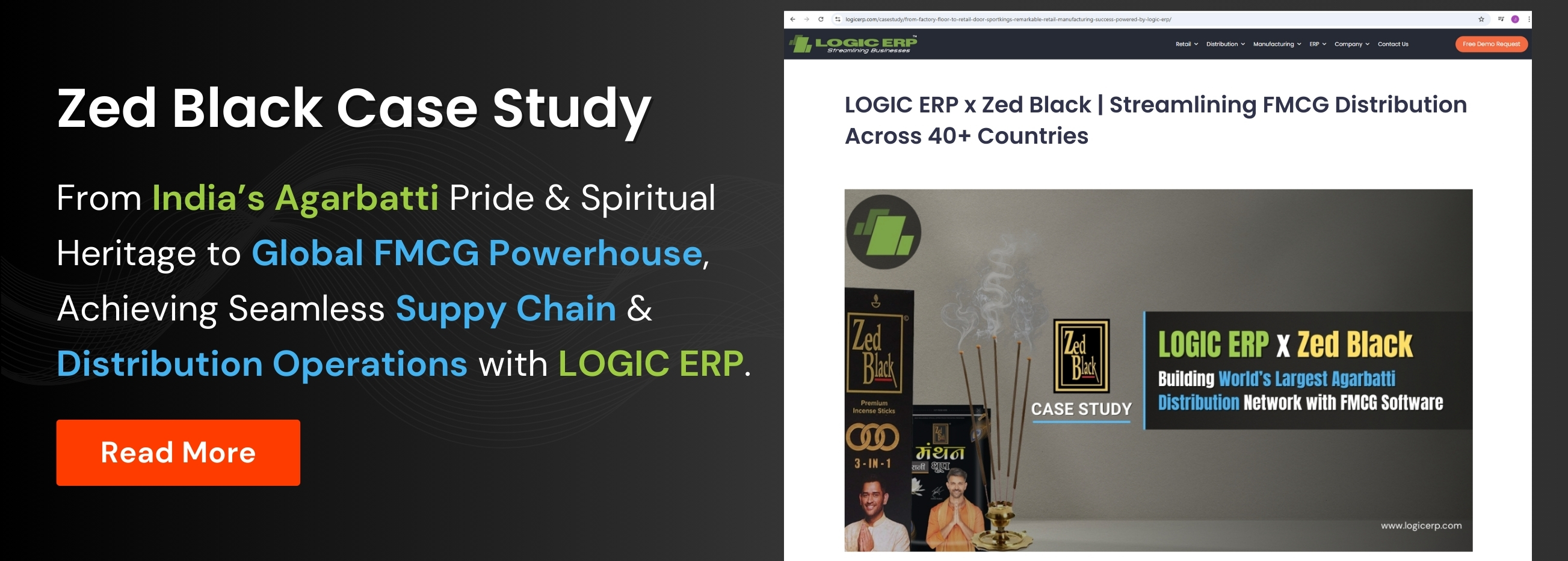
Read Full Case Study: LOGIC ERP x Zed Black | Streamlining FMCG Distribution Across 40+ Countries
Conclusion
In an increasingly complex FMCG ecosystem, managing trade, retail, wholesale, and B2B operations without integrated systems is no longer viable. A robust ERP for FMCG distribution, combined with advanced FMCG distribution billing software, empowers businesses to centralize operations, ensure compliance, gain real-time visibility, and scale with confidence.
Investing in the right FMCG distribution business software is not just a technology decision, it is a strategic move toward sustainable growth and long-term success. Call at +91–73411-41176 or send us an email at sales@logicerp.com to FMCG distribution software today!
Frequently Asked Questions (FAQs)
What is FMCG distribution ERP software?
FMCG distribution ERP software is an integrated business solution that manages sales, billing, inventory, finance, taxation, and distributor operations on a single platform. It helps FMCG businesses streamline trade, retail, wholesale, and B2B distribution with real-time visibility and centralized control.
Why do FMCG distributors need ERP software?
FMCG distributors need ERP software to manage high transaction volumes, multiple sales channels, complex pricing structures, schemes, and GST compliance. ERP for FMCG distribution reduces manual effort, improves accuracy, and enables scalable business growth.
What is FMCG distribution billing software?
FMCG distribution billing software is designed to generate fast, accurate, and GST-compliant invoices for FMCG businesses across trade, retail, wholesale, and B2B channels. When integrated with ERP, it ensures seamless accounting and inventory updates.
How does ERP improve multi-channel FMCG distribution?
ERP improves multi-channel FMCG distribution by centralizing billing, inventory, and finance, enabling channel-specific pricing and schemes, providing real-time stock visibility, and eliminating data silos between trade, retail, wholesale, and B2B operations.
What is the difference between FMCG billing software and ERP?
FMCG billing software primarily focuses on invoicing and taxation, while ERP for FMCG distribution manages end-to-end operations including billing, inventory, finance, compliance, analytics, and distributor management. Billing software becomes more powerful when integrated with ERP.
Can ERP handle trade, retail, wholesale, and B2B billing together?
Yes. Modern FMCG distribution and wholesale billing software integrated with ERP can manage trade distributor billing, retail POS billing, wholesale bulk invoicing, and B2B contract-based billing from a single unified platform.
How does ERP help in inventory management for FMCG businesses?
ERP provides real-time stock visibility, batch-wise and expiry-wise tracking, multi-warehouse inventory management, and automatic stock updates after every transaction, reducing stockouts, overstocking, and expiry losses.
Is ERP useful for GST compliance in FMCG distribution?
Yes. FMCG management billing software ensures GST-compliant invoice generation, correct HSN and tax calculations, e-invoicing integration, and audit-ready GST reports, reducing compliance risk and manual effort.
How does ERP improve cash flow for FMCG distributors?
ERP improves cash flow by automating the order-to-cash cycle, tracking real-time outstanding and aging, enforcing credit limits, and enabling faster billing and collections.
What is order-to-cash automation in FMCG ERP?
Order-to-cash automation refers to automating the complete cycle from order creation to dispatch, invoice generation, payment receipt, and reconciliation. This reduces delays, manual errors, and improves working capital efficiency.
How does ERP help with credit control and outstanding management?
ERP provides customer-wise aging analysis, credit limit alerts, automated payment reminders, and real-time outstanding visibility, helping businesses reduce bad debts and strengthen financial discipline.
Can ERP support wholesale FMCG businesses with high billing volumes?
Yes. FMCG wholesale billing software is built to handle bulk orders, multiple price slabs, high transaction volumes, and fast invoice processing, even during peak sales periods.
What role does analytics play in FMCG ERP software?
Advanced FMCG software provides channel-wise performance dashboards, SKU-level profitability analysis, and demand forecasting, helping businesses make data-driven decisions and improve margins.
Is cloud-based FMCG ERP safe and reliable?
Yes. Cloud-based FMCG distribution business software offers secure data encryption, role-based access control, automated backups, disaster recovery, and high availability, making it safe and scalable for growing businesses.
Can small and mid-sized FMCG distributors use ERP software?
Absolutely. ERP for FMCG distribution is scalable and suitable for small distributors, growing regional players, and large enterprises, allowing businesses to grow without increasing operational complexity.
How does ERP help in distributor and retailer management?
ERP enables distributor-wise pricing, scheme management, secondary sales tracking, credit monitoring, and performance analysis, improving transparency and strengthening channel relationships.
What features should I look for in FMCG distributor software?
Key features include multi-channel billing, GST compliance, inventory and expiry management, credit control, analytics, reporting, and seamless ERP integration.
How does ERP reduce errors in FMCG billing?
ERP reduces errors by automating pricing, tax, and scheme application, eliminating manual data entry, and ensuring real-time validation across billing, inventory, and finance systems.
Can ERP support FMCG business expansion into new markets?
Yes. ERP supports multi-location and multi-state operations, easy onboarding of new distributors and warehouses, and centralized control with local flexibility, making expansion smooth and controlled.
Why is ERP important for future-ready FMCG businesses?
ERP is essential because it delivers automation, real-time visibility, compliance readiness, analytics, scalability, and control, making it a strategic growth enabler for modern FMCG businesses.

Author
Sharanjit Ghuman
Director of Communications | LOGIC ERP Solutions Pvt. Ltd.
Leading and managing the company’s internal and external communication strategies and working closely with senior leadership to develop and execute communication plans.