A Detailed Guide on Features, Benefits, Types, Trends, Automation, and Implementation
Discover the power of AI-powered ERP software. Learn how cutting-edge technologies like machine learning, natural language processing, robotic process automation, and image recognition transform your business operations. Unlock benefits such as boosted efficiency, smarter financial management, and streamlined supply chains.
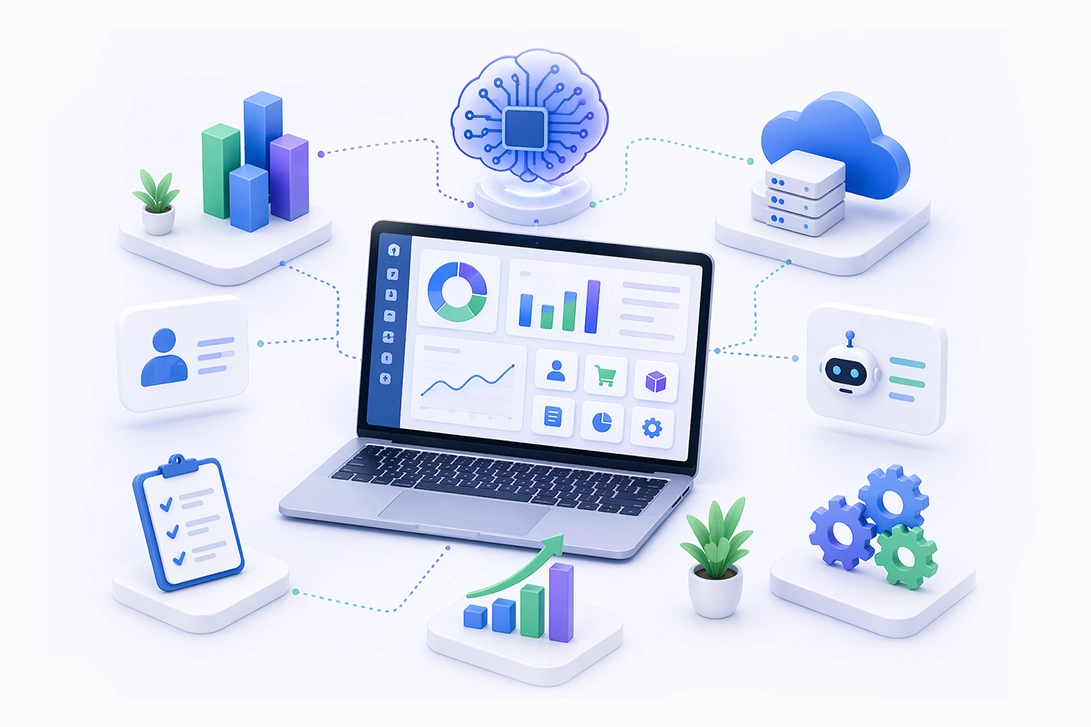
Unlock the full potential of your enterprise with AI-powered ERP software that integrates cutting-edge artificial intelligence technologies machine learning, natural language processing, and predictive analytics into your core business systems. Experience a new era of proactive decision-making, automated workflows, and real-time insights that drive efficiency and growth.
Designed for business leaders, IT decision-makers, and enterprise stakeholders, this guide offers everything you need to know about AI-enabled ERP systems in 2026, including key features, benefits, implementation strategies, and emerging trends. Take control of your operations and stay ahead of the competition with AI-powered ERP, while ensuring the reliability of AI models through strong governance and validation to mitigate risks such as hallucinations and compliance issues.
Explore AI in ERP SoftwareAI in ERP software refers to the integration of artificial intelligence technologies, powered by advanced AI models whose reliability and validation are critical for effective outcomes, into enterprise resource planning systems to automate business operations, generate actionable insights, and enable smarter decision-making.
It transforms traditional ERP platforms from reactive data repositories into intelligent, proactive systems that anticipate needs, detect anomalies, and optimize workflows in real time. This evolution empowers organizations to respond swiftly to market changes and improve overall business performance.
AI in ERP is crucial because it addresses the increasing complexity and volume of business data that traditional ERP solutions struggle to manage effectively. By leveraging AI capabilities, companies can automate repetitive tasks, enhance forecasting accuracy, optimize supply chain operations, and personalize customer and employee experiences.
This leads to reduced operational costs, faster decision cycles, and improved competitive positioning in dynamic markets.
Predictive analytics leverages historical data to anticipate future trends and outcomes. AI-enhanced ERP systems utilize past behaviors and organization-specific data to forecast consumer actions or market changes, enabling business leaders to make swift, data-driven decisions.
Natural language processing (NLP) empowers ERP systems to comprehend and respond to human language, enhancing user interactions. Recent advancements in large language models (LLMs), like ChatGPT, have refined NLP capabilities, providing more nuanced and context-aware tools within ERP software. For instance, NLP can analyze unstructured texts such as customer emails to conduct sentiment analysis or interpret informal user queries in back-office settings, making the software more user-friendly.
Robotic process automation automates repetitive and routine tasks or entire workflows through software bots. This includes data extraction, entry, and file transfers. With RPA, ERP systems can automatically generate reports, distribute essential HR documents, or manage customer and employee data efficiently.
Machine learning enables systems to learn from data over time, enhancing prediction accuracy and decision-making. When integrated into ERP solutions, ML reduces operational errors and boosts efficiency by continually improving performance. Given the vast amounts of organization-specific data ERP systems handle, ML models tailored to particular business scenarios can significantly enhance ERP functionality.
These assistants utilize NLP to offer real-time support, elevating customer experiences and guiding employees through ERP workflows. Within ERP platforms, these AI agents efficiently manage employee self-service portals by addressing common HR-related inquiries.
Image recognition technology, also known as computer vision, uses AI to detect and interpret visual inputs like objects, text, or locations. This technology enables ERP systems to convert videos or scanned documents into searchable formats and monitor manufacturing quality by analyzing visual data throughout production. Additionally, image recognition supports quality control by monitoring manufacturing materials.
Generative AI represents the latest advancement in AI-powered ERP systems, capable of automatically creating detailed business reports, drafting emails, and generating strategic content based on raw data inputs. This technology accelerates report generation, improves consistency, and supports scenario planning by simulating various business outcomes, helping organizations make better-informed decisions faster.
Generative AI can automatically create detailed business reports from raw data, saving time and ensuring consistency. These reports can be generated on-demand, providing stakeholders with information as they need it.
Generative AI can draft emails, marketing content, code or technical documentation based on predefined parameters. Applications include generating personalized messages to individual consumers or employees or translating code from one language to another.
AI generates various business scenarios and evaluates potential outcomes, significantly advancing the strategic planning capacity of earlier ERP systems. For example, an AI-enabled ERP system might analyze sustainability regulations and produce a series of customized recommendations to reduce an organization’s carbon footprint.
Explore AI Features in ERP SoftwarePredictive maintenance systems typically leverage Internet of Things (IoT) sensors or digital twin technology to continuously monitor critical equipment. These systems forecast routine maintenance needs or detect potential issues early, helping organizations avoid costly downtime and last-minute repairs.
Industries such as transportation, energy, civil infrastructure, and defense greatly benefit from intelligent predictive maintenance by preventing dangerous breakdowns and outages. This technology has proven effective in increasing wind farm productivity and reducing unnecessary energy consumption in agricultural manufacturing.
Demand forecasting within ERP systems plays a vital role in production planning. By analyzing historical internal data and sometimes external datasets, organizations can anticipate market fluctuations, enabling more accurate planning. Integrating demand forecasting with inventory management helps prevent stockouts and excess inventory.
Machine learning also enhances spend management by optimizing cash flows. Algorithms compare projected figures with actual performance, generating precise cash forecasts that improve financial planning.
AI accelerates digital transformation by automating code development, testing, and application lifecycle management. ERP tools now facilitate intelligent automation of code translation and data migration, streamlining modernization efforts.
Natural Language Processing (NLP) and Robotic Process Automation (RPA) simplify invoice and document handling by minimizing manual data entry errors and speeding up payment cycles. Certain ERP modules automatically verify receipts and invoices for production deliveries, while AI-driven financial tools use document recognition and intelligent data entry to process supplier invoices efficiently.
AI-powered ERP systems significantly enhance customer relationship management (CRM). Utilizing NLP and machine learning, these systems automatically resolve common issues, improve user experience, and provide real-time customer query responses 24/7. Some ERP CRM modules employ generative AI to draft emails and prepare account summaries.
ERP modules focused on human capital management (HCM) use AI to automate routine tasks, personalize employee workflows, and identify talent during recruitment. For example, platforms can deliver personalized learning recommendations to millions of employees monthly and automatically source candidates matching job requirements.
Machine learning algorithms and AI-driven search functions embedded in B2C and B2B purchasing platforms help surface products and services that meet specific criteria. Recommendation engines assist procurement specialists by presenting bids aligned with sustainability goals or budget constraints, as demonstrated in leading AI-enabled procurement networks.
Process mining applies algorithms to analyze business workflows. Leveraging extensive historical organizational data stored in ERP systems, AI identifies inefficiencies, pain points, and opportunities for more streamlined, cost-effective, or sustainable processes.
Anomaly detection was one of the earliest AI applications in ERP. This technology automatically flags potential fraud or irregularities, acting as an early warning system for stakeholders and freeing compliance teams to focus on complex issues.
Originally prominent in banking and financial sectors, anomaly detection now applies to broader parameters like predefined KPI standards across various industries.
Intelligent order management monitors and optimizes nearly every aspect of e-commerce and fulfillment. From determining fulfillment routes based on specific constraints to providing automatic customer updates on order status, AI-enabled order management integrates multiple data sources to ensure smooth end-to-end commerce operations.
NLP and machine learning can condense lengthy reports or documents, delivering key insights to employees. For instance, AI algorithms can extract essential takeaways from legal, compliance, or internal reports, enhancing information accessibility.
Machine learning predicts market demand shifts to optimize inventory and production planning, enabling companies to predict demand accurately and reduce stockouts or overstock situations.
Robotic Process Automation (RPA) scans and matches vendor invoices with purchase orders, significantly reducing manual data entry errors and accelerating payment cycles.
Virtual assistants and chatbots handle customer inquiries instantly, providing real-time support that improves service quality and frees staff to focus on complex tasks.
IoT sensors combined with AI forecast equipment failures and maintenance needs, minimizing downtime and reducing repair expenses by up to 30%.
Natural Language Processing (NLP) and machine learning customize ERP interfaces based on user roles and behavior patterns, boosting productivity through tailored user experiences.
AI enhances supply chain resilience by anticipating disruptions, streamlining procurement processes, and enabling proactive adjustments in inventory and logistics management. AI can personalize user experiences by adapting ERP dashboards based on individual roles and behavior patterns.
AI-enabled ERP systems analyze vast datasets to identify trends and generate multiple business scenarios, helping organizations make informed strategic decisions.
Generative AI automatically creates detailed, consistent business reports from raw data, saving time and ensuring accuracy across departments.
AI monitors and optimizes e-commerce and fulfillment processes, from route planning to customer notifications, ensuring smooth end-to-end order delivery.
AI continuously monitors ERP data to detect anomalies and potential fraud early, strengthening compliance and reducing operational risks.
AI in ERP helps businesses work smarter by automating tasks and providing real-time insights for better decisions. By leveraging AI technologies such as machine learning, natural language processing, and predictive analytics, AI-powered ERP systems improve operational efficiency by automating routine tasks, optimizing business processes, and enhancing decision-making across the organization. Let’s explore the top advantages of AI in ERP software:
AI-powered ERP software enhances productivity by automating routine back-office tasks such as data entry, invoice processing, and order management. Organizations report productivity gains of 20–30%, allowing employees to focus on higher-value activities and strategic initiatives. According to McKinsey, AI could add $29 trillion to $48 trillion in revenues by 2040, highlighting the potential for AI to enhance operational efficiency across various industries.
Leveraging machine learning and predictive analytics, AI-enabled ERP systems provide more accurate predictions of market trends, customer demand, and supply chain challenges. This improved forecasting capability helps businesses optimize inventory levels, manage procurement effectively, and reduce the risk of stockouts or overstocking.
AI tools within ERP systems enable personalized interactions by analyzing customer data and behavior patterns. AI-powered chatbots and virtual assistants handle a wide range of customer service inquiries in real time, improving response times and freeing human representatives to address complex issues, thereby boosting customer satisfaction and loyalty.
AI continuously monitors data for anomalies and potential fraud, enabling early detection and proactive mitigation of risks. This capability strengthens compliance and security measures, reducing vulnerabilities and safeguarding sensitive business information.
By optimizing business operations and automating repetitive tasks, AI-powered ERP software helps significantly lower labor costs and inventory expenses. Enhanced demand forecasting and supply chain optimization reduce waste and improve resource allocation, contributing to overall cost savings.
AI-enabled ERP systems offer real-time insights and actionable recommendations across finance, human resources, supply chain, and other functions. They integrate key performance indicators to provide comprehensive performance tracking, enabling leaders to make informed strategic choices. By leveraging AI, businesses can manage inventory more effectively, optimize resource allocation, and enhance overall operational agility. Leading platforms like Microsoft Dynamics incorporate these capabilities, facilitating seamless integration and advanced analytics that support continuous improvement and competitive advantage.
AI-enabled ERP systems reduce human errors by automating tasks and leveraging advanced data analytics to quickly and accurately analyze large datasets that would be difficult for humans to process.
An agile and successful business quickly adapts to market changes and unexpected events. AI-enabled ERP systems ensure that all business processes operate at peak efficiency, enabling rapid responses to challenges through real-time insights and analytics.
By automating routine tasks like invoice processing and order management, ERP systems free employees to focus on more creative and value-added work.
AI continuously monitors systems to detect and address security threats or anomalies faster and more accurately than human personnel, significantly strengthening an organization’s overall security.
Automated invoicing systems in AI-powered ERP reduce manual data entry by scanning and matching vendor invoices with purchase orders.
Machine learning algorithms in ERP systems can optimize logistics and delivery routes in real time, reducing operational costs and enhancing customer satisfaction through automation.
Automate routine tasks and reduce manual data entry errors.
Gain real-time insights with advanced data analysis and performance metrics
Improve forecast accuracy and optimize supply chain operations and logistics
Enhance employee productivity with intelligent business workflows and employee self service portals
Strengthen security against evolving security threats.
Enable data-driven decisions across financial operations, human resources, and more.
Clean, standardized, and integrated data is essential for effective AI model training and reliable outputs. Successful AI implementations rely on high-quality, error-free data that is securely stored and properly managed.
Focus on areas like demand forecasting, expense tracking, invoice automation, and supply chain optimization for quick wins.
Opt for solutions that support cloud deployment and easy AI integration with ERP solutions.
Establish data access controls, AI usage policies, and ethical guidelines to manage risks and compliance.
Train employees on AI-driven workflows and promote a culture of human-AI collaboration, including employee self service portals.
Continuously evaluate AI system performance and update models to adapt to evolving business workflows and operational needs. Regularly tracking and updating AI-enabled ERP platforms — or partnering with external experts — helps maintain optimal performance and long-term success.
Successful AI implementations rely on high-quality, error-free data that is securely stored and properly managed.
Investing in scalable IT infrastructure, whether cloud-based or hybrid, is crucial to support advanced AI functionalities in ERP systems.
Regularly tracking and updating AI-enabled ERP platforms or partnering with external experts helps maintain optimal performance and long-term success.
Developing a clear integration approach aligned with core business goals is key to maximizing the benefits of AI within ERP implementations.
Ensure clean, integrated, and real-time business data across all core functions to support AI capabilities.
Focus on supply chain operations, demand forecasting, invoice processing automation, and customer interactions where AI delivers rapid ROI.
Evaluate AI maturity, integration capabilities with existing systems, and support for cloud ERP deployments.
Start with proven AI features like virtual assistants and predictive analytics, then expand AI adoption across the entire business.
Empower employees with AI-driven tools, conversational interfaces, and AI-generated insights to improve adoption and operational efficiency.
Implement robust data governance frameworks to protect sensitive data and ensure compliance during AI adoption.
Embrace emerging advances like generative AI for automated report generation and custom AI agents tailored to your business needs. AI-powered ERP platforms increasingly leverage hyperautomation, combining robotic process automation with AI technology to streamline complex business workflows and intelligence.
The future of AI in ERP includes continuous learning systems that adapt to changing market dynamics, enhanced sentiment analysis for customer and employee engagement, and deeper integration with supply chain management to anticipate and prevent disruptions.
AI powered ERP software integrates artificial intelligence technologies like machine learning, natural language processing, and robotic process automation into traditional enterprise resource planning systems. This enables automation of complex processes, improved decision-making, and real-time business intelligence for enhanced operational efficiency.
AI enabled ERP systems use advanced analytics and machine learning algorithms to predict supply chain disruptions, optimize inventory levels, and streamline procurement processes. This results in more resilient and efficient supply chain logistics, reducing costs and improving customer satisfaction.
Natural language processing (NLP) allows AI powered ERP software to understand and respond to human language, enabling conversational interfaces and AI agents that enhance user experience. NLP facilitates intuitive querying, personalized dashboards, and automated customer service within ERP platforms.
AI agents in ERP AI software act as virtual assistants that automate routine tasks, provide actionable insights, and support complex decision-making. They improve productivity by managing financial transactions, human resources workflows, and supply chain operations with minimal manual intervention.
Robotic process automation (RPA) automates repetitive tasks such as invoice processing, data entry, and report generation within AI powered ERP software. This reduces errors, accelerates workflows, and frees employees to focus on strategic activities, enhancing overall business performance.
Machine learning enables ERP AI software to analyze historical and real-time data to identify patterns and forecast future trends. This advanced analytics capability supports smarter financial planning, demand forecasting, and risk management, driving data-driven decisions across the enterprise.
Yes, AI powered ERP software enhances human resources management by automating recruitment, personalizing employee self service portals, and providing predictive insights on workforce planning. This leads to improved employee engagement and optimized HR operations.
AI enabled ERP systems can forecast disruptions caused by demand fluctuations, supplier instability, logistics delays, and geopolitical events. By analyzing complex data sets, these systems enable proactive measures to mitigate risks and maintain supply chain continuity.
AI powered ERP software automates financial transactions through intelligent invoice processing, fraud detection, and predictive cash flow management. This improves accuracy, accelerates closing cycles, and strengthens compliance, resulting in more efficient financial operations.
AI powered ERP software is essential because it combines automation, business intelligence, and predictive analytics to manage complex processes efficiently. It empowers enterprises to adapt quickly to market changes, optimize resources, and gain a competitive advantage in a data-driven economy.
Popular Products