Supervisory Control and Data Acquisition in Modern Manufacturing
Discover the SCADA full form and learn how Supervisory Control and Data Acquisition systems work in manufacturing. Explore key components, benefits, cybersecurity risks, and real-world applications.
SCADA stands for Supervisory Control and Data Acquisition. It is the backbone of industrial process automation in factories, utilities, and distributed infrastructure worldwide. This guide covers what SCADA means, how it works inside manufacturing plants, its key components, security risks, and how it connects to enterprise platforms like LOGIC ERP.
The SCADA full form is "Supervisory Control and Data Acquisition." In manufacturing, SCADA is an industrial control system for real-time monitoring and supervisory control of processes through computers, communication networks, software interfaces, and field devices. For plant managers, IT/OT leaders, industrial automation professionals, and manufacturing business executives, understanding SCADA helps connect shop-floor operations with business systems so teams can improve efficiency, reduce downtime, strengthen safety and product quality, and make faster, data-driven decisions that support growth.
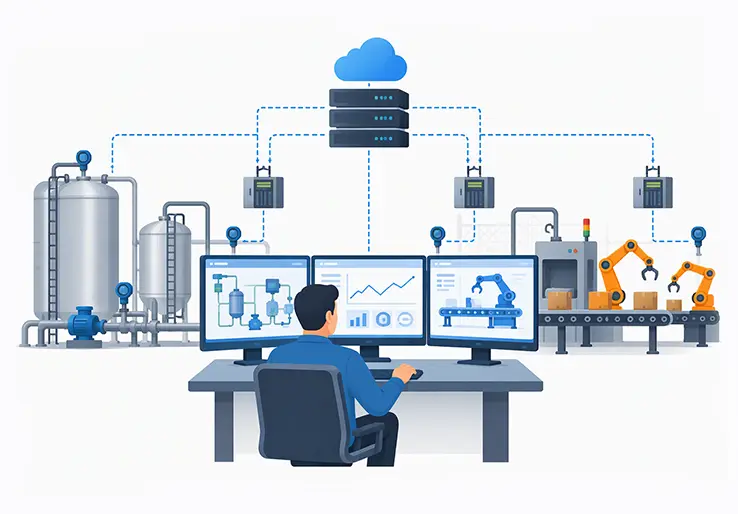
SCADA combines two core capabilities: supervisory control, which sends commands to field devices, and data acquisition, which collects sensor readings and equipment status across a facility or distributed assets. A typical SCADA deployment monitors variables such as temperature, pressure, motor speed, and line status from a centralized control room, where operators use live dashboards and alarms to respond when values move outside defined thresholds. SCADA systems use controllers such as PLCs and RTUs to manage plant-floor devices and convert raw signals into structured process data that operators and automated logic can act on. Modern SCADA platforms also communicate with programmable logic controllers, remote terminal units, sensors, and upstream business systems. When connected to ERP solutions like LOGIC ERP, SCADA data can feed production planning, costing, and inventory modules.
This guide explains how SCADA works in manufacturing, its main components, core functions, system types and generations, operational benefits, cybersecurity risks and mitigation, ERP integration, real-world use cases, how to choose the right solution, and where SCADA is heading with IIoT and AI.
SCADA in manufacturing is an automation layer that supervises entire production lines, utilities, and support systems from a single operations center. SCADA systems are crucial for managing industrial operations where dozens or hundreds of machines, motors, and instruments run simultaneously.
SCADA provides a "single pane of glass" for operators: a user interface displaying production status, active alarms, throughput, and KPIs such as OEE across the plant. The system provides real-time data visualization for operators who need to make decisions within seconds.
Typical manufacturing assets under SCADA include conveyors, mixers, ovens, packaging machines, compressors, boilers, chillers, and power systems.
SCADA coordinates with PLCs for low-level machine control and with MES/ERP platforms for order tracking, inventory, and quality data. Connecting SCADA to a manufacturing ERP like LOGIC ERP lets production counts, energy readings, and quality flags feed directly into business workflows.
This setup helps manufacturers move from manual intervention and reactive troubleshooting to automated control and data-driven decision-making across production facilities.
Breaking down the SCADA full form into its three constituent parts clarifies what the system actually does on a plant floor.
Supervisory refers to high-level oversight and command capabilities. Supervisory control gives operators and software the ability to start, stop, and adjust physical processes without performing the millisecond-level scan cycles that PLCs handle. It is a supervisory system, not a direct machine controller.
Control means starting and stopping equipment, changing setpoints, switching operational modes, and orchestrating automation tasks across multiple lines. Control commands travel from the SCADA server through communication networks down to field devices.
Data Acquisition is the continuous data collection from sensors and meters measuring temperature, flow, speed, vibration, and energy consumption. Each data point is tagged with a timestamp and quality flag, forming the basis for monitoring, data analysis, and regulatory compliance.
SCADA sits at Level 2 in the ISA-95 automation pyramid: above field devices and PLCs (Level 1), below MES (Level 3) and ERP (Level 4). It bridges Operational Technology and Information Technology, enabling industrial organizations to connect shop-floor readings to business intelligence.
How SCADA Systems Work Step by Step?
Data originates on the plant floor, moves through local controllers, travels over networks to SCADA servers, and reaches operators through dashboards. Here is the signal chain:
Sensors and actuators on machines measure physical variables (temperature, pressure, flow, level) and control equipment (valves, motors, drives). These field devices generate analog or digital signals.
PLCs and remote terminal units convert those signals into digital data, execute local logic such as interlocks and safety shutdowns, and relay structured data upstream. RTUs collect data from sensors and send it to the master terminal unit or SCADA server.
The communication infrastructure transports data using protocols like Modbus, Profibus, Profinet, DNP3, OPC UA, and IEC 61850. Reliable communication between devices and servers is essential for system performance.
SCADA servers receive, aggregate, and process incoming data. They maintain redundancy, store data in historians, and run supervisory logic.
SCADA software and human machine interface dashboards display real time data, alarms, and trends. Operators interact through these screens to issue control commands or acknowledge events.
The system logs historical data with timestamps for trending, audits, and root-cause analysis. On threshold exceedances, SCADA triggers alarms and can automatically execute control actions.
Integration layer: SCADA passes production counts, quality metrics, and energy readings to MES and ERP platforms for scheduling, costing, and inventory optimization.
Example workflow: A furnace temperature sensor reports a rising reading. The PLC transmits the value to the SCADA server. SCADA detects the value exceeds the alarm threshold, raises a notification on the HMI, and sends an automated command to reduce fuel input. The event is logged with a timestamp. MES receives the record for quality traceability.
A SCADA architecture blends hardware, software, and communication networks into a unified supervisory platform. The main scada components of a modern system work together to collect data, control processes, and inform decisions.
Field devices and sensors measure temperature, pressure, flow, vibration, and level across machines and process lines. These are the data sources for everything upstream.
Programmable logic controllers and remote terminal units handle local I/O, execute safety interlocks, and serve as the interface between physical processes and the SCADA network. SCADA systems include remote terminal units and programmable logic controllers as their primary data collection endpoints.
Communication infrastructure connects devices to servers using industrial Ethernet, fiber optics, radio links, cellular connections, and VPNs for secure remote access.
SCADA servers and databases (on-premises, cloud, or hybrid) handle real-time processing, data logging, and historical storage. Data historians retain years of tag data for trend analysis.
SCADA software and HMI dashboards provide visualization, alarm management, trending, and supervisory control. Human-machine interfaces allow operators to monitor and control systems from centralized or distributed stations.
Engineering and configuration tools let integrators design screens, define tags, set alarm logic, configure reports, and manage user roles.
Integration with other systems is critical. SCADA feeds process data into MES for production execution and into ERP platforms like LOGIC ERP for business planning, costing, and resource allocation.
SCADA in Manufacturing: Architecture and Communication
Manufacturing SCADA architectures range from single-plant setups with one control room to multi-site, multi-region deployments managed through centralized monitoring dashboards.
A common topology includes redundant SCADA servers in a control room, distributed HMIs at production lines, and edge gateways near machines for local buffering and pre-processing.
Communication protocols connect shop-floor SCADA devices to control rooms and cloud services. Modbus TCP, Profinet, EtherNet/IP, and OPC UA are common. Modern SCADA systems increasingly use MQTT and REST APIs for data transmission to cloud analytics and enterprise solutions.
Network segmentation separates OT and IT zones. DMZ architectures allow safe data exchange between SCADA networks and corporate systems without exposing control equipment to the broader internet.
Networked SCADA systems replaced older point-to-point links with Ethernet-based topologies that support multi-vendor device connectivity and remote control from remote locations.
When connected to LOGIC ERP through OPC UA or API-based integration, SCADA process data merges with order management and financial data, giving management a unified view.
SCADA technology has evolved through four distinct generations since the 1960s, each adding capability and connectivity.
Monolithic SCADA systems (first generation): standalone mainframe-based systems like the IBM 1800, introduced in 1964, used proprietary protocols with no networking. These early data acquisition systems were isolated and vendor-locked.
Distributed systems (second generation): multiple computers on LANs shared SCADA tasks within a plant. Local processing improved, but protocols remained mostly proprietary. Microprocessor-based RTUs appeared in the mid-1970s.
Networked SCADA systems (third generation): Ethernet-based architectures, open communication protocols (DNP3, Modbus TCP), and multi-vendor device support allowed distributed control systems and SCADA platforms to interoperate across wide areas.
Modern SCADA systems (fourth generation): browser-based HMIs, cloud historians, mobile dashboards, edge computing, and web technologies for remote access. Platforms from vendors like Inductive Automation exemplify this shift toward open, IT-friendly SCADA software solutions.
Legacy vs. modern comparison: monolithic SCADA systems lack scalability, have weak cybersecurity, and resist integration. A modern SCADA solution supports multi-site scaling, encrypted communications, role-based access, and native connectivity to ERP platforms like LOGIC ERP.
Core Functions of SCADA in Manufacturing Operations
This section covers what SCADA actually does on a daily basis inside a manufacturing plant. SCADA enables real-time monitoring and control of industrial processes across every shift.
Real-time data collection: SCADA polls or streams process data from machines every few seconds. A food plant, for example, records pasteurization temperatures every 2 seconds for regulatory compliance.
Supervisory control of equipment and setpoints: operators adjust mixer speed, oven temperature, or conveyor rate through SCADA screens. The system relays control commands to PLCs, which execute the changes.
Alarm and event detection: SCADA monitors thresholds and raises alarms when values exceed limits. If seal temperature on a packaging line drops below specification, SCADA stops the line and notifies the operator, preventing defective output.
Trend monitoring and historical data logging: data logging stores tag values with timestamps for weeks, months, or years. Engineers use this historical data to identify drift in equipment performance or validate process control changes.
Automated control sequences: SCADA executes timed start/stop routines, batch transitions, and safety interlocks as part of broader automation tasks, reducing manual intervention.
Reporting and dashboards: shift reports, OEE summaries, energy consumption breakdowns, and scrap tracking feed into management information systems and ERP modules for business review.
These functions collectively improve operational efficiency, reduce downtime, and standardize production across lines and shifts.
SCADA connects plant-floor reality to business outcomes. For plant managers and executives, the value translates into measurable KPIs.
Improved operational efficiency through centralized visibility and automated control. SCADA systems improve operational efficiency in industrial processes by replacing manual rounds with constant monitoring from a control room.
Reduced unplanned downtime via early fault detection. SCADA helps minimize downtime through timely issue detection; trend analysis on vibration or temperature data reveals potential equipment failures before they cause stoppages.
Enhanced product quality and consistency. Real-time process monitoring catches deviations before they produce off-spec products. SCADA systems improve production quality in food processing, pharmaceuticals, and other regulated sectors.
Better resource and energy management by tracking electricity, gas, steam, and compressed air consumption. Energy management dashboards identify waste and support reduction targets.
Increased safety. SCADA helps in detecting dangerous conditions to ensure safety. Monitoring equipment for critical parameters like pressure and toxic gas levels and automating emergency shutdowns protects workers and assets. SCADA systems support compliance with safety and regulatory standards.
Scalability and flexibility to add new lines, industrial equipment, and sites without redesigning the entire architecture.
SCADA enables industrial organizations to make smarter decisions through data analysis. When integrated with LOGIC ERP, SCADA data supports accurate costing, scheduling, capacity planning, and procurement workflows. SCADA systems facilitate smarter decision-making through data analysis that connects process performance to financial results.
SCADA Security and Cyber Risks in Industrial Control Systems
SCADA security is critical in manufacturing because compromised control systems can halt production, damage equipment, endanger workers, and violate regulatory requirements. These vital systems control physical processes with real-world consequences.
Unauthorized remote access: vendors or employees accessing SCADA from remote locations via poorly secured VPNs or maintenance portals can expose control systems to attackers. SCADA systems are vulnerable to hacking and insider threats.
Ransomware and malware: attacks targeting SCADA servers and HMIs can lock operators out of monitoring equipment and control functions. In 2018, Schneider Electric faced a targeted SCADA cyberattack that exploited vulnerabilities in its safety instrumented systems.
Data manipulation: altering sensor readings or setpoints can degrade quality, create unsafe operating conditions, or falsify production records.
Weak communication protocols: legacy protocols like unencrypted Modbus lack authentication. Common SCADA vulnerabilities include lack of software updates and security training for operators.
Flat network architectures: poor segmentation between IT and OT networks allows malware to spread from corporate email systems into SCADA networks.
Standards like IEC 62443 and NIST SP 800-82 provide frameworks for securing industrial control systems. SCADA security is crucial for protecting vital infrastructure services.
How to Mitigate SCADA Cybersecurity Risks?
Securing SCADA in manufacturing requires layered defenses that account for both IT and OT realities.
Implement network segmentation, firewalls, and DMZ zones between OT and IT networks. Organizations must document system connections to mitigate cyber risks and identify exposure points.
Use strong authentication, role-based access control, and least-privilege policies. Operators and engineers should have only the permissions their role requires; shared or generic accounts introduce risk.
Keep SCADA software, operating systems, and firmware updated. Schedule patching during planned maintenance windows to avoid disrupting continuous monitoring.
Encrypt communication channels using VPNs, TLS-enabled protocols like OPC UA, and secure remote access gateways. Avoid sending unencrypted Modbus traffic over routable networks.
Continuously monitor logs, events, and anomalous behavior with intrusion detection systems built for OT environments. Establish incident response procedures specific to SCADA devices.
Train staff on cyber hygiene, phishing recognition, and safe use of remote access tools. Security awareness reduces human error, one of the most common entry points for attacks.
Modern SCADA software solutions and ERP platforms like LOGIC ERP support centralized monitoring and audit trails that strengthen compliance posture.
Manufacturing floors run multiple automation and business systems. Understanding how SCADA fits among them prevents overlap and integration gaps.
SCADA vs PLC: PLCs handle local, deterministic, real-time control with scan cycles measured in milliseconds. SCADA supervises multiple PLCs and aggregates their data into a unified view. PLCs control; SCADA coordinates.
SCADA vs DCS: Distributed control systems are common in continuous process industries (chemical, refining) where control loops are tightly integrated. SCADA is more distributed and protocol-open, suited for wide-area and hybrid manufacturing. Both may coexist in the same plant.
SCADA vs HMI: A human machine interface is the local screen for a machine or area. SCADA includes HMIs but extends across assets and plants, adding data acquisition, alarm management, and historical trending.
SCADA vs MES: MES manages production execution, scheduling, and quality workflows. MES consumes process data from SCADA to track orders and enforce recipes.
SCADA vs ERP:ERP systems like LOGIC ERP manage business processes: orders, inventory, finance, and HR. ERP consumes SCADA and MES data for planning, costing, and product lifecycle management.
A well-integrated stack (field devices → PLC/RTU → SCADA → MES → LOGIC ERP) creates end-to-end visibility, from a temperature sensor on a furnace to a cost variance report on a CFO’s dashboard.
Real-World SCADA Applications in Manufacturing and Beyond
SCADA is deployed across dozens of industries. Manufacturing is the core use case, but the same principles apply wherever industrial operations require centralized monitoring and remote control.
Discrete manufacturing: automotive plants, electronics assembly, and packaging lines use SCADA to track line speed, reject rates, cycle times, and OEE. Such systems help synchronize operations across hundreds of stations.
Process manufacturing: food and beverage, pharmaceutical, and chemical plants rely on SCADA to control processes like temperature, pressure, and batch mixing. SCADA systems automate processes in pharmaceutical manufacturing, enforcing recipe compliance and electronic batch records.
Plant utilities: boilers, chillers, compressed air systems, and power distribution networks inside an industrial plant fall under SCADA supervision. SCADA systems enhance HVAC performance in commercial buildings and production facilities alike.
Energy and pipelines: SCADA systems are crucial for energy pipeline monitoring, tracking flow, pressure, and valve status over hundreds of kilometers. Leak detection algorithms run on SCADA data from remote terminal units placed along pipeline routes.
Water and infrastructure: SCADA systems help monitor water treatment facilities efficiently. Smart city deployments extend SCADA to street lighting, traffic control, and district energy. SCADA systems are common in various industries including electrical power and water treatment.
Manufacturers using LOGIC ERP alongside SCADA can analyze production performance across multiple plants, compare site-level KPIs, and centralize planning.
Selecting the Right SCADA Solution for Your Business
Choosing a SCADA solution is a multi-year commitment. Here is a checklist for plant managers, IT/OT leaders, and owners evaluating options.
Define functional requirements: number of tags, concurrent users, redundancy needs, and required automation tasks. A small plant with 500 tags has different needs than a multi-site operation with 50,000.
Check compatibility with existing PLCs, RTUs, field devices, and communication protocols already deployed. Replacing all field hardware is rarely practical.
Assess integration capabilities with MES and ERP platforms. Integration with LOGIC ERP is a differentiator for manufacturers who need production data flowing into costing, scheduling, and distributor management workflows.
Evaluate SCADA software usability: dashboard design, alarm configuration, trending tools, and engineering tools for operators and engineers.
Consider deployment models: on-premises, hybrid, or cloud. Each has different communication infrastructure, latency, and cybersecurity implications.
Review vendor support, training programs, SCADA security posture, and long-term product roadmap.
Start with a pilot project on a single line or area, validate the integration with existing PLCs and your ERP, then scale across the plant.
Future of SCADA: IIoT, AI, and Integration with LOGIC ERP
SCADA technology is converging with Industry 4.0 trends. Edge computing, cloud analytics, AI, and open APIs are reshaping how manufacturers collect data and control processes.
IIoT sensors and edge devices expand SCADA’s reach into previously unmonitored areas. Wireless sensor networks and LPWAN technologies connect hard-to-reach points without running new cable.
AI and ML models trained on SCADA historical data predict equipment failures, optimize setpoints, and reduce energy consumption. Predictive maintenance algorithms flag potential equipment failures days or weeks before breakdown.
Unified data models based on OPC UA and REST APIs make it easier to connect SCADA data to enterprise platforms like LOGIC ERP, closing the gap between shop-floor readings and business decisions.
Web-based HMIs and mobile-friendly dashboards give maintenance technicians, production managers, and executives role-based views of system performance from any device.
LOGIC ERP serves as a strategic partner for companies modernizing their industrial automation stack. By linking shop-floor SCADA with top-floor business intelligence, manufacturers gain the integrated visibility needed to compete in data-driven markets.
The gap between collecting process data and acting on it determines whether a plant runs lean or loses margin. SCADA, connected to the right ERP, closes that gap.
SCADA, which stands for Supervisory Control and Data Acquisition, is a foundational technology in modern manufacturing and industrial automation. It provides real-time monitoring, control, and data acquisition capabilities that enable manufacturers to optimize operations, improve safety, reduce downtime, and enhance product quality. By integrating SCADA with enterprise platforms like LOGIC ERP, organizations can bridge the gap between shop-floor processes and business intelligence, driving smarter decision-making and scalable growth.
With its key components PLCs, RTUs, HMIs, communication networks, and SCADA software this system offers a comprehensive solution for managing complex industrial environments. Despite the cybersecurity risks inherent to SCADA, proper mitigation strategies ensure robust protection of critical infrastructure.
As Industry 4.0 advances, SCADA continues to evolve with IIoT, AI, and cloud integration, making it an indispensable tool for digital transformation in manufacturing.
SCADA stands for Supervisory Control and Data Acquisition.
SCADA collects real-time data from sensors and machines, processes it through PLCs and RTUs, and provides operators with visualization and control interfaces to monitor and manage production processes efficiently.
The main components include field devices and sensors, programmable logic controllers (PLCs), remote terminal units (RTUs), communication networks, SCADA servers, and human-machine interfaces (HMIs).
SCADA improves operational efficiency, reduces downtime, enhances product quality, supports safety compliance, and enables data-driven decision-making by providing real-time supervisory control and data acquisition.
Yes, SCADA systems can integrate with ERP platforms like LOGIC ERP to synchronize production data with business processes such as costing, scheduling, and inventory management.
Risks include unauthorized remote access, ransomware attacks, data manipulation, weak communication protocols, and poor network segmentation.
SCADA is widely used in manufacturing, energy, water treatment, food processing, pharmaceuticals, HVAC and utilities.
PLCs are hardware devices for local real-time control of machines, while SCADA is a supervisory system that monitors and controls multiple PLCs and devices across a facility or multiple sites.
SCADA is integrating with IIoT sensors, AI and machine learning for predictive maintenance, cloud computing for remote access, and open APIs for seamless data exchange with enterprise systems.
SCADA stands for Supervisory Control and Data Acquisition, a system used to monitor and control industrial processes in real time.
Communication infrastructure connects field devices, controllers, and SCADA servers, enabling reliable data transmission and remote control across industrial networks.
Common SCADA communication protocols include Modbus, DNP3, OPC UA, Profibus, and Ethernet/IP, facilitating data exchange between devices and control systems.
SCADA collects data from sensors and field devices via PLCs and RTUs, aggregating process variables like temperature, pressure, and flow for real-time monitoring and analysis.
By providing centralized monitoring, real-time data visualization, and automated control, SCADA reduces downtime, optimizes resource use, and streamlines industrial operations.
SCADA automates control sequences such as equipment start/stop, setpoint adjustments, batch processing, and safety interlocks to enhance process consistency and reduce manual intervention.
Automated control refers to SCADA’s ability to execute predefined commands on field devices without human intervention, ensuring timely responses to process changes or alarms.
SCADA software processes real-time data, visualizes system status through HMIs, manages alarms, logs historical data, and enables operators to supervise and control complex processes efficiently.
SCADA supervisory control provides centralized monitoring and high-level command over industrial processes. It allows operators to remotely start, stop, and adjust equipment through real-time data visualization. This control layer optimizes operations, enhances safety, reduces downtime, and ensures consistent product quality by managing multiple devices and automating responses across production lines.