The order to cash process starts when a customer places an order and ends with payment collection — covering order management, credit management, fulfillment, invoicing, accounts receivable, and collections. An efficient O2C process can reduce Days Sales Outstanding by 30%.
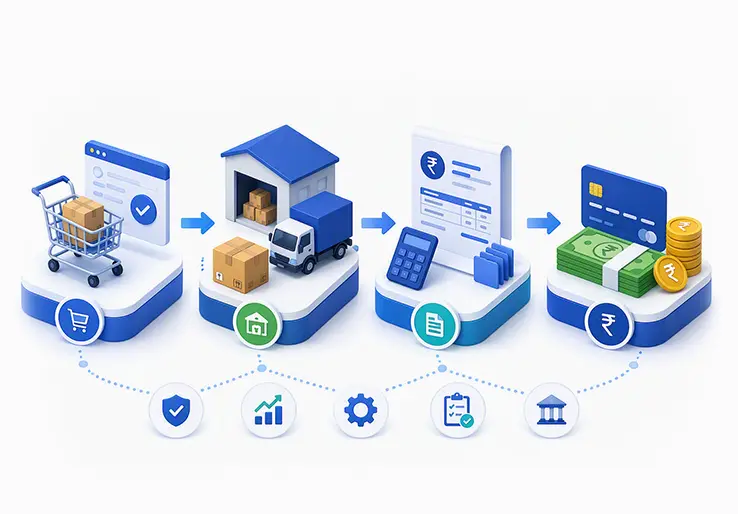
The order to cash process starts when a customer places an order and ends with payment collection, covering order management, credit management, fulfillment, invoicing, accounts receivable, and collections — and every step in between determines whether your business thrives or bleeds revenue. For finance, sales, and operations teams across manufacturing, distribution, B2B services, growing enterprises, and AR functions, an efficient O2C process can reduce Days Sales Outstanding (DSO) by 30%, accelerate cash flow, improve financial visibility, and prevent bad debt or customer friction caused by delays and errors.
This guide breaks down the complete order to cash cycle — what it is, why it matters, the detailed process steps, how it differs from quote to cash, where common challenges slow performance, and which best practices, automation strategies, and implementation approaches improve results. You'll also see how optimized O2C lowers operational costs, strengthens customer experience, and why businesses choose LOGIC ERP to streamline the process and turn every customer order into collected cash faster.
If your finance team spends more time chasing outstanding invoices than analyzing financial performance, you're not alone. Most businesses struggle with manual O2C processes that create delays between order placement and the moment the company receives payment. Spreadsheets, disconnected systems, and reactive collections workflows turn what should be a streamlined cash cycle into a source of constant frustration.
Inefficiencies in O2C can negatively impact cash flow and working capital, creating a ripple effect across your entire operation — from inventory management to customer relationships. When invoicing is delayed, payment terms are unclear, or credit checks fall through the cracks, the result is predictable: payment delays, rising bad debt, and declining customer satisfaction.
Effective management of the Order-to-Cash process is crucial for improving cash flow and customer satisfaction. A well-designed O2C process eliminates these pain points by connecting every stage — from order entry and credit management through order fulfillment, invoicing, and payment collection — into a single, visible workflow. The result is faster cash collection, fewer billing errors, and a customer experience that strengthens rather than strains your business.
The purchasing journey can range from straightforward online orders to more complex transactions involving discussions with sales representatives and multiple internal approvals. It is essential for businesses to accurately capture all necessary details from product specifications to delivery instructions to enable efficient order processing and fulfillment.
After a customer places an order, the order management process guides it through the subsequent stages of the order-to-cash cycle. Utilizing order management systems allows businesses to effectively monitor the order at every phase, keep customers updated, and proactively address potential issues like stock shortages or shipping limitations before they affect delivery schedules. Effective order management also involves checking inventory levels prior to order acceptance to ensure items are neither temporarily out of stock nor permanently unavailable.
For businesses extending credit, ongoing evaluation of customer financial risk is vital. New customers may undergo credit checks before being granted payment terms, aiming to minimize losses by setting appropriate credit limits and terms based on their financial background and current market conditions. For existing customers, continuous credit oversight and monitoring of payment behaviors help reduce overdue accounts and bad debt write-offs.
Order fulfillment encompasses picking and packing the ordered products and preparing them for shipment. This process involves selecting the correct inventory items or manufacturing them for custom orders, assembling any required configurations, and coordinating shipping. Efficient warehouse management systems and clear communication between departments support timely and accurate delivery.
Once items are shipped, customers should receive notifications along with estimated delivery dates. Shipping logistics can be complex, requiring expertise to select optimal shipping methods and cost-effective options, particularly for international shipments. Businesses may implement automated tools to generate tracking numbers, notify customers, and monitor delivery progress. International shipments also necessitate consideration of customs documentation and potential border delays when scheduling.
Timely invoicing accelerates the order-to-cash cycle and enhances cash flow, as customers cannot make payments without receiving an invoice. It is crucial to eliminate delays between order fulfillment and invoice creation to ensure invoices reach customers promptly. To expedite invoicing, all relevant supporting documents, such as sales or purchase orders, should be readily accessible to the invoicing system.
After invoice issuance, the accounts receivable (AR) team is responsible for payment collection. Financial management software can streamline AR activities by automatically tracking invoice due dates and sending payment reminders. These systems may also automate tasks like flagging overdue accounts and generating regular performance reports.
Recognizing that not all customers pay on time, the AR team must accurately monitor overdue accounts and initiate collection efforts as needed. Delinquent accounts can be flagged to prevent further purchases. Early engagement in the collection process increases the likelihood of recovering owed amounts. Since missed payments often result from simple errors like incorrect billing addresses or outdated payment details, collection strategies should balance maintaining customer relationships with securing timely payments.
With appropriate software, companies can evaluate the efficiency of each step in the order-to-cash cycle and pinpoint areas for enhancement. Integrated data management is essential for effective reporting and analysis. ERP systems that consolidate data across departments and offer robust reporting tools enable businesses to monitor key metrics such as total order cycle time and accounts receivable turnover ratio.
| Aspect | Order-to-Cash (O2C) | Quote-to-Cash (QTC) |
|---|---|---|
| Process Start | When the customer places an order | When the customer expresses purchase intent (quote) |
| Process End | When payment is collected and recorded | When revenue is realized after contract and payment |
| Key Steps | Order management, credit management, fulfillment, invoicing, payment collection | Includes quoting, configuring offerings, contract negotiation, order management, invoicing, accounts receivable |
| Focus | Processing orders and payments | Entire sales cycle from quote to revenue recognition |
| Typical Use Cases | Businesses with straightforward sales and order processing | Businesses with configurable products or services requiring quotes and contract negotiation |
| Complexity | Generally simpler and shorter cycle | More complex due to additional pre-order sales steps |
Here's why companies that optimize their order to cash o2c process consistently outperform those that don't:
The order-to-cash process includes nine key steps, but they group into three critical phases. Key stages in the Order-to-Cash cycle include order management, credit management, order fulfillment, and invoicing. Analyzing each step can identify areas for process improvement.
The O2C process starts when a customer places an order — whether through e-commerce, a sales team, EDI portal, or email. The order management process begins with validating order details: checking real-time inventory availability, confirming pricing accuracy against price lists and promotions, and verifying customer identity against master data.
Credit management assesses customer financial risk before order fulfillment. This means evaluating the customer's financial history using internal credit scores, external bureau reports, and payment history. Based on this assessment, your team sets credit limits and payment terms — net 30, net 60, or early payment discounts for prompt payers.
Businesses may run credit checks for new customers before extending credit. Effective credit management prevents extending credit to unreliable customers, and regular credit reviews help adjust customer credit limits based on payment habits. Regular credit reviews can reduce overdue balances by 30%, making automated credit management a critical component of a healthy cash flow.
Once an order clears credit approval and validation, the fulfillment process begins. Order fulfillment involves picking, packing, and shipping items to customers. Your warehouse management system coordinates with your order management software to ensure the right products leave the right facility at the right time.
Real-time inventory updates prevent overselling and backorder surprises. Automated shipping notifications — integrated with carriers for tracking and delivery confirmation — keep customers informed and reduce inbound inquiries. For service businesses or digital products, this stage involves provisioning, scheduling, or activating the purchased service.
The connection between order shipping and the next step is critical: delays in confirming delivery directly cause delays in invoicing, which cascade into payment delays and elevated days sales outstanding.
Invoicing should occur immediately after order fulfillment to speed up payments. Automating invoicing can accelerate cash flow significantly — automated invoice generation ensures accurate invoices are created the moment shipment is confirmed, with correct pricing, tax calculations, discounts, and shipping charges.
Invoice delivery channels now include email, EDI, customer portals, and paper — matching what each customer prefers. For recurring or subscription billing, automation handles recurring cycles, proration, and revenue recognition compliance.
The accounts receivable process then takes over: tracking outstanding invoices, sending automated payment reminders, and escalating overdue accounts through a structured dunning sequence. Diligent credit management minimizes overdue balances and bad debt during this phase. Effective O2C management helps prevent bad debt and ensures timely payments.
Cash application — matching customer payments to open invoices — is where many companies lose visibility. Automated systems can drive 90%+ straight-through cash posting, dramatically reducing unapplied cash. Payments arrive through multiple channels (ACH, wire, check, credit card, online portals), and AI-powered tools extract remittance data using OCR to match them accurately. The final step is posting to the general ledger and reconciling with bank feeds for complete revenue realization.
The Order-to-Cash (O2C) process is fundamental to a company's financial health and operational success. It governs the entire journey from receiving a customer order to collecting payment, directly impacting cash flow and working capital. Efficient management of this process ensures that businesses convert sales into actual revenue quickly, enabling timely reinvestment and growth.
An optimized O2C process reduces Days Sales Outstanding (DSO) by up to 30%, accelerating cash inflows and improving liquidity. This efficiency minimizes the risk of bad debt and reduces operational costs by eliminating manual errors and delays in invoicing and payment collection. Moreover, a streamlined O2C cycle enhances customer satisfaction by providing accurate order fulfillment, transparent billing, and clear payment terms, fostering trust and encouraging repeat business.
Conversely, inefficiencies in the O2C process such as delayed invoicing, poor credit management, or disconnected systems can create bottlenecks that stall cash flow, increase overdue accounts, and strain customer relationships. Therefore, prioritizing order-to-cash optimization is essential for businesses aiming to maintain healthy finances, improve operational efficiency, and deliver superior customer experiences.
The gap between traditional and modern order to cash approaches is not incremental — it's transformational:
Modern O2C must also support subscription and usage-based billing, omnichannel commerce, customer self-service portals, and complex compliance requirements — capabilities that manual processes simply cannot deliver at scale.
Results from real-world O2C transformations speak louder than theory:
An enterprise working with Prime AI Solutions achieved a 62% reduction in DSO within just 12 weeks through targeted automation of their cash process.
Discovery Education saw their K-12 segment DSO drop from 128 days to 43 days — a 66% improvement. Their overall collection period across all segments fell from 97 to 59 days.
An insurance brokerage partnering with WNS reduced DSO by 57%, from approximately 70 days to roughly 30 days, while improving invoice accuracy and reducing bad debt provisions through integrated predictive analytics.
Yaskawa, a global manufacturer, achieved zero bad debt and reduced DSO by approximately 5.5 days via automation in deductions, cash application, and collections prioritization. Their A/R team productivity improved by roughly 60%.
A global logistics company saw a 40% productivity increase and $150 million improvement in cash flow through delinquency prediction, with automation handling 70% of cash application allocations and reducing handle time by 60%.
These outcomes consistently demonstrate that an efficient O2C process can reduce Days Sales Outstanding by 30% or more, and that the cost savings and operational efficiency gains compound rapidly once process improvements take hold. Establishing standardized procedures helps ensure consistency in Order-to-Cash processes across companies.
Order to cash optimization delivers value across industries and company sizes:
If your organization has high DSO, frequent invoice disputes, significant unapplied cash, or limited visibility into your accounts receivable process, O2C optimization is not optional — it's urgent.
To optimize your Order-to-Cash process, adopting best practices is essential for improving efficiency, reducing errors, and accelerating cash flow. Key strategies include:
Automation transforms the O2C cycle by eliminating manual bottlenecks and increasing accuracy. Benefits include:
Despite its importance, many businesses face hurdles in managing the O2C cycle effectively:
O2C optimization is critical for a wide range of organizations, including:
In short, any business aiming to accelerate cash inflows, reduce operational costs, and improve customer relationships should prioritize Order-to-Cash process optimization.
Start with manual process documentation and workflow standardization. Map your current state from order placement to the moment the customer pays, identify bottlenecks, and standardize inputs — order forms, pricing structures, contract templates. Implement basic automation for invoice processing and payment reminders. This approach suits small businesses with simple order processes and delivers quick wins: some organizations see measurable DSO improvements within 30–60 days.
Connect your enterprise resource planning system to order management, billing, and collections modules. Advanced automated credit management evaluates customer purchase risk in real time. An integrated invoicing system generates accurate invoices automatically, while real-time reporting and analytics dashboards give leadership visibility into every stage of the cash o2c process. This approach addresses the root cause of most O2C inefficiency: disconnected software causing information silos.
For organizations with complex, global operations, an enterprise-grade platform provides complete automation across all O2C steps. AI-powered credit decisions and payment predictions prioritize collections efforts. Machine learning forecasts payment behavior, flags delinquency risk, and optimizes cash application. Custom integrations connect CRM, WMS, TMS, and B2B order management systems into a unified ecosystem. Dedicated implementation support ensures rapid adoption — some enterprises achieve major results within 12 weeks.
The order to cash cycle is the financial backbone of your business. Every day of delay between order placement and payment collection costs you working capital, strains customer relationships, and limits your ability to invest in growth. An efficient O2C process doesn't just improve cash flow — it strengthens operational efficiency, reduces risk, and creates the financial visibility that leadership needs to make confident decisions.
Optimizing O2C can improve cash flow and liquidity significantly. Companies that take action see 30% or greater reductions in DSO, dramatic drops in unapplied cash and bad debt, and productivity improvements that free their teams to focus on strategic work rather than manual processing.
LOGIC ERP provides integrated order management, automated invoicing, accounts receivable tracking, credit management, and real-time financial reporting — everything you need to master your order to cash process from a single, connected platform. Whether you're standardizing basic workflows or deploying enterprise-grade automation, the path to a healthy cash flow starts with the right system.
LOGIC ERP stands out as the premier solution for mastering your Order-to-Cash process due to its comprehensive, integrated platform designed to eliminate inefficiencies and accelerate cash flow. Here's why businesses trust LOGIC ERP to optimize their O2C cycle:
By choosing LOGIC ERP, you empower your finance and operations teams with the tools to reduce Days Sales Outstanding by up to 30%, minimize revenue leakage, and enhance customer satisfaction through a seamless order-to-cash experience.
The Order-to-Cash process is the financial backbone of any business, directly impacting cash flow, working capital, and customer relationships. Inefficiencies in this cycle create costly delays, increase bad debt risk, and frustrate customers. LOGIC ERP offers a modern, integrated solution that transforms your O2C process from a manual bottleneck into a strategic advantage.
With LOGIC ERP's automation, real-time visibility, and robust credit management, businesses can accelerate payment collection, reduce operational costs, and deliver a superior customer experience. Whether you are just beginning to optimize your workflows or aiming for enterprise-grade automation, LOGIC ERP provides the scalable platform and expert support to drive measurable improvements.
Take control of your cash flow today by partnering with LOGIC ERP where every order counts, and every payment is faster. Experience the difference of a truly connected Order-to-Cash process that powers growth, efficiency, and customer loyalty.
Call at +91-73411-41176 / +91-73411-41175 or send us an email at sales@logicerp.com to book a free demo today!
The order to cash process manages the revenue side: it begins when a customer places an order and ends when the company receives payment. It governs customer orders and cash inflows. The procure to pay (P2P) process manages the spending side — the purchasing process from requisition through supplier payment, governing cash outflows. A related process, quote to cash, extends O2C by including the pre-order sales cycle (quoting, proposal, contract negotiation). All three are essential business processes for complete cash flow management.
Timeline varies based on current process complexity and the scope of changes. Basic improvements — standardizing workflows, automating payment reminders, cleaning up data management practices — show results within 30–60 days. A healthcare company achieved a 25% DSO reduction within that timeframe. Full automation benefits, including AI-driven collections and predictive analytics, are typically realized within 3–6 months. One enterprise achieved a 62% DSO reduction in 12 weeks through aggressive automation.
The most common pitfalls include manual data entry errors and processing delays, poor system integration causing information silos, inadequate credit management leading to bad debts, and lack of real-time visibility into process performance. Data quality issues — inaccurate customer master data, wrong pricing, missing remittance information — cascade through the entire cycle. Change management resistance and underestimating required stakeholder buy-in also derail many optimization initiatives.
Faster order processing and accurate delivery estimates set the right expectations from the start. Reduced billing errors and clearer invoice communication eliminate friction that damages customer relationships. Automated payment reminders are timely and professional rather than inconsistent. Self-service portals let customers view invoice status, submit disputes, and track payments — enhancing customer satisfaction while reducing your team's workload. The net effect: you improve customer satisfaction while simultaneously accelerating how fast you collect payment.
Processing customer orders is the foundational step in the order to cash (O2C) cycle. It begins when a customer places an order, which can occur through various channels such as e-commerce platforms, sales representatives, or electronic data interchange (EDI). The key steps include accurately capturing all order details, validating product availability by checking real-time inventory levels, confirming pricing and discount terms, and verifying customer information against master data records. Effective order management systems track the order through each stage, providing visibility and enabling proactive resolution of potential issues like stock shortages or shipping constraints. This ensures that orders are fulfilled accurately and promptly, setting a positive tone for the subsequent credit assessment, fulfillment, invoicing, and payment collection steps in the O2C process. Efficient processing of customer orders not only accelerates cash flow but also enhances customer satisfaction by delivering a seamless purchasing experience.
Accounts receivable refers to the outstanding invoices or payments a company is owed by its customers after goods or services have been delivered. It plays a crucial role in managing cash flow and ensuring timely payment collection, which directly impacts the overall cash cycle and financial health of the business.
Credit management involves assessing and monitoring the financial risk of customer orders before extending credit. Effective credit management helps minimize bad debts and overdue payments, thereby improving cash flow and maintaining a healthy cash cycle for the company.
Improving cash flow ensures that a business has sufficient liquidity to meet its operational expenses and invest in growth opportunities. Optimizing the order to cash process accelerates payment collection from customer orders, reduces Days Sales Outstanding (DSO), and strengthens overall financial stability.
Data management encompasses the accurate collection, storage, and analysis of information related to customer purchases, invoicing, and payments. Proper data management ensures seamless coordination across departments, reduces errors, and enhances decision-making to optimize the entire order to cash cycle.
Customer invoicing is the process of generating and sending bills to customers for their purchases. Timely and accurate invoicing is essential to prompt payment collection, which shortens the cash cycle and improves the company's cash flow.
Customer purchase marks the beginning of the order to cash cycle. It involves the customer placing an order, which triggers subsequent steps such as order management, credit assessment, fulfillment, and invoicing. Efficient handling of this initial step sets the stage for a smooth cash cycle and positive customer experience.
Popular Products