Buffer stock refers to a reserve of goods kept ready to stabilize prices, absorb demand fluctuations, and maintain supply when markets or supply chains become uncertain. In inventory management, buffer stock acts as surplus inventory to meet unexpected demand, while in public policy a buffer stock scheme is used to stabilize prices and ensure food security.
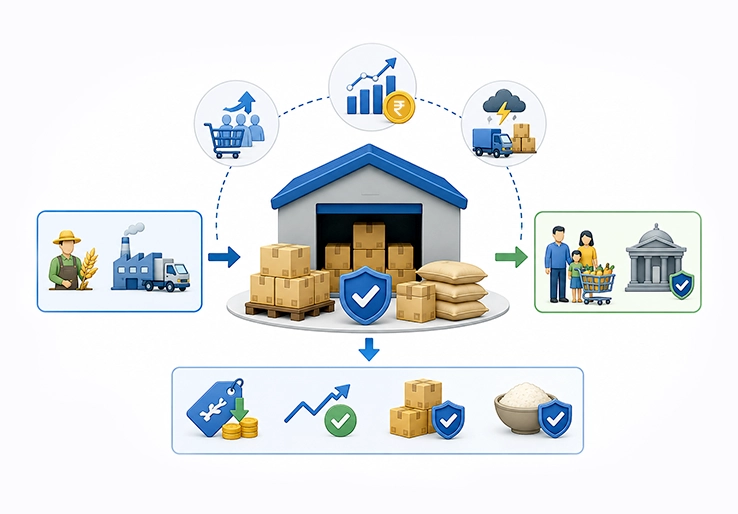
Buffer stock refers to a reserve of goods kept ready to stabilize prices, absorb demand fluctuations, and maintain supply when markets or supply chains become uncertain. In inventory management, buffer stock acts as surplus inventory to meet unexpected demand, while in public policy a buffer stock scheme is used to stabilize prices and ensure food security for essential goods like agricultural crops.
This guide covers government buffer stock schemes, business buffer inventory, price stabilization, food security programs, and practical calculation methods. It also explains what falls outside the scope: advanced econometric modeling and highly specialized commodity pricing models are not covered in depth. The article is written for business managers, supply chain professionals, policy makers, and economics students who need a practical understanding of buffer stock management.
You will learn how to:
Buffer stock is a strategic reserve held by governments or businesses to manage supply and demand imbalances. Governments create buffer stocks to stabilize market prices, protect vulnerable populations, and prevent food shortages. Businesses maintain buffer stock to fulfill customer orders, avoid lost sales, and keep operations stable during supply chain disruptions.
The terms buffer stock and safety stock are often used together, but they are not always identical. Buffer stock often focuses on demand-side risks such as sudden demand spikes, promotional surges, or seasonal market fluctuations. Safety stock addresses supply-side uncertainties like delays, supplier disruptions, and unreliable replenishment. Both buffer and safety stock prevent stockouts, support customer satisfaction, and help maintain minimum stock levels.
Buffer stock is especially important where price fluctuations can harm producers, consumers, or businesses. In agriculture, buffer stock controls inflation by keeping consumer prices steady for essential goods. In supply chain management, buffer inventory absorbs unexpected demand increases so companies can continue meeting customer demand without interrupting sales or production.
A buffer stock is surplus inventory held above regular stock levels to meet unexpected demand, stabilize prices, or respond to low supply. Buffer stock is primarily used for essential goods like agricultural crops, food grains, petroleum, raw materials, and high-demand finished products.
The core mechanism is simple. Governments buy goods during high supply to prevent prices from dropping too sharply. Agencies buy excess commodities during oversupply to prevent price crashes, especially when surplus production or surplus grain could push the market price below a fair level for farmers. Governments then sell stored goods during low supply to prevent price spikes. Agencies release stored commodities during shortages to prevent price spikes and protect consumers.
This approach is a form of active market intervention. A buffer stock scheme regulates supply by adding demand when markets are oversupplied and adding supply when markets are short. Buffer stocks stabilize prices by regulating supply and demand, and buffer stock schemes stabilize prices by regulating supply across market cycles.
Historically, this idea is linked to the "ever-normal granary," where grain reserves were accumulated during good harvests and released during scarcity. Modern examples include food grain procurement, strategic petroleum reserves, and agricultural commodity stock schemes. In manufacturing, a similar logic applies when a company stores extra raw materials or finished products to avoid production stoppages or delivery failures.
Buffer stock smooths out market fluctuations caused by unpredictable factors such as weather, war, natural disasters, fuel shocks, supplier delays, and changing customer demand. It can prevent extreme price fluctuations in markets, reduce the risk of food shortages, and support a more balanced market.
Government and business buffer stock systems use a similar reserve-based logic, but their objectives differ.
Government buffer stock schemes focus on public welfare, food security, inflation control, market regulation, and price control. A government may use a minimum support price to protect farmers, buy essential food grains during bumper harvests, and release stored grain through the public distribution system when food availability becomes uncertain. Price floors protect producers by setting a minimum price, while price ceilings protect consumers by setting a maximum price.
Business buffer stock systems focus on operational efficiency, customer satisfaction, and cost savings. Companies keep buffer inventory to prevent stockouts during demand spikes, handle supply chain disruptions, support promotions, and fulfill customer orders on time. For example, a retailer may carry additional stock before a festival season, while a manufacturer may hold extra raw materials when supplier lead times are unstable.
The scale also differs. Governments manage national food security, essential commodities, storage infrastructure, and public budgets. Businesses manage SKU-level stock levels, warehouse storage capacity, average demand, average lead time, maximum lead time, and inventory carrying costs through inventory management systems or ERP software.
The next section shows how these principles work in real applications, from India's food corporation system to business safety stock planning.
Buffer stock applications can be divided into three practical areas: government food security programs, business inventory management, and price stabilization mechanisms. In each case, buffer stock acts as a safety net against uncertainty, but the design depends on the objective.
For governments, maintaining buffer stock supports food availability and affordable prices. For companies, maintaining buffer stock helps prevent stockouts, protect revenue, and preserve customer satisfaction. For commodity markets, buffer stocks stabilize prices by regulating supply during market fluctuations.
Government food security programs use buffer stock to prevent food shortages, ensure food security, and protect poorer populations from famine or hyperinflation. Buffer stocks are used to maintain food security during shortages, and buffer stock ensures a continuous food supply during disasters.
India is one of the most important examples. The Food Corporation of India, also called Food Corporation of India FCI or Corporation of India FCI in policy discussions, procures and stores food grains such as rice and wheat. These reserves support the Public Distribution System, the Targeted Public Distribution System, and welfare obligations connected with the National Food Security Act. The goal is ensuring subsidized food reaches eligible households at affordable prices.
The Food Corporation of India maintains central pool stocks for operational requirements and strategic reserve needs. Buffer stock norms define how much grain should be available at different times of the year. These buffer stock norms include operational stock for regular welfare schemes and a strategic reserve for emergencies.
Government releases grains when open market availability is low or food prices rise sharply. Under mechanisms such as the Open Market Sale Scheme, stored grain can be released into the market to stabilize prices and prevent food shortages. This is especially important when agricultural production falls short due to drought, floods, pest attacks, or other natural disasters.
In business, buffer stock is used to handle demand surges, promotions, supply delays, and unpredictable customer demand. Buffer stock prevents shortages during unexpected demand spikes and helps maintain customer satisfaction during demand fluctuations.
A business buffer stock level is usually set above cycle stock. Cycle stock covers expected demand between orders, while buffer inventory protects against uncertainty. Safety stock protects against supplier disruptions, while buffer stock is often used for demand surges during promotions or seasonal peaks. Both buffer and safety stock prevent stockouts.
For example, an e-commerce company may increase stock levels before a holiday sale because customer demand can rise suddenly. A manufacturer may keep extra raw materials because international shipments can be delayed. A distributor may store excess inventory for high-value items where lost sales would be expensive.
The key is balance. Too little buffer stock causes stockouts and lost sales. Too much buffer stock creates excess inventory, higher storage costs, and tied-up working capital. Modern inventory management systems help monitor average demand, stock levels, reorder points, and buffer stock performance.
Price stabilization is one of the most important reasons governments use buffer stock. A buffer stock scheme can stabilize markets by buying surplus commodities when supply is high and selling stored commodities when supply is low.
The mechanism usually works through a price band:
This system supports stable prices and market stability. It also encourages continued agricultural production by protecting farmers from severe price crashes. Buffer stock guarantees income for agricultural workers during bumper harvests when oversupply would otherwise reduce prices sharply.
Examples include food grain stock schemes, cocoa buffer stocks, and other commodity price stabilization programs. International commodity agreements for tin, coffee, cocoa, and other goods have attempted to stabilize prices through stock schemes, although many faced high costs and implementation difficulties.
Buffer stock schemes can reduce the risk of food shortages and protect poorer populations from famine or hyperinflation. However, they must be designed carefully because market distortion from buffer stocks can encourage overproduction, weaken private sector participation, and create unsustainable excess stock.
Discover Stock Management Now Get a Free Demo| Aspect | Buffer Stock | Safety Stock |
|---|---|---|
| Definition | Excess inventory kept to meet unexpected demand surges | Additional inventory reserved to handle supply-side uncertainties |
| Primary Purpose | To absorb sudden increases in customer demand | To protect against supply chain disruptions such as delays or supplier issues |
| Focus Area | Demand-side risks (e.g., promotional spikes, seasonal demand) | Supply-side risks (e.g., transportation delays, supplier problems) |
| Usage Context | Used during unexpected demand surges | Used during supply chain disruptions |
| Common Scenarios | Promotions, holiday seasons, sudden market demand spikes | Supplier delays, transportation issues, natural disasters affecting supply |
| Goal | Ensure sufficient inventory to meet unexpected demand and avoid stockouts | Ensure sufficient inventory to maintain operations during supply disruptions |
| Outcome | Prevents stockouts due to demand fluctuations | Prevents stockouts due to supply uncertainties |
| Aspect | Buffer Stock | Anticipation Inventory |
|---|---|---|
| Purpose | To meet unexpected increases in demand | To meet expected or forecasted increases in demand |
| Demand Type | Unpredictable demand surges | Predictable demand increases |
| Usage Scenario | Sudden market demand spikes, promotions | Seasonal sales peaks, holiday seasons |
| Inventory Planning | Maintained as a safety cushion | Planned based on forecasts and demand projections |
| Risk Management Focus | Absorbs demand fluctuations | Prepares for known future demand |
Once the purpose of buffer stock is clear, the next step is deciding how much to hold. A buffer stock level should be large enough to absorb demand fluctuations and supply risk, but not so large that it creates waste, storage pressure, or unnecessary capital lock-in.
Buffer stock calculation requires knowing lead times for items, average demand, demand variability, average lead time, maximum lead time, storage capacity, holding costs, and acceptable stockout risk. In business settings, the safety stock formula estimates extra inventory needed for demand fluctuations and replenishment uncertainty.
Businesses and governments need precise buffer stock levels when goods are essential, demand is volatile, supply is uncertain, or storage costs are high. A fixed buffer stock maintains a constant amount above regular stock levels, but more advanced methods adjust stock dynamically based on data.
Review daily, weekly, or monthly demand. Identify average demand, average daily usage, peak demand, promotions, and seasonal demand fluctuations.
Measure average lead time, maximum lead time, and supplier reliability. Buffer stock calculation requires knowing lead times for items because delays directly affect stockout risk.
Choose a target service level, such as 90%, 95%, or 99%. Higher service levels reduce stockouts but increase buffer stock and carrying costs.
Compare formula outputs with warehouse space, storage capacity, spoilage risk, capital cost, and the financial impact of lost sales.
An effective buffer stock strategy depends on decision-makers accurately determining the optimal inventory levels a business should maintain. Without this precision, a company risks either overspending on excess inventory or facing stockouts. Various methods are available to calculate buffer stock levels, and the best choice depends on the specific needs of the business. It is important to note that nearly all these calculation approaches require knowledge of the lead times for the items involved.
The safety stock formula is the most basic method for determining buffer stock levels for a specific item. While effective for simple cases, it may lack nuance for more complex situations.
This calculation multiplies the average daily usage of an item by its average lead time, then subtracts this from the product of the maximum daily usage and maximum lead time. The resulting figure indicates the required buffer stock.
By comparing the maximum scenario to the average, this formula estimates the buffer stock needed to handle demand peaks or extended lead times.
Example: Consider an electronics retailer determining buffer stock for a popular smartphone model.
Buffer stock = 350 units – 150 units = 200 units
This means the retailer should maintain 200 units as buffer stock to cover maximum demand over the longest lead time, ensuring stock availability even if supplier deliveries are delayed.
Developed by Jay Heizer and Barry Render, this method is useful for companies facing inconsistent supplier delivery times rather than demand variability.
Here, σLT measures how much delivery times deviate from the average. The service level factor (Z) reflects the desired probability of avoiding stockouts. Higher Z values increase buffer stock and security but also raise carrying costs.
Example: Using the smartphone retailer's data:
Buffer stock = 1.65 × 2 = 3.3 days of sales
If the retailer sells 20 smartphones per day, buffer stock = 3.3 × 20 = 66 units. This stock covers variability in supplier lead times with a 95% confidence level.
Andrew Greasley’s method builds on Heizer and Render’s by also factoring in average demand. The formula is:
This approach is ideal when both demand and lead times fluctuate significantly. It provides a tailored buffer stock estimate based on product consumption rates and supply uncertainty.
Example: For the smartphone retailer:
Buffer stock = 2 × 20 × 1.65 = 66 units
Fixed buffer stock maintains a constant extra inventory above regular stock levels to protect against demand or supply fluctuations. It is often set as a percentage of regular stock based on historical data or expert judgment, making it simple and popular for smaller businesses or less critical items.
Example: If the retailer's regular stock is 500 units, and management decides on a 10% buffer:
Buffer stock = 500 × 0.10 = 50 units
Thus, the retailer keeps 50 units as fixed buffer stock in addition to regular inventory.
This approach determines safety stock levels by analyzing past sales and inventory data, including order patterns, turnover rates, and SKU performance across locations and channels. It helps businesses tailor buffer stock to actual demand fluctuations, seasonality, and supply chain dynamics.
By leveraging historical data, companies can balance minimizing stockouts with avoiding excess inventory costs, resulting in more effective and responsive inventory management.
Common formulas include:
Heizer and Render's method uses standard deviation of lead time for calculations, making it useful when supplier timing is uncertain. Greasley's method incorporates average demand in buffer stock calculations, which helps estimate the inventory needed when demand and replenishment patterns interact.
| Method | Best For | Complexity | Data Requirements |
|---|---|---|---|
| Fixed Percentage | Stable demand products | Low | Basic historical sales |
| Safety Stock Formula | Variable demand/lead time | Medium | Demand variability, lead times |
| Service Level Approach | Customer service targets | High | Statistical demand analysis |
A fixed percentage or fixed buffer stock method works for low-risk products with stable demand. The basic safety stock formula works when maximum lead time and average daily usage are known. A service level approach is better for businesses that need high customer satisfaction, precise cost control, and reliable stockout protection.
For many companies, the best approach is segmentation. High-value or high-risk SKUs should use statistical models. Stable, low-value SKUs can use simpler fixed percentage rules. ERP and inventory management systems can automate recalculation so buffer stock management stays aligned with customer demand, lead time changes, and supply chain conditions.
Buffer stock is useful, but it is not free. Maintaining buffer stock involves financial costs, storage constraints, quality risks, forecasting errors, and policy trade-offs. Poor buffer stock management can create excess inventory, spoilage, inefficient procurement, and distorted market signals.
High financial costs for buffer stock procurement require substantial investment. Maintaining large inventories for buffer stock ties up government funds, while high costs for buffer stock include storage and maintenance expenses. For businesses, carrying excess inventory also ties up working capital that could be used elsewhere.
Inventory holding costs often include warehousing, insurance, financing, handling, shrinkage, and obsolescence. Large buffer stocks can protect supply, but they can also reduce cost savings if stock is not actively managed.
Solution:
The solution is to optimize rather than simply increase stock. Use just-in-time principles where appropriate, improve supplier reliability, segment SKUs, recalculate buffer stock regularly, and improve storage facilities for cost efficiency. Businesses should compare the cost of holding stock with the cost of stockouts, lost sales, and missed customer demand.
Perishables and grains are vulnerable to spoilage and quality degradation. Food items can spoil or degrade in quality if kept too long, especially when storage infrastructure is poor or rotation is weak.
This is a major issue in food grains, fresh produce, pharmaceuticals, and temperature-sensitive products. Buffer stock may ensure food availability, but if stored goods deteriorate, the reserve loses value and may fail during emergencies.
Solution:
The solution is strict FIFO rotation, quality inspection, cold storage where needed, pest control, moisture management, and better warehouse monitoring. Governments should align buffer stock norms with shelf life and storage capacity. Businesses should use batch tracking, expiry alerts, and automated inventory management systems to reduce waste.
Forecast errors can make buffer stock too low or too high. If demand is underestimated, businesses face stockouts, lost sales, and lower customer satisfaction. If demand is overestimated, businesses accumulate excess stock and higher carrying costs.
Buffer stock absorbs demand fluctuations, but it cannot replace good forecasting. Demand planning should include seasonality, promotions, market trends, customer behavior, and supply chain disruptions. Buffer stock is used for demand surges during promotions, so promotional plans should be included before setting stock levels.
Solution:
The solution is to use advanced analytics, demand sensing, rolling forecasts, and machine learning where practical. Regularly compare forecasted demand with actual demand, update safety stock formulas, and adjust buffer stock levels when market fluctuations change.
Higher service levels reduce stockouts but increase buffer stock. A 99% service level may be necessary for critical medical supplies, essential food grains, or strategic reserve items, but it may be too expensive for slow-moving commercial products.
Governments must balance price stability, food security, fiscal cost, and market regulation. Businesses must balance customer satisfaction, storage capacity, working capital, and profitability.
Solution:
The solution is to set clear service level targets by item category. Essential items should have higher buffers. Non-critical products can use lower safety stock. Review stock levels, service levels, and cost benchmarks regularly to ensure buffer stock serves its purpose without creating unnecessary excess inventory.
The main purpose of maintaining buffer stock is to protect a business from sudden increases in demand that cannot be met with regular inventory levels. Therefore, it plays a vital role in any inventory management strategy.
Determining the optimal amount of buffer stock enhances business stability by minimizing the risk of stockouts while preventing overstocking, which can lead to higher holding costs and reduced profitability. Instead of inventory managers scrambling to respond to unexpected demand spikes, a well-planned buffer stock strategy helps maintain operational efficiency, control production expenses, and, most importantly, ensure customer satisfaction.
Advanced Stock Optimization Now Get a Free DemoWhile the advantages of maintaining buffer stock are clear, deciding on the appropriate quantity can be complex. To make informed, data-driven decisions about the amount of additional inventory to hold, several key factors and capabilities must be considered:
Reliable demand forecasting is essential for estimating the right buffer stock levels and timing purchases. Although buffer stock is meant to handle unexpected demand surges, better forecasting helps avoid excessive inventory and related costs while effectively managing risk.
Understanding the lead time — the total duration for production and transit — is crucial when planning buffer stock. Most calculation methods incorporate lead times, so accurately knowing this helps ensure buffer stock arrives when needed, avoiding early or late replenishment.
Buffer stock should not remain idle indefinitely; it must be used to meet increased demand and then replenished. Developing clear inventory replenishment plans that specify refill frequency is vital for effective buffer stock management.
The shelf life of items held as buffer stock is a critical consideration. Perishable goods like fresh produce, meat, and dairy have limited usability periods, requiring careful planning to minimize spoilage and ensure availability when needed.
Overstocking seasonal items such as winter coats, summer swimwear, or popular holiday toys can lead to significant losses due to discounting, write-offs, or extended storage costs. Therefore, seasonality must be factored into buffer stock levels, adjusting inventory to align with expected demand fluctuations throughout the year.
Buffer stock acts as a safeguard in an unpredictable market, helping to prevent shortages during unexpected spikes in demand. Although maintaining extra inventory without a precise timeline for usage incurs costs, the benefits it provides are significant, including:
Unexpected surges in demand can disrupt supply chains and sales. Buffer stock helps mitigate the risk of running out of essential goods, raw materials, or components by compensating for inaccuracies in demand forecasting.
Stockouts often lead to increased expenses due to urgent orders and expedited shipping. Maintaining buffer inventory stabilizes costs, thereby enhancing financial performance.
Purchasing additional inventory can benefit suppliers, who may offer discounts as incentives for larger orders, reducing overall procurement costs.
Extra inventory cushions production lines against sudden demand increases, preventing costly halts caused by material shortages.
Consistent production helps maintain stable employment. Avoiding production stoppages reduces the risk of layoffs or employee turnover caused by job insecurity.
Buffer stock provides companies with greater resilience against demand fluctuations and supply chain disruptions, enabling more accurate forecasting, improved operational efficiency, and better customer service.
Having buffer stock allows businesses to respond effectively to demand surges or special orders. It also facilitates bulk purchases, which can lead to cost savings through supplier discounts.
LOGIC ERP Buffer Stock Management Software offers a comprehensive solution designed to optimize inventory levels, reduce carrying costs, and enhance supply chain resilience. By leveraging advanced analytics and real-time data integration, LOGIC ERP enables businesses and governments to accurately calculate and maintain optimal buffer stock levels tailored to their unique demand patterns and lead times.
The software supports automated monitoring of stock levels, alerts for replenishment needs, and seamless integration with procurement and distribution processes. This ensures timely interventions to prevent stockouts or overstock situations, improving operational efficiency and customer satisfaction.
Additionally, LOGIC ERP's user-friendly interface and customizable dashboards provide actionable insights, helping decision-makers balance service levels with cost constraints effectively. Its scalability makes it suitable for diverse industries, from agriculture and food security programs to manufacturing and retail.
Choosing LOGIC ERP means gaining a reliable partner in buffer stock management that not only stabilizes prices and secures supply but also drives strategic inventory planning for sustainable growth and risk mitigation.
Book a Free ERP Demo Now Book a Free ConsultationBuffer stock is an essential tool for price stabilization, supply security, and risk management. It helps stabilize prices, prevent food shortages, protect farmers and consumers, absorb demand fluctuations, and reduce the impact of supply chain disruptions.
For governments, buffer stock management supports food security, price control, and emergency response. For businesses, buffer inventory protects customer satisfaction, helps fulfill customer orders, and reduces lost sales during demand spikes or supplier delays. The main challenge is finding the right balance between protection and cost.
Next steps:
Related areas worth exploring include advanced inventory optimization, supply chain resilience planning, public distribution system design, agricultural market regulation, and government policy analysis for strategic reserve planning.
Call at +91-73411-41176 / +91-73411-41175 or send us an email at sales@logicerp.com to book a free demo today!
Buffer stock is a reserve of goods or commodities held by governments or businesses to stabilize prices, manage supply and demand fluctuations, and ensure continuous availability during unexpected market changes or supply chain disruptions.
Buffer stock helps stabilize prices by buying excess supply when market prices fall and releasing stock when prices rise, thereby preventing extreme price fluctuations and protecting both consumers and producers.
Buffer stock primarily addresses demand-side uncertainties like sudden demand spikes, while safety stock is held to mitigate supply-side risks such as supplier delays or transportation disruptions; both aim to prevent stockouts but focus on different aspects.
Buffer stock ensures a continuous supply of essential food grains during shortages caused by natural disasters, crop failures, or market disruptions, thereby preventing famine and protecting vulnerable populations.
Governments manage buffer stock through procurement during surplus production, storage in warehouses, and releasing stock during shortages or price spikes, often using minimum support prices and public distribution systems.
Maintaining buffer stock involves high storage and carrying costs, risks of spoilage especially for perishables, forecasting inaccuracies, and potential market distortions that may encourage overproduction.
Buffer stock calculation involves analyzing average demand, maximum and average lead times, demand variability, and desired service levels using formulas such as the safety stock formula or statistical methods like Heizer and Render’s or Greasley’s method.
Yes, buffer stock can be applied to non-food essential goods such as petroleum, raw materials, and critical manufacturing components to ensure supply continuity and price stability.
Buffer stock helps businesses prevent stockouts during demand surges, maintain customer satisfaction, reduce lost sales, and manage supply chain disruptions effectively.
By regulating supply through strategic buying and selling, buffer stock schemes reduce price volatility, protect producer incomes, and ensure affordable prices for consumers.
Buffer stock is the extra inventory that a company holds to protect against unexpected surges in demand. This reserve stock ensures that businesses can fulfill customer orders without running out, enabling smoother operations and higher customer satisfaction during periods of variable demand.
A toy retailer keeping additional units of popular products before the holiday season, beyond their usual sales forecast, is an example of buffer inventory. This surplus helps the retailer handle sudden increases in demand and avoid stockouts.
Carrying buffer stock offers advantages such as price stability, opportunities for supplier discounts, prevention of shortages and stockouts, and enhanced strategic planning.
In medical contexts, buffer stock refers to the extra supplies of medications, equipment, or medical materials that healthcare facilities maintain to manage unexpected demand spikes or supply chain interruptions. This ensures continuous patient care during emergencies or unforeseen events.
A level business maintains a steady production rate over time, regardless of demand fluctuations. Such companies typically keep some buffer stock to accommodate demand changes and supply chain uncertainties without significantly increasing inventory holding costs, aligning with their goal of predictable operations.
A buffer stock scheme is a government or organizational program designed to stabilize market prices and supply by buying excess stock during periods of surplus and releasing stock during shortages, thereby managing demand fluctuations effectively.
Buffer stock helps manage demand fluctuations by maintaining a reserve inventory that can be deployed during sudden spikes in demand or supply shortages, ensuring consistent availability and preventing stockouts.
The optimal buffer stock level depends on factors such as average demand, variability in demand, lead times, supply reliability, and the acceptable risk of stockouts, balancing cost with service level goals.
Buffer stock generally refers to surplus reserves held for price stabilization and supply security, often by governments, while buffer inventory is the extra stock businesses keep to handle demand variability and supply delays in daily operations.
The Food Corporation, such as the Food Corporation of India (FCI), plays a critical role in procuring, storing, and distributing essential food grains to maintain buffer stock, ensuring food security and stabilizing prices for vulnerable populations.
The Food Corporation, such as the Food Corporation of India (FCI), plays a critical role in procuring, storing, and distributing essential food grains to maintain buffer stock, ensuring food security and stabilizing prices for vulnerable populations.
By maintaining adequate reserves of essential commodities, buffer stock ensures food security by providing a continuous supply during crop failures, natural disasters, or market disruptions, preventing shortages and price spikes.
Buffer stock norms are government-defined guidelines that specify the minimum and maximum quantities of commodities to be maintained in reserve to ensure effective supply management and price stabilization.
The Corporation of India FCI is responsible for implementing buffer stock policies by procuring food grains at minimum support prices, managing storage, and distributing stocks through public programs to maintain market stability.
Buffer stock positively impacts customer satisfaction by preventing stockouts during demand surges, ensuring product availability, stabilizing prices, and supporting reliable supply chains for both consumers and businesses.
Buffer stock is a reserve inventory of goods held by governments or businesses to stabilize prices, manage supply-demand fluctuations, and ensure continuous availability during unexpected market changes or supply chain disruptions.
Buffer stock is surplus stock maintained above regular inventory levels to meet unforeseen demand surges, prevent stockouts, and stabilize market prices, especially for essential commodities like food grains.
Buffer stock refers to extra inventory kept as a cushion against demand spikes or supply disruptions, ensuring smooth operations and price stability.
In inventory management, buffer stock is an additional quantity of stock kept to absorb fluctuations in demand or supply delays, preventing stockouts and maintaining service levels.
In economics, buffer stock is a stockpile of commodities held to regulate market prices by buying during surplus and selling during shortages, thus stabilizing prices and supply.
Buffer Stock is the Level of Stock MCQ.
Useful resources for deeper implementation include:
Popular Products