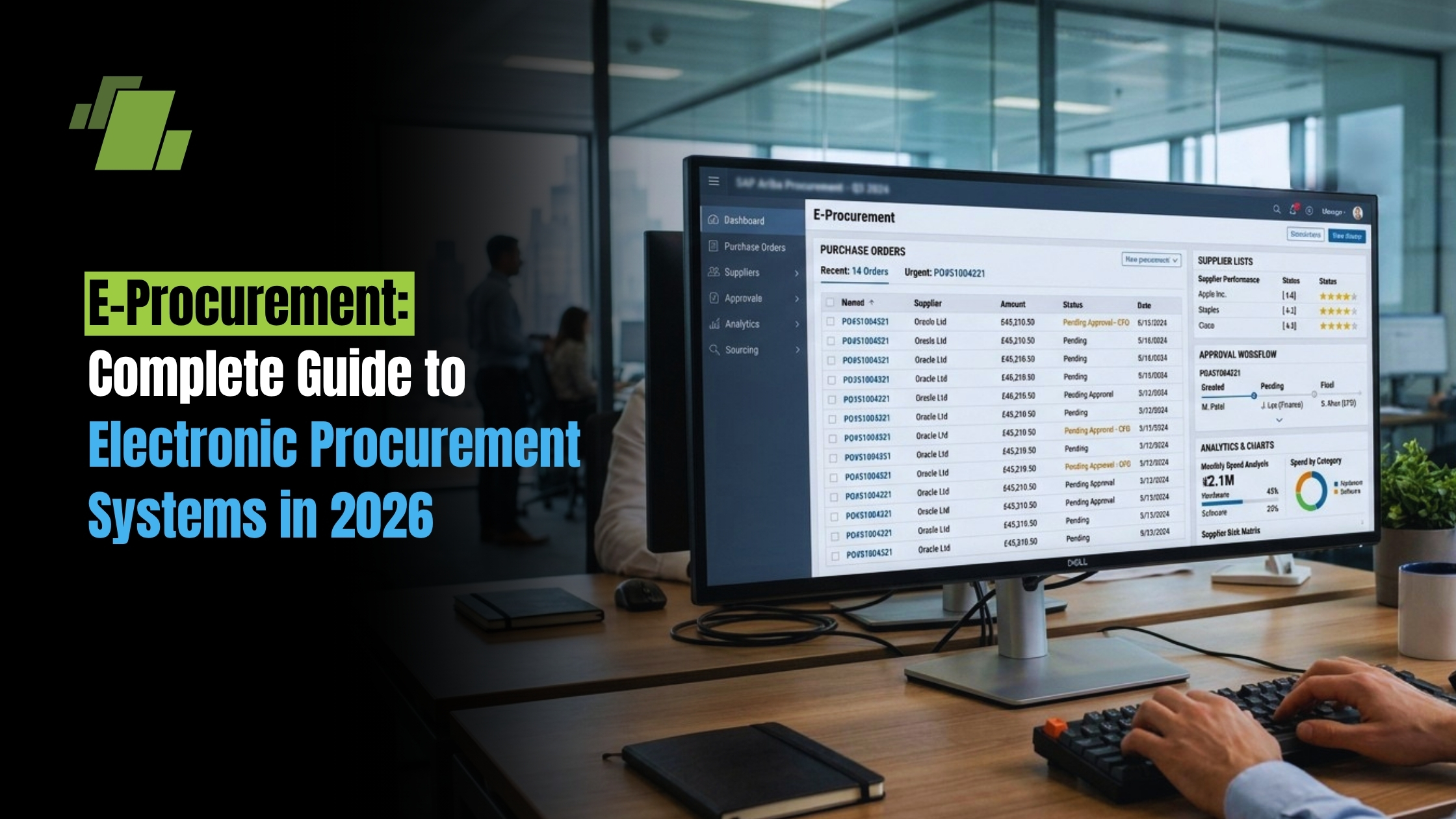
E-Procurement: Complete Guide to Electronic Procurement Systems in 2026

Summary
E-procurement systems digitize and automate the procurement process, helping businesses reduce costs, improve efficiency, enhance supplier management, and gain real-time visibility through advanced procurement software and analytics.
Table of content
- Introduction to E-Procurement Systems
- Understanding Electronic Procurement Fundamentals
- Core Components of E-Procurement and Tender Schedule
- Types of E-Procurement Solutions
- Key Features and Capabilities of E-Procurement Platforms
- Supplier Portal Integration and Online Bid Submission
- Spend Analytics and Real-Time Reporting
- E-Procurement Implementation Best Practices
- Platform Comparison: Cloud vs On-Premise vs ERP Integration
- Common Challenges and Solutions in E-Procurement Adoption
- Government E-Procurement Systems Overview
- Tender Opportunities and Bid Submission Deadlines in 2026
- Cost Savings and Efficiency Gains with E-Procurement
- Future Trends: AI and Automation in Procurement
- Conclusion and Next Steps for Successful E-Procurement
Introduction to E-procurement System
E-procurement is the digital transformation of traditional procurement processes, replacing paper-based purchasing workflows with automated, integrated electronic systems that manage everything from requisition to payment. Welcome to e-procurement system technology that has fundamentally reshaped how organizations source goods, manage suppliers, and control spending across concerned departments.
This guide covers procurement software platforms, digital workflows, supplier management portals, and automated purchasing systems designed for the information technology department, finance department, and procurement teams. The target audience includes procurement managers seeking process efficiency, finance teams requiring spend visibility, business owners evaluating digital transformation, and IT decision-makers assessing system integration requirements. Whether you’re implementing your first e-procurement platform or upgrading existing systems, understanding these technologies directly impacts cost control, compliance, and supplier relationships.
E-procurement is the use of digital technology to automate and streamline the entire procurement process from requisition to payment, enabling organizations to submit the bids online, manage approvals electronically, and maintain complete audit trails through a centralized platform.
By the end of this guide, you will gain:
- Cost reduction strategies through automated purchasing and spend analytics
- Process efficiency improvements via digital workflows and approval automation
- Supplier relationship management techniques using integrated vendor portals
- Compliance benefits from audit trails and policy enforcement mechanisms
- ROI measurement frameworks for evaluating e-procurement investments
Understanding Electronic Procurement Fundamentals
E-procurement encompasses all digital technologies and platforms that automate the procurement lifecycle from initial purchase requisitions through supplier selection, purchase order management, receiving, invoicing, and payment processing. These systems replace manual, email-driven, and paper-based workflows with structured digital processes that provide transparency, control, and measurable efficiency gains.
Traditional procurement relies on paper forms, phone calls, fragmented email chains, and manual tracking spreadsheets. This approach creates slow cycle times, limited spend visibility, inconsistent supplier data, and weak audit trails. E-procurement addresses these limitations through centralized digital catalogs, automated approval routing, real-time spend dashboards, and integrated supplier portals. Organizations using electronic procurement typically reduce transaction processing time by up to 80% compared to manual methods.
Core Components of E-Procurement and Tender Schedule
Digital catalogs compile approved, contracted goods and services with negotiated vendor pricing, enabling users to select items without unauthorized purchases. Purchase requisitions trigger automated workflows that route requests through budget checks, multi-level approvals, and exception handling before generating purchase orders. These approval workflows enforce spending policies, delegation authorities, and compliance requirements automatically.
The tender schedule functionality enables the tenderers to download specifications, review requirements, and submit the bids online through structured RFx processes (RFI, RFQ, RFP). Organizations can download the tender schedule free of cost to evaluate opportunities, with bid opening date and closing date clearly defined for transparency. This structured approach replaces informal negotiations with documented, auditable sourcing events.
Types of E-Procurement Solutions
Cloud-based solutions deliver e-procurement via subscription (SaaS), requiring no in-house infrastructure. Implementation typically spans 3-6 months with pre-built connectors and automatic updates. On-premise systems require higher upfront capital expenditure for hardware, licenses, and internal staff, with implementation often extending 9-18 months.
ERP-integrated modules (within SAP, Oracle, Microsoft Dynamics) provide seamless data flows for master data, financials, and budgeting. Stand-alone platforms offer greater flexibility, faster innovation cycles, and lighter footprints for organizations not requiring deep ERP integration.
The optimal choice depends on organizational size, geographic distribution, supplier base complexity, regulatory environment, data security requirements, and existing legacy systems. Cloud solutions often deliver 66-71% lower total cost of ownership over 10 years compared to on-premise deployments.
E-Procurement System Features and Capabilities
Modern e-procurement platforms extend far beyond basic purchase order automation, incorporating sophisticated features that transform procurement from a transactional function into a strategic business enabler. Understanding these capabilities helps organizations evaluate platforms against specific operational requirements.
Automated Purchase Order Management and Bid Opening Date
Systems generate purchase orders automatically once requisitions receive approval, with PO data flowing to suppliers via integrated portals or EDI connections. Automated PO management handles versioning, change orders, supplier acknowledgments, and status tracking throughout the order lifecycle. Supplier notifications trigger when POs are raised, modified, or require attention eliminating manual follow-up and reducing cycle times by 50-60% in documented implementations.
Three-way matching automatically reconciles purchase orders, goods receipts, and invoices, flagging discrepancies for review while processing compliant transactions without intervention. This automation reduces invoice processing costs while improving accuracy and compliance.
Supplier Portal Integration to Submit the Bids Online
Supplier portals allow vendors to register, update profile and compliance documents, maintain catalog entries, and participate in bidding events online through this portal. The certifying agency search functionality enables verification of supplier credentials, while agency search tools help identify qualified vendors meeting specific requirements.
Real-time collaboration features include messaging, milestone tracking, and document sharing that improve responsiveness and reduce miscommunication. Suppliers gain visibility into order status, payment timelines, and performance metrics strengthening relationships and reducing inquiry volumes. Organizations should ensure screen resolution compatibility and support Hindi voice options for diverse supplier bases operating across India designed, developed and hosted platforms.
Spend Analytics and Reporting
Real-time dashboards display spend by category, business unit, supplier, and contract status. Alerts trigger when spending exceeds thresholds or deviates from contracted terms. Analytics tools forecast demand, identify savings opportunities, and expose maverick spend occurring outside approved channels.
Latest tenders updates every 15 mins and latest corrigendum updates every 15 minutes ensure stakeholders access current information for time-sensitive decisions. Corrigendum updates every 15 minutes helps procurement teams respond to specification changes promptly, while tenders updates every 15 minutes enables timely bid submissions.
ESG and risk metrics increasingly integrate into procurement analytics tracking supplier certifications, emission scoring, labor standards compliance, and diversity metrics. Approximately 75% of purchasing departments now maintain precise CSR/ESG objectives, with procurement platforms selected specifically for compliance capabilities.
E-Procurement Implementation and Best Practices
Successful e-procurement deployment requires systematic planning, stakeholder alignment, and structured change management. Organizations that approach implementation methodically achieve faster time-to-value and higher adoption rates than those pursuing rapid, unstructured rollouts.
Implementation Process
Implementation begins with comprehensive assessment of current procurement workflows, identifying pain points such as manual tasks, approval delays, off-contract spending, and supplier performance issues.
- Assess current procurement processes and identify pain points: Map existing workflows across requisition, approval, ordering, receiving, and payment. Document cycle times, error rates, compliance gaps, and user frustrations. Quantify baseline metrics for ROI measurement.
- Define system requirements and select appropriate e-procurement platform: Prioritize must-have features including digital catalogs, RFx functionality, supplier portal, analytics dashboards, and integration requirements. Evaluate cloud versus on-premise deployment, mobile capabilities, security certifications, and vendor stability.
- Configure workflows, approval hierarchies, and supplier onboarding: Establish approval thresholds, delegation rules, exception handling procedures, and user roles. Define supplier registration requirements, document templates, and compliance verification processes. Ensure maximum characters limits and allowed special characters are configured appropriately for tender title reference and corrigendum title reference fields.
- Train users and establish change management procedures: Develop role-based training programs for requisitioners, approvers, buyers, and administrators. Identify champions within each business unit. Communicate benefits consistently and provide ongoing support resources.
- Go live with pilot program and scale organization-wide: Deploy initially within limited scope single business unit or spend category measuring cycle times, savings, compliance rates, and user satisfaction. Iterate based on feedback before expanding to full organizational deployment.
E-Procurement Platform Comparison
Platform selection requires evaluating deployment models against organizational constraints, technical requirements, and long-term strategic objectives.
| Step | Configuration | Description |
|---|---|---|
| 1 | Navigate to Party Wise Settings | Access configuration to define customer-specific discount slabs. |
| 2 | Define Item-Wise Slabs | Set discount slabs based on individual items. |
| 3 | Define Bill-Wise Slabs | Apply discounts based on total bill value. |
| 4 | Set Minimum Bill Value | Define threshold value for discount eligibility. |
| 5 | Choose Calculation Basis | Select Gross or Net amount for slab calculation. |
| 6 | Enable Item-Wise CD Option | Activate item-level discount application. |
| 7 | Link Slabs to Party/Group | Assign defined slabs to specific customers or groups. |
| 8 | Enable in Sales Order | Activate slab implementation during order entry. |
| 9 | Auto Apply Discount | System automatically applies eligible discounts. |
For SMEs or organizations with constrained capital budgets, cloud solutions typically deliver optimal value. Enterprises with strict data sovereignty requirements, heavy regulatory obligations, or substantial legacy ERP investments may prefer on-premise or hybrid deployments. Organizations prioritizing rapid deployment and continuous innovation often select standalone cloud platforms, while those requiring deep financial integration favor ERP-native modules.
Employees use internal, customized e-catalogs to select goods, with requests routed for digital approval based on budget and policy, reducing manual error and maverick spend.
The system holds all supplier communication, performance metrics, and contracts, enhancing transparency.
Common E-Procurement Challenges and Solutions
Implementation obstacles typically center on user behavior, supplier readiness, and technical integration. Addressing these challenges proactively improves adoption rates and accelerates return on investment.
User Adoption and Change Management
Resistance stems from unfamiliarity with new tools, disruption to established routines, and uncertainty about personal impact. Effective solutions include early stakeholder engagement across procurement, finance department, and operations teams. Role-based training programs address specific job functions rather than generic system overviews.
Phased rollouts allow users to adjust gradually while building confidence. Internal champions within each business unit provide peer support and demonstrate practical benefits. Simplified UX through guided workflows and intuitive catalog search with id title reference functionality reduces learning curves.
Supplier Onboarding and Integration
Large organizations often experience supplier onboarding delays extending to six months. Research indicates 53% of procurement professionals rate their supplier data quality as poor, with none rating it excellent. Challenges include manual document collection, inconsistent data formats, and varying supplier digital readiness.
Solutions include automated, self-service supplier portals with clear templates and verification workflows. Certifying agency integration enables automated credential verification. Incentive programs faster payment terms, preferential RFx participation, encourage supplier compliance. Multilingual portals with digital assistant capabilities and desk nic chat interface support improve accessibility for diverse supplier bases.
Data Migration and System Integration
Moving master data suppliers, catalog items, contracts while integrating with existing ERP and finance systems creates complexity. Common issues include format mismatches, duplicate records, missing data fields, and failed conversions. When conversion failed messages appear, systematic data cleanup and validation procedures prevent recurring problems.
Solutions require data audit and cleanup before migration, standardized coding structures (UNSPSC categories), comprehensive system mapping, and API-based integration architecture. Enter correct name and enter correct identifier validation rules during import prevent common errors. Thorough testing in pilot environments with representative data samples identifies issues before production deployment.
Conclusion and Next Steps
E-procurement systems deliver measurable benefits across cost reduction, process efficiency, compliance enforcement, and supplier relationship management. Organizations implementing electronic procurement typically achieve procurement cycle time reductions of 30-40%, with documented ROI ranging from 400-720% over multi-year periods.
The Government of India has implemented an eProcurement system to streamline procurement processes across various departments. This system allows for online submission of bids, enhancing transparency and efficiency in government procurement. As of 2026, the eProcurement system in Rajasthan includes features for managing tenders and bids electronically, improving accessibility for vendors. The Government of Tamil Nadu’s eProcurement system facilitates the submission of tenders online, which is expected to reduce processing time by up to 30%. The eProcurement system in Himachal Pradesh is designed to operate for a period of five years, focusing on the maintenance of state-wide networks.
Engaging in competitive bidding through e-auctioning involves suppliers underbidding each other to negotiate the best price and contract terms.
Immediate actionable steps:
- Assess current procurement processes, documenting baseline metrics for cycle time, off-contract spend percentage, and supplier performance
- Identify key stakeholders across procurement, finance, IT, and operations for evaluation committee participation
- Evaluate e-procurement platforms against organizational requirements using the comparison framework provided
- Develop business case quantifying expected savings, efficiency gains, and compliance improvements
Related topics for continued exploration include digital transformation strategy across enterprise operations, ERP integration architecture for unified business systems, and procurement compliance requirements including emerging ESG regulations and supply chain due diligence obligations.
Automation in Procurement
Automated workflows for requisitions, approvals, and purchase order generation can reduce procurement cycle times by 60–80%.
Additional Resources
E-procurement ROI Assessment Framework
- Calculate transaction cost savings from automation
- Quantify cycle time reduction value
- Measure compliance improvement impact
- Project supplier relationship benefits
Industry-Specific Compliance Requirements
- Contents owned and maintained by eprocurement system government platforms must meet public sector transparency requirements
- Healthcare procurement requires additional regulatory documentation
- Manufacturing supply chains face increasing ESG disclosure obligations
Integration Considerations
- API connectivity requirements for popular ERP systems
- EDI standards for supplier electronic data interchange
- Accounting platform integration for automated invoice processing
- C 2017 tenders nic compliant government procurement interfaces for public sector requirements
Call at +91-73411-41176 or send us an email at sales@logicerp.com to book a free demo today!
Frequently Asked Questions (FAQs) on E-Procurement
1. What is e procurement and how does it benefit organizations?
E procurement refers to the use of digital technology to automate and streamline the entire procurement process, from requisition to payment. It benefits organizations by reducing procurement cycle times, lowering costs through automation, enhancing compliance, and improving supplier management with real-time spend analytics.
2. How can e procurement systems reduce maverick spend and improve compliance?
E procurement platforms enforce company-wide procurement policies through automated approval workflows and centralized digital catalogs. This reduces unauthorized purchases (maverick spend) and ensures all transactions comply with contracts and legal requirements, enhancing auditability and transparency.
3. What are the key features to look for in an e procurement platform?
Essential features include automated purchase order management, supplier portal integration for online bid submission, real-time spend analytics, seamless ERP integration, and support for e-auctioning. These capabilities help organizations optimize procurement efficiency and cost control.
4. How does automation in e procurement contribute to cost savings?
Automation reduces manual paperwork and approval delays, cutting transaction costs by up to 80%. It accelerates tasks like price checks and invoice matching, leading to typical cost reductions of 25% compared to traditional procurement methods.
5. Can e procurement systems integrate with existing ERP software?
Yes, many e procurement platforms offer integration with popular ERP systems such as SAP, Oracle, and Microsoft Dynamics. This synchronization ensures accurate financial records, streamlined workflows, and consolidated data visibility across procurement and finance departments.
6. What role does AI play in modern e procurement solutions?
AI-powered tools analyze spending patterns and supplier performance, uncovering new savings opportunities and risk factors. Advanced analytics enable proactive decision-making and continuous procurement process improvement.
7. How do government e procurement systems enhance transparency and efficiency?
Government e procurement portals enable online tender publication, bid submission, and real-time tracking of procurement activities. This digital approach reduces processing time, minimizes corruption risks, and improves vendor accessibility across regions.
8. What steps should organizations follow to successfully implement an e procurement system?
Successful implementation involves assessing current processes, selecting the right platform, configuring workflows and supplier onboarding, training users, and scaling gradually. Change management and stakeholder engagement are critical for adoption and maximizing ROI.
9. How does e procurement support geographic and linguistic diversity in vendor bases?
Modern e procurement platforms support multilingual interfaces, voice-enabled options, and mobile compatibility to accommodate diverse suppliers. This inclusivity helps expand vendor participation and fosters competitive bidding.
10. Where can businesses find the latest tender opportunities and bid submission deadlines?
Government and enterprise e procurement portals regularly update tender schedules and corrigenda, often every 15 minutes. These platforms provide centralized access to procurement opportunities with clear submission dates and extension notices, helping vendors stay informed and competitive.

Author
Gurbir Singh
Co-founder & Managing Director | LOGIC ERP Solutions Pvt. Ltd.
With 30+ years of experience in the tech industry, I took the helm of technology & product development, ensuring LOGIC ERP’s continuous innovation & leadership in the evolving tech landscape.