Difference Between Financial Accounting and Management Accounting: Complete Guide for 2026

Summary
What is the difference between financial accounting and management accounting, and how can integrating both through ERP systems like LOGIC ERP improve accuracy, decision-making, and overall business performance?
Table of Content
- Introduction
- Understanding Financial and Management Accounting Fundamentals
- Financial Accounting Fundamentals
- Management Accounting Fundamentals
- Key Differences and Characteristics Analysis
- Purpose and Target Audience
- Reporting Standards and Compliance Requirements
- Time Focus and Data Types
- Detailed Comparison and Business Implementation
- Comprehensive Comparison Matrix
- Implementation in Modern ERP Systems
- Common Challenges and Solutions
- Data Integration and Consistency Issues
- Resource Allocation and Skill Requirements
- Balancing Compliance with Flexibility
- Why Choose LOGIC ERP Finance Management and Accounting Software for Your Business?
- Conclusion and Next Steps
- Frequently Asked Questions (FAQs)
Introduction
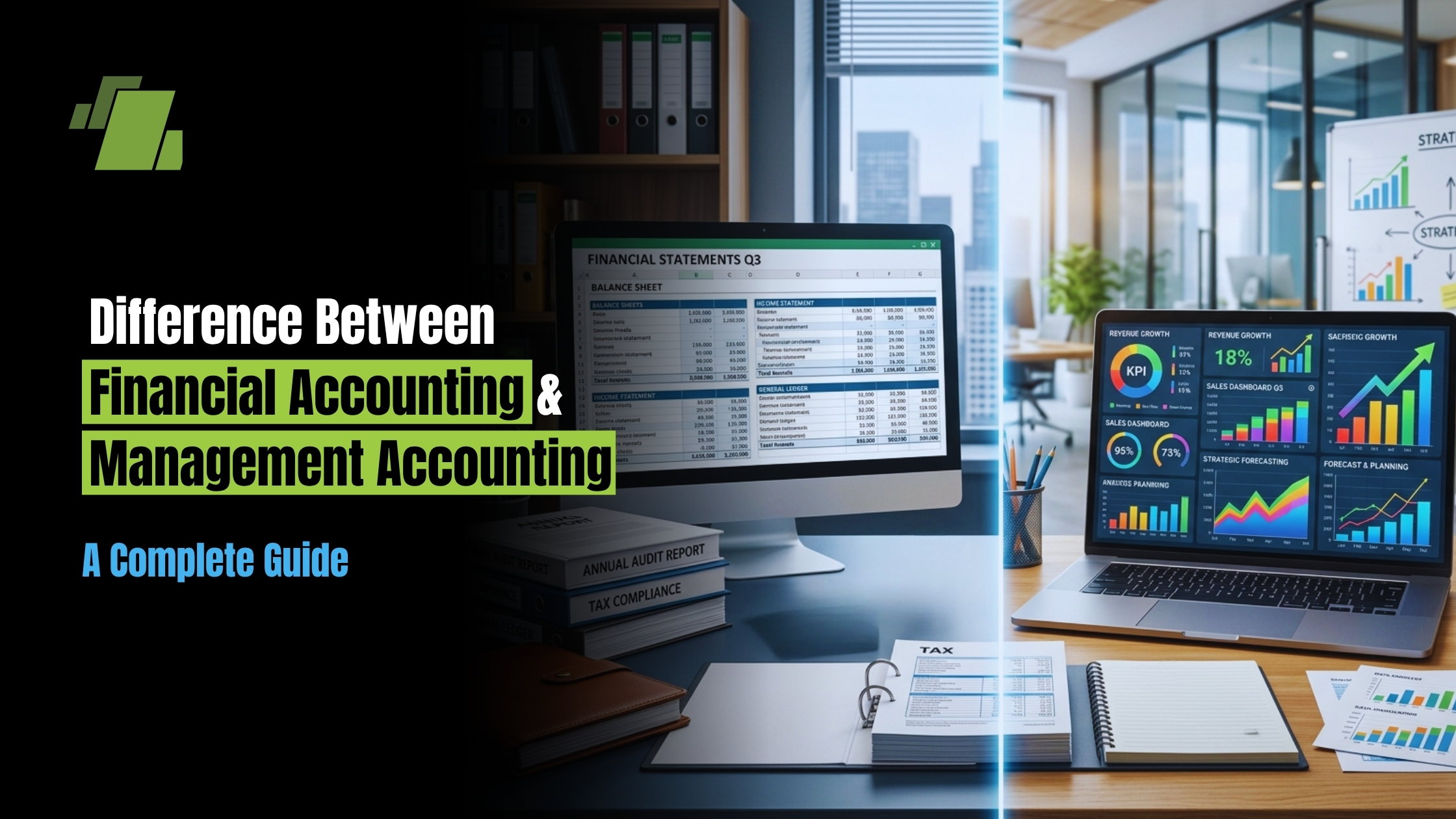
The difference between financial accounting and management accounting represents one of the most fundamental distinctions in business management and financial reporting. Financial accounting focuses on preparing financial statements for external stakeholders, while management accounting provides internal management reports that drive strategic decision making within organizations.
This comprehensive guide covers the core purposes, reporting standards, target audiences, and practical applications of both accounting types. Whether you’re a business owner evaluating accounting practices, an accounting student building foundational knowledge, a financial analyst seeking clarity, or a decision-maker selecting a financial management system, this comparison addresses your specific needs for understanding business operations from a financial perspective.
Direct answer: Financial accounting centers on historical financial data and regulatory compliance for external users like investors and creditors, whereas management accounting supports internal management through forward-looking financial analysis, budgeting, and performance analysis that enables informed decisions.
By the end of this guide, you will gain:
- Clear understanding of how financial accounting and management accounting serve distinct organizational functions
- Knowledge of when and why to apply each accounting type for effective financial management
- Insight into career implications for financial accountant versus management accountant roles
- Practical implementation strategies using modern ERP systems
- Actionable frameworks for integrating both approaches to optimize business performance
Understanding Financial and Management Accounting Fundamentals
Both financial accounting and management accounting are essential pillars of comprehensive accounting and financial management. While they draw from the same raw financial data and company’s financial transactions, each serves fundamentally different purposes that together provide complete visibility into financial health and business management capabilities.
Financial Accounting Fundamentals
Financial accounting is the systematic process of recording, summarizing, and reporting financial data that reflects an organization’s financial position and financial performance over specific periods. This discipline produces external financial statements designed to provide transparency to parties outside the organization.
The core outputs of financial accounting include:
- Income statement: Reports company’s revenue, expenses, and profitability over a reporting period
- Balance sheet: Presents assets, liabilities, and equity at a specific point in time
- Cash flow statement: Tracks how the organization generates and uses cash, helping maintain positive cash flow visibility
- Statement of equity: Details changes in ownership interests throughout the reporting period
Financial accounting operates within strict regulatory frameworks. In the United States, Generally Accepted Accounting Principles (GAAP) govern preparing financial statements, while over 140 jurisdictions worldwide follow International Financial Reporting Standards (IFRS). These accounting standards ensure consistency, comparability, and reliability when reporting financial data across organizations.
Primary users of financial accounting outputs include investors making investment decisions, creditors assessing credit risk, regulatory bodies enforcing compliance, and external auditors verifying accuracy. These external stakeholders rely on standardized financial records to evaluate whether an organization meets its financial targets and maintains financial stability.
Management Accounting Fundamentals
Management accounting also called managerial accounting encompasses the analysis, interpretation, and communication of financial information specifically designed to support internal management decision making. Unlike financial accounting, this discipline prioritizes relevance and timeliness over standardization.
Core components of management accounting include:
- Budgets and forecasts: Project future financial scenarios and resource allocation needs
- Variance analysis: Compares planned versus actual performance to identify deviations
- Cost accounting reports: Analyze product, service, or departmental profitability
- Performance metrics: Track both financial and non-financial indicators of business operations
- Strategic planning documents: Support long-term financial planning and competitive advantage development
Management accounting operates without mandated reporting standards. This flexibility allows finance teams to customize reports based on specific business needs, whether that means daily cash management updates, weekly cost analysis reports, or monthly strategic reviews. The absence of regulatory constraints enables management accountants work to focus on delivering timely and relevant information rather than compliance-driven outputs.
Primary users include executives developing financial scenarios, finance managers overseeing day to day operations, department heads managing budgets, and internal stakeholders driving operational improvements. These internal users need information that supports strategic decision making and helps achieve financial goals.
The fundamental differences between these accounting types create distinct characteristics and applications that organizations must understand to implement effective financial management across all business functions.
Key Differences and Characteristics Analysis
Building on these foundational concepts, examining the specific differentiating factors reveals why organizations need both accounting approaches to achieve comprehensive financial management and optimize business performance.
Purpose and Target Audience
Financial accounting exists to ensure external transparency, regulatory compliance, and accountability to stakeholders outside the organization. Its purpose centers on demonstrating that the organization has accurately recorded company’s financial transactions and presents a fair view of financial status. External users including shareholders, potential investors, lending institutions, and regulatory agencies use these reports to make investment decisions, assess creditworthiness, and verify compliance.
Management accounting, by contrast, serves internal optimization and strategic planning purposes. Its purpose focuses on helping financial managers and business leaders understand operations deeply enough to improve performance, control costs, and allocate financial resources effectively. Internal management uses these reports to identify problems early, evaluate alternatives, and execute strategies that drive competitive advantage.
This purpose distinction directly impacts report design. Financial reports follow standardized formats to ensure comparability across companies. Management reports take whatever form best communicates insights to decision-makers, whether that’s dashboards, detailed spreadsheets, or executive summaries focused on specific aspects of business operations.
Reporting Standards and Compliance Requirements
Financial accounting requires mandatory adherence to accounting principles established by authoritative bodies. Organizations must follow GAAP or IFRS standards precisely, with deviations requiring disclosure and justification. External audits verify compliance, and failure to meet standards carries legal and financial consequences including restatements, penalties, and reputational damage.
Management accounting faces no such regulatory constraints. Organizations design management reports based entirely on what provides value for decision making. A certified management accountant might create reports that combine financial metrics with operational data, customer satisfaction scores, or market trends formats that would never appear in external financial statements but deliver critical insights for finance management.
This flexibility versus standardization trade-off means financial accounting provides comparability across organizations while management accounting provides relevance within organizations. Both qualities matter, but for different purposes.
Time Focus and Data Types
Financial accounting is fundamentally retrospective. It reports what happened during past periods quarterly, annually, or other standardized timeframes. The financial data must be precise, verified, and based on completed transactions. Non-financial metrics rarely appear in financial statements because accounting standards focus on monetary measurements of financial position.
Management accounting is predominantly forward-looking. While it uses historical data as inputs, its outputs focus on projecting future outcomes, developing financial scenarios, and supporting proactive decision making. Reports often combine financial information with non-financial data such as production volumes, customer acquisition costs, employee productivity metrics, or market share projections.
Reporting frequency also differs dramatically. Financial accounting follows fixed schedules annual reports for external stakeholders, quarterly filings for public companies. Management accounting operates on whatever frequency delivers value: real-time dashboards for cash flow monitoring, weekly variance analysis for budget control, or ad-hoc reports for specific strategic decisions.
These distinct characteristics directly influence how organizations implement both accounting functions within their finance and accounting systems.
Detailed Comparison and Business Implementation
Organizations achieving comprehensive financial health typically implement both accounting types in coordinated fashion, drawing from shared financial records while producing distinct outputs tailored to their different audiences and purposes.
Comprehensive Comparison Matrix
| Criterion | Financial Accounting | Management Accounting |
|---|---|---|
| Purpose | External reporting and compliance | Internal decision support and strategic planning |
| Audience | External stakeholders (investors, creditors, regulators) | Internal management (executives, finance managers, department heads) |
| Standards | Mandatory (GAAP/IFRS compliance required) | Flexible (customized to organizational needs) |
| Time Focus | Historical (past performance analysis) | Forward-looking (forecasting and financial planning) |
| Report Types | Income statement, balance sheet, cash flow statement | Budgets, variance analysis, cost reports, performance dashboards |
| Frequency | Periodic (quarterly, annually) | As needed (daily, weekly, monthly, real-time) |
| Flexibility | Standardized formats and content | Highly customizable formats and metrics |
| Legal Requirements | Subject to audit and regulatory oversight | No external verification required |
| Data Types | Monetary, historical, verified | Financial and non-financial, projected, estimated |
When selecting approaches, consider that financial accounting is non-negotiable for regulatory compliance and external financing, while management accounting depth should match organizational complexity. Small businesses may need basic budgeting and cost analysis, while larger enterprises require sophisticated variance analysis, activity-based costing, and strategic scorecards.
Implementation in Modern ERP Systems
Modern enterprise resource planning systems like LOGIC ERP integrate both accounting functions within unified platforms, enabling organizations to manage finances efficiently while maintaining distinct outputs for each accounting type.
Effective implementation follows a systematic approach:
- Assess organizational reporting requirements by mapping external compliance needs (GAAP, IFRS, tax filings, regulatory reports) alongside internal decision-support needs (budgeting, cost centers, product profitability, forecasting). Identify key performance indicators and non-financial metrics essential for internal users.
- Configure financial accounting modules including general ledger, accounts receivable/payable, fixed assets, and standard financial statements. Establish chart of accounts aligned with accounting standards, implement audit trails, and define internal controls supporting external verification requirements.
- Set up management accounting tools for budgeting, cost analysis, and performance tracking. Configure cost centers, budget management workflows, variance reporting, and activity-based costing capabilities. Integrate business intelligence dashboards that combine financial and operational metrics for real-time visibility into business performance.
- Establish data integration workflows ensuring both accounting functions draw from the same transaction-level data while producing appropriately distinct outputs. Create clear mapping between internal cost elements and externally disclosed items, with versioning and historical tracking supporting both compliance audits and internal analysis.
Current research indicates approximately 75% of finance and accounting teams use automation tools as of 2026, with over half incorporating AI capabilities. These technologies reduce manual reconciliation work, accelerate closing cycles, and improve accuracy across both accounting functions. However, less than 40% of management accountants actively use advanced analytics platforms, with many finance teams still relying on spreadsheets for analytical tasks representing significant opportunity for competitive advantage through technology investment.
These implementation approaches face common obstacles that organizations must address proactively.
Common Challenges and Solutions
Organizations managing both accounting types encounter predictable challenges that, when addressed systematically, enable effective financial management and strategic decision making capabilities.
Data Integration and Consistency Issues
When financial accounting and management accounting operate from separate data sources, inconsistencies emerge that undermine trust in both outputs. Finance leaders may find management reports showing different figures than external financial statements, creating confusion and credibility problems.
Solution: Implement unified chart of accounts and standardized data collection processes across all departments. Use integrated ERP systems establishing a single source of truth for financial transactions. Ensure management accounting reports draw from the same verified data underlying financial statements, with clear documentation of any adjustments or allocations applied for internal purposes.
Resource Allocation and Skill Requirements
Many organizations struggle with limited accounting staff who must handle both compliance-focused financial accounting and analysis-focused management accounting. The skill sets differ significantly precision and standards mastery versus analytical thinking and strategic communication.
Solution: Cross-train accounting staff in both financial and management accounting principles, recognizing that career advancement often requires competency in both areas. Leverage technology to automate routine financial accounting tasks like reconciliations and journal entries, freeing resources for higher-value management accounting work including developing financial scenarios and cost analysis.
Balancing Compliance with Flexibility
Organizations sometimes over-standardize internal reports to match external formats, sacrificing the flexibility that makes management accounting valuable. Alternatively, they may allow management reporting to drift so far from financial accounting that the two become difficult to reconcile.
Solution: Establish clear protocols maintaining financial accounting compliance while preserving management accounting adaptability. Create separate reporting workflows that draw from shared data sources, with defined reconciliation points ensuring internal and external reports remain consistent at appropriate aggregation levels. Document how management reports relate to financial statements so stakeholders understand connections and differences.
Why Choose LOGIC ERP Finance Management and Accounting Software for Your Business?
LOGIC ERP Finance Management and Accounting Software is designed to streamline your company’s financial processes by integrating both financial accounting and management accounting functions into a single, unified platform. This comprehensive solution ensures accuracy, compliance, and efficiency, helping your business maintain regulatory standards while enabling strategic financial decisions.
Key benefits of choosing LOGIC ERP include:
- Integrated Financial Management: Seamlessly manage financial accounting tasks such as ledger maintenance, accounts payable/receivable, and regulatory reporting alongside management accounting activities like budgeting, cost analysis, and performance tracking.
- Improved Data Consistency: By consolidating all financial data within one system, LOGIC ERP eliminates discrepancies between external reports and internal management information, fostering trust and transparency.
- Customizable Reporting: Generate tailored financial and managerial reports that meet the specific needs of external stakeholders and internal decision-makers, supporting better business insights and planning.
- Automation and Efficiency: Reduce manual data entry and reconciliation through automation features, accelerating closing cycles and freeing staff to focus on value-added financial analysis.
- Scalability and Flexibility: Suitable for businesses of all sizes, LOGIC ERP adapts to evolving financial management needs, supporting complex budgeting, investment management, and business budgets.
- Enhanced Decision-Making: Access real-time financial data and analytics to set financial targets, monitor company’s financial performance, and maximize profits through informed financial decisions.
Choosing LOGIC ERP empowers your finance team to optimize financial operations, ensure compliance, and drive business growth with a robust, user-friendly system tailored to modern financial management demands.
Conclusion and Next Steps
Financial accounting and management accounting serve complementary but distinct roles essential for comprehensive business management. Financial accounting ensures regulatory compliance, supports investment decisions, and provides external stakeholders with standardized financial performance visibility. Management accounting enables internal optimization, strategic planning, and the informed decisions that drive competitive advantage through understanding business operations deeply.
Neither approach alone delivers complete financial management capabilities. Organizations achieving sustained financial health integrate both types effectively, drawing from shared financial records while producing targeted outputs for their different audiences.
Immediate actionable steps:
- Evaluate current accounting practices by auditing existing reports against both external compliance requirements and internal decision-support needs, identifying gaps in either area
- Consider integrated accounting systems like LOGIC ERP that support both functions efficiently through shared data architecture and specialized modules
- Develop staff competencies in both accounting areas, recognizing that finance managers increasingly need skills spanning compliance, analysis, and strategic communication
Related topics worth exploring include cost accounting methodologies for deeper operational insight, working capital management for cash flow optimization, and risk management approaches integrating financial and operational considerations.
Call at +91-73411-41176 or send us an email at sales@logicerp.com to book a free demo today!
Frequently Asked Questions
1. What is the main difference between financial accounting and management accounting?
The fundamental difference between financial accounting and management accounting lies in purpose and audience. Financial accounting produces standardized financial statements for external stakeholders like investors and regulators, focusing on historical financial data and compliance with accounting standards. Management accounting generates customized reports for internal management, emphasizing forward-looking analysis, variance analysis, and decision support that helps achieve financial goals.
2. Can a business operate with only financial accounting or management accounting?
Legally, businesses can operate with only financial accounting since it satisfies compliance and external reporting requirements. However, organizations without management accounting capabilities struggle to optimize operations, control costs, and make informed decisions about resource allocation. Even small businesses benefit from basic management accounting budgeting, cost analysis, performance tracking to maintain positive cash flow and grow sustainably.
3. What are the career differences between financial accounting and management accounting?
Financial accountant roles focus on external reporting, audit support, regulatory compliance, and preparing financial statements that meet accounting standards. Career paths include external auditor, tax specialist, and financial reporting manager. Management accountant positions emphasize internal planning, cost analysis, budgeting, and strategic decision support. Career paths include FP&A analyst, cost controller, and business analyst. Leadership roles increasingly require competency in both areas.
4. How do ERP systems support both types of accounting?
Modern ERP systems integrate financial accounting modules (general ledger, accounts receivable/payable, standard reports) with management accounting capabilities (budgeting, cost centers, variance analysis, dashboards). Shared transaction data ensures consistency while specialized tools serve each function’s distinct requirements. Finance teams benefit from automation reducing manual work and analytics capabilities enabling deeper financial analysis.
5. What skills are needed for financial vs management accounting roles?
Financial accounting requires mastery of GAAP/IFRS standards, precision in financial records, attention to compliance details, and audit support capabilities. Management accounting demands skills in cost accounting, budgeting, forecasting, data visualization, and business intelligence tools. Both roles increasingly require technology proficiency, with management accountants particularly needing analytical capabilities and strategic communication skills for influencing financial managers and executives.
6. Which type of accounting is more important for small businesses?
Financial accounting is essential for small businesses needing compliance, tax filing, and external financing. However, management accounting provides critical capabilities for sustainable growth even in simplified forms. Basic budgeting, cost analysis, and cash flow monitoring help small businesses identify problems early, control expenses, and make strategic decisions about raising capital or expanding operations. The most effective approach integrates both types proportionate to organizational complexity.

Author
Gurbir Singh
Co-founder & Managing Director | LOGIC ERP Solutions Pvt. Ltd.
With 30+ years of experience in the tech industry, I took the helm of technology & product development, ensuring LOGIC ERP’s continuous innovation & leadership in the evolving tech landscape.