Why Supermarkets Should Switch to Cloud Based Billing

Introduction
In today’s fast-paced supermarket environment, every second counts. With rising customer expectations, high transaction volumes, and complex inventory across thousands of SKUs, supermarket retailers need a solution that is fast, accurate, and fully automated and that’s exactly where advanced supermarket retail billing software steps in.
Supermarket billing software transforms the entire checkout experience by enabling rapid scanning, seamless POS operations, real-time inventory updates, centralized pricing control, secure payment handling, and detailed analytics. From reducing long queues during peak hours to minimizing manual errors and improving store productivity, it empowers supermarket owners to deliver a smoother, smarter, and more reliable shopping experience.
Whether it’s daily sales, stock movements, loyalty programs, discounts, or multi-branch management, the right billing software ensures complete efficiency, full visibility, and effortless store management, helping supermarkets operate faster, sell smarter, and grow consistently.
What Is Cloud Based Billing for Supermarkets
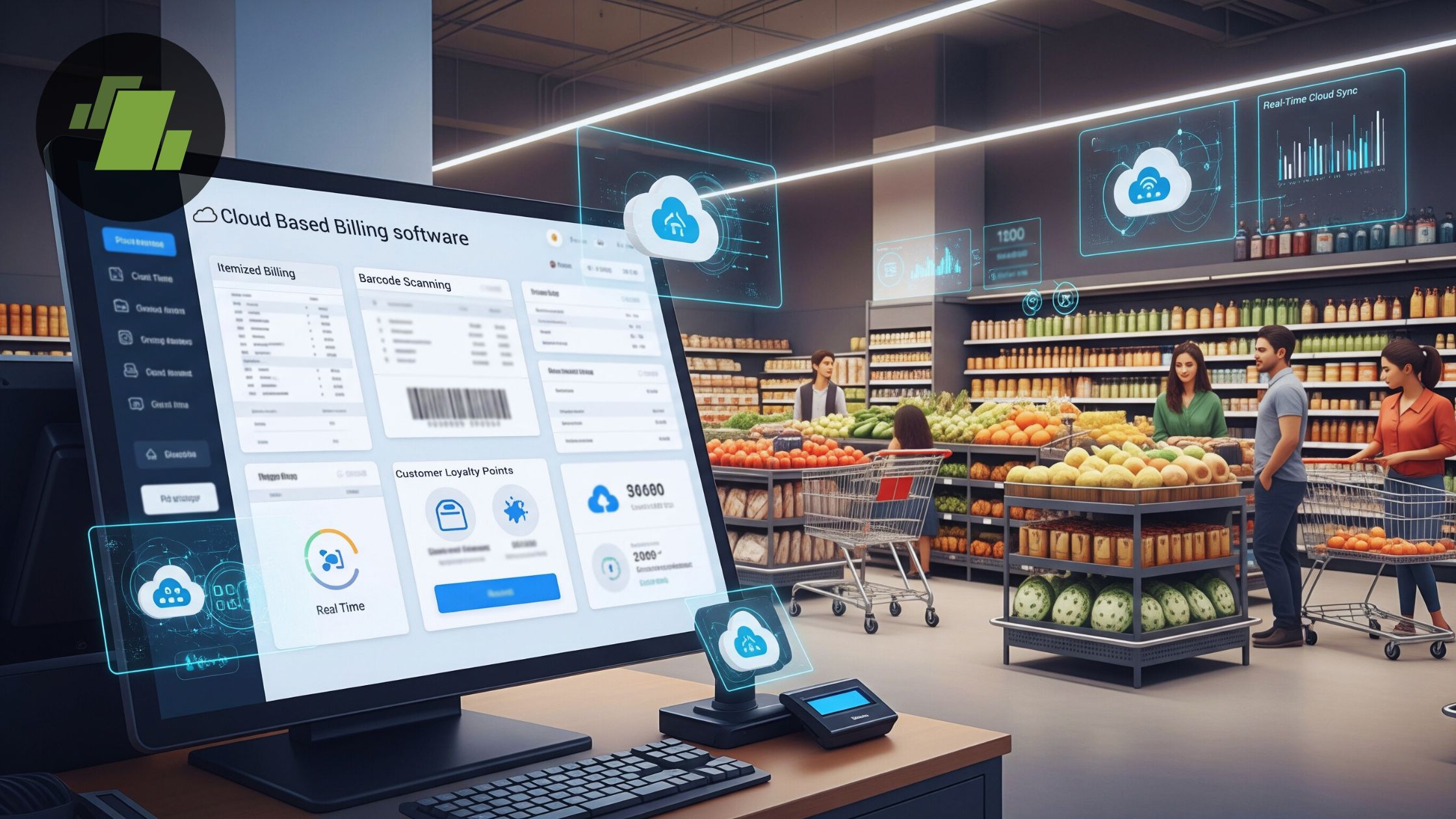
Cloud based billing for supermarkets refers to the use of cloud computing technology to handle all supermarket billing, invoicing, and transaction management processes. Unlike traditional systems that rely on localized servers or manual recording, cloud billing stores data on remote servers that can be accessed anytime from any device with internet connectivity.
Key aspects of cloud billing solution include:
- Data Storage and Access: All sales, stock, and customer data is securely stored in the cloud, allowing real-time access from anywhere.
- Data Syncing Across Counters: Multi-counter supermarkets can synchronize all transactions instantly.
- Comparison with On-Premise Solutions: Traditional systems require dedicated servers, are prone to downtime, and lack scalability, while cloud billing provides automatic updates, remote monitoring, and low maintenance costs.
Limitations of Traditional Billing Systems
While traditional billing systems have served supermarkets for decades, they present several limitations:
- High Maintenance Cost: On-premise hardware and software require frequent maintenance and upgrades, increasing operational expenses.
- Limited Accessibility: Managers cannot monitor sales or stock remotely, restricting flexibility.
- Data Loss Risks: Local storage makes systems vulnerable to crashes, theft, or physical damage.
- Slow Updates and Manual Processes: Any changes in pricing, taxes, or inventory require manual updates, slowing down operations.
Key Advantages of Cloud Based Billing for Supermarkets
Let’s explore the top cloud billing advantages, helping you make an informed decision about upgrading your retail technology.
1. Real-Time Data Access Across All Counters
One of the most significant benefits of retail cloud based billing software is real-time data synchronization across multiple checkout counters. With cloud-based billing, supermarket owners and managers can enjoy:
- Multi-counter synchronization for accurate daily reporting: All transactions from different counters are recorded instantly, ensuring precise daily sales data.
- Instant sales tracking for better revenue insights: Monitor sales trends and daily revenue in real time, helping identify fast-selling products or underperforming items.
- Unified dashboard access: Managers and owners can view data from a single, centralized dashboard, reducing administrative workload and enhancing decision-making.
This capability is especially valuable for multi-store supermarkets or high-traffic outlets where consistent and accurate reporting is important.
2. Improved Inventory Accuracy
Efficient inventory management is important for supermarkets dealing with thousands of SKUs, perishables, and bulk stock. Cloud billing software for supermarkets transforms inventory control by automating and synchronizing every transaction:
- Automatic stock updates with every sale or purchase: Each sale immediately adjusts stock levels, reducing manual errors.
- Reduction in overstocking and stockouts: Accurate inventory data ensures shelves remain stocked with the right products without excess inventory.
- Real-time syncing of purchases and sales: Prevent discrepancies and errors by having a single source of truth for stock management.
Using cloud billing, supermarkets can avoid revenue losses from stockouts, reduce wastage for perishable goods, and improve operational efficiency.
3. Cost-Effective Setup and Maintenance
Cloud-based billing systems for supermarket retail stores and shops eliminate the need for expensive hardware and reduce dependency on IT personnel, making them a cost-efficient solution for supermarkets:
- No costly servers or infrastructure maintenance: Cloud systems operate on secure remote servers, saving significant upfront hardware costs.
- Automatic software updates without disruptions: Vendors manage updates, ensuring your system remains current without downtime.
- Affordable subscription-based models: Pay-as-you-go pricing reduces the financial burden and makes advanced billing accessible for smaller supermarkets.
For supermarkets looking to optimize operational costs, cloud billing is a smarter investment than maintaining traditional local systems.
4. Enhanced Billing Speed and Checkout Experience
Customer experience is directly tied to billing efficiency. During peak hours, slow checkout processes can frustrate shoppers and harm store reputation. Cloud-based billing addresses these issues:
- Faster transaction processing: High-speed cloud servers handle large volumes of transactions smoothly.
- Stable performance under high load: Unlike traditional systems, cloud solutions are designed to maintain speed even during rush hours.
Faster checkouts lead to higher customer satisfaction, increased repeat visits, and better overall store efficiency, making cloud billing indispensable for high-volume supermarkets.
5. Advanced Security and Backup
Supermarkets handle sensitive customer data, payment information, and financial records. Cloud billing supermarket ERP retail systems provide robust security measures:
- End-to-end encryption: All transactional and customer data is encrypted to prevent unauthorized access.
- Automated daily backups: Data is backed up automatically, ensuring business continuity in case of hardware failure or cyberattacks.
- Reduced risk of hacking and data loss: Cloud vendors continuously monitor systems for threats, reducing risks compared to on-premise systems.
Secure cloud billing protects both the business and customer trust, which is important in the retail sector.
6. Multi-Store and Remote Management
Supermarket chains with multiple branches require centralized control and consistency. Cloud billing enables:
- Centralized monitoring of all branches: Track sales, inventory, and employee performance across locations from a single platform.
- Remote updates for pricing, discounts, and promotions: Make real-time adjustments across all stores without needing physical presence.
- Seamless coordination across outlets: Ensure consistent policies, promotions, and pricing for an enhanced customer experience.
This feature is important for expanding supermarket chains looking to maintain operational consistency and streamline management.
7. Scalability as Business Grows
As supermarkets expand, supermarket retailers usually struggle to accommodate additional counters, outlets, or high transaction volumes. The implementation of supermarket retail store software and supermarket cloud POS software helps to scale:
- Easily add new counters or branches: Add stores without worrying about server capacity or infrastructure limitations.
- No additional hardware costs: Cloud infrastructure grows with your business, reducing capital expenditure.
- Support for expansion plans: Scale operations smoothly without disrupting current processes or customer experience.
Cloud billing provides a future-proof solution for supermarkets planning long-term growth.
8. How Cloud-Based Billing Improves Decision Making
Real-time data and advanced analytics empower supermarket owners to make faster and smarter decisions:
- Sales trend analysis: Identify peak sales periods, high-demand products, and slow movers.
- Inventory forecasting: Predict stock requirements based on historical data and seasonal trends.
- Remote access: View reports and analytics from smartphones, tablets, or laptops.
- Quick response to promotions or seasonal demand: Adjust pricing, discounts, or inventory proactively.
These insights are important for improving profitability, customer satisfaction, and operational efficiency.
Comparison: Cloud Based Supermarket Billing Software vs Traditional Billing Software
Here is a detailed comparison of cloud-based supermarket billing software and traditional billing software.
| Features | Cloud Billing Software | Traditional Billing Software |
|---|---|---|
| Cost | Lower maintenance & subscription | High hardware & IT costs |
| Accessibility | Remote access anytime | Local access only |
| Updates | Automatic | Manual |
| Data Security | Encrypted & backed up daily | Prone to loss & theft |
| Scalability | Easy to expand | Limited by infrastructure |
| Speed | Faster checkout & multi-counter sync | Slower under high load |
Who Should Switch to Cloud-Based Billing
Cloud-based billing software solution implementation is a strategic move for supermarkets of all sizes. Here’s who can benefit the most:
- Single-Shop Supermarkets: Small, independent stores can improve operational efficiency, reduce manual work, and speed up billing during peak hours. Cloud billing also simplifies inventory tracking and reporting, helping owners focus on growth.
- Multi-Store Chains: Supermarket chains with multiple outlets can centralize management, monitor sales and stock in real time, and apply consistent pricing and promotions across all stores from a single dashboard.
- High-Volume Retail Outlets: Supermarkets with heavy footfall can handle peak-hour rushes without delays, ensuring faster checkouts, smoother operations, and enhanced customer satisfaction.
Cloud-based billing solutions are suitable for any supermarket aiming to streamline operations, boost efficiency, and scale operations with ease.
Choosing the Right Cloud Based Supermarket Billing Software
Selecting the right supermarket billing software is important for maximizing the benefits of cloud billing. Consider the following:
- Checklist of Features: Ensure the software offers multi-counter synchronization, real-time inventory management, mobile access, loyalty program integration, and advanced sales analytics.
- Scalability and Integration: Look for software that allows easy addition of new counters or branches and integrates smoothly with existing POS systems, ERP solutions, or payment gateways.
- Reliability & Support: Choose a provider that offers setup assistance, staff training, and responsive technical support to minimize downtime.
By evaluating features, scalability, integration, and support, supermarkets can choose the right cloud billing software that aligns with their business goals.
Conclusion
Switching to cloud billing systems for supermarkets is a transformative step for supermarkets, enabling faster checkout, real-time inventory management, and multi-counter synchronization that enhances operational efficiency and customer satisfaction. By providing centralized control for multi-store chains, automated backups, and robust data security, cloud billing ensures business continuity and protects sensitive customer and financial information.
Its cost-effective, subscription-based model eliminates heavy hardware expenses while offering scalability to add new counters or branches effortlessly as your business grows. With actionable insights from real-time sales analytics and the ability to manage pricing, promotions, and stock remotely, cloud billing empowers supermarket owners to make smarter decisions, reduce operational costs, and deliver a seamless shopping experience, making it the best supermarket billing software for efficiency, growth, and long-term success in today’s competitive retail market.
Call at +91-73411-41176 or send us an email at sales@logicerp.com to book a free demo for supermarket cloud billing software solutions today!
Frequently Asked Questions (FAQs)
Q1: What is cloud based billing for supermarkets?
Cloud billing software is a system that stores all supermarket transactions, inventory, and reports on remote servers, enabling real-time access and multi-counter synchronization.
Q2: Is cloud billing secure for retail stores?
Yes. Cloud billing systems use encrypted data storage, automated backups, and advanced security protocols to protect sensitive data.
Q3: Does cloud based billing work for multi-counter supermarkets?
Absolutely. Transactions from all counters are instantly synchronized, and data is accessible from a centralized dashboard.
Q4: What are the biggest advantages of cloud billing?
Key advantages include real-time data access, improved inventory accuracy, reduced costs, enhanced billing speed, and multi-store management.
Q5: Can small supermarkets switch to cloud based billing?
Yes. Cloud billing is scalable and cost-effective, making it suitable for small, single-location supermarkets as well as large chains.
Q6: How does cloud billing improve decision making?
Cloud billing provides analytics, reports, and real-time insights that help supermarket owners react quickly to sales trends and optimize inventory management.
Q7: Why should supermarkets use cloud-based billing?
Supermarkets should use cloud-based billing because it offers real-time data access, faster checkout speeds, centralized control over pricing and inventory, and seamless multi-branch management. Unlike traditional POS software, cloud billing automatically syncs sales, stock, customer data, and reports across devices and locations, helping supermarkets reduce manual work, cut operational errors, and improve customer experience. It also enables remote monitoring, scalability, and cost efficiency without heavy IT infrastructure.
Q8: What are the benefits of cloud billing for grocery stores?
Cloud billing provides grocery stores with major benefits such as:
- Instant updates on inventory, expiry dates, and stock levels
- Faster POS operations with minimal downtime
- Centralized discount and pricing management
- Accurate reporting and analytics for daily and monthly sales
- Easy integration with barcode scanners, weighing scales, loyalty apps, and eCommerce platforms
- Seamless updates without manual installation or server maintenance
This helps grocery stores streamline operations, reduce billing errors, and improve overall profitability.
Q9: What is the best cloud POS for supermarkets?
LOGIC ERP is the best cloud POS for supermarkets that offers robust inventory management, fast billing, advanced pricing controls, loyalty program integration, secure cloud data backup, and multi-store support. This top supermarket cloud POS handles large SKU volumes, supports online/offline modes, works across devices, and provides real-time business insights. Choose a solution that is scalable, reliable, and customizable for grocery and FMCG retail operations.
Q10: What features should a cloud billing system include for supermarkets?
A good cloud billing system features should include:
- Real-time inventory management
- Barcode-based and PLU-based billing
- Multi-mode payments (UPI, cards, wallets, cash)
- Dynamic pricing, discounts, and scheme management
- Fast POS with queue management tools
- Home delivery and order tracking
- Role-based access control
- Customer loyalty and CRM
- Auto data backup
- Multi-branch dashboard and reporting
These features ensure complete control over supermarket operations.
Q11: How does cloud POS help high-traffic supermarkets?
The best cloud POS for high traffic supermarkets helps in streamlining operations by offering ultra-fast billing, instant item lookup, optimized checkout flows, and seamless synchronization between POS terminals. It reduces queue time, handles peak-hour load efficiently, prevents system lag, and ensures accurate billing even during massive rushes. Cloud POS also supports multiple counters, express lanes, self-checkout kiosks, and mobile POS devices to speed up the entire customer journey.
Q12: What is cloud billing for multi branch supermarkets?
Cloud billing is the best software solution for multi-branch supermarkets because it offers:
- Centralized price, scheme, and product updates
- Unified inventory visibility across branches
- Stock transfers and warehouse synchronization
- Multi-location sales reporting
- Branch-wise performance analytics
- Centralized customer loyalty program
This helps supermarket owners manage multiple outlets effortlessly from a single dashboard.
Q13: How does cloud-based billing improve retail operations?
Cloud-based billing improves retail operations by automating key processes like stock updates, purchase ordering, pricing, GST-compliant billing, customer data management, and sales reporting. It eliminates manual errors, speeds up decision-making with real-time insights, improves forecasting, and enhances workflow efficiency. Retailers can also monitor store performance remotely and scale operations quickly.
Q14: What are the security benefits of cloud billing systems?
Cloud billing security benefits are many, including:
- Encrypted data storage and transmission
- Automatic cloud backups
- Multi-factor authentication
- Role-based user access
- Continuous updates and security patches
- Disaster recovery systems
These features protect supermarket data from theft, corruption, cyberattacks, and hardware failure.
Q15: What is a supermarket checkout cloud system?
A supermarket checkout cloud system is a POS solution that runs entirely on the cloud and connects billing counters, inventory, customer data, and payment systems in real time. It ensures fast billing, accurate price updates, and synchronized stock levels across all counters. With cloud connectivity, supermarkets can operate multiple billing points efficiently and maintain a smooth checkout flow during rush hours.
Q16: What is cloud based retail management?
Cloud-based retail management refers to using cloud technology to manage all aspects of a retail business: billing, inventory, purchasing, accounting, CRM, loyalty programs, and multi-branch operations from a centralized platform. It helps retailers gain real-time visibility, automate routine tasks, cut costs, and make data-driven decisions, resulting in better efficiency and profitability.
Q17. What is a Cloud POS for grocery stores?
A Cloud POS for grocery stores is an online billing and inventory system that processes transactions, updates stock, manages pricing, and records sales in real time. It helps grocery stores run multiple counters, handle high-traffic hours, and access sales data from any device. Cloud POS improves billing speed, accuracy, and operational efficiency without heavy hardware costs.
Q18. What is real-time retail data in cloud billing?
Real-time retail data means instant updates on sales, inventory, customer activity, and store performance. With cloud billing, every sale or stock movement is synced immediately across all devices. This helps supermarket owners reduce stockouts, maintain accurate inventory, predict demand better, and make fast, data-driven decisions.
Q19. What is multi-store cloud billing?
Multi-store cloud billing allows grocery and supermarket chains to manage multiple branches from a single dashboard. Owners can control pricing, offers, stock transfers, and sales reporting across all stores in real time. It ensures consistency, centralized operations, and better performance tracking for every location.
Q20. What is the difference between cloud billing and traditional billing?
Cloud billing uses internet-based servers, offering remote access, automatic updates, real-time syncing, and low maintenance. Traditional billing relies on local systems, requires manual updates, involves high hardware costs, and lacks multi-location access. Cloud billing is faster, more scalable, more secure, and ideal for modern supermarkets.
Q21. How does retail billing automation help supermarkets?
Retail billing automation speeds up checkout, minimizes manual entry, applies discounts automatically, calculates GST, updates inventory instantly, and reduces human errors. It helps supermarkets handle queues faster, improve customer experience, and maintain accuracy during peak hours.
Q22. How secure is a cloud billing system for supermarkets?
Cloud billing systems offer strong security with data encryption, multi-factor authentication, role-based access, and automated backups. The implementation of cloud based supermarket billing software protects supermarkets from data loss, hacking, system failures, and unauthorized access. Cloud providers also ensure regular security updates and disaster recovery support.
Q23. What is online billing software for supermarkets?
Online billing software is a cloud-based POS solution for supermarkets that helps to handle billing, inventory management, payments, discounts, and reporting through an internet-connected system. It eliminates server installation, reduces IT costs, and offers remote access from any device. It’s ideal for modern grocery stores seeking flexibility and speed.
Q24. What are subscription-based billing systems for supermarkets?
Subscription-based billing systems allow supermarkets to use cloud billing features by paying a monthly or yearly fee. This model removes upfront IT investments, offers automatic updates, and provides continuous support. It’s cost-effective, scalable, and perfect for both single stores and multi-branch supermarkets.
Q25. What is a remote access POS system?
A remote access POS system allows supermarket owners and managers to monitor sales, adjust pricing, track staff activity, and review inventory from anywhere. With real-time dashboards accessible via mobile or web, it offers complete visibility and control even when they are away from the store.

Author
Sharanjit Ghuman
Director of Communications | LOGIC ERP Solutions Pvt. Ltd.
Leading and managing the company’s internal and external communication strategies and working closely with senior leadership to develop and execute communication plans.