Make to Assemble keeps sub-assembly parts ready and triggers final assembly only when a customer places an order — delivering customized goods fast without warehouses full of unsold inventory.
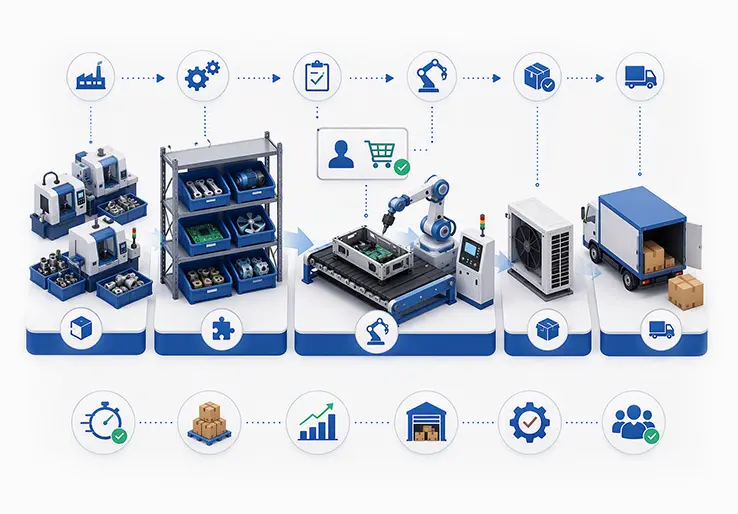
Every manufacturer faces the same tension: stock too many finished goods and you bleed cash on storage costs; wait to build everything from scratch and customers walk away. Make to Assemble (MTA) manufacturing eliminates this dilemma by keeping sub-assembly parts ready and triggering final assembly only when a customer places an order delivering customized goods fast without warehouses full of unsold inventory.
If you're struggling to balance inventory costs against customer expectations for rapid, personalized delivery, you're facing the central challenge of modern production. Make to assemble (MTA) manufacturing solves that problem by stocking components and sub-assemblies in advance and triggering final assembly only after a customer order is placed. It gives manufacturers a middle path between make-to-stock, which ties up capital in finished goods, and make-to-order, which often extends lead times.
Instead of producing complete products in anticipation or starting raw materials for every order, MTA keeps the right modules ready and assembles the final configuration when demand is confirmed. For manufacturers of configurable products such as electronics, furniture, auto parts, and industrial equipment that means faster delivery, better customization, and tighter control over inventory and working capital.
This guide explains how make to assemble works, where it fits among other manufacturing strategies, and why the customer order decoupling point sits at final assembly. It also covers the core features and benefits of MTA, the step-by-step process, implementation best practices, technology integration, common challenges, real-world success stories, and how LOGIC ERP supports make to assemble operations. The goal is simple: help you decide whether MTA is the right production model to improve responsiveness without overstocking every possible variant.
Here's what makes make to assemble manufacturing fundamentally different from traditional production processes:
Instead of forcing you to guess which finished variants will sell, this order system gives you a streamlined way to meet demand with precision.
Getting results from MTA doesn't require reinventing your entire manufacturing process. The workflow follows three clear stages:
The MTA workflow begins before any customer places an order. Manufacturers forecast demand not for specific finished goods, but for component families displays, processors, frames, motors, or whatever modules define your product architecture. This demand planning uses historical data, market signals, and lifecycle-aware forecasting to predict quantities.
Based on these forecasts, the manufacturer orders and stocks sub-assemblies and components. Manufacturers stock sub-assembly parts for quick assembly upon order. Demand forecasting is crucial for effective MTA implementation errors here propagate into component shortages or excess, though component-level misforecasts are far more recoverable than finished-goods overproduction. The Bill of Materials (BOM) structure becomes critical: modular BOMs allow postponement of product differentiation until the last possible moment.
Preparation is key for efficient assembly. Organize all parts and tools before starting the assembly process. Use containers to group similar hardware for easy access during assembly. Verify all parts against the inventory list before beginning assembly.
When a customer places an order with specific configuration requirements, the order system determines which modules are needed. Available-to-Promise logic checks real-time stock levels to confirm component availability.
This is the decoupling point: forecast-driven production stops here, and order-driven assembly begins. The system allocates appropriate components and sub-assemblies for each order, generating work orders for final assembly, finishing, and packaging. Make-to-order products are manufactured from scratch after orders are received; MTA skips directly to assembly because the building blocks are already prepared.
The manufacturer assembles the final product according to customer specifications. Assemble smaller components before connecting them to the main structure. Ensure proper orientation of parts to avoid assembly mistakes. Leave screws and bolts slightly loose until the complete assembly is aligned. Follow the instructions carefully to ensure proper assembly.
In well-optimized MTA environments, this final assembly process takes hours rather than days. Quality control follows, then shipping all with reduced lead times compared to any make-to-order approach.
Most manufacturing strategies fall along a spectrum. Understanding where MTA sits and why it occupies the optimal middle ground for many companies requires comparing it directly with alternatives.
Make-to-Stock (MTS)
Make-to-stock involves producing goods based on demand forecasts. Finished goods are built and warehoused before any customer demand materializes. This delivers same-day or next-day fulfillment, but at enormous cost. High holding costs are a risk in make-to-stock strategies. Make-to-stock is different from make-to-order production and from MTA. When product variants multiply, MTS becomes untenable: you can't stock every configuration.
Make-to-Order (MTO)
Production starts only after a confirmed manufacturing order. Make-to-order allows for high customization based on customer specifications, and make-to-order is used in industries like aerospace and medical equipment where each product is unique. But make-to-order typically results in longer lead times for delivery often weeks or months. Longer lead times can deter customers from purchasing.
Make to Assemble (MTA)
MTA captures the advantages of both. It's faster than MTO because modules are pre-stocked. It's more flexible than MTS because final configuration responds to actual customer demand. And it carries lower inventory costs than both, because you hold components rather than finished variants.
| Factor | Make-to-Stock | Make to Assemble | Make-to-Order |
|---|---|---|---|
| Lead Times | Shortest | Short | Longest |
| Customization | None/Limited | Moderate-High | Highest |
| Inventory Costs | Highest | Moderate | Lowest |
| Risk of Unsold Inventory | Highest | Low | None |
| Forecast Accuracy Required | Finished SKU level | Component level | Minimal |
MTA requires careful BOM design, component-level demand forecasting, and strong ERP support but for manufacturers with configurable products, it provides the optimal balance between supply chain responsiveness and cost control.
The make to assemble strategy is ideal for:
If your business model involves products that share common components but require variation at the finished product level, MTA was built for you.
Implementing a make to assemble strategy requires deliberate planning across four dimensions:
Start with a pilot for one product family that has many configurations but reasonably stable component demand. Choose products suitable for modular assembly where sub-assembly parts can be standardized. Design products with shared modules decomposing the finished product into interchangeable building blocks that allow postponement of differentiation until the final assembly process.
Implement real-time inventory tracking for all components and sub-assemblies. Tier your components: critical long-lead modules need higher safety stock levels; shorter-lead items follow stricter reorder points. MTA requires stocking sub-assembly parts in advance, and LOGIC ERP provides comprehensive inventory management capabilities including dynamic safety stock calculations, inventory control techniques, and real-time visibility across facilities.
Train staff on efficient assembly processes, quality control protocols, and the specific MTA workflow. Quality may suffer if assembly processes are rushed to develop standard operating procedures for every step from order receipt to delivery. Implement lean methods like Kanban and FIFO for component staging areas to keep production schedules on track.
Integrate ERP systems for seamless order processing, BOM configuration, and inventory control in supply chain management. Your technology stack should support Available-to-Promise at the module level, order configurators with dependency rules, and demand forecasting tools that optimize component stocking levels. The manufacturer forecasts orders at the component family level, not the finished-goods level your systems must support this shift.
No manufacturing strategy is without risk. Here's how to address the most common MTA pitfalls:
Component Stockouts
MTA can lead to stockouts during demand surges. A single missing component can block multiple product variants. Mitigate this through dual sourcing for critical modules, strategic safety stock, and supplier relationship management with clear lead time agreements. Purchase order management discipline is essential.
Demand Variability
Even when you forecast demand at the component level, variability exists. Use ABC/XYZ classification, demand sensing, and lifecycle-aware forecasting to reduce error. Low supply situations for specific modules require early warning alerts and pre-defined escalation protocols.
Supply Chain Disruptions
Build resilience through alternate suppliers, geographic diversification, and buffer stock for long-lead components. Monitor supplier lead times continuously variability here directly undermines MTA's core promise of short customer lead times.
Customization Complexity
More configuration options means more complexity in the manufacturing process. Balance the number of customizable features against assembly efficiency. Too many options create a combinatorial explosion in BOM management, increase training requirements, and raise the risk of assembly errors. Not every product needs maximum configurability.
Make to assemble manufacturing offers the rare combination that modern manufacturers need: the speed customers demand, the customization that drives premium pricing, and the inventory discipline that protects your bottom line. By stocking versatile components instead of finished variants, triggering final assembly only on confirmed customer orders, and leveraging modular product design, MTA delivers a production model built for today's market realities.
LOGIC ERP supports every stage of MTA implementation from advanced inventory management and modular BOM configuration to real-time order processing and demand forecasting integration. Whether you're an electronics manufacturer scaling customization, a furniture company expanding configuration options, or an industrial equipment producer optimizing lead times, LOGIC ERP's manufacturing software provides the technological foundation your MTA strategy requires.
Ready to stop choosing between fast delivery and smart inventory? Contact LOGIC ERP for a consultation or request a demo to see how make to assemble manufacturing can transform your production processes, reduce costs, and exceed customer expectations.
Make to assemble manufacturing offers a powerful, balanced approach that combines the best aspects of make-to-stock and make-to-order strategies. By stocking components and sub-assemblies in advance, manufacturers can respond rapidly to customer orders with customized products, reducing inventory carrying costs and minimizing the risk of dead stock. This make to assemble model enables faster delivery times and improved cash flow management, making it ideal for industries with configurable products such as electronics, furniture, and industrial equipment.
Successfully implementing an MTA system requires careful demand forecasting, modular product design, efficient inventory management, and staff training. Leveraging advanced ERP solutions like LOGIC ERP can streamline these processes, providing real-time visibility and control across the supply chain. While challenges like demand variability and supply chain disruptions exist, strategic planning and technology integration help manufacturers overcome these hurdles.
Ultimately, make to assemble manufacturing empowers businesses to meet modern customer expectations for speed and customization without sacrificing operational efficiency or financial performance. Embracing this approach positions manufacturers to thrive in competitive markets by delivering tailored products quickly and cost-effectively.
Call at +91-73411-41176 / +91-73411-41175 or send us an email at sales@logicerp.com to book a free demo today!
The key difference lies in when production starts and what's already prepared. In a make to order strategy, manufacturing begins from scratch often from raw materials only after an order is received. Make-to-order products are manufactured from scratch after orders are received, and make-to-order typically results in longer lead times. In make to assemble, manufacturers stock sub-assembly parts in advance and perform only final assembly after the order arrives. This makes MTA significantly faster while still supporting meaningful product customization.
Implementation timelines vary based on product complexity and existing infrastructure. A focused pilot on a single product family may take 3–9 months. Full-scale adoption across multiple product lines, including modular BOM redesign, ERP configuration, staff training, and demand forecasting calibration, typically requires 12–24 months.
Products with many configurable features composed from shared modules are ideal computers, electronics devices, furniture with options, consumer appliances, industrial machinery with modular components. The closely related Configure-to-Order (CTO) model also suits these categories. If your final product can be decomposed into standardized sub assemblies with variation applied at the end, MTA is likely a strong fit.
MTA often increases component inventory compared to holding only raw materials (as in MTO), but dramatically reduces finished goods inventory compared to make to stock. The net effect is typically lower overall inventory costs and improved cash flow. Initial investment goes toward modular product design, ERP systems, and process redesign, but these costs are recovered through reduced storage costs, fewer write-offs on unsold inventory, and higher customer satisfaction from faster, customized delivery.
At minimum, you need a robust ERP system supporting modular BOMs, component-level inventory tracking, Available-to-Promise logic, and order configuration management. Manufacturing ERP software like LOGIC ERP provides these capabilities alongside demand forecasting integration, real-time stock visibility, dynamic safety stock management, and supplier lead-time tracking. Advanced implementations may add APS (Advanced Planning & Scheduling) and AI-driven demand sensing tools.
The assemble to order (ATO) workflow involves stocking components and sub-assemblies in advance, then assembling the final product only after receiving a customer order. This approach balances inventory costs and customization by preparing parts ahead and completing assembly based on specific customer requirements.
ATO production typically offers shorter lead times than make-to-order strategies because components are pre-stocked. Final assembly begins once an order is received, allowing faster delivery than building products entirely from scratch, though lead times are generally longer than make-to-stock models.
The order system in ATO manufacturing manages customer orders, checks component availability, and triggers the assembly process. It integrates demand planning and inventory data to ensure components are ready and allocated efficiently for each customized order.
The assemble to order strategy stocks components rather than finished products, allowing customization and reducing inventory carrying costs. In contrast, make to stock (MTS) produces and stores finished goods based on demand forecasts, which can lead to overstock or stockouts.
Accurate demand planning forecasts the quantity of components needed to meet customer orders without overstocking. Effective demand planning minimizes stockouts and excess inventory, ensuring smooth assembly and timely delivery of customizable products.
Products with modular designs and configurable options, such as electronics, computers, and furniture, are ideal for ATO manufacturing. The strategy enables customers to choose features while manufacturers assemble the product quickly from stocked components.
The ATO strategy reduces inventory costs by keeping versatile components in stock instead of finished goods. This lowers the risk of dead stock and allows manufacturers to respond flexibly to changing customer demands with customizable products.
An ATO product is a finished good assembled from pre-manufactured components or sub-assemblies after a customer places an order. This product benefits from customization options and quicker delivery compared to fully made-to-order items.
Yes, ATO production can be integrated with modern order systems and ERP software to streamline order processing, inventory management, and assembly scheduling, ensuring efficient fulfillment of customized orders.
ATO offers higher customer satisfaction by enabling product customization and faster delivery than make to stock, which may only offer limited options but delivers immediately from inventory. ATO balances customization with reasonable lead times.
Make to assemble manufacturing offers several benefits including the ability to deliver goods quickly, increased efficiency in production processes, and the ability to produce high quality products through controlled final assembly. This strategy reduces inventory costs while enabling customization and faster order fulfillment.
By focusing on assembling pre-manufactured components only after an order is received, make to assemble manufacturing ensures high quality products. The final assembly process can be closely monitored and controlled, reducing errors and allowing for quality checks at the last stage.
Increased efficiency helps manufacturers reduce lead times and operational costs. Make to assemble streamlines production by stocking components in advance and assembling only when orders are confirmed, minimizing waste and speeding up delivery.
Make to assemble reduces delivery times by having all necessary components ready in inventory. Once an order is placed, final assembly can be completed quickly, allowing manufacturers to deliver goods quickly compared to make-to-order methods that start from raw materials.
Yes, make to assemble allows for significant customization by assembling different combinations of pre-stocked components. This flexibility enables manufacturers to offer tailored products without sacrificing efficiency or quality.
Popular Products