Process manufacturing creates goods by combining raw ingredients using formulas or recipes, producing bulk materials that cannot be disassembled back into their original components — measured by weight, volume, or mass rather than individual units.
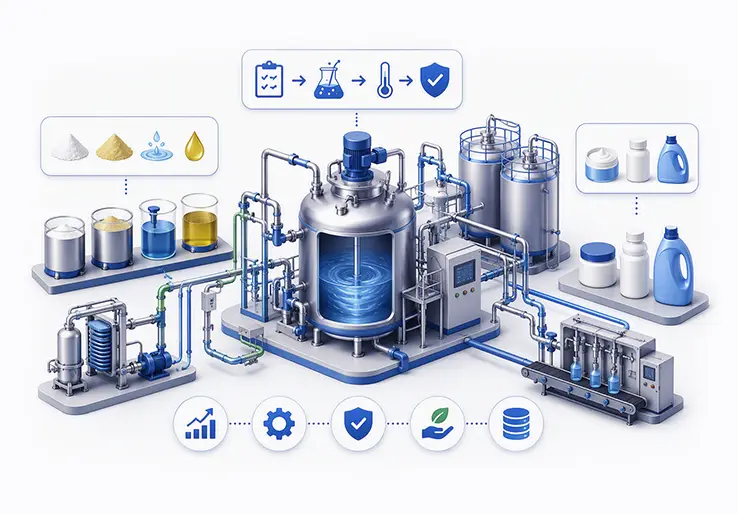
Process manufacturing creates goods by combining raw ingredients using formulas or recipes, producing bulk materials that cannot be disassembled back into their original components. Unlike discrete manufacturing, which assembles distinct items from countable parts, process manufacturing irreversibly changes materials into bulk end-products through chemical reactions, blending, heating, or other transformations. Common industries include food and beverage, pharmaceuticals, chemicals, and petroleum — sectors where in process manufacturing, goods are measured by weight, volume, or mass rather than individual units.
This guide covers everything process manufacturers need to know: from the core production processes and manufacturing steps to selecting the right process manufacturing ERP software for your business.
Process manufacturing is a production method where goods are created by combining raw materials or ingredients based on specific formulas or recipes. Unlike discrete manufacturing, which assembles distinct parts into finished products, process manufacturing involves irreversible chemical, physical, or biological transformations that produce bulk products measured by weight, volume, or mass. This approach is common in industries such as food and beverage, pharmaceuticals, chemicals, and petroleum, where consistent quality, traceability, and regulatory compliance are critical. Process manufacturing emphasizes batch consistency, quality control, and detailed tracking of raw materials and finished goods to ensure safety and efficiency throughout production. It typically operates on either batch or continuous processes, requiring specialized management systems to handle formulation, scaling, and complex production workflows. Understanding process manufacturing is essential for businesses seeking to optimize operations, maintain compliance, and deliver high-quality products in regulated and competitive markets.
If you're running a manufacturing business that relies on formulas, recipes, or batch production, you already know the unique challenges that come with it. Batch inconsistency, regulatory compliance headaches, ingredient traceability gaps, and yield variability are problems that generic manufacturing software simply wasn't designed to solve.
Process manufacturing differs from discrete manufacturing, which assembles distinct items that can be taken apart. In process manufacturing, ingredients cannot be easily disassembled into original components once combined. A pharmaceutical tablet can't be separated back into its active ingredients, binders, and coatings. A gallon of paint can't be split back into pigments, resins, and solvents.
This fundamental difference means process manufacturers require specialized approaches to recipe management, inventory management, quality control, and regulatory compliance. Process manufacturing software standardizes recipe management for consistency, ensuring every batch meets the same specifications regardless of scale or production facility.
This complete guide walks you through the features, benefits, types, and ERP solutions that drive success in the process manufacturing industry — giving you the knowledge to streamline operations and gain a competitive advantage.
Process manufacturing is characterized by several distinct features that set it apart from other manufacturing methods. These include:
Implementing process manufacturing offers numerous advantages that enhance operational efficiency and product quality:
Process manufacturing spans a wide range of industries where raw materials are transformed into bulk products through continuous or batch processes. Key sectors include:
Each industry faces unique challenges but shares common needs for formula management, batch consistency, traceability, and compliance, making specialized process manufacturing ERP solutions essential for success.
Here's what makes structured process manufacturing systems deliver measurable results across food, chemical, pharmaceutical, and other process industries:
Instead of forcing your team through manual workarounds and disconnected spreadsheets, structured process manufacturing gives you centralized control over every aspect of production — from ingredient sourcing to finished product shipment.
Getting consistent, compliant results doesn't require complexity. The manufacturing process follows a clear, repeatable flow:
Recipe formulation is essential in process manufacturing for defining specific ingredient proportions. R&D and process engineering teams define ingredient specifications — grade, purity, shelf-life, potency — along with precise ratios, scaling factors, and unit-of-measure conversions. Powders measured by mass, liquids by volume, and concentrations adjusted for temperature or potency all require rigorous formula management.
Process manufacturing uses formulas or recipes for production, and these often include multi-level bills of materials with sub-recipes or pre-mixes. Co-products and by-products are defined at this stage — for example, a chemical synthesis yielding a primary product alongside recoverable waste streams. Version control determines which formulation is active, a critical requirement for regulatory traceability and batch and lot tracking.
Ingredients in process manufacturing can vary by source and season, so formulas must account for raw material variability in potency, moisture content, and contaminants.
Batch production requires careful real-time monitoring. During execution, raw materials are pulled from lot-controlled inventory and undergo mixing, blending, chemical reactions, heating, cooling, drying, and pH adjustment. Process manufacturing often involves heating, chemical reactions, or blending of ingredients — transformations that are irreversible by nature.
Equipment control is essential: reactors, mixers, tanks, and blenders equipped with sensors track temperature, pressure, flow rate, pH, viscosity, and humidity in real time. Batch processing in manufacturing refers to producing a specific quantity before cleaning, while continuous processing runs non-stop and does not involve cleaning between production runs.
Manufacturing Execution Systems (MES) or Manufacturing Operations Management (MOM) platforms enforce sequence of operations, hold times, and changeover steps. In process manufacturing, tracking methods include monitoring batch numbers, and yield tracking compares expected versus actual output to identify losses and optimize future runs.
At designated production stages, samples are taken for microbiological, chemical, or sensory testing. Quality control is critical in highly regulated industries like food and pharmaceuticals, where analytical QC and in-line measurements (near-infrared spectroscopy, spectrometry) determine whether a batch passes or requires rework, re-blending, or disposal.
Separation and purification may be required to isolate the desired product in process manufacturing. Once approved, the finished product receives lot and batch number assignments through packaging lines that maintain complete identification from formula through shipping. All documentation — batch records, QC results, deviation logs, and compliance records — is compiled for regulatory submissions and audit readiness.
Process manufacturing and discrete manufacturing differ fundamentally in their production methods, outputs, and operational requirements. Process manufacturing produces goods by combining raw materials through formulas or recipes, resulting in products that cannot be disassembled back into their original components. These products are typically measured by weight, volume, or mass. In contrast, discrete manufacturing assembles distinct parts into finished products that can often be taken apart, with outputs counted as individual units or pieces.
Key distinctions include:
Understanding these differences is crucial for selecting appropriate management systems and ensuring operational efficiency.
Regulatory compliance is a critical aspect of process manufacturing, given the strict standards imposed by health, safety, and environmental authorities. Industries such as food and beverage, pharmaceuticals, and chemicals must adhere to regulations like FDA guidelines, GMP, HACCP, REACH, and OSHA standards.
Compliance requirements include:
Detailed Documentation
Maintaining accurate batch records, quality control logs, and audit trails to demonstrate adherence to regulations.
Ingredient and Product Traceability
Tracking raw materials and finished products by lot or batch numbers to facilitate recalls and ensure safety.
Environmental and Safety Protocols
Managing hazardous materials, waste disposal, and workplace safety to meet legal obligations.
Automated Compliance Management
Utilizing ERP systems to automate documentation, regulatory reporting, and change control processes, reducing human error and audit risks.
Effective compliance management not only mitigates legal risks but also enhances product quality and consumer trust.
Batch consistency is vital in process manufacturing to ensure that every production run meets exact quality standards. Consistent batches reduce variability, prevent defects, and maintain customer satisfaction.
Quality control involves:
Maintaining batch consistency and rigorous quality control helps process manufacturers comply with regulations, reduce waste, and uphold brand reputation.
ERP solutions play a pivotal role in managing the complexities of process manufacturing by integrating various operational aspects into a unified system. They support:
By streamlining processes and enhancing transparency, ERP systems enable process manufacturers to improve productivity, reduce costs, and maintain regulatory compliance.
Most confusion in the manufacturing sector comes from conflating processes and discrete approaches. Here's how they compare across critical dimensions:
| Dimension | Process Manufacturing | Discrete Manufacturing |
|---|---|---|
| Production Basis | Formulas and recipes | Bills of materials and assemblies |
| Input/Output Units | Weight, volume, concentration | Pieces, units, serial numbers |
| Reversibility | Irreversible — cannot recover original ingredients | Often disassemblable |
| Yield | Variable — losses, scrap, by-products expected | Predictable output per unit |
| Traceability | Lot/ingredient-level through every batch | Component serial number or assembly tracking |
| Regulatory Complexity | Heavy — GMP, HACCP, FSMA, REACH, GHS | Standard quality and safety |
Process manufacturing creates goods that are fundamentally transformed. Paint manufacturing measures pigments and solvents by weight and volume; an automotive assembly line counts doors, engines, and bolts. This distinction drives every difference in how production processes, quality assurance, and compliance management are structured.
Regulatory compliance requires meticulous tracking of raw materials — a requirement that shapes the entire operational architecture of process manufacturing companies compared to their discrete counterparts.
Results speak louder than claims. Here are documented cases showing how process manufacturing systems deliver measurable operational efficiency:
BASF Batch Process Optimization — BASF partnered with ABB to implement a "Batch Process Fingerprint" solution that analyzed and optimized batch processes at their Ohio facility. The outcome: reduced off-spec losses, shorter batch cycle times, and increased throughput — all while maintaining strict product quality standards. This demonstrates how process mining tools applied to the process manufacturing industry deliver performance metrics that directly impact profitability.
Nutraceutical Manufacturer KPI Tracking — A multi-site nutraceutical producer replaced manual logs and spreadsheets with a digital platform implementing SQDCPE (Safety, Quality, Delivery, Cost, People, Environment) metrics. Post-implementation, they achieved faster identification of quality deviations, superior batch-to-batch consistency, proactive control over production processes, and dramatically improved production visibility across sites.
Life Sciences Digital Compliance Transformation — A pharmaceutical-adjacent facility transitioned from paper-based to digital compliance for batch production, changeover, and line clearance. Results included faster batch release (averaging one hour saved per shift), fewer human errors, improved OEE, and stronger conformance with regulatory data integrity standards including 21 CFR Part 11.
Chocolate Supply Chain Traceability — Improvements in traceability across the chocolate supply chain reduced recall sizes, improved inventory levels, and enhanced logistics efficiency. The primary quantitative gain was in reduced scope of recalls and better detection/response time — protecting both consumers and brand reputation.
Process manufacturing is the backbone of industries that transform bulk materials into consumer and industrial products:
Process manufacturing includes food, pharmaceuticals, and chemicals — but also emerging sectors like biotech, cannabis processing, and cultured food production that face many of the same operational challenges.
Not every process manufacturing business needs the same level of technology. Choose the manufacturing ERP system that matches your complexity and growth trajectory.
Perfect for small process manufacturers with relatively simple production processes — few ingredients, modest batch sizes, limited regulatory oversight. Basic ERP systems provide entry-level formula management, inventory management, simple lot and expiry tracking, and basic recipe scaling.
However, limitations are real: lack of built-in regulatory compliance, weak or manual lot traceability, limited real time monitoring, and manual workarounds for data capture. ERP systems help manage ingredient availability and shelf-life effectively even at this level, but growing businesses often find themselves constrained. Real-time data insights improve inventory management in process manufacturing, and basic systems may lack the depth needed as operations scale.
This is where process manufacturing ERP software delivers its greatest value. Tailored for food, pharma, chemical, and FMCG manufacturing sectors, these ERP solutions include:
ERP systems streamline production planning and scheduling processes, automating processes that previously required manual oversight. ERP systems help maintain compliance with industry regulations and standards — a non-negotiable requirement in the process manufacturing industry. 86% of US chemical manufacturers expect more regulations next year, making automated compliance management essential rather than optional.
For global process manufacturers with multi-site operations, enterprise-level manufacturing ERP platforms provide cloud or hybrid deployment, IoT sensor integration, AI and machine learning analytics, multi-currency support, and process standardization across facilities. These comprehensive solution platforms support:
Enterprise resource planning at this level enables organizations to identify trends, manage resources across geographies, meet customer demands, and maintain competitive advantage in a rapidly evolving manufacturing industry.
LOGIC ERP system for process industry offers a comprehensive, industry-specific solution designed to meet the unique challenges of process manufacturing. Key advantages include:
Robust Formula and Recipe Management
Ensures precise control over ingredient proportions and batch scaling.
Advanced Lot and Batch Traceability
Facilitates quick recalls and regulatory compliance.
Integrated Quality Management
Supports real-time monitoring, deviation tracking, and audit readiness.
Regulatory Compliance Automation
Simplifies adherence to FDA, GMP, HACCP, and other standards
Scalable and Flexible Architecture
Supports businesses from small batch producers to large multi-site operations.
User-Friendly Interface and Support
Enables smooth implementation and ongoing assistance tailored to your industry.
With LOGIC ERP, process manufacturers gain a powerful platform to optimize production, maintain quality, and achieve sustainable growth.
Selecting the right manufacturing ERP software comes down to three critical factors: your industry's regulatory requirements, your company's current size and growth plans, and the complexity of your core processes.
Every process manufacturing business — whether you're producing specialty chemicals, pharmaceutical products, or food and beverages — needs robust formula management, complete lot traceability, and automated compliance management. These aren't optional features; they're the foundation of operational efficiency and regulatory survival in the process manufacturing industry.
The right process manufacturing solution vendor delivers more than software — they provide industry expertise, structured implementation support, and a platform that scales with your business functions as you grow. Look for solutions that offer real time data visibility, streamline workflows across production stages, and enhance productivity without adding operational complexity.
LOGIC ERP's process manufacturing solutions are purpose-built for formula-based production environments, delivering the batch consistency, regulatory compliance, and production planning capabilities that process manufacturers demand. From 7 core ERP modules covering every business function to deep integration with quality management and supply chain systems, LOGIC ERP helps manufacturing operations run smarter.
Ready to see how LOGIC ERP can transform your process manufacturing operations? Request a free demo and discover how the right manufacturing ERP system reduces operational costs, improves product quality, and positions your business to meet market demands — today and tomorrow.
Process manufacturing is a complex yet essential production method that transforms raw materials into bulk products through precise formulas, batch control, and continuous process management. Its unique characteristics, irreversible transformations, stringent regulatory compliance, and critical batch consistency demand specialized ERP solutions tailored to the needs of industries like the food industry, pharmaceuticals, chemicals, and more.
Implementing a robust process manufacturing ERP system streamlines operations, enhances traceability, improves quality control, and ensures compliance with evolving regulations. Whether you are a small batch producer or a global manufacturer, leveraging the right ERP technology can drive operational efficiency, reduce costs, and accelerate time-to-market.
With LOGIC ERP's industry-specific features and scalable architecture, process manufacturers gain full visibility and control over their production lifecycle from formula management to finished goods shipment. This empowers businesses to maintain consistent product quality, meet regulatory demands, and adapt quickly to market changes.
Optimize your process manufacturing operations today with ERP solutions designed to support your growth and success in a highly competitive and regulated landscape.
Call at +91-73411-41176 / +91-73411-41175 or send us an email at sales@logicerp.com to book a free demo today!
Process manufacturing creates goods by combining raw ingredients using formulas or recipes — think pharmaceuticals, paints, or beverages. The finished product cannot be disassembled back into its original components. Discrete manufacturing assembles individual components into finished goods (cars, electronics, furniture) that can theoretically be taken apart.
Process manufacturing focuses on batch or continuous production measured by weight and volume, while discrete manufacturing focuses on unit production counted by pieces. The production processes, quality control methods, traceability requirements, and regulatory compliance demands differ fundamentally between the two.
Yes — particularly if your operation involves formula-based outputs, regulatory compliance, or lot traceability. Standard ERP software designed for discrete manufacturing lacks critical features like recipe management, co-product handling, potency adjustments, and weight/volume conversions.
Manufacturers must track ingredients through complex business processes that generic systems simply cannot accommodate. Process manufacturing ERP software provides the industry expertise and specialized functionality — from managing inventory at the lot level to automating regulatory documentation — that process manufacturing companies require to operate efficiently and compliantly.
ERP implementation ROI varies based on company size, complexity, and current process efficiency. Research shows that 55% of manufacturing companies achieve full ROI within two years, while 24% see returns within the first year. For high-leverage improvements like shop-floor digitization and quality automation, returns of 25–60% per year are documented, with payback periods ranging from 6 to 18 months.
Early improvements — faster batch release times, reduced errors in records, better managing inventory — often appear within weeks or months. More substantial gains in waste reduction, yield improvement, and improving operational efficiency typically materialize over 6 to 24 months. On average, manufacturing ERP investments return $3 to $7 per dollar invested over multi-year horizons.
Process manufacturers often deal with complex formula management, batch consistency, and stringent regulatory requirements. They must ensure precise ingredient tracking and quality control throughout the manufacturing process to maintain product safety and compliance.
Effective supply chain management is critical in process manufacturing to ensure timely availability of raw materials, manage shelf life, and coordinate logistics. Integrated systems help optimize inventory levels, reduce waste, and improve production scheduling.
Process industries encompass sectors such as food and beverage, pharmaceuticals, chemicals, petrochemicals, nutraceuticals, and personal care products. These industries rely on continuous or batch processing methods to transform raw materials into finished goods.
ERP systems centralize data and automate core functions like formula management, inventory control, quality assurance, and compliance management. They provide real-time visibility and streamline operations, helping process manufacturers improve efficiency and regulatory adherence.
Chemical manufacturers operate within highly regulated environments, managing hazardous materials and complex formulations. Their manufacturing process requires strict safety protocols, precise formula adjustments, and comprehensive documentation to meet environmental and health standards.
Compliance management ensures adherence to industry regulations such as FDA, GMP, HACCP, and REACH. It involves maintaining accurate records, traceability, and audit trails to avoid penalties, protect consumer safety, and uphold product quality throughout the manufacturing process.
Popular Products