Discover how Universal Product Code (UPC) simplifies product identification and streamlines business operations. Learn how it improves billing accuracy, inventory tracking, and retail efficiency.
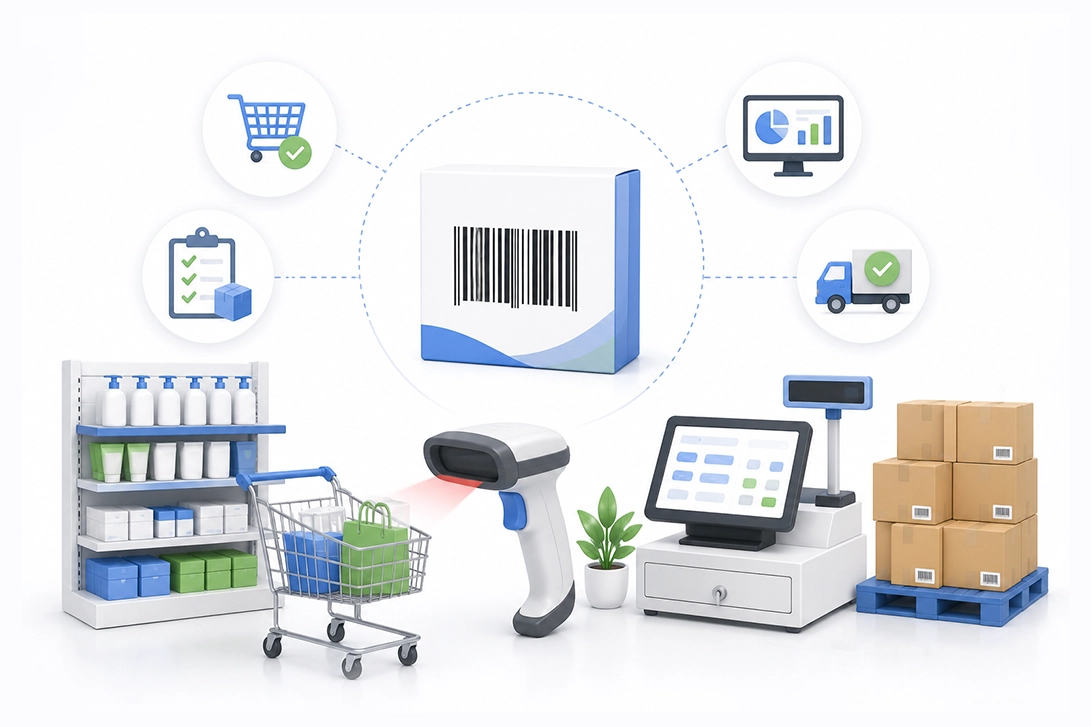
Universal Product Code (UPC) is a 12-digit barcode system used globally to identify products in retail and supply chain operations. This standardized product identification method has become the backbone of modern commerce, enabling businesses to track inventory, process sales, and manage logistics with unprecedented accuracy and speed. A UPC includes a 12-digit numerical code that uniquely identifies a product, encompassing manufacturer, product details, and related information to facilitate inventory management, pricing, and error detection.
This complete guide covers UPC fundamentals, business applications, the implementation process, and best practices for retail, e-commerce, and logistics companies. Whether you’re a small business owner preparing to list products on online marketplaces or a supply chain manager optimizing warehouse operations, understanding UPC codes is essential for operational success. The content addresses how UPCs work, why they matter, and exactly how to obtain and implement them effectively.
By reading this guide, you will:
The Universal Product Code (UPC) is a GS1-managed global standard for product identification that has served the retail industry since 1973. On June 26, 1974, the first commercial UPC scan occurred on a pack of Wrigley’s chewing gum, marking the beginning of automated retail operations that now process tens of thousands of transactions every second worldwide.
Universal Product Codes serve as a standardized method for identifying products globally, which is essential for efficient inventory management and sales processing across various retail channels. The manufacturer's UPC code acts as a standardized global identifier, uniquely identifying products for international trade and product recognition, and is distinct from internal identifiers like SKUs or manufacturer part numbers. The UPC system belongs to the broader Global Trade Item Number (GTIN) family of international standards, ensuring compatibility with products sold in other countries and across international markets.
The structure of a standard UPC consists of a manufacturer identification number, an item reference number, and a check digit. A standard UPC contains both the UPC-A barcode (the scannable pattern of black bars and white spaces) and the 12-digit number printed below it.
Here's the breakdown of UPC data structures:
Company Prefix (6-10 digits): The first six to nine digits of a UPC are referred to as the “Company Prefix,” which uniquely identifies a company and is assigned by GS1. This prefix is uniquely assigned to each business, ensuring no two retailers or manufacturers share the same code. The length of your company prefix determines how many barcodes you can create a shorter prefix allows for more item references.
Item Reference (1-5 digits): Following the company prefix, these digits identify the specific product. Each color and size variation of the same item requires a different UPC. For example, a red t-shirt in size medium needs a separate UPC from the same shirt in size large or in blue.
Check Digit (1 digit): The UPC check digit is the final digit of the 12-digit code, calculated using a mathematical formula based on the preceding digits to ensure the barcode scans correctly. This error detection mechanism catches mistakes like transposed numbers or single-digit errors during scanning.
Understanding the distinction between the visual barcode and the numeric identifier is vital information for proper implementation. The UPC barcode, those black lines and white spaces you see on retail products, is simply the machine-readable encoding of the 12-digit GTIN number.
When scanned, a barcode reader shines light (typically laser or LED) onto the pattern, reads the reflected light from the bars and spaces, and converts those width variations into digital signals. The scanner then decodes these signals into the 12-digit number, which your point-of-sale or inventory management system uses to retrieve the product’s details from its database. This quick access to a product's details enables faster and more efficient order fulfillment during inventory management and picking processes.
A Global Trade Item Number (GTIN) is a broader category that includes UPCs and EANs, and can have 8, 12, 13, or 14 digits, making it a versatile identifier for products globally. The GTIN-12 (UPC) is primarily used in North America, while the GTIN-13 (EAN) serves international markets. Both formats are part of the same global standard managed by GS1.
UPCs enable real-time inventory tracking from the point of manufacture to the final sale. This capability transforms how small and large businesses manage their operations, reducing manual processes and human error while providing accurate sales data and inventory insights.
Point-of-Sale (POS) systems utilize UPCs to reduce manual entry errors and increase transaction speed by instantly retrieving product info from databases. When a retailer sells an item, the scanner reads the UPC, and the system automatically pulls pricing, applies discounts, calculates taxes, and updates inventory all in milliseconds.
UPCs enhance the accuracy of transactions by allowing point-of-sale systems to quickly retrieve product information, thus streamlining the checkout process and reducing wait times for customers. This automation eliminates the need for cashiers to memorize prices or manually enter product codes, dramatically reducing errors that affect both revenue and customer satisfaction.
Real-time sales data flows directly into business analytics, enabling dynamic pricing adjustments, promotional effectiveness tracking, and demand forecasting. Most retailers rely on this data to make informed decisions about stock levels, seasonal inventory, and product placement.
UPCs facilitate automated inventory management and forecasting by monitoring stock levels in real-time. When products arrive at a warehouse, staff scan the manufacturer’s UPC code during receiving, automatically verifying shipments against purchase orders and updating inventory counts.
UPCs help ecommerce businesses track inventory movement in real-time by syncing barcode scanning with inventory management systems, reducing the need for manual counts and improving accuracy. Throughout the warehouse from putaway to picking to packing scanning ensures the right products reach the right destinations.
The use of UPCs is crucial for maintaining accurate inventory records, as they allow businesses to track product movement and sales data effectively, which is vital for operational efficiency in retail and eCommerce . Additionally, the UPC code can be used to identify, track, and remove specific products in case of recalls, enhancing consumer safety.
Universal Product Codes are essential for ecommerce as they provide a standardized way to identify, label, and distinguish products, facilitating easier collaboration across different sales channels. Amazon, Walmart, Target, and other major online marketplaces require GS1-issued UPC codes for product listings.
When scanned, UPC barcodes allow point-of-sale and warehouse systems to automatically manage inventory, reorders, and sales analytics, significantly improving operational efficiency in ecommerce. Platforms verify submitted UPCs against GS1’s database, and listings with invalid or unauthorized codes face rejection.
Unique identification through UPCs ensures that products can be recognized identically by every retailer, warehouse, and shipping partner. This standardization prevents duplicate listings, improves product discoverability in search results, and enables accurate product matching across multiple sellers offering the same item.
With clear understanding of UPC benefits established, the next step is obtaining legitimate codes and integrating them into your business operations. To obtain UPC codes, businesses must purchase them from GS1, the global standards organization that manages the UPC system.
When applying for UPC codes, businesses should first determine how many unique barcodes they need based on the number of products and their variations. Remember that each color and size variation requires its own UPC; you cannot use the same UPC codes for different variants of the same item.
Calculate Your UPC Requirements Count all the various UPCs you’ll need by listing every product and variant. A single product with 5 colors and 4 sizes requires 20 unique UPC numbers. Plan for growth if you expect to start selling new products soon, factor those into your calculations.
Choose Your Registration Option Visit the GS1 website and select between individual GTINs ( suitable for businesses with very few products) or a company prefix (which allows you to create many barcodes under your uniquely assigned prefix). The prefix option is more cost-effective for businesses with multiple products.
Complete Registration Provide required business information and complete payment. GS1 will assign your company prefix, and you’ll gain access to tools for managing your UPC data and generating all the barcodes you need.
Download and Integrate After obtaining UPCs from GS1, businesses must download their barcode images and integrate the GTINs into their inventory management systems to link internal SKUs with global barcodes. Use high-resolution vector files for printing on packaging, and ensure each unique SKU number in your system connects to its corresponding UPC.
Different product codes serve different purposes. Understanding when to use each helps businesses properly track their products across all channels.
| Code Type | Digits | Usage | Scope |
|---|---|---|---|
| UPC | 12 | North America retail | Global GS1 standard |
| EAN | 13 | International markets | Global GS1 standard |
| SKU | Variable | Internal tracking | Company-specific |
| ASIN | 10 | Amazon marketplace | Amazon-only |
UPCs are a 12-digit code commonly used in regions like North America, while EANs (European Article Numbers) are 13 digits and used globally, indicating the country of the manufacturer. The EAN-13 barcode is a superset of the UPC-A, allowing for a greater number of unique values and indicating the country of the company selling the product, which is not possible with UPCs alone.
A Stock Keeping Unit (SKU) is an internal code that each retailer creates for their own tracking purposes; two retailers can assign different SKU numbers to the same item. ASINs exist only within Amazon’s ecosystem. Neither SKUs nor ASINs replace the need for proper UPC codes when selling through major retail channels or listing on most online marketplaces.
Even with proper UPC codes, businesses face implementation obstacles. Understanding these common issues and their solutions helps ensure smooth operations from your own website to major retail partnerships.
A complete barcode requires proper print quality, correct contrast between black bars and white spaces, appropriate sizing, and adequate quiet zones (the blank margins surrounding the barcode). Poor printing leads to scanning failures at retail checkout or in warehouse operations.
Solution:
Follow GS1 printing standards, use high-resolution vector files (.eps or .svg formats), and test scanning with actual barcode readers before full production. Avoid placing barcodes over package seams, curved surfaces, or areas with competing graphics.
Having valid UPCs means nothing if they’re not properly connected to your inventory management system. Mismatched data, wrong prices, incorrect product descriptions, or SKUs that don’t link to UPCs creates operational chaos and inaccurate stock counts.
Solution:
Ensure UPC codes are properly entered into inventory management systems and linked to existing SKUs. Establish workflows requiring UPC fields during product setup, conduct regular audits of your product data, and train staff on proper data entry procedures.
LOGIC ERP retail software offers comprehensive solutions that help to streamline the management and implementation of Universal Product Codes (UPCs) across your business operations. By integrating UPC functionality directly into inventory , sales, and supply chain modules, LOGIC ERP helps businesses maintain accurate product tracking, improve inventory visibility, and enhance transaction efficiency.
Key benefits of using LOGIC ERP for UPC management include:
LOGIC ERP supports the direct input and validation of UPCs, ensuring that every product is correctly identified and linked to its respective data in your inventory system.
With UPC scanning integrated into warehouse operations, LOGIC ERP inventory software provides real-time updates on stock levels, aiding in keeping track of trade items and preventing stockouts or overstock situations.
Automating UPC scanning at point-of-sale and during logistics processes reduces manual errors, speeds up checkout, and streamlines order fulfillment.
LOGIC ERP accommodates UPC-E, EAN codes, and other article number systems, enabling businesses to operate efficiently across different markets and comply with global standards.
Gain insights into product performance, sales trends, and inventory turnover by leveraging UPC data within LOGIC ERP’s robust reporting tools.
Choosing LOGIC ERP ensures your business leverages the full potential of Universal Product Codes, enhancing operational efficiency, improving customer satisfaction, and supporting scalable growth in retail and e-commerce environments.
Get Retail Software DemoUniversal Product Codes form the foundation of modern product tracking, enabling businesses to manage inventory accurately, process sales efficiently, and access major retail and e-commerce channels. From the barcode symbologies that encode your product data to the inventory systems that interpret it, UPCs connect every touchpoint in your supply chain with a globally recognized standard.
Your immediate action steps:
For businesses seeking to optimize their operations further, related topics worth exploring include inventory management software integration, barcode printing solutions for different packaging materials, and supply chain optimization strategies that leverage UPC data for demand forecasting and automated reordering.
Call at +91-73411-41176 / +91-73411-41175 or send us an email at sales@logicerp.com to book a free demo today!
UPC stands for Universal Product Code. It’s a 12-digit numeric identifier encoded in a barcode, used globally to uniquely identify retail products for scanning, inventory tracking , and sales processing. The system enables automated checkout, accurate stock management, and seamless product data exchange across retailers , warehouses , and shipping partners.
In India, GS1 India is the authorized source for purchasing UPC/barcodes. Pricing typically starts from ₹4,000–₹8,000 for 10 barcodes, while larger packages for 100 or 1,000 barcodes cost more depending on business requirements and annual renewal plans. MSMEs may also avail barcode fee reimbursement benefits under government schemes. Always buy directly from GS1 India, as third-party barcode sellers may lead to marketplace verification issues and limited acceptance across retail platforms.
UPC is a 12-digit code used primarily in North America, while EAN (European Article Number) uses 13 digits and indicates the manufacturer’s country. GTIN (Global Trade Item Number) is the umbrella term encompassing both plus 8-digit and 14-digit variants. all are GS1 standards; a UPC can convert to EAN-13 by adding a leading zero.
Yes. Each variation in size, color, packaging, or any distinguishing characteristic requires its own unique UPC. Using the same UPC codes for different variations causes inventory tracking errors, marketplace listing problems, and customer confusion. Plan your UPC purchases based on total variant count, not just product count.
You cannot create legitimate UPCs independently. Valid codes require a GS1-assigned company prefix, proper item reference assignment, and correctly calculated check digit. self-created or third-party codes lack GS1 registration and will be rejected by major retailers and online marketplaces that verify against GS1’s database.
Use GS1’s GEPIR (Global Electronic Party Information Registry) or verified by GS1 tools to look up UPC information. These databases show the brand owner, company details, and basic product information associated with registered codes. This verification helps confirm code legitimacy before purchasing products or accepting supplier shipments.
Consequences include product listing rejection from major retailers and marketplaces, removal of already-listed products, inability to participate in retailer programs, shipping and routing errors, and potential legal issues for code infringement.
UPC codes link to product master data within inventory management systems . Each product record contains the company prefix, item reference, and check digit alongside descriptions, pricing, and supplier information. When items are scanned during receiving, sales, or transfers, the system automatically updates stock levels, triggers reorder workflows, and generates analytics. proper UPC integration eliminates manual entry errors and enables real-time inventory visibility across all sales channels.
A Universal Product Code (UPC) is a standardized 12-digit barcode used globally to uniquely identify products for inventory tracking and sales processing.
You can obtain a UPC by registering with GS1, the global standards organization, which assigns company prefixes and issues legitimate UPC codes.
A UPC scanner reads the barcode by detecting the pattern of two bars and spaces, converting it into the 12-digit number that links to product information in databases.
UPC lookup can be done using online databases like GS1’s GEPIR or third-party tools to find product details by entering the UPC number.
Yes, some online tools offer Universal Product Code generators, but only GS1-issued UPCs are valid for retail and marketplace use.
Laser or LED barcode scanning, including omnidirectional scanners are used to read the UPC barcode by detecting the pattern of two bars and spaces.
You can find a product’s UPC on its packaging barcode or by searching in UPC databases and retailer websites.
Some providers offer downloadable UPC databases, but official and updated data is best accessed through GS1 or authorized sources.
Register your business with GS1 to obtain a company prefix and then assign UPCs to your products following their guidelines.
In India, UPCs are used similarly to other regions, and businesses obtain them through GS1 India, the local GS1 member organization.
This refers to a specific UPC number; each UPC is unique, and the number “666” may appear as part of a code but has no special meaning beyond’
UPC stands for Universal Product Code, a 12-digit barcode system used primarily in North America for product identification.
You can get UPC codes in India by registering with GS1 India, which manages the issuance of company prefixes and UPCs for Indian businesses.
Get a UPC by applying through GS1, selecting the appropriate package (individual codes or company prefix), and paying the associated fees.
While free generators exist for practice, only GS1-assigned UPCs are valid for commercial use; free tools should not be used for official product labeling.
GS1, a global non-profit standards organization, registers and manages the issuance of Universal Product Codes worldwide.
The UPC barcode is the visual representation of the 12-digit UPC number, consisting of two bars and spaces encoding the data for scanners to read.
The company prefix in a Universal Product Code (UPC) uniquely identifies the manufacturer or brand owner of a product. Assigned by GS1, this prefix ensures that each business has a distinct code range, preventing duplication of UPCs across different companies. The length of the company prefix affects how many unique product codes a business can generate, making it a crucial component for maintaining global product identification standards.
The check digit is the final digit in a 12-digit UPC, calculated using a mathematical formula based on the preceding digits. It serves as an error detection mechanism that verifies the barcode has been scanned or entered correctly. If the check digit does not match the calculated value, the system recognizes the code as invalid, preventing misreads and ensuring reliable product identification at points of sale and in inventory systems.
The number of barcodes an ecommerce business needs depends on the total number of unique products and their variations, such as size, color, or packaging. Each product variant requires its own unique UPC to enable precise inventory tracking and sales reporting . For example, a shirt available in three sizes and four colors would require 12 distinct UPCs. Proper planning of barcode quantity is essential for efficient inventory management and marketplace compliance.
UPC (Universal Product Code) and EAN (European Article Number) codes differ primarily in their digit length and geographic usage. UPCs are 12-digit codes mainly used in North America, while EANs are 13-digit codes used internationally. EANs include a country code segment that identifies the country of the manufacturer or seller, providing additional supply chain traceability. Both codes are part of the global GTIN system managed by GS1, ensuring compatibility across markets.
Popular Products