The law of supply and demand is the foundational economic principle that explains how prices are determined in a free market — describing how much of a product producers are willing to offer (supply) and how much consumers are willing to buy (demand) at various price points.
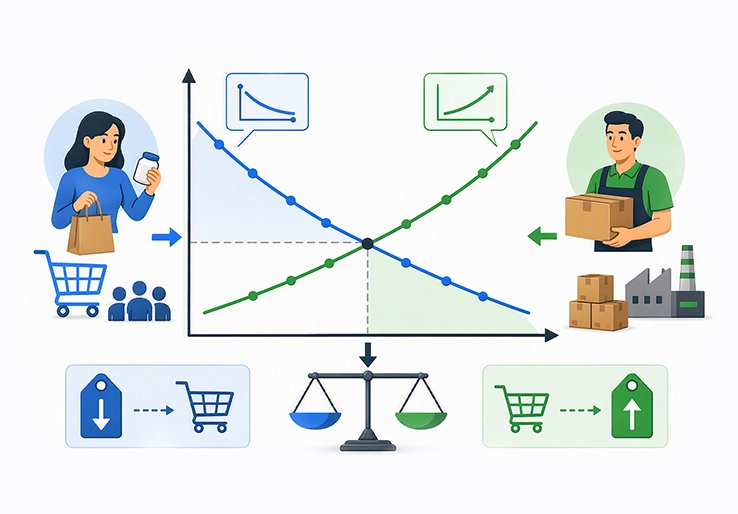
The law of supply and demand is the foundational economic principle that explains how prices are determined in a free market. It describes the relationship between how much of a product or service producers are willing to offer (supply) and how much consumers are willing to buy (demand) at various price points. When these two forces interact, they establish the market price for virtually every good and service exchanged in competitive economies worldwide.
This guide covers the core mechanics of supply and demand, how market equilibrium forms and adjusts, the key factors that shift supply and demand curves, notable exceptions like Giffen and Veblen goods, and real-world supply and demand examples spanning agriculture, housing, electric vehicles, and pandemic-era shortages. The content is designed for business owners making pricing and inventory decisions, students building economic foundations, investors analyzing market trends, and professionals navigating supply chain dynamics.
After reading this guide, you will be able to:
At its core, the demand and supply law describes the interaction between buyer willingness to purchase and seller willingness to produce at various price points. Buyers evaluate goods based on price, income, preferences, and available alternatives. Sellers evaluate production based on cost structures, profit margins, technology, and market conditions. The constant negotiation between these forces — what buyers are willing to pay and what sellers will accept — drives price fluctuations that seek a balance point.
This principle matters far beyond textbook economics. For business strategy, it guides pricing, production scale, and inventory planning. For investors, it helps anticipate shortages or surpluses that move asset prices. For policymakers, it frames the consequences of taxes, subsidies, and regulations. Understanding how supply and demand interact is essential for navigating economic cycles driven by supply shocks, demand shifts, or both simultaneously.
The law of demand states that, all other factors being constant (ceteris paribus), as the price of a good rises, the quantity demanded falls. Conversely, as the price decreases, the quantity demanded increases. A demand curve is always downward-sloping, reflecting this inverse relationship between price and quantity.
Three mechanisms explain why rising prices reduce demand:
These forces combine to ensure that, under normal conditions, demand decreases as prices increase, leading to less quantity purchased across the market.
The law of supply establishes the positive relationship between price and quantity supplied. As prices rise, producers are willing and able to supply more; when the price decreases, quantity supplied decreases. This creates an upward sloping supply curve on the standard supply and demand graph.
Several motivations explain this behavior:
Understanding both laws together reveals the mechanism by which prices are set: the law of supply and the law of demand work in tandem, pulling prices toward the point where supply and demand meet — the market equilibrium.
Grasping the balance between supply and demand is vital across numerous industries. While price plays a significant role in determining this balance, it is not the sole factor. The degree to which price influences demand and how price changes affect demand varies by product type and market competitiveness. For nonessential goods or products with many substitutes, demand tends to be highly elastic, meaning demand is very sensitive to price changes. Conversely, demand for essential goods, such as gasoline or healthcare, is relatively inelastic: consumers will likely pay regardless of price, especially if alternatives like public transit are unavailable.
Supply levels are affected by more than just price; various market forces can shift the supply curve, changing supply even if prices stay constant. Rising production costs including raw materials, labor, and energy can reduce supply, whereas technological advancements like automation can boost output at lower per-unit costs. Other influences include the entry or exit of competitors, resource discoveries, weather conditions, taxes, subsidies, and regulations. Additionally, suppliers' expectations about future prices can impact production decisions, with some holding back inventory anticipating higher returns.
Demand often fluctuates, causing sales to vary from period to period even without price changes. Consumer purchasing power, linked to income levels, plays a major role: higher wages typically increase demand for quality goods and reduce demand for inferior alternatives. The prices of complementary or substitute products also affect demand; for example, higher gasoline prices reduce automobile demand but may increase public transit use if accessible. Shifts in consumer preferences driven by trends, seasons, or culture — such as growing interest in plant-based or sustainably sourced products — also impact demand. Changes in population and demographics, like an aging population's greater healthcare needs, alter market size and composition. Marketing efforts, product reviews, and expectations about future prices or availability further influence when and how much consumers buy.
To remain competitive amid market fluctuations, businesses must track changes in supply and demand closely. When demand rises, companies can boost profits and market share by raising prices, expanding production, or both. When demand falls or new competitors enter, businesses may diversify product lines, target new customer segments, or adjust pricing to sustain revenue. Sudden supply disruptions may require quickly sourcing alternative suppliers, but proactive strategies like maintaining inventory buffers or vertically integrating the supply chain can help lessen the impact of shortages.
Beyond tactical adjustments, technology increasingly supports proactive supply and demand management. Real-time analytics and forecasting tools enable early detection of market shifts before they affect profitability. Businesses can enhance resilience through dynamic pricing models that adapt to market conditions, scalable operations, and strong supplier partnerships that provide advance warnings and priority access during shortages.
When the forces of supply and demand interact in a competitive market, they converge on a natural balance point. This is market equilibrium — the state where the quantity buyers want to purchase exactly matches the quantity sellers want to produce at a specific price. A shift in demand or supply changes market equilibrium, triggering price adjustments until a new balance is found.
The standard supply and demand graph plots price on the vertical axis and quantity on the horizontal axis. The downward sloping demand curve runs from upper-left to lower-right, showing that higher prices correspond to lower quantities demanded. The upward sloping supply curve runs from lower-left to upper-right, indicating that suppliers tend to offer more at higher prices. A supply curve shows price on the vertical axis alongside the demand curve, making the graphical intersection immediately visible.
The equilibrium price is where supply and demand curves intersect, the point where supply and demand intersect on the graph. At this market clearing price, there is no unsold inventory and no unmet demand — every willing buyer finds a willing seller, and every willing seller finds a buyer. The corresponding quantity at this intersection is the equilibrium quantity.
A critical distinction in supply and demand analysis separates two types of changes:
Accurate forecasting requires businesses to distinguish whether observed price movements result from shifting fundamentals (curve shifts) or simple responses to price changes (movements along curves). This distinction is essential for demand forecasting and strategic planning.
Markets self-correct through automatic adjustment processes:
Price fluctuations seek a balance between what buyers are willing to pay and what sellers will accept. While real markets experience friction — information lags, production delays, capacity constraints — the market clearing mechanism consistently pushes toward efficient resource allocation in competitive markets. Understanding this mechanism is the foundation for analyzing the more complex real-world factors and exceptions that follow.
Beyond price, numerous non-price determinants shift supply and demand curves, fundamentally altering market outcomes. Accurately assessing supply and demand requires monitoring these variables continuously, as they can transform market conditions faster than price alone would suggest.
Businesses need to understand demand drivers to set pricing, plan inventory, and anticipate market movements. The key determinants include:
On the supply side, production planning and supply chain management depend on understanding what causes supply curve shifts:
| Factor | Impact on Supply | Example |
|---|---|---|
| Production Costs | Higher costs decrease supply; supply curves shift left with increased production costs | Rising labor wages, fluctuating production costs for raw materials |
| Technology | Technological improvements can increase supply at lower costs | Automation, manufacturing efficiency gains |
| Government Policy | Taxes decrease supply; subsidies increase supply | Carbon taxes, agricultural subsidies; supply can be affected by government regulations and taxes |
| Natural Conditions | Weather events can significantly impact agricultural supply levels | Drought affecting crop yields, mining disruptions |
| Number of Suppliers | New competitors entering the market can increase overall supply | Market liberalization attracting entrants |
Businesses must monitor multiple supply and demand determinants simultaneously for accurate forecasting. Elasticity describes how sharply prices change based on demand and supply — goods with high demand elasticity see large quantity changes from small price movements, while inelastic goods remain relatively stable. Understanding elasticity helps businesses determine optimal pricing, minimize inventory carrying costs, and fulfill customer demand efficiently.
While the standard demand and supply law holds across most competitive markets, certain goods and market structures defy conventional patterns. Recognizing these exceptions is crucial for avoiding costly forecasting errors.
Giffen goods are a rare category of inferior goods where demand increases as price rises — a direct violation of the law of demand. This paradox occurs when the income effect dominates the substitution effect. As the price of a staple good rises, consumers become so much poorer in real terms that they can no longer afford better alternatives and must buy even more of the cheap staple. Named after Sir Robert Giffen and cited by Alfred Marshall, the classic example involves bread or rice among low-income populations. Empirical studies in rural China by Jensen and Miller found that rice price increases led to higher rice consumption among impoverished households, though only across narrow price ranges. These goods are exceedingly rare and typically exist only under conditions of extreme poverty with few available substitutes.
Veblen goods represent the opposite end of the spectrum: luxury items where higher prices actually increase demand. Named after economist Thorstein Veblen and his theory of conspicuous consumption, these goods derive value from their exclusivity and status-signaling properties. Designer handbags, high-end watches, luxury cars like Ferrari, and limited-edition fashion items all exhibit this pattern. A price decrease for such goods may actually reduce their desirability by diminishing perceived exclusivity. While luxury goods generally have high income elasticity, true Veblen goods display positive price elasticity over certain ranges — making them a notable exception to the downward sloping demand curve.
Several structural factors prevent markets from operating according to idealized supply and demand theory:
Understanding these exceptions helps businesses develop more nuanced strategies — particularly when operating in markets where standard assumptions about how price affects demand depend on context, status effects, or regulatory constraints.
Success in any competitive market hinges on accurately evaluating supply and demand. Companies launching new products must decide how much to produce and at what price. Overproducing or pricing too high can lead to unsold inventory and dead stock. Conversely, underproducing or pricing too low cuts into profits and may drive away customers who cannot wait for backorders. Effective demand forecasting helps businesses determine the ideal supply level and set the equilibrium price.
These four fundamental laws explain how changes in demand or supply influence pricing.
When supply grows without a change in demand, a surplus often results. This can happen due to factors like productivity boosts. To clear excess inventory, especially items nearing expiration, sellers usually lower prices to stimulate demand.
A surplus can also arise if customers reduce their desire for a product or service, even if supply stays the same. The outcome is similarly lower prices.
A decrease in supply causes shortages. In such cases, buyers are often willing to pay more to obtain goods or services. Supply disruptions can have various causes, including supply chain issues. If temporary, prices typically revert to normal once supply is restored.
Shortages can also occur if demand grows but supply does not keep pace or if demand outstrips production capacity. Once supply catches up, prices generally stabilize.
Economic theory becomes actionable when applied to observable market phenomena. The following supply and demand examples illustrate how theoretical curves translate into prices, shortages, surpluses, and business decisions in practice.
India's recurring onion price crises demonstrate supply and demand dynamics in essential commodity markets. During recent episodes, bumper harvests shifted the supply curve dramatically rightward while domestic demand remained constant and export demand dropped due to geopolitical disruptions. The result: wholesale onion prices in Maharashtra collapsed to ₹0.50–₹2 per kilogram — far below production costs of ₹20–₹25 per kilogram.
The government's Price Stabilisation Fund (PSF) intervened by procuring buffer stocks, though this covered only 1–2% of national production. Despite its small scale, the PSF reduced retail price volatility by approximately 24% and increased farmer incomes by roughly 19%. Retail prices during buffer stock releases stayed 36–45% below prevailing market rates. This case underscores how supply constraints (or their absence), storage infrastructure gaps, and policy mechanisms interact with fundamental supply and demand forces. For businesses in agricultural supply chains, it highlights the critical importance of demand forecasting, storage capacity planning, and minimizing excess inventory of perishable goods.
The early months of the pandemic created one of the most visible demand shocks in recent memory. Global demand for face masks surged almost overnight — huge demand far outstripping existing production capacity. Supply chains, designed for steady-state medical procurement, couldn't scale immediately. The result was a textbook shortage: demand exceeds supply, prices rise sharply, and rationing occurs through both price mechanisms and government mandates.
Over subsequent months, supply eventually catches up: manufacturers expanded production lines, new entrants entered the market, and the supply curve shifted rightward. As supply increases met stabilizing demand, prices fell toward pre-crisis levels. This case illustrates how time lags between demand shocks and supply responses create temporary but severe disequilibrium — and why businesses that can rapidly scale production or adjust procurement gain competitive advantage during disruptions.
The electric vehicle market shows simultaneous shifts in both supply and demand curves. On the demand side, rising fuel prices, environmental awareness, and government incentives (tax credits, rebates) have shifted the demand curve rightward. Increased demand raises equilibrium price and quantity in the short term. On the supply side, technological improvements can increase supply at lower costs — battery costs per kilowatt-hour have dropped approximately 80% over the past decade, shifting the supply curve rightward as well.
Initially, supply shortages in battery components (lithium, cobalt) created supply constraints that kept prices elevated. As manufacturing scale expanded and new competitors entered, supply became more elastic. The net effect: both curves shifting right has dramatically increased equilibrium quantity while moderating the price impact — making EVs accessible to a broader market while encouraging mining companies and battery manufacturers to invest in expanded capacity.
Urban housing markets exemplify what happens when supply constraints meet persistent demand growth. In cities like San Francisco, London, and Mumbai, population growth and urbanization continuously push demand rightward. However, supply is severely constrained by limited land, restrictive zoning regulations, lengthy permitting processes, and labor and material shortages. The supply curve is nearly vertical (inelastic) in the short run.
When demand increases but supply remains constant, the result is sustained rising prices. Decreased supply through regulatory constraints raises equilibrium price and lowers the equilibrium quantity of housing available. Markets where regulatory reforms have eased zoning restrictions have shown measurable price relief, confirming that the supply side — not just demand — drives housing affordability. For real estate investors and developers, understanding these supply elasticity dynamics is essential for evaluating where prices tend to rise fastest and where new construction can satisfy demand.
LOGIC ERP offers advanced supply chain management software designed to enhance demand forecasting accuracy. By integrating real-time market data, historical sales trends, and external factors that influence demand, LOGIC ERP enables businesses to anticipate customer needs more effectively. This proactive approach helps businesses meet customer demand while optimizing inventory levels, reducing stockouts, and minimizing excess carrying costs.
The software's robust analytics tools allow companies to model various supply and demand scenarios, incorporating factors such as seasonal fluctuations, market demand changes, and supply constraints. By understanding how these variables affect pricing, businesses can make informed decisions about production schedules and procurement strategies.
Additionally, LOGIC ERP's demand forecasting capabilities support dynamic pricing strategies by predicting how availability and demand help businesses determine optimal price points. This ensures a competitive edge that depends on accurate insights, enabling companies to respond swiftly to market changes, maintain profitability, and improve customer satisfaction.
Incorporating LOGIC ERP into your supply chain operations empowers your business to harness the law of supply and demand effectively, turning market data into actionable intelligence for sustained growth and competitive advantage.
The law of supply and demand remains the most essential framework for understanding how prices form, how markets allocate resources, and why shortages and surpluses occur. In a competitive market, prices adjust continuously as supply and demand fluctuate — driven by production costs, consumer preferences, technological change, government policy, and external shocks. Increased demand raises prices; increased supply lowers them; and equilibrium emerges where these forces balance.
To apply these principles immediately:
Related concepts worth exploring next include price elasticity of demand for optimizing pricing strategies, market structures and competition for understanding how market power affects pricing, behavioral economics for navigating irrational consumer behavior, and macroeconomic policy analysis for anticipating how fiscal and monetary decisions affect demand and supply at scale.
Call at +91-73411-41176 / +91-73411-41175 or send us an email at sales@logicerp.com to book a free demo today!
When supply and demand are equal, the market reaches equilibrium. The equilibrium price is where supply and demand curves intersect, and the equilibrium quantity represents the amount traded. At this point, there is no pressure for prices to change — every unit produced finds a buyer, and every buyer finds a unit available. However, equilibrium is dynamic: any change in underlying determinants (income, costs, preferences, policy) shifts curves and establishes a new equilibrium.
Price ceilings set below equilibrium (such as rent control) create shortages because quantity demanded exceeds quantity supplied at the artificial price. Price floors set above equilibrium (such as minimum wage or agricultural minimum procurement prices) create surpluses because quantity supplied exceeds quantity demanded. In India's onion markets, for example, government intervention through buffer procurement helped stabilize prices but couldn't fully prevent wholesale price crashes when supply overwhelmed demand. Price controls distort the natural market clearing mechanism and typically create unintended consequences.
Several frictions prevent markets from reaching or maintaining perfect equilibrium. Information lags mean buyers and sellers don't always know current conditions. Production time delays mean supply can't respond instantly to demand changes. Capacity constraints limit how quickly output can scale. Government regulations, imperfect competition (monopolies, oligopolies), price stickiness, and external shocks all create persistent deviations from theoretical equilibrium. In practice, markets are always moving toward equilibrium rather than sitting precisely at it.
Understanding how demand affects prices and how supply conditions change helps businesses determine optimal pricing. Key applications include: estimating price elasticity to balance volume against margin, monitoring substitute good prices to anticipate demand shifts, tracking input cost trends that may force supply curve adjustments, and implementing dynamic pricing that responds to real-time market conditions. Businesses that integrate demand forecasting with supply-side monitoring can better fulfill customer demand while minimizing excess inventory and maximizing profitability.
Time is critical because supply and demand adjust at different speeds. In the short run, supply is often inelastic — factories can't be built overnight, crops take seasons to grow, and new market entrants need time to establish operations. Demand can also be slow to adjust as consumers gradually change habits and find substitutes. In the long run, both supply and demand become more elastic: producers invest in capacity, adopt new technologies, and optimize production, while consumers fully adjust their purchasing patterns. This difference between short-run and long-run elasticity explains why markets often experience temporary shortages or surpluses before reaching a new equilibrium — and why lower prices in the long run often follow initial supply shortages as production scales.
The four basic laws of supply and demand are: (1) Prices will fall if supply increases while demand remains unchanged. (2) Prices will fall if demand decreases while supply remains constant. (3) Prices will rise if supply decreases while demand remains unchanged. (4) Prices will rise if demand increases while supply remains constant.
Supply refers to the quantity of a specific good or service available in the market. Demand represents the quantity of that good or service that customers want to purchase. Both supply and demand are influenced by the prices of goods and services.
For instance, if the price of coffee becomes too high, some consumers may stop buying it and switch to tea. Conversely, if the price is too low, coffee shops may run out of stock and lose potential profits. The equilibrium price balances supply and demand, allowing coffee shops to maintain profitability while satisfying customers.
The law of demand states that as prices increase, customers tend to purchase fewer quantities, often substituting with alternative goods.
Popular Products