PIM is the practice of centralizing, enriching, and distributing all your product data from a single repository to every sales channel your business operates — one authoritative hub for every product detail your customers, partners, and teams need.
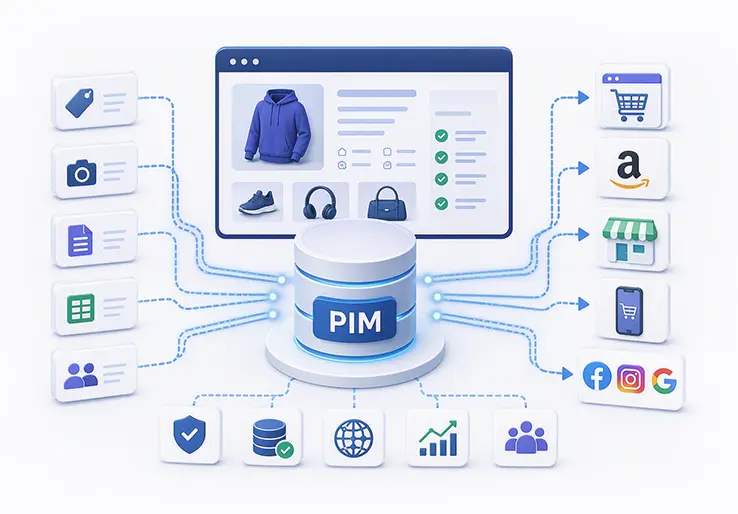
Product Information Management (PIM) is the practice of centralizing, enriching, and distributing all your product data from a single repository to every sales channel your business operates. If your product descriptions live in spreadsheets, your digital assets sit in shared drives, and your technical specifications are buried in ERP systems, a PIM system eliminates that fragmentation — giving you one authoritative hub for every product detail your customers, partners, and teams need.
If you're managing product data across disconnected spreadsheets, siloed ERP systems, and dozens of marketplace dashboards, you already know the pain. Missing technical specs trigger customer complaints, inconsistent product descriptions across online shops erode trust, and manual processes slow every product launch to a crawl.
You're not alone. Most ecommerce businesses, multi-channel retailers, manufacturers, distributors, B2B companies, multi-brand enterprises, and growing teams hit this wall once their catalog passes a few hundred SKUs. Data silos multiply, manual tasks pile up, and errors get expensive through returns, lost sales, and damaged brand credibility.
Product information management (PIM) is the system built to fix that: a single repository that centralizes, enriches, and distributes product data across every sales channel. PIM emerged in the early 1990s alongside eCommerce growth, evolving from simple catalog tools into a centralized platform for managing every dimension of product content, from marketing copy and technical specifications to compliance data, digital assets, and localized descriptions.
In 2026, PIM is a practical requirement for businesses selling across multiple channels because fragmented product data slows launches, creates inconsistencies, weakens customer trust, and limits conversion. This guide explains how PIM works, how it differs from ERP, which core features and integrations matter, how to choose and implement the right solution, where it delivers ROI, and how businesses in retail, manufacturing, distribution, and B2B use it to improve accuracy and scale faster.
A properly implemented PIM platform gives you faster product launches, more accurate information at every customer touchpoint, simpler operations, and fewer costly errors that eat into margins.
Product Information Management (PIM) has evolved significantly since its inception in the early 1990s, driven by the rapid growth of eCommerce and the increasing complexity of product data management. Initially, businesses relied heavily on printed catalogs and basic ERP systems to manage product information. However, these traditional tools were not designed to handle the rich, varied, and dynamic product data required for modern omnichannel sales and marketing.
As digital commerce expanded, the need for a centralized platform to consolidate, enrich, and distribute product information became critical. Early PIM systems emerged to fill this gap, providing a single source of truth that could manage everything from technical specifications and pricing to marketing content and digital assets. This shift enabled businesses to maintain consistent and accurate product data across multiple channels, reducing errors and improving customer experience.
Today, PIM is indispensable for organizations aiming to scale their product offerings and meet customer expectations in a fast-paced market. It supports localization by managing multiple languages and regional data, facilitates faster time-to-market through automated workflows, and enhances data quality with validation and approval processes. The importance of PIM lies in its ability to break down data silos, streamline collaboration across departments, and ensure that every customer touchpoint delivers reliable, engaging product information.
In an era where customers demand seamless and personalized shopping experiences, PIM serves as the backbone of effective product data management, driving operational efficiency, boosting sales, and fostering brand loyalty.
Here's what makes product information management systems fundamentally different from everything else businesses try, especially when you need to streamline workflows around product information:
Instead of forcing you to reconcile conflicting spreadsheets or chase down missing product details across departments, PIM gives you a streamlined way to manage, enrich, and distribute product content at scale.
Product Information Management (PIM) software offers a robust set of features designed to centralize, enrich, and distribute product data efficiently. Key features include:
Implementing a PIM system delivers substantial PIM benefits for operational efficiency, customer experience, and revenue growth:
While both PIM and Enterprise Resource Planning (ERP) systems manage product-related data, their focus and capabilities differ significantly:
Selecting the ideal PIM platform requires careful consideration of your organization's unique needs:
PIM software serves diverse industries by addressing their specific product data challenges:
Retail and eCommerce
Managing large, dynamic catalogs with rich content to improve online shopping experiences and omnichannel consistency.
Manufacturing
Distributing detailed technical specifications, compliance data, and product lifecycle information to partners and customers, while using product lifecycle management data to enrich downstream product content.
Distribution and Wholesale
Streamlining product data aggregation from multiple suppliers and ensuring accurate, consistent information across sales channels.
Consumer Packaged Goods (CPG)
Managing complex product assortments, tracking raw materials, and supporting brand management initiatives.
Healthcare and Pharmaceuticals
Ensuring regulatory compliance, managing detailed product attributes, and delivering accurate information to distributors and customers.
Automotive
Handling extensive product variants, technical documentation, and after-sales information for dealers and service centers.
Effective PIM deployment depends on seamless integration with your technology ecosystem:
Quantifying the return on investment (ROI) for PIM implementations helps justify the expenditure and guides continuous improvement:
By regularly analyzing these metrics, businesses can optimize their PIM strategy to maximize impact and maintain competitive advantage.
Getting results from PIM software doesn't require reinventing your operations. The process follows three clear phases:
PIM aggregates data from multiple sources into a structured format. Your existing systems — ERP, supplier databases, spreadsheets, and external data sources — connect to the PIM through APIs, batch imports, or feed integrations. Basic product information like SKUs, pricing, inventory levels, and technical specifications flows in automatically.
PIM must integrate with existing ERP and CRM systems to function effectively. The platform maps source fields to a structured data model supporting attribute families, classification trees, and variant relationships. During this phase, duplicate records are cleaned, attribute mismatches resolved, and your catalog taxonomy established.
This integration with your organization's systems ensures the PIM becomes the central repository for master data — not another disconnected tool.
Once raw product data is imported, enrichment begins. Teams add marketing descriptions, technical specifications, digital assets (images, videos, PDFs), localized content for different regions, and SEO-optimized product content. PIM supports localization by managing various languages and regional data, making it essential for businesses expanding internationally.
PIM should enable data governance and approval workflows at this stage. Validation rules enforce completeness — for example, requiring that every product has minimum image counts, mandatory safety attributes, or translated descriptions before publication. Automated workflows route products through review and approval chains. Version control and audit logs maintain accountability.
PIM supports SEO efforts by providing optimized product content, ensuring that every product page published to your digital channels carries the structured, keyword-rich information search engines reward.
Enriched product data syndicates to every distribution channel your business uses. PIM automates catalog creation and maintenance processes, pushing formatted data to ecommerce platforms, Amazon and other marketplaces, print catalogs, POS systems, mobile apps, and sales materials.
Each channel may require different formats, attribute subsets, or content variations. The best PIM systems handle channel-specific transformations automatically — tailoring product listings for each platform while maintaining consistent branding and accurate information everywhere your customers encounter your products.
PIM automates the distribution of product listings across channels, replacing what previously required manual formatting, copying, and uploading across dozens of platforms.
Understanding what PIM replaces clarifies its value:
Results from PIM adoption are measurable and well-documented across industries:
Faster Product Launches: Companies implementing mature PIM platforms report up to 60% faster time-to-market for new products. What previously took 8–12 weeks from product concept to live listing compresses to 3–5 weeks through automated workflows and centralized product data enrichment.
Reduced Returns and Errors: PIM helps reduce product returns by improving data accuracy. When product pages carry complete, validated technical specs, accurate dimensions, and rich media, customers make better-informed purchase decisions. Error rates — incorrect specifications, missing attributes — drop by 50–70% post-implementation. Accurate product data improves customer trust and engagement.
Higher Sales Conversion: PIM automates catalog creation, enhancing sales conversion rates. Retailers with complete product content (full specifications, multiple images, video) see 20–40% conversion uplift compared to sparse listings. PIM enhances the customer experience by providing rich product information — detailed descriptions, comparison data, and consistent presentation across every channel.
Operational Efficiency Gains: Teams managing 10,000+ SKUs across multiple channels report dramatic reductions in manual work. Centralized product data management eliminates duplicated effort — content created once distributed everywhere.
Marketplace Compliance: Fewer de-listings and feed rejections on marketplaces when product data meets platform-specific requirements consistently.
PIM centralizes product data for consistent marketing across channels — and the financial impact is tangible across every metric that matters.
Product information management delivers the highest ROI for specific business profiles:
eCommerce Retailers
Managing complex product catalogs across multiple online marketplaces, websites, and mobile apps. If you sell products through Amazon, Shopify, and your own online stores, PIM keeps every listing accurate, enriched, and synchronized. Ecommerce managers gain hours back each week as repetitive tasks disappear.
B2B Manufacturers
Distributing technical data, compliance data, safety certifications, and product specifications to distributors, resellers, and business partners. Complex variant hierarchies and technical specs demand structured master data management that spreadsheets cannot provide.
Multi-Brand Companies
Coordinating product information across different brands, regions, and customer segments. PIM supports localization, multi-currency, and region-specific compliance — essential for companies operating across borders with different regulatory requirements. The ability to manage omnichannel retail operations from a single platform becomes transformative.
Growing Businesses
Scaling from manual processes to automated, professional product data management. Startups and SMBs that have outgrown static catalogs need PIM to expand into new sales channels, new regions, and new marketing channels without proportionally scaling headcount. When your catalog grows, your data management approach must grow with it.
If you need to market products across digital channels, physical stores, and business partners while maintaining data accuracy and enhancing customer experience, PIM was built for you.
Selecting the right PIM solution depends on your catalog complexity, technical resources, budget, and growth trajectory.
SaaS PIM platforms offer the fastest deployment path. Hosting, maintenance, and upgrades are handled by the vendor, letting your team focus on product data enrichment rather than infrastructure. Cloud-based PIM solutions typically include pre-built connectors for popular ecommerce platforms like Shopify, along with marketplace integrations and ERP connectivity.
Cloud PIM works well for mid-market businesses that need quick deployment, scalability, and minimal IT overhead. Integration capabilities with existing ecommerce and ERP systems are typically strong, with REST APIs enabling connection to virtually any platform in your stack.
For large product catalogs, complex organizational structures, and mission-critical deployments, enterprise PIM platforms provide advanced key features: sophisticated workflow engines, supplier portal management, digital product passport support, and enterprise-grade security.
These platforms support multi-channel distribution at scale with dedicated support teams, advanced customization options, and SLA-backed reliability. Enterprise PIM is the standard for companies managing hundreds of thousands of SKUs across dozens of distribution channels.
Open-source PIM solutions offer cost-effective entry points with full code access and customization flexibility. They're ideal for businesses with internal development resources who want complete control over their data, hosting, and feature development.
However, evaluate total cost of ownership beyond subscription fees. Even with zero license costs, hosting, implementation, data migration, developer hours, and ongoing maintenance commonly run €30,000–€80,000 in the first year for mid-size catalogs. Open-source PIMs require technical capacity for upgrades, security patches, and feature development.
The open-core licensing model dominates: base features are free, while premium modules, enterprise support, and managed hosting carry costs. Assess revenue thresholds — some platforms have commercial licensing limitations — and build total cost of ownership models that include ongoing operational expenses.
Your product data challenge has a clear solution. Start by assessing where you stand:
Evaluate your current state. How many data sources feed your product catalogs? How many hours does your team spend on manual data entry and corrections? How many channels require unique formatting? The answers reveal your PIM readiness — and the potential ROI.
Match the right PIM solution to your business. Consider your catalog size, number of sales channels, internal technical resources, compliance requirements, and growth plans. A growing D2C brand with 2,000 SKUs has different needs than a multi-store retail chain managing 50,000 products across wholesale, retail, and ecommerce.
Plan for adoption, not just deployment. Successful PIM implementation requires cross-functional alignment. Define who owns product taxonomy, who enriches content, who approves publication, and how governance workflows operate. Include marketing teams, product managers, and IT stakeholders from day one.
Integrate PIM with your ERP foundation. PIM integrates with ERP systems to enhance product data management — connecting transactional accuracy with marketing-ready content. When your ERP and PIM work together, you achieve a single, consistent view of every product across your entire organization.
Ready to eliminate product data chaos and accelerate your growth across every channel? Connect with LOGIC ERP to explore how integrated ERP and PIM capabilities can transform your product information management from scattered data to a competitive advantage.
Call at +91-73411-41176 / +91-73411-41175 or send us an email at sales@logicerp.com to book a free demo today!
ERP manages business processes like finance and inventory transactional data that powers operations. PIM focuses specifically on marketing-enriched, customer-facing product content: detailed product descriptions, digital assets, localized content, technical specifications, and channel-specific formatting. ERP systems often lack detailed product information management capabilities. PIM integrates with ERP systems to enhance product data management, creating a complete ecosystem where transactional accuracy meets content richness.
Implementation timelines range from 3–12 months depending on catalog size, data complexity, number of integration points, and internal resources. A mid-market retailer with 5,000 SKUs and two sales channels might deploy in 3–4 months. An enterprise manufacturer with 100,000+ SKUs, supplier feeds, regulatory compliance requirements, and ten distribution channels may need 9–12 months for full deployment.
Yes. Modern PIM platforms offer API-based integrations with most ecommerce, ERP, CRM, and marketing tools. Pre-built connectors exist for major platforms like Shopify, Magento, Amazon, and leading ERP systems. Open-source PIMs offer full control over custom integrations. The key is ensuring bidirectional data flow product data flowing out, and order/inventory data flowing back in.
ROI manifests through multiple channels: reduced manual work (fewer hours spent on data entry and correction), faster product launches (weeks instead of months), fewer customer complaints and returns from improved data accuracy, and measurable conversion lift from richer product pages. Companies typically see 20–40% conversion improvement on product pages with complete content, plus significant operational cost savings from eliminating duplicated effort across teams. PIM also streamlines workflows for supply chain partners and business partners who rely on accurate, timely product data.
Data governance in the context of Product Information Management (PIM) refers to the set of policies, processes, and controls that ensure the accuracy, consistency, and reliability of product data throughout its lifecycle. It involves establishing validation rules, approval workflows, and role-based permissions that manage how product information is created, enriched, reviewed, and published across various sales channels. Effective data governance within a PIM system prevents errors, maintains compliance with industry standards, and ensures that only verified and high-quality product information reaches customers. This structured approach not only enhances data quality but also fosters trust, reduces costly mistakes such as product returns, and supports a seamless omnichannel customer experience.
PIM centralizes product information, ensuring consistent and accurate data across all sales channels. It employs data governance practices and validation rules that enhance data quality, reducing errors and improving the overall customer experience.
Digital asset management (DAM) within a PIM system organizes and stores digital assets such as images, videos, and documents. This integration ensures that enriched product content includes high-quality digital assets, supporting marketing efforts and enhancing product listings.
Ecommerce managers use PIM to streamline product data management, automate catalog updates, and distribute consistent product information across multiple channels. This leads to faster product launches and improved customer experience.
Master data management (MDM) oversees all critical business data, including customers and suppliers, while PIM specifically focuses on managing detailed product information to support marketing and sales channels.
The core functions of PIM include centralizing product data, enriching product content with marketing and technical information, managing digital assets, enforcing data governance, and distributing product information across multiple digital commerce channels.
By providing accurate, consistent, and enriched product information along with digital assets, PIM ensures customers receive a seamless and informative shopping experience, which increases trust and conversion rates.
Look for PIM systems that offer strong data governance, integration capabilities with existing systems, robust digital asset management, scalability, automation features, and user-friendly interfaces to support your marketing data needs.
Popular Products