Learn what RFID is, how radio frequency identification works, its types, benefits, applications, and role in inventory tracking and ERP integration.
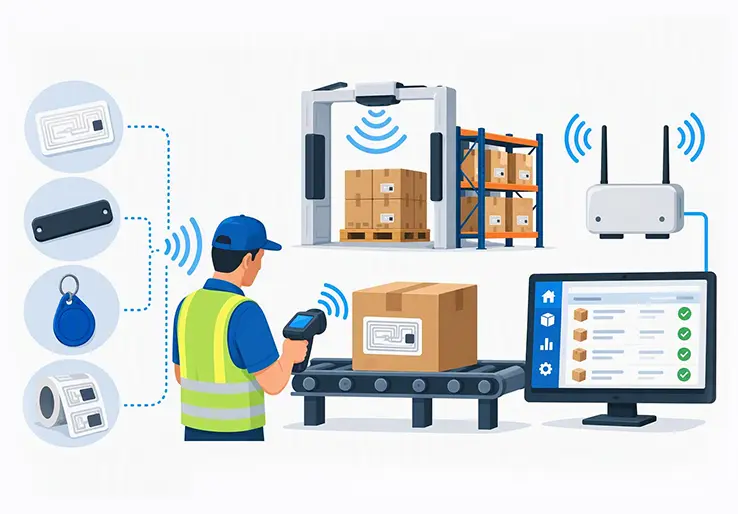
Businesses across retail, manufacturing, and logistics face a common challenge: keeping track of thousands (or millions) of items accurately, quickly, and without drowning in manual processes. Radio frequency identification, commonly known as RFID, solves this by using radio waves to automatically identify and track tagged objects without requiring a direct line of sight.
This guide covers how RFID technology works, the different types of tags and frequency bands, where businesses apply it, its benefits and limitations, and how it integrates with inventory and ERP systems like LOGIC ERP.
Radio frequency identification (RFID) is an automatic identification and data capture technology that uses radio waves to wirelessly identify, track, and manage tagged objects, people, or animals. Unlike barcodes, RFID does not require line-of-sight scanning, allowing businesses to automatically identify items at speed and scale across warehouses, stores, and supply chains.
RFID technology traces its origins to mid-20th century radar and military identification friend-or-foe (IFF) systems. Commercial adoption began in the 1970s and accelerated in the early 2000s when major retailers like Walmart mandated RFID tagging across their supply chain. Today, RFID enables automatic identification and data capture (AIDC) for products, assets, animals, and people across virtually every industry.
At its core, RFID consists of tags and readers communicating via radio waves. Common applications of RFID include supply chain management, access control, and retail security. It is also widely used in inventory management and automated tracking systems.
Key terms to understand:
RFID technology operates through a straightforward sequence of wireless communication between tags and readers.
Here is how the process works, step by step:
Passive RFID tags are powered by the reader’s radio waves, giving them a typical read range from a few centimeters up to about 10 meters depending on frequency and conditions. Active RFID tags have their own battery for power, enabling ranges of tens to hundreds of meters.
RFID tags can be read from several meters away without line-of-sight, and RFID systems can read multiple tags simultaneously, unlike barcodes. In practice, RFID tags can be read hundreds at a time, which is what makes bulk processes like pallet scanning or cycle counting dramatically faster.
RFID tags can also be read through packaging materials, eliminating the need to open boxes or orient items toward a scanner. However, the radio link is affected by distance, tag orientation, RF interference, and nearby materials. Metal can detune antennas, and liquids absorb RF energy, both of which reduce read reliability if not accounted for in system design.
Every RFID system consists of hardware (tags, readers, antennas), middleware for data processing, and business software for acting on the results. LOGIC ERP interacts with the data and business process layer, while specialized vendors supply the RFID hardware. The physical layout varies significantly, from a simple doorway portal in a stockroom to a multi-reader setup across a large factory or yard.
RFID readers are network connected devices that generate the radio frequency field and capture tag responses. They serve as the bridge between the physical world of tagged items and the digital data systems that process the information.
Two main categories exist:
Reader performance depends on transmit power, receiver sensitivity, the number of antenna ports, and compliance with local regulatory limits on radiated power. A fixed reader at a warehouse gate will typically have higher power and more antennas than a mobile unit, giving it a wider and more reliable read zone.
The RFID antenna shapes and directs the radio frequency field, defining the coverage zone where tags can be read. Antenna selection directly influences read density (how many tags are captured in a given area) and overall system reliability.
Common antenna types include:
Antennas are mounted on door frames (portal reads), ceilings (for aisle or zone coverage), and conveyor sides (for item flow detection). Poor antenna placement leads to missed reads, stray reads from adjacent zones, and dead spots where tags go undetected.
Middleware is the processing layer between raw RFID hardware reads and business applications. It filters duplicate reads, applies anti-collision protocols, and translates physical tag events into meaningful business transactions.
For example, middleware can enforce event rules such as "tag detected at dock door A triggers a goods receipt in ERP" or "tag not seen at expected location generates an alert." These rules connect the physical world of tags to communicate with readers to the digital world of inventory management software and ERP platforms like LOGIC ERP.
Integration typically happens through APIs, message queues, or event-based connectors. In modern deployments, middleware may run on on-premise servers, industrial edge PCs in the warehouse, or cloud platforms depending on latency, reliability, and security requirements.
RFID systems are classified by how their tags are powered. This choice affects read range, tag cost, lifespan, and the types of RFID applications the system can support.
| Feature | Passive RFID | Active RFID | Battery-Assisted Passive (BAP) |
|---|---|---|---|
| Power source | Reader’s RF signal | Own power source (battery) | Battery for chip; backscatter for communication |
| Typical read range | Up to ~10 m (UHF) | 30–200 m | Similar to passive or slightly extended |
| Cost per tag | ~0.10–0.50 | ~10–50+ | Between passive and active |
| Lifespan | Very long (no battery) | Limited by battery (years) | Limited by battery |
| Common uses | Product labels, cartons, apparel | Fleet tracking, high-value tools, containers | Cold chain monitoring, sensor-equipped assets |
Passive RFID tags dominate retail and supply chain deployments due to their low cost and zero-maintenance design. Active RFID tags suit scenarios where long read range and continuous tracking matter, such as monitoring expensive equipment across a factory floor. Semi-passive tags bridge the gap, enabling sensor data collection (like temperature logging) without the full cost and complexity of active systems.
Beyond power source, RFID systems are classified by the radio frequency bands they operate on. The RFID frequency directly determines read range, data transfer speed, and how well the system performs around different materials.
The frequency of RFID systems affects the read distance and speed of item identification. Tags and readers must operate on the same radio frequency to communicate, and multi-frequency deployments require careful planning to avoid interference and ensure compliance with local spectrum regulations.
RFID standards ensure interoperability across manufacturers, regions, and supply chains. Without them, a tag from one vendor might be unreadable by another vendor’s reader.
Major standards by frequency band:
The Electronic Product Code (EPC) is a standardized identifier defined by GS1 and EPCglobal. EPC formats like SGTIN-96 provide unique item-level frequency identification across global supply chains. EPC Gen2 was approved in December 2004, and ISO 18000-6C was adopted in 2006, together forming the backbone of modern UHF RFID deployments.
The latest EPC Gen2 v3.0 standard, finalized by GS1 in 2024, introduced improvements including better tag-selection commands, fringe-tag interference mitigation, simplified crypto tag support, and logical operators for filtering. As of October 2014, 78 countries had RFID regulations governing spectrum use, power limits, and compliance, and that number has continued to grow.
The core benefits of RFID come down to speed, visibility, accuracy, and labor savings. But these outcomes depend on correct tag selection, reader configuration, and process redesign — not just installing hardware.
Key benefits include:
RFID technology enhances traceability and reduces manual errors in data entry across the entire supply chain. As a real-world example, Decathlon reported that after implementing RFID across all products, inventory counts became approximately five times faster, checkout dropped to under one minute from up to 20 minutes, and shrinkage declined measurably.
RFID is a proven technology with applications spanning nearly every sector. Adoption has accelerated since the early 2000s as tag and reader prices declined and RFID standards matured.
RFID applications span both item-level tagging (individual garments, pharmaceuticals) and high-value asset tracking (machinery, vehicles, containers) depending on business goals. The following sections explore the most impactful use cases in detail.
In warehouse environments, passive UHF RFID tags are the most common choice for case- and pallet-level tracking. Fixed readers installed at dock door portals can automatically capture inbound and outbound shipments as pallets pass through, with typical read ranges of several meters.
Key warehouse use cases include:
Integration with LOGIC ERP means that tag reads at a dock door can automatically update stock records, assign items to bins, trigger putaway tasks, and generate receiving documents — all without manual keying. For businesses managing multiple facilities, this level of automation supports centralized inventory control across locations.
Retailers have embraced item-level RFID tagging, particularly in apparel, where each garment carries a UHF RFID label. Staff use handheld readers to count entire racks in minutes rather than hours, and inventory accuracy in successful deployments regularly exceeds 95%.
Typical retail RFID deployments include:
RFID is used in retail for inventory visibility and loss prevention. Real-time stock accuracy also powers omnichannel services like click-and-collect and ship-from-store, which require knowing exactly what is available in each location at any moment.
RFID data integrated with LOGIC ERP’s retail and inventory modules can synchronize store and warehouse stock levels, trigger automatic replenishment when tags indicate low stock, and support audit trails. For apparel businesses specifically, combining RFID with inventory management software eliminates overstocks and stockouts by providing granular size-color-style visibility.
Manufacturing environments present unique RFID challenges — metal surfaces, high temperatures, and complex workflows — but also significant payoffs in traceability and operational efficiency.
Common manufacturing RFID applications:
Work-in-Progress (WIP) Tracking
Tags on assemblies or containers move through production stages, with RFID readers at each station logging progress. This gives production managers a real-time view of where every job stands.
Tool and Mold Management
Active tags or rugged passive tags on high-value tools, dies, and molds help locate assets quickly and track maintenance schedules.
Returnable Transport Items (RTIs)
Tags on pallets, racks, and containers ensure these assets are tracked across facilities and between partners.
Finished Goods
Tags applied at the end of a production line feed directly into shipping and logistics workflows.
For example, an automotive plant might tag engine blocks with rugged UHF tags that survive paint processes and assembly heat, providing full traceability from casting through final vehicle assembly. A plastics factory could tag injection molds to monitor usage cycles and trigger preventive maintenance.
RFID events in these settings can update production orders, machine utilization records, and asset registers within systems like LOGIC ERP, connecting shop-floor data to supply chain management decisions.
Beyond inventory and asset tracking, RFID plays a central role in physical access control and transportation payment systems.
These systems follow the same basic logic: a tagged item (card, ticket, vehicle sticker) communicates with a reader, which checks an identifier against stored permissions and logs the event. While these are not primary LOGIC ERP use cases, the same integration principles apply when connecting RFID to enterprise identity, attendance, or access management systems.
RFID and barcodes are both identification technologies, but they work differently and excel in different scenarios.
| Feature | RFID | Barcode |
|---|---|---|
| Identification method | Radio waves | Optical scanning |
| Line of sight | Generally not required | Barcodes require direct line of sight to be scanned |
| Multiple-item reading | Can read multiple tags at once | Scanned one at a time |
| Read distance | RFID tags can be read from distances up to 33 feet | Requires close proximity |
| Read through materials | Tags can be read through packaging materials | Label must be visible |
| Tag/label cost | Higher (0.10–50+ depending on type) | Very low (fractions of a cent) |
| Durability | Rugged options available | Susceptible to damage, smudging |
| Data capacity | Tags can store several pages of data | Limited to printed information |
| Best for | High-volume, automated tracking | Cost-effective identification, low-volume scanning |
RFID tags can be read without direct line of sight, which is a fundamental advantage in bulk scanning and automated environments. However, barcodes remain highly cost-effective for low-value, low-volume items where manual scanning is acceptable.
The two technologies are often complementary. Many RFID tags are integrated with printed barcodes on smart labels, allowing teams to use whichever method suits the situation. For businesses already using barcode management, RFID can be layered on top as an enhancement rather than a replacement. QR codes and other optical codes serve similar fallback roles.
NFC (Near-Field Communication) is a subset of high frequency RFID operating at 13.56 MHz, but designed specifically for very short-range, secure, two-way communication between devices.
Key differences:
Both rely on the radio frequency portion of the electromagnetic spectrum, but they serve different business needs. When evaluating which technology to deploy, the deciding factors are range, interaction style, and whether bulk reading is required.
RFID is powerful, but it comes with real constraints that businesses must plan for.
Technical Challenges:
Organizational Challenges:
RFID’s ability to read tags wirelessly raises legitimate security concerns and privacy questions.
Privacy Risks:
Security Mechanisms:
Regulations and RFID standards from ISO, IEC, EPCglobal, and regional spectrum authorities (FCC in the US, ETSI in the EU) govern frequency identification use, power limits, and in some cases data protection obligations. Careful system design — limiting read range, using shielding, controlling reader access, and implementing data governance — manages these risks effectively in enterprise settings.
Billions of RFID tags are produced annually, many embedded in packaging materials and textiles that are discarded after a single use. This raises valid questions about e-waste and environmental impact.
Key considerations:
Emerging good practices include designing recyclable tag constructions, adopting selective tagging strategies (only tagging items where the visibility benefit justifies the cost and waste), enabling tag reuse on returnable containers and assets, and collaborating with recycling systems that can handle mixed electronic materials.
The real business value of RFID emerges when tag-read events flow seamlessly into the systems where decisions are made. An RFID system consists of hardware collecting data and software interpreting it — LOGIC ERP sits on the interpretation side.
Integration Architecture:
RFID event data (tag ID, reader location, timestamp) is captured by readers, filtered by middleware, and passed to LOGIC ERP via APIs or integration connectors. LOGIC ERP then maps this data to business entities: SKUs, lot or batch numbers, bin locations, and transaction types.
Key Integration Points:
Goods Receipt
Tagged pallets pass through dock portals, and LOGIC ERP automatically creates receiving entries.
Stock Transfers
Tag reads at origin and destination locations trigger inter-warehouse or inter-bin movement records.
Order Picking
Handheld readers verify that picked items match the order, and LOGIC ERP confirms fulfillment.
Cycle Counting
Bulk tag reads from handheld scanners are compared against LOGIC ERP’s on-hand records, with discrepancies flagged for investigation.
Mini-Scenario: A pallet of finished goods arrives at a distribution center dock. The fixed UHF portal reader captures tag IDs from all 48 cases on the pallet. Middleware matches tag IDs to expected purchase order lines and transmits a "goods receipt" event to LOGIC ERP. The system updates inventory in the receiving location, assigns a putaway task, and the forklift operator drives the pallet to its designated bin — where a bin-location tag read confirms the placement. Total elapsed time from dock to bin: under three minutes, with zero manual data entry.
For businesses evaluating this kind of integration, exploring how ERP systems enhance inventory visibility provides additional context on the software side of the equation.
Rolling out RFID requires methodical planning. Here is a practical checklist:
Radio frequency identification is a flexible, proven technology that removes manual bottlenecks from inventory tracking, warehouse operations, retail stock management, and asset tracking across industries. When deployed with the right combination of tags, readers, frequency bands, and integrated software, RFID delivers measurable gains in speed, accuracy, and visibility.
Successful deployments are never just about hardware. They require robust software like LOGIC ERP to interpret RFID data, enforce business rules, and turn raw tag reads into actionable inventory records and operational insights.
If you are evaluating where RFID could eliminate manual scans, reduce errors, and close visibility gaps in your current processes, start by mapping your highest-impact use cases and running a focused pilot.
Managing inventory across warehouses, production facilities, and retail locations requires accurate data and reliable tracking processes. Explore how LOGIC ERP supports inventory management and operational visibility through integrated business workflows. Request a Free Demo Today.
Call at +91-73411-41176 / +91-73411-41175 or send us an email at sales@logicerp.com to book a free demo today!
RFID stands for radio frequency identification. It is a wireless technology that uses radio signals to identify and track tagged objects, animals, or people without requiring physical contact or a direct line of sight between the tag and the reader.
RFID is used across retail, manufacturing, warehousing, logistics, healthcare, and transportation. Common uses include inventory management, asset tracking, supply chain management, access control, contactless payments, and animal identification.
An RFID reader is a network connected device that transmits radio waves via its antenna. When a tag enters the reader’s field, it uses that energy to transmit data back to the reader, and connected software processes the response into actionable business information. RFID helps businesses collect data automatically without manual scanning.
The three types are passive RFID tags (powered by the reader’s signal), active RFID tags (battery powered with their own power source), and battery-assisted passive or semi-passive tags (battery powers the chip but communication uses backscatter). The read range of RFID tags varies based on the type and frequency band used.
Unlike barcodes, RFID does not require line-of-sight scanning. RFID can read multiple tags simultaneously, works through packaging, and captures data automatically. Barcodes are cheaper to produce but must be scanned individually with an optical reader aimed directly at the label.
The read range depends on tag type and frequency. Passive UHF tags typically reach several meters (up to about 10 meters). Active tags can reach 30 to 200 meters. LF and HF tags have much shorter ranges, from a few centimeters to about one meter. Metal and liquids can significantly reduce effective range.
Yes. RFID tags can be read without a direct line between the reader and the tag. Tags can be read through cardboard, plastic, fabric, and other non-metallic packaging materials. This is one of the key advantages over optical barcode scanning.
RFID automates goods receipt, putaway, cycle counting, and dispatch verification. Tags on items, cases, or pallets are read by fixed or mobile readers, and the data feeds into inventory management or ERP systems. This eliminates most manual counting and data entry.
Challenges include higher upfront costs compared to barcodes, read reliability issues near metal and liquids, integration complexity with existing systems, security concerns around unauthorized tag reading, and the need for staff training and process changes.
Yes. RFID hardware and middleware can transmit filtered tag-read events to LOGIC ERP via APIs or connectors. These events can trigger inventory receipts, stock movements, cycle count updates, and dispatch confirmations within LOGIC ERP’s warehouse management and inventory modules.
It can be, particularly for case- or pallet-level tracking where volumes justify the investment. Item-level tagging requires more infrastructure but can deliver strong ROI for retail apparel or high-value stock. A controlled pilot is recommended before committing to a full rollout.
Costs vary widely. Passive UHF tags run approximately 0.10–0.50 each in volume. Fixed readers cost several thousand dollars each. Active tags range from $10 to $50 or more. Total system cost depends on the number of read zones, software and middleware, integration effort, and ongoing tag consumption. There is no single universal price — every deployment is different.
Ultra High Frequency RFID operates in the 860–960 MHz range and is widely used for inventory tracking, warehousing, and supply chain management due to its long read range and ability to read multiple tags simultaneously.
An RF tag is another term for an RFID tag, which stores data and communicates wirelessly with RFID readers using radio frequency signals to identify and track objects.
The RFID industry encompasses the development, manufacturing, and deployment of RFID technologies, including tags, readers, antennas, middleware, and software across sectors like retail, manufacturing, logistics, and healthcare.
Communication cables connect RFID readers to antennas and network systems, enabling data transmission between hardware components and integration with business software.
Passive tags do not have an internal power source and rely on energy transmitted by RFID readers to power their response. They are cost-effective and commonly used for product labels and inventory management.
Active tags have their own battery to power communication, allowing longer read ranges and additional features like sensor data transmission, used for tracking high-value assets and vehicles.
High Frequency RFID operates at 13.56 MHz, offering read ranges of up to about 1 meter. It is used in applications like smart cards, access control, and library systems due to its reliability near metal and water.
Popular Products