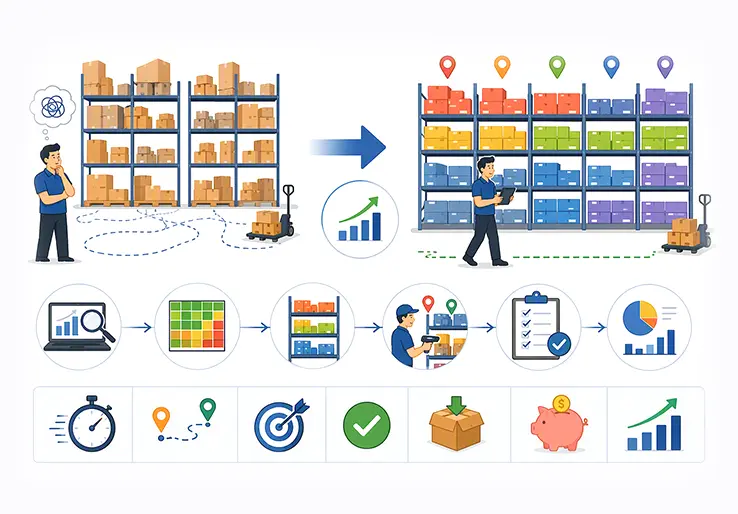
Bin and slot optimization is the strategic process of organizing warehouse storage locations and assigning specific products to those locations — maximizing efficiency, reducing travel time, and improving picking accuracy.
Bin and slot optimization is the strategic process of organizing warehouse storage locations and assigning specific products to those locations to maximize efficiency, reduce travel time, and improve picking accuracy. In any warehouse or distribution center, how inventory is physically arranged directly determines how fast orders move, how much labor is consumed, and how effectively available space is used.
This guide covers the full scope of bin and slot optimization — from foundational concepts and key strategies to step-by-step implementation, technology requirements, ROI measurement, and ongoing best practices. It is written for warehouse managers, operations directors, and logistics professionals who need to improve storage efficiency, reduce operational costs, focus on optimizing warehouse space, and scale warehouse performance without expanding their physical warehouses.
The direct answer: Optimized slotting can reduce travel time for pickers by 30% or more, while effective warehouse layout can increase storage capacity by 50% or more. Together, bin and slot optimization delivers measurable gains in speed, accuracy, space utilization, and labor productivity — often with payback periods as short as 3–6 months.
By reading this article, you will gain:
A clear understanding of what bin optimization and slot optimization mean — and how they differ
Proven strategies (fixed, dynamic, hybrid) for assigning products to storage locations
A step-by-step implementation process with technology selection guidance
Quantitative benchmarks and ROI expectations grounded in real case studies
Best practices for sustaining optimization and avoiding common pitfalls
Understanding Bin and Slot Optimization Fundamentals
At its core, bin and slot optimization is about placing the right product in the right location at the right time. A bin is a specific identifiable storage location in a warehouse — it could be a shelf position, a rack slot, a tote, or a floor location. Bin optimization is the strategic assignment of inventory to specific storage containers, shaped by product characteristics such as size, weight, and fragility, as well as demand patterns and handling requirements.
Slot optimization is the process of arranging products based on physical characteristics and movement velocity into specific storage positions to minimize travel distances, reduce picking errors, and improve overall operational efficiency. While the terms are often used interchangeably, bin optimization is the broader discipline of designing storage locations (bin types, sizing, structure), while warehouse slotting optimization focuses specifically on mapping SKUs to those physical positions.
The connection between the two is critical: good bin design enables slot assignment algorithms to work effectively, and slot assignment data reveals bin design inefficiencies. Effective bin and slot optimization relies on data-driven placement and ergonomic layout design — without both working in concert, warehouses leave significant efficiency on the table.
Core Components of Optimization
Velocity Analysis is the foundation of every slotting strategy. ABC analysis classifies inventory into three categories: A, B, and C. A items represent 20% of SKUs but 80% of picks — these high-demand items should be placed in easily accessible locations to improve productivity. Slow movers (C items) belong in deeper or less accessible storage zones. Beyond simple ABC classification, the Cube-per-Order Index (COI) considers both movement frequency and dimensional characteristics, assigning each SKU to the slot that minimizes both wasted space and handling effort. Duration-of-stay policies add another layer, accounting for how long items remain before shipment.
Product Affinity addresses a different dimension of warehouse efficiency. Grouping items frequently ordered together minimizes cross-warehouse travel and reduces picking errors. Commonly co-picked SKUs should be located near each other to reduce travel time. This principle extends to grouping by handling requirements — fragile items together in protected zones, hazardous materials in dedicated zones with appropriate safety measures. Grouping frequently co-ordered items reduces picking errors and enhances ergonomics across the picking process.
Ergonomic Considerations directly impact both worker safety and productivity. Heavy or bulky items belong at waist height (the "golden zone"), not on top shelves or floor level. Ergonomic placement reduces strain and injury risk for workers, which translates to improved safety, reduced absenteeism, and higher sustained picking rates. Aisle widths must accommodate equipment, and weight limits of racks must be respected — these physical constraints shape every slot assignment decision.
These foundational concepts — velocity, affinity, and ergonomics — form the basis for choosing and implementing specific optimization strategies.
With the core principles established, the next step is selecting the right strategic approach. The choice between fixed, dynamic, and hybrid optimization depends on your product mix stability, demand variability, and technology infrastructure. Each approach has distinct advantages for different warehouse operations.
Fixed vs Dynamic Optimization Approaches
Fixed Slotting assigns permanent homes to products regardless of demand fluctuations. Every SKU has a designated storage location that doesn't change. This approach works well when product lines are stable and demand patterns are predictable. The advantages include simplicity — pickers memorize locations, training is straightforward, and warehouse management overhead is minimal. The limitation is clear: fixed slotting cannot adapt when seasonality shifts, promotions spike demand, or new SKUs are introduced.
Dynamic Slotting adapts product locations based on changing demand patterns, recalculating optimal positions on a daily, weekly, or monthly basis. This approach captures efficiency gains that fixed slotting misses, particularly in e-commerce fulfillment and seasonal operations where inventory turnover fluctuates significantly. However, dynamic slotting requires robust data systems, strong warehouse management system capabilities, and operational discipline to execute frequent moves without disrupting ongoing operations.
Hybrid Slotting combines fixed and dynamic placement strategies — and it is where most mature operations land. Core SKUs with high velocity and stable demand get fixed optimal slots, while less frequent or seasonal SKUs are dynamically placed. In a 2024 operations survey, slotting functionality usage rose from 12% to 22% of respondents, reflecting increasing adoption of these capabilities in WMS management systems across the industry.
Zone-Based Optimization Methods
Zone-based strategies layer on top of the fixed/dynamic decision, organizing the warehouse into distinct areas optimized for different requirements.
Temperature zone optimization is essential for food, pharmaceutical, and chemical distribution. A distribution center handling frozen, cooler, and ambient products must maintain dedicated zones with appropriate climate controls — slot assignments within each zone follow their own velocity and affinity logic. One simulation-driven case study involving three zones (freezer, cooler, general rack) demonstrated how zone-specific optimization delivered 7–9% pick zone efficiency gains.
Access zone classification groups storage locations by the equipment required for retrieval. Hand-pick zones, forklift-accessible areas, and automated storage and retrieval systems each have different throughput characteristics and cost profiles. Automated storage and retrieval systems can maximize cubic capacity in warehouses while improving order accuracy and reducing labor costs — but they require dedicated zones with appropriate infrastructure.
Velocity zone arrangement places fast-pick areas near shipping docks and slow-moving inventory deeper in the facility. This directly reduces the largest component of picking time: travel. Bin and slot optimization ensures fast-moving goods are easily accessible, while slow movers occupy storage space where lower access frequency is acceptable.
Technology-Driven Optimization
The technology landscape for warehouse slotting has expanded significantly. The global warehouse management system market will reach $4.1 billion by 2025, driven in part by growing demand for slotting optimization capabilities.
14.3% cycle time reduction and 7.8% throughput increase in research settings
IoT / RFID / scanners
Automated data collection, velocity tracking, congestion detection
Eliminates manual data entry errors and enables real time inventory data flow
Pick to light systems
Visual picking guidance, reduced errors
Automated systems can improve picking rates to over 300 picks per hour
Integrating warehouse management systems can enhance real-time inventory visibility, connecting slot performance data directly to inventory management and order fulfillment systems. Warehouse management systems enhance operational efficiency by streamlining workflows from receiving through put-away, picking, and shipping.
Understanding these strategies enables effective implementation planning — the topic of the next section.
Implementing bin and slot optimization is not a one-time project but a systematic, phased process. Organizations that treat it as a continuous improvement discipline consistently outperform those that approach it as a one-off layout change.
Step-by-Step Implementation Process
Step 1
Conduct Current State Analysis
including inventory velocity data, warehouse layout assessment, and operational workflow mapping. Collect accurate inventory data — SKU history (orders, picks, returns), physical characteristics (size, weight, fragility), existing slot assignments, and equipment capabilities. Spatial layout documentation should cover all racks, bins, slots, aisles, and human pathways. Gather staff input on ergonomic issues, congested areas, and pain points. Without clean data, every subsequent step is compromised.
Step 2
Define Optimization Objectives
such as reducing pick time, increasing accuracy, or maximizing storage density. Quantify targets: reduce travel distance by X%, improve pick rate to Y lines per hour, achieve accuracy above 98%. Warehouse Capacity Utilization is calculated as (Total Utilized Capacity / Total Available Capacity) × 100 — establish your baseline before setting goals. Also consider service level requirements, safety mandates, and space constraints.
Step 3
Design Bin and Slot Layout
using ABC analysis, product affinity data, and ergonomic principles. Assign SKUs first to zones, then to specific slots within zones. Dimensional profiling ensures optimal bin size usage and eliminates empty space — matching item dimensions to bins maximizes space utilization in warehouses. Consider multi-height or multi-deep racking configurations; research shows multi-height slot layouts can lead to 25–35% space savings and 15–25% operating cost reductions in unit-load environments.
Step 4
Implement Changes in Phases
starting with high-impact areas and gradually expanding optimization across the facility. Start with fastest-moving SKUs or worst-performing areas. Pilot and measure: compare baseline versus pilot results in pick time, error rates, and travel distance. This phased approach ensures minimal disruption and provides measurable evidence to support broader rollout.
Step 5
Train Staff on New Procedures
including location systems, picking protocols, and technology tools. Communicate new layouts with clear signage and visual cues like color coding. Engage warehouse staff in slot definition — they often know real pain points better than any algorithm. Make the transition visible and supported through hands-on training rather than documentation alone.
Step 6
Monitor Performance Metrics and Adjust
optimization parameters based on operational feedback. Track key performance indicators to measure the success of slotting changes. Use dashboards, heat maps, and pick path visualizations. Regular updates to slotting layouts are necessary to accommodate demand changes — review quarterly at minimum, or monthly in high-volume environments. Address drift caused by new SKUs, seasonality, and promotions.
Selecting the right optimization software is critical. The tool must integrate with your existing ERP and warehouse management systems for seamless integration of data flows.
Criterion
Basic WMS Slotting
Advanced Optimization Platform
AI-Driven Solution
Implementation complexity
Low
Medium
High
Data requirements
Historical velocity
Velocity + affinity + dimensions
Full order history + real-time feeds
Optimization frequency
Manual / quarterly
Semi-automated / monthly
Continuous / automated
ROI timeline
6–12 months
3–6 months
1–4 months
Integration depth
Basic inventory sync
ERP + WMS bidirectional
Full ecosystem including IoT
Best for
Stable, low-SKU operations
Mid-complexity distribution
High-mix, high-variability warehouses
Effective warehouse management systems reduce inventory carrying costs significantly through better slot utilization and faster inventory turnover. When evaluating platforms, prioritize those offering automated data ingestion (orders, inventory), durable bin mapping, affinity clustering, and scalability for growing product lines. LOGIC ERP's warehouse module, for example, connects SKU master data, order history, and inventory tracking to enable the data foundation that optimization requires.
Measurement and KPI Tracking
Successful optimization requires rigorous measurement against clear benchmarks:
Pick Productivity: Lines per hour, picks per hour, travel distance per pick. A 2024 literature review found that slotting reduces order preparation times by 15–30% when high-movement SKUs are placed in accessible locations.
Accuracy Improvements: Error rates, mispick frequency, customer satisfaction scores. Proper slotting can improve order accuracy by separating similar items and placing them in logical, well-organized locations. Logical placement reduces picking mistakes and product damage.
Space Utilization: Storage density improvements, capacity optimization, vertical space utilization. APQC benchmarking shows many companies operating at approximately 84% slot utilization at median — there is typically significant room for improvement.
Financial Returns: From a CreateASoft distribution center case study: a facility handling approximately 750,000 weekly transactions achieved over $1.1 million in annual savings with a payback period of 3.6 months. First-year ROI reached 471%. Key improvements included 35% fewer replenishments, 22.3% less outbound congestion, and gains in dock-to-ship cycle times.
Replenishment Efficiency: Organized inventory locations make cycle counting and stock replenishment faster, and reducing travel time can cut daily worker movement by up to 30%.
Successful implementation requires addressing common obstacles — a reality every warehouse team faces.
Even well-planned optimization initiatives encounter predictable obstacles. Recognizing and preparing for these operational challenges separates successful projects from stalled ones.
Data Quality and Availability Issues
Inaccurate or incomplete inventory data is the most common root cause of failed optimization. Wrong velocity classifications, outdated warehouse layouts, or missing dimensional data lead to inefficient slotting that may perform worse than the original arrangement.
Solution: Implement data cleansing procedures and establish standardized inventory classification systems before optimization begins. Validate SKU master data — weights, dimensions, handling requirements — against physical product. Eliminate reliance on manual data entry wherever possible by deploying scanners and RFID for automated data collection. If your ERP and WMS are poorly integrated, resolve synchronization gaps first; optimization built on inconsistent data will misclassify products and produce unreliable slot assignments.
Change Management and Staff Resistance
Changes to habitual pick paths and storage locations create uncertainty and frustration among warehouse staff. If employees don't understand why changes are happening or feel excluded from the process, resistance slows adoption and introduces human error.
Solution: Develop comprehensive training programs and involve warehouse staff in optimization planning to build buy-in. Pickers often have the most granular knowledge of congestion points, awkward slot placements, and workflow bottlenecks. Solicit their feedback during the design phase, validate slot assignments with them before rollout, and use visual cues — signage, color coding, floor markings — to make new layouts intuitive. Phased rollouts help teams adjust gradually rather than facing disorienting wholesale changes.
Technology Integration Complexity
When warehouse management systems, ERP platforms, and execution systems are poorly integrated, real-time data lags or becomes inconsistent. This undermines the accuracy of dynamic slotting decisions and creates friction between planning and execution.
Solution: Partner with experienced implementation consultants and choose optimization software that integrates seamlessly with existing systems. Prioritize platforms offering API-driven seamless integration with your ERP — for example, LOGIC ERP's inventory management module supports the bidirectional data flow (SKU data, order history, real time inventory data) that continuous optimization demands. Verify integration before scaling beyond pilot zones.
Maintaining Optimization Over Time
The most dangerous assumption in warehouse optimization is that it's a one-time event. Demand shifts, new SKUs arrive, seasonal patterns change — and yesterday's optimal slot becomes today's inefficient slotting. Excess inventory builds up, product velocity shifts, and the original ABC classifications become stale.
Solution: Establish regular review cycles calibrated to your operation's variability. For lower-complexity operations, re-slotting every 6–12 months may suffice. In high-mix, high-volume, or seasonal warehouse operations, review monthly or even weekly. Implement automated inventory monitoring through dashboards that flag drift — when a formerly fast-moving SKU's velocity drops, or when a new product's demand patterns signal it needs a prime location. Continuous improvement requires treating optimization as an ongoing discipline, not a project with a finish line.
Why Choose LOGIC ERP for Bin and Slot Optimization?
LOGIC ERP stands out as a comprehensive solution for bin and slot optimization due to its deep integration of inventory management, warehouse slotting optimization, and data analytics capabilities. By leveraging LOGIC ERP, warehouses can achieve superior warehouse space utilization and efficient warehouse operations without the need for costly expansions.
Key advantages of LOGIC ERP include:
Seamless Integration: LOGIC ERP connects inventory management, warehouse layout optimization, and slotting optimization into a single platform, ensuring real-time visibility and accurate data flow.
Advanced Slotting Strategies: Supports fixed, dynamic, and hybrid warehouse slotting strategies tailored to your operation’s unique needs.
Data-Driven Decisions: Utilizes sophisticated data analytics to continuously refine slot assignments, improving pick rates and reducing travel time.
Scalable and Flexible: Designed to optimize existing space and adapt to changing inventory profiles and demand patterns.
User-Friendly Interface: Simplifies complex warehouse processes, making it easier for staff to adopt and maintain best practices.
Choosing LOGIC ERP means partnering with a technology provider committed to maximizing your warehouse efficiency, reducing labor costs, and enhancing overall productivity through intelligent bin and slot optimization.
Bin and slot optimization delivers measurable improvements in warehouse efficiency, accuracy, and cost reduction from 15–30% reductions in picking time to 25–35% space savings through intelligent slot design. The evidence is clear across academic research, industry surveys, and real-world case studies: organizations that systematically optimize their storage locations reduce costs, improve warehouse performance, and meet rising consumer expectations for faster, more accurate fulfillment.
Recent developments in AI-driven optimization are pushing warehouses further. A 2026 study integrating generative AI agents with discrete event simulation achieved a 14.3% reduction in cycle time, 33.7% reduction in blocking, and 7.8% throughput increase in a high-mix make-to-order warehouse. Product velocity can be improved by positioning fast-moving items in the golden zone, while vertical storage solutions can increase warehouse capacity without expanding the footprint. These advances combined with increasing adoption of slotting features in WMS platforms mean the tools are becoming more accessible, not less.
Immediate actionable steps:
Assess current warehouse performance document your baseline pick rates, error rates, travel distances, and space utilization percentages
Gather velocity and affinity data from your inventory management system to identify your A, B, and C items and commonly co-picked product combinations
Evaluate optimization software options that offer seamless integration with your existing ERP and WMS platforms
Start with a pilot zone your highest-volume area or most congested picking zone and measure results before scaling
For related topics, explore warehouse layout optimization strategies, inventory control techniques for tighter stock management, and warehouse automation integration to complement your optimization efforts.
Bin optimization is the broader discipline of designing storage containers and locations determining bin types, sizing, and physical structure within the warehouse space. Slot optimization focuses specifically on assigning individual SKUs to those storage locations based on velocity, product affinity, dimensions, and ergonomic requirements. Warehouse slotting optimizes product storage locations for efficiency. Together, they ensure that both the physical infrastructure and product placement are optimized for maximum space efficiency and throughput.
Most mid-to-large distribution centers see payback within 3–6 months when using simulation-based or data-driven approaches. In one documented case, a facility handling 750,000 weekly transactions achieved a 3.6-month payback period with $1.1 million in annual savings and a first-year ROI of 471%. Smaller operations with less complex product mixes may see results in weeks, particularly when addressing obviously inefficient slotting.
Absolutely. Small warehouses often benefit disproportionately because space constraints make every square foot more valuable. In a constrained facility, even simple ABC classification and dimensional profiling can help optimize warehouse space and optimize warehouse-wide storage efficiency, freeing up significant capacity. High-density manual storage strategies, flexible storage solutions, and vertical space utilization can transform how much space a small facility effectively uses without expanding the warehouse footprint.
At minimum: SKU-level order and pick history (ideally 6–12 months), product dimensions and weights, current warehouse layout with bin locations mapped, and inventory levels by location. Well-organized locations improve inventory visibility and support accurate picking so if your current location data is incomplete, cleaning it up is the essential first step. Demand forecasting data and seasonal trend information significantly improve dynamic optimization outcomes.
Optimization depends on accurate master data (SKU dimensions, weights, handling requirements), order history, and real-time inventory positions of all data that resides in ERP systems. LOGIC ERP's warehouse management software provides the data backbone for optimization by connecting inventory tracking, order management, and warehouse operations into a unified platform. Effective integration ensures that slot recommendations are based on current, accurate data rather than stale snapshots.
The top mistakes include acting on inaccurate or outdated data, moving too many SKUs simultaneously (which causes confusion and makes it impossible to measure impact), ignoring ergonomic and safety constraints, failing to account for seasonality or new product introductions, and neglecting to track ROI or KPIs after implementation. Best practices recommend small pilots, staff involvement, respect for physical constraints, standardized labeling, and planned re-slot cycles to avoid these pitfalls and sustain warehouse optimization over time.
Storage systems refer to the physical infrastructure used to organize, store, and retrieve inventory within a warehouse. They include shelving, racks, bins, pallets, and automated solutions like AS/RS. Effective storage systems support operational efficiency by maximizing storage space and enabling fast, accurate picking.
Storage optimization involves strategically organizing inventory and storage locations to maximize space utilization and reduce handling time. It improves warehouse performance by minimizing travel distances for pickers, increasing throughput, and reducing labor costs.
Space optimization is the process of maximizing the use of available warehouse space through layout design, storage system selection, and inventory placement. It enhances operational efficiency by increasing storage capacity without expanding the physical footprint.
A warehouse management system (WMS) tracks inventory in real-time and uses data analytics to recommend optimal slotting arrangements. This supports slotting optimization by dynamically assigning products to storage locations based on demand, size, and handling requirements, improving picking accuracy and speed.
Operational efficiency ensures that warehouse processes such as receiving, storage, picking, and shipping are performed with minimal waste of time and resources. High operational efficiency reduces costs, improves order fulfillment speed, and enhances customer satisfaction.
Space utilization is typically measured as the percentage of total available storage space that is actively used for inventory. Metrics include cubic utilization, bin occupancy rates, and warehouse capacity utilization, helping managers identify underused areas and opportunities for optimization.
Maximizing storage space involves using vertical storage solutions, high-density shelving, mezzanine floors, and optimizing warehouse layout to reduce aisle widths while maintaining accessibility. These strategies increase capacity and improve flow without physical expansion.
Best practices include designing efficient pick paths, grouping fast-moving items near shipping areas, using zone-based storage, maintaining clear aisles, and integrating technology like WMS for real-time inventory tracking. These practices reduce travel time and improve worker productivity.
Management systems like WMS and ERP integrate inventory tracking, order processing, and labor management to provide a unified view of warehouse activities. Integration enables data-driven decisions, automation of workflows, and improved coordination across functions.
Key strategies include velocity-based slotting (placing fast movers in accessible locations), product affinity grouping (storing commonly co-picked items together), ergonomic placement (reducing worker strain), and dynamic slotting that adapts to demand changes.
Data analytics provides insights into inventory velocity, order patterns, and space usage. These insights enable warehouses to optimize storage systems by adjusting slot assignments, forecasting demand, and identifying inefficiencies, leading to improved space utilization and operational efficiency.
Storage systems determine how inventory is physically arranged and accessed. Well-designed systems maximize vertical and horizontal space, support flexible slotting, and accommodate various product sizes, all contributing to effective space optimization.
Optimizing warehouse layout improves flow, reduces travel time for pickers, and minimizes congestion. This leads to faster order fulfillment, lower labor costs, and higher throughput, directly boosting overall warehouse performance.
Management systems automate and streamline complex warehouse processes, provide real-time visibility, and support data-driven optimization. They are essential for handling high SKU counts, dynamic inventory, and meeting customer expectations efficiently.
Common challenges include data inaccuracies, resistance to change, and integration complexity. Overcoming them involves data cleansing, staff training, phased implementation, and choosing systems that integrate seamlessly with existing warehouse management platforms.
Book a Free Demo
LOGIC ERP | India's #1 ERP Software for Retail | Distribution | Manufacturing | WMS