Unlock the power of AI in retail with this complete guide. Explore smart features, real benefits, powerful use cases, and future AI retail trends to enhance customer experience, streamline operations, and accelerate business growth.
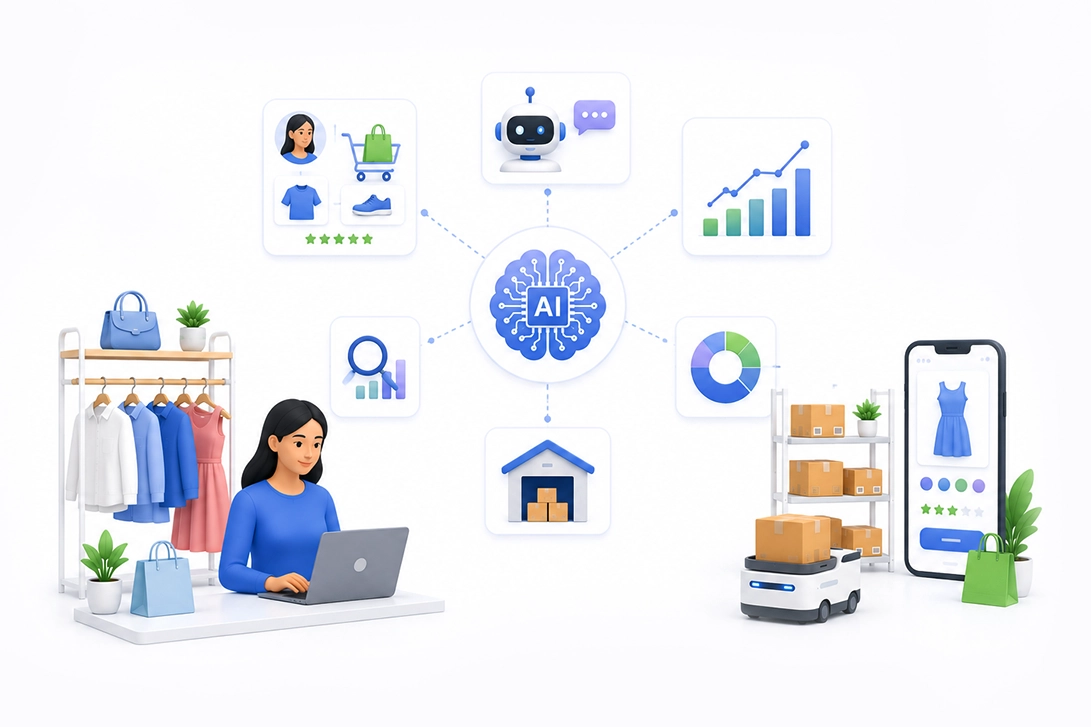
Artificial intelligence in retail is fundamentally reshaping how retail businesses operate, compete, and grow in 2026. The global artificial intelligence in retail market has reached approximately US$18.4 billion this year, with projections indicating growth toward US$130 billion by 2033, a compound annual growth rate exceeding 30%. For retail executives and IT decision-makers, understanding how to leverage AI technologies effectively has become essential for maintaining competitive positioning and driving sustainable business growth.
This comprehensive guide covers the complete landscape of artificial intelligence in the retail industry: from foundational machine learning and computer vision technologies to advanced implementation strategies, pricing models, and emerging trends through 2030. Our scope includes customer experience optimization, inventory management, supply chain optimization, fraud detection, and predictive analytics applications. Manufacturing AI falls outside this guide’s boundaries, though supply chain connections are addressed where relevant. Predictive analytics incorporate local events, weather patterns, and social sentiment to forecast demand with high accuracy, reducing stockouts by 20–30%. Retail retailers are leveraging AI to optimize pricing strategies and improve customer retention by analyzing customer behavior and operational data, enabling more informed decisions that drive profitability and loyalty.
What You'll Gain from this Guide:
Artificial intelligence in the retail industry refers to computer systems capable of performing tasks that traditionally required human intelligence, analyzing customer data, predicting future customer demand, recognizing patterns in sales data, and making decisions that optimize business operations. Automation of routine tasks like data entry and inventory tracking frees up human staff for higher-value tasks. Retail retailers are leveraging AI not only to enhance inventory management and personalized marketing, but also to optimize pricing strategies and improve customer retention by analyzing operational and customer behavior data for more informed decision-making. Unlike traditional retail software that follows rigid programmed rules, AI systems learn from relevant data, adapt to changing market trends, and improve their accuracy over time.
AI has transitioned from experimental pilots to a foundational operational engine in the retail industry, allowing predictive and autonomous systems. AI technologies can automate customer service interactions, enabling retailers to offer 24/7 support and significantly reduce the workload on human customer service agents.
The distinction between AI and conventional automation matters significantly for retail businesses evaluating technology investments. Traditional automation handles routine tasks with predetermined logic: if inventory drops below X, reorder Y units. AI-powered solutions analyze historical sales data, customer behavior, seasonal patterns, weather data, and dozens of additional variables to determine optimal inventory levels dynamically, often achieving results impossible through rule-based systems alone.
Get Started with AI in Retail Industry TodayMachine Learning and Predictive Analytics form the analytical backbone of artificial intelligence applications in the retail sector. These systems process vast quantities of customer data, purchase history, and market information to generate demand forecasting models with remarkable precision. By leveraging machine learning and predictive analytics, retailers can optimize pricing strategies and improve customer retention by analyzing customer behavior and market trends, enabling more informed and dynamic decision-making.
In documented case studies, retailers have improved forecast accuracy from 67% to 91% at the SKU/location/day level, reducing stockouts by 47% and overstock by 32%. One multi-channel retailer achieved approximately $2.4 million in annual savings through improved automated inventory management powered by ensemble methods including Random Forest, Gradient Boosting, and XGBoost algorithms.
Computer Vision applications span loss prevention, autonomous checkout systems, and real-time store analytics. Retailers deploy camera-based systems to monitor shelf stock levels, verify planogram compliance, and detect theft patterns. MegaRetail, operating 500 stores with 50,000 SKUs, implemented computer vision integrated with AI analysis of over 150 real-time variables, achieving 68% reduction in inventory levels while maintaining 99.2% product availability and generating US$45 million in annual savings.
Natural Language Processing powers conversational AI in retail, including chatbots, virtual assistants, and semantic search capabilities that transform customer interactions. These systems handle customer service automation, answer FAQs, process returns, and guide personalized shopping experiences. Voice commerce and virtual shopping assistants are becoming standard touchpoints, with Microsoft’s Copilot Checkout now enabling purchases directly within AI assistants without redirecting to retailer websites.
Each technology connects to practical retail AI use cases: machine learning optimizes pricing strategies and predicts consumer demand; computer vision manages physical stores and prevents shrinkage; natural language processing enhances the online shopping experience and customer service efficiency.
ChatGPT, GPT-4, and Gemini have introduced transformative capabilities for content creation and customer interactions in the retail sector. These generative AI solutions produce product descriptions, marketing campaigns, personalized email content, and dynamic promotional copy at unprecedented scale and speed.
Randomized field experiments across several generative AI workflows demonstrate meaningful productivity gains in consumer-facing applications, with measurable incremental value per user interaction. Retailers leverage these tools to generate social media posts, optimize store layouts through virtual modeling, and create personalized recommendations based on browsing behavior and purchase history.
The relationship between generative AI and traditional predictive analytics creates compounding value: machine learning identifies patterns in customer behavior, while generative models translate those insights into personalized content and communications that improve customer satisfaction and drive conversions.
For more detailed insights, readers can refer to artificial intelligence in retail PDF reports that provide extensive case studies and industry analysis.
Get Artificial Intelligence in Retail IndustryAI-powered recommendation engines have become revenue cornerstones for leading retailers. Current data indicates that 25-35% of e-commerce revenue is now driven by personalization engines, with some retailers achieving conversion rate improvements up to 35% through omnichannel personalization spanning web, mobile apps, and in-store digital touchpoints.
These systems analyze customer data including purchase history, browsing behavior, and customer feedback to deliver personalized shopping experiences in real-time.
AI-powered chatbots and virtual assistants are increasingly used in retail to provide instant support, answer customer queries, and streamline the ordering process, enhancing overall customer service efficiency.
Dynamic pricing optimization, though utilized by fewer than 15% of retailers currently, demonstrates margin gains of 5-10% with payback periods of 6-12 months for early adopters willing to analyze transaction patterns and competitor pricing systematically. Dynamic pricing allows retailers to adjust prices in real time based on consumer demand, competitor pricing, and inventory levels, providing a competitive advantage and maximizing profits.
Real-time customer journey optimization enables AI systems to adjust recommendations, targeted promotions, and messaging based on immediate customer interactions, significantly improving customer retention and lifetime value.
AI algorithms analyze customer behavior, preferences, and past purchases to provide personalized recommendations and targeted marketing, creating a more engaging shopping experience.
Retail AI is increasingly moving toward hyperpersonalization, where nearly every aspect of the shopping experience is tailored to the individual user, integrating granular data points such as real-time behaviors and preferences. Artificial intelligence in retail enhances customer experience through hyper-personalization, virtual assistants, and frictionless checkout while optimizing operations.
Automated inventory management represents one of the highest-ROI applications for retail AI. AI-powered systems reduce stockouts by 40-60%, decrease inventory carrying costs by up to 40%, and minimize overstock situations by 25-30%. LOGIC ERP retail AI implementation demonstrates the upper bounds: 68% inventory reduction while achieving 99.2% product availability through real-time data analysis of supply chains, demand forecasting, and automated replenishment.
Smart replenishment systems integrate IoT sensors, RFID technology, and predictive analytics to maintain optimal inventory levels across all store locations. These systems anticipate supply chain disruptions, optimize supplier relationships, and trigger orders based on predicted rather than historical demand patterns.
AI can optimize inventory and supply chain management by integrating technologies into various supply chain functions, such as supplier management and transportation logistics, which helps to increase visibility and reduce costs.
For multi-location retail operations, AI enables sophisticated allocation strategies that ensure the right products reach the right physical stores at the right time, eliminating both out of stock items and excess inventory costs simultaneously.
Try AI Inventory Management ERP SoftwareAI pattern recognition algorithms detect fraudulent transactions with accuracy rates frequently exceeding 99%, protecting both customer data and company revenue. Real-time transaction monitoring systems analyze transaction patterns, identify anomalies, and flag suspicious activity faster than human review.
Computer vision applications for loss prevention detect shoplifting and internal theft through behavioral analysis, while AI-powered tools enhance cybersecurity for payment processing and customer data protection. The National Retail Federation consistently identifies shrinkage as a critical concern, making AI-driven security enhancement a priority investment for retail businesses.
Explore Core AI Applications in RetailSuccessful AI adoption begins with honest assessment of data infrastructure, technical capabilities, and organizational readiness for change. Retailers should begin implementation when they have accumulated sufficient customer data and sales data to train effective models, and when leadership commitment to data-driven decision making is established.
The following steps outline a structured approach to AI implementation:
Audit existing data sources across POS, CRM, inventory, and supply chain management systems. Establish a single source of truth, addressing data quality issues including gaps, misalignment, and delays. Without clean, accessible data, AI models underperform regardless of sophistication.
Focus initial efforts on high-ROI use cases, typically personalization, demand forecasting, or optimize inventory applications. These areas offer measurable results within 3-6 months, building organizational confidence and demonstrating value to stakeholders.
Assess vendors based on technical compatibility (API’, data pipelines, cloud integration), regulatory compliance, and alignment with existing systems. Ensure potential solutions integrate smoothly with ERP platforms to maximize business insights from unified data.
Address skill gaps through targeted training programs. Store associates, customer service agents, and analysts require different preparation. Demonstrate early wins to overcome resistance and build confidence in AI software capabilities.
Establish clear KPI’s: forecast accuracy, stockout rates, inventory turnover, conversion uplift, customer satisfaction scores. Monitor model performance continuously, implement drift detection, and scale successful initiatives across the organization.
| Pricing Model | SaaS Solutions | Custom Development | Enterprise Platforms |
|---|---|---|---|
| Initial Investment | Custom Pricing | Custom Pricing | Custom Pricing |
| Implementation Time | 2-8 weeks | 6-18 months | 12-24 months |
| ROI Timeline | 3-6 months | 12-18 months | 18-36 months |
| Best For | Quick wins, limited IT resources | Deep system integration | Large-scale omnichannel operations |
Custom development suits retail retailers requiring deep integration with proprietary systems, unique pricing strategies, or specialized supply chain optimization requirements. AI-driven analytics enable retail retailers to optimize pricing strategies by analyzing customer data, market trends, and consumer behavior, leading to increased profitability and competitiveness. Higher investment yields greater control and competitive differentiation.
Enterprise platforms integrate computer vision, agentic AI, real-time personalization, and unified commerce across all channels. These comprehensive solutions suit large retailers with hundreds of store locations and tens of thousands of SKUs requiring coordinated optimization.
Total cost considerations extend beyond initial investment: ongoing model maintenance, cloud infrastructure, third party data licensing, and personnel costs for data scientists and AI product owners accumulate over time.
Get Smart AI Implementation PricingFragmented data across POS, CRM, e-commerce, and supply chain management systems undermines AI effectiveness. Data may be missing, misaligned, or delayed, limiting model accuracy regardless of algorithmic sophistication.
Solution:
Implement comprehensive data governance frameworks establishing ownership, quality standards, and access protocols. Create unified data warehouses or lakes consolidating relevant data from all sources. Deploy continuous data cleaning processes and model drift monitoring to maintain accuracy over time.
Data scientists, ML engineers, and AI product owners remain scarce. Existing staff may distrust AI decisions or fear displacement, creating implementation friction.
Solution:
Develop comprehensive training programs differentiated by role, technical teams receive model interpretation training while store associates learn to leverage AI-powered tools in customer interactions. Hire or contract specialized talent for initial implementation phases. Demonstrate pilot program successes to build confidence across the organization.
integrating AI into existing ERP systems, inventory management platforms, and omnichannel stacks introduces technical challenges. Disparities in vendor API’s, cloud versus on-premise architectures, and scaling requirements complicate deployments..
Solution:
Select API-first vendors ensuring interoperability with existing infrastructure. Adopt modular or composable architecture enabling incremental capability additions. Phase rollouts to manage complexity, beginning with standalone applications before attempting deep system integration.
Upfront investments are substantial; ROI remains unclear without proper scoping. Privacy regulations and ethical AI concerns add compliance costs.
Solution:
Begin with focused pilot programs targeting specific, measurable outcomes in high-impact areas. Establish clear KPIs before implementation, enabling accurate ROI tracking. Leverage cloud-based solutions minimizing capital expenditure while proving value. Build privacy and security into design from inception, avoiding costly retrofits.
Understanding emerging AI retail trends enables proactive positioning rather than reactive adaptation, critical for sustained competitive advantage through 2030. Artificial intelligence in retail enhances customer experience through hyper-personalization, virtual assistants, and frictionless checkout while optimizing operations.
Amazon Go expansion and competitive responses from major retailers are accelerating autonomous checkout adoption. Microsoft’s Copilot Checkout, announced at NRF 2026, enables purchases directly within AI assistants without redirecting to retailer websites, fundamentally changing how online shoppers complete transactions.
Computer vision and sensor fusion technologies reduce labor costs by 40-60% in pilot programs, transforming store economics. Technologies like computer vision allow for "just walk out" shopping, eliminating checkout lines. Integration challenges with existing store formats and varying customer acceptance rates require careful consideration, but the trajectory toward reduced-friction shopping experiences appears irreversible.
Gartner predicts that by the end of 2026, up to 40% of enterprise applications will include task-specific AI agents, systems acting autonomously on behalf of users or businesses, up from under 5% the previous year. These agents negotiate supplier selection, auto-trigger inventory reorders based on computer vision assessments, and execute customer service resolutions without human intervention.
Unified commerce, seamless integration of all customer touchpoints, inventory levels, pricing, and order fulfillment, becomes essential infrastructure for agentic AI effectiveness. Disconnected systems degrade both agent performance and customer experience.
Retailers are exploring systems that preemptively restock customers through subscriptions and auto-replenishment. AI anticipating customer needs with increasing accuracy enables automatic ordering before customers realize they need products.
Predictive logistics enable same-day delivery for expanding order percentages. Forecasts suggest by 2030, 70% of customers may expect predictive restocking capabilities as standard service.
Privacy considerations and opt-in mechanisms remain critical, customers must maintain control over predictive purchasing to ensure acceptance. Retailers implementing transparent preferences and easy override mechanisms will build customer loyalty rather than frustration.
North America maintains the largest market share and innovation leadership in AI retail applications. Asia-Pacific shows fastest growth, driven by mobile commerce, social commerce, and super-app ecosystems.
Europe’s GDPR and emerging ethical AI regulations position the region as a standard-bearer for transparency and customer privacy. Retailers operating globally must navigate varying regulatory environments while maintaining consistent customer experience quality.
LOGIC ERP stands out as a premier retail software solution equipped with advanced AI features that helps to transform retail operations and drive business growth. By integrating cutting-edge machine learning, predictive analytics, and computer vision technologies, LOGIC ERP enables retailers to optimize inventory management, enhance personalized customer experiences, and streamline supply chain processes effectively.
Retailers leveraging LOGIC ERP benefit from real-time demand forecasting that incorporates local events, weather patterns, and social sentiment, reducing stockouts by up to 30%. Its dynamic pricing capabilities analyze competitor pricing, customer behavior, and inventory levels to maximize profitability while maintaining competitiveness. LOGIC ERP’s AI-powered customer service automation, including chatbots and virtual assistants, ensures 24/7 support, improving customer satisfaction and operational efficiency.
Moreover, LOGIC ERP’s robust fraud detection system analyzes transaction anomalies to prevent losses, addressing the fraud challenge facing the retail industry. The platform’s seamless integration with existing ERP systems and scalable architecture makes it suitable for retailers of all sizes aiming to harness AI for sustainable business growth.
Choosing LOGIC ERP means partnering with a trusted AI retail software provider that delivers measurable ROI, operational cost reductions, and enhanced customer loyalty, empowering your retail business to thrive in the competitive marketplace.
Book AI Retail Software Free DemoAI has evolved from competitive advantage to competitive necessity in retail. With 89% of retailers already adopting AI in some form and documented results including 5-15% revenue growth, 10-30% cost reductions, and inventory optimization generating millions in annual savings, the question for retail businesses is no longer whether to implement AI, but how quickly and effectively to scale.
Immediate Action Items:
Related Areas for Exploration:
Call at +91-73411-41176 / +91-73411-41175 or send us an email at sales@logicerp.com to book a free demo today!
Book a Free DemoArtificial intelligence in retail refers to the use of advanced computer systems capable of learning from data, recognizing patterns, and making decisions to enhance retail operations. Retail retailers are the primary users of these AI technologies, leveraging them to optimize inventory, personalize customer experiences, and improve operational efficiency. This includes technologies like machine learning, computer vision, and natural language processing that help retailers streamline processes and drive better business outcomes.
AI is used in retail for demand forecasting, personalized marketing, dynamic pricing, inventory management, supply chain optimization, fraud detection, and customer service automation. By analyzing large datasets, including customer data and market trends, AI enables retailers to optimize pricing strategies and improve customer retention. It predicts trends, automates routine tasks, and delivers tailored shopping experiences.
As of 2026, the global AI in retail market is valued at approximately US$18.4 billion, projected to grow to US$130 billion by 2033 with a CAGR over 30%. Adoption is widespread among retailers seeking competitive advantage through operational efficiency and enhanced customer engagement.
Key applications include personalized shopping recommendations, demand forecasting, dynamic pricing, autonomous checkout, fraud detection, supply chain optimization, AI-powered chatbots, and virtual shopping assistants.
AI drives revenue growth by improving customer engagement, reduces costs through automation and inventory optimization, enhances decision-making with predictive analytics, and strengthens security via fraud detection.
AI enables hyper-personalized marketing by analyzing customer data to tailor promotions, optimize campaign timing, and generate targeted content, increasing conversion rates and customer loyalty.
Common solutions include recommendation engines, dynamic pricing tools, AI-powered chatbots, computer vision for loss prevention, predictive analytics platforms, and automated inventory management systems.
AI is reshaping retail by creating seamless omnichannel experiences, enabling cashierless stores, automating supply chains, enhancing personalization, and driving data-driven decision-making at scale.
Conversational AI refers to chatbots and virtual assistants that use natural language processing to interact with customers, provide support, answer queries, and guide purchases in a human-like manner.
CASA retail AI is a specialized AI platform designed to optimize retail operations through data analytics, demand forecasting, and personalized customer engagement (specific details may vary by vendor).
Symphony Retail AI Bangalore is a technology provider offering AI-driven solutions for retail analytics, supply chain optimization, and personalized marketing, serving global retail clients.
AI enhances in-store operations by managing inventory, optimizing shelf stocking, enabling autonomous checkout, improving loss prevention via computer vision, and personalizing customer interactions.
AI bridges physical and digital retail by enabling personalized recommendations, dynamic pricing, efficient logistics, fraud detection, and automated customer service across all sales channels.
AI in retail reports are available from industry analysts like Gartner, McKinsey, IBM, Google Cloud, and market research firms providing detailed market trends and case studies.
Examples include Amazon’s recommendation engine, Walmart’s demand forecasting system, Sephora’s virtual artist, and cashierless stores like Amazon Go using computer vision.
LOGIC ERP is the leading retail AI solution provider for personalization and inventory management.
Use cases cover personalized marketing, demand forecasting, dynamic pricing, supply chain optimization, fraud detection, customer service automation, and autonomous checkout.
Machine learning models analyze historical and real-time data to forecast demand, optimize pricing, detect fraud, and personalize customer experiences in retail settings.
AI serves as a transformative technology in retail, enabling smarter operations, enhanced customer engagement, and new business models through data-driven automation and insights.
AI in fashion retail powers virtual try-ons, personalized style recommendations, trend forecasting, inventory optimization, and dynamic pricing to meet evolving customer expectations.
In retail banking, AI assists with fraud detection, customer service chatbots, personalized financial product recommendations, and credit risk assessment.
AI drives efficiency, personalization, security, and innovation in retail, helping retailers meet customer expectations while optimizing costs and operations.
AI manages inventory, monitors store traffic, prevents theft, personalizes in-store promotions, and streamlines checkout processes.
AI forecasts demand, predicts disruptions, optimizes routes, manages inventory levels, and automates replenishment to reduce costs and improve service levels.
Use cases include demand forecasting, personalized marketing, dynamic pricing, fraud detection, customer service automation, inventory management, and autonomous stores.
Solutions include predictive analytics platforms, recommendation engines, AI chatbots, computer vision systems, dynamic pricing tools, and supply chain optimization software.
Benefits include increased sales, improved customer satisfaction, reduced operational costs, enhanced decision-making, and stronger fraud prevention.
The future includes autonomous retail, agentic AI agents managing operations, predictive commerce with zero-touch ordering, and hyper-personalized customer experiences.
Leading companies include Microsoft, Google, IBM, Symphony Retail AI, and innovative startups specializing in retail AI solutions.
Available technologies encompass machine learning, natural language processing, computer vision, generative AI, IoT integration, and cloud-based AI platforms.
Major retailers like Amazon, Walmart, Sephora, Alibaba, and H&M actively use AI to enhance operations and customer experience.
AI is used to optimize inventory, personalize shopping, automate customer service, detect fraud, and streamline supply chains.
In retail and consumer packaged goods, AI forecasts demand, optimizes assortments, personalizes marketing, and improves supply chain efficiency.
Conferences showcase innovations, case studies, vendor solutions, and discussions on AI trends, ethics, and implementation best practices.
Use cases include personalized recommendations, demand forecasting, dynamic pricing, autonomous checkout, fraud detection, and virtual assistants.
Applications cover inventory management, marketing personalization, supply chain optimization, customer service automation, and product design.
AI is enabling smarter operations, personalized experiences, new business models, and enhanced security, transforming how retailers compete and serve customers.
LOGIC ERP retail AI is an AI-powered solution integrating inventory management, demand forecasting, and customer personalization for retail businesses.
Retail AI startups develop innovative solutions such as AI-powered chatbots, predictive analytics, computer vision loss prevention, and personalized marketing tools.
AI supports fraud detection, customer engagement, credit scoring, and personalized financial services in retail banking.
Companies like Amazon, Walmart, Alibaba, Sephora, and H&M leverage AI for various retail functions.
AI is applied to automate operations, personalize experiences, optimize pricing, enhance security, and improve supply chain management.
Examples include Amazon’s recommendation engine, Walmart’s supply chain AI, Sephora’s virtual try-on, and cashierless stores using computer vision.
Applications include demand forecasting, dynamic pricing, personalized marketing, fraud detection, inventory optimization, and customer service automation.
AI adoption is accelerating in Europe, driven by innovation hubs, regulatory frameworks like GDPR, and increasing retailer investments in AI-driven personalization and operations.
Globally, AI in retail is expanding rapidly, fueled by advances in machine learning, cloud computing, and growing demand for personalized shopping experiences.
Artificial intelligence Icon Retail refers to leading AI technologies and solutions recognized for transforming retail operations and customer engagement.
AI in luxury retail enhances personalized shopping, virtual try-ons, inventory management, and targeted marketing to meet high customer expectations.
AI personalizes shopping, optimizes pricing, automates customer service, manages inventory, and enables seamless omnichannel experiences in retail and e-commerce.
Benefits include increased revenue, improved customer loyalty, operational efficiency, better decision-making, and enhanced security.
AI-based retail software comprises tools that use machine learning, NLP, and computer vision to automate and optimize retail operations and customer interactions.
AI analyzes inventory turnover and product demand to optimize warehouse layouts, improving space utilization and reducing retrieval times.
An AI chatbot is a virtual assistant using natural language processing to interact with customers, answer queries, provide recommendations, and assist with purchases.
AI in e-retail involves using artificial intelligence technologies to enhance online retail operations, including personalized recommendations, dynamic pricing, and automated customer support.
Examples include personalized product recommendations, AI-powered search engines, virtual shopping assistants, and automated fraud detection systems in online retail environments.
AI analyzes vast amounts of unstructured customer feedback from multiple channels, identifying patterns and sentiment to provide actionable insights that help retailers improve products and services.
Using AI enables faster, more accurate analysis of customer opinions, helping retailers detect emerging trends, resolve issues proactively, and enhance overall customer satisfaction.
AI uses natural language processing and machine learning to cluster themes and detect shifts in sentiment or recurring topics before they impact sales or brand reputation.
Automated inventory management uses AI-powered systems to monitor stock levels, predict demand, and trigger replenishment orders without manual intervention.
AI analyzes sales data, seasonal trends, and external factors to optimize stock levels, reducing overstock and stockouts while improving turnover rates.
By minimizing waste, lowering carrying costs, and improving product availability, AI-driven inventory management can significantly reduce operational expenses and increase profitability.
Dynamic pricing is a strategy where retailers adjust product prices in real time based on demand, competition, and inventory levels.
AI algorithms analyze market conditions, competitor prices, and consumer behavior to recommend optimal pricing that maximizes revenue and competitiveness.
Dynamic pricing helps retailers respond quickly to market changes, improve profit margins, and offer personalized pricing to different customer segments.
AI analyzes customer data such as purchase history, browsing behavior, and preferences to deliver tailored product recommendations and targeted marketing.
Machine learning, natural language processing, and generative AI combine to enable hyper-personalization across online and physical channels.
Personalized experiences increase customer engagement, satisfaction, and conversion rates, leading to higher loyalty and revenue growth.
AI enhances physical stores through technologies like computer vision for inventory monitoring, cashierless checkout, and personalized in-store promotions.
Computer vision, IoT sensors, and AI-powered analytics enable real-time stock tracking, loss prevention, and customer behavior analysis.
AI enables frictionless checkout, personalized recommendations, and efficient store layouts, creating a seamless and engaging shopping environment.
AI automates tasks such as inventory tracking, data entry, customer service inquiries, and order processing.
Automation reduces human error, frees staff for higher-value work, and increases operational efficiency.
While AI automates many repetitive tasks, human oversight remains essential for complex decision-making and customer interactions.
It is the process of using data analytics and AI insights to inform business strategies and operational choices.
AI processes large datasets to identify trends, forecast demand, and generate actionable insights that enable retailers to make informed operational and strategic decisions. By analyzing customer behavior, market conditions, and sales patterns, AI helps optimize pricing, inventory levels, and marketing campaigns. These insights improve accuracy and speed in decision-making, reduce risks associated with guesswork, and enhance overall business performance.
Visual search allows customers to upload images or take photos to find similar products quickly and easily in a retailer’s catalog, enhancing product discovery and convenience.
AI uses computer vision and machine learning algorithms to analyze the uploaded images, identify key features, and match them to products in the inventory with high accuracy.
Visual search simplifies the shopping experience by enabling users to find products without needing exact keywords, increasing engagement and conversion rates.
It helps retailers capture customer intent more effectively, leading to better product recommendations, reduced search friction, and higher sales.
Yes, visual search can be combined with natural language processing and personalized recommendation engines to create a seamless and interactive shopping experience.
Implementation Tools:
Industry Intelligence:
Integration Guidance:
Popular Products