A Customer Data Platform (CDP) is a software system that helps businesses collect customer data, organize it, create unified customer profiles, and activate customer data across marketing campaigns, with data unification as a core function. CDP data unification enables the merging of information from multiple sources to provide a single, comprehensive view of each customer.
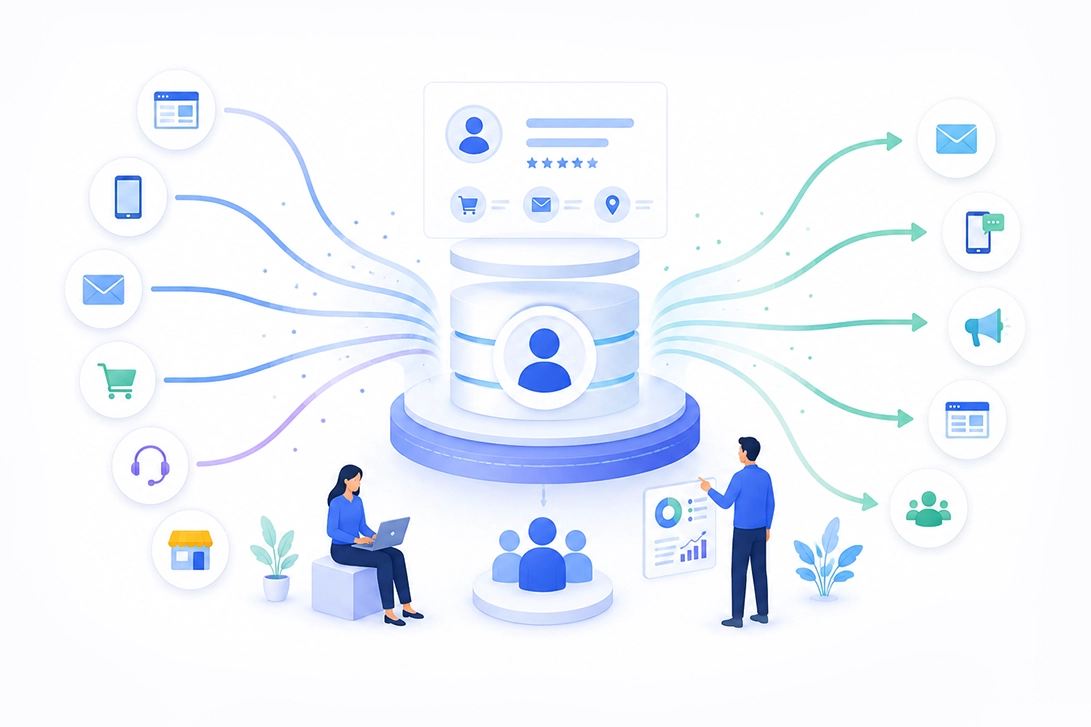
CDP full form is Customer Data Platform. In marketing, analytics, and customer experience technology, a CDP is a unified software system that helps businesses collect customer data, organize it, create unified customer profiles, and activate customer data across marketing campaigns, customer service systems, mobile apps, websites, and other customer touchpoints.
This guide explains the complete meaning of CDP, how a customer data platform works, how it differs from customer relationship management systems , data management platforms, and a data warehouse, and why businesses use CDP solutions for personalized marketing, customer engagement, customer retention, and customer lifetime value growth. It is written for marketers, business leaders, data teams, CX teams, and anyone comparing tools to manage customer data more effectively.
A Customer Data Platform (CDP) is software that collects and unifies first-party customer data from multiple sources, a process known as data unification to create a single, coherent view of each customer. A customer data platform (CDP) collects and unifies first-party customer data from multiple sources to create a single, coherent view of each customer.
In this article, you will learn:
A Customer Data Platform is a data platform that helps to integrate data unification, merging a company's customer data from multiple systems into a persistent, usable, and actionable customer database. This process of data unification brings together first party data, behavioral data, transactional data, customer interactions, offline interactions, consent data, and engagement history so teams can build a complete customer profile and use that profile for better customer experience.
The acronym became important because businesses were collecting data across many marketing systems, sales tools, analytics platforms, websites, mobile apps, call centers, and customer service systems, but that data often stayed trapped in data silos. Marketing teams needed a way to consolidate a company's customer data, identify customers across touchpoints, analyze customer behavior, and activate customer data without relying only on IT-heavy warehouse projects.
The term Customer Data Platform can be understood by breaking down each word:
The phrase Customer Data Platform was coined by David Raab in April 2013 to describe a new category of marketing technology that could collect data from many sources, connect related records to the same individual, support analytics, and inform marketing across channels. Before CDPs, companies mainly relied on customer relationship management tools, data warehouse environments, and analytics systems, but those tools often lacked marketer-friendly identity resolution, real-time data activation, and cross-channel orchestration.
In simple terms, a CDP is not just a place to store raw data. It is a system for unifying customer data into comprehensive customer profiles that remain updated as new customer interactions occur.
The primary purpose of a CDP is to create a unified customer view from fragmented customer data. CDPs enable businesses to manage customer data by resolving identities across different systems and creating unified customer profiles through data unification, a process that merges data from multiple sources to enable segmentation, personalization, and AI-driven marketing strategies.
A CDP operates by continuously collecting data, unifying customer profiles, applying intelligence for decision-making, and activating data across various marketing channels. This means a business can collect customer data from websites, mobile apps, CRM tools, email platforms, purchase systems, support platforms, and offline interactions, then use that unified customer data to deliver relevant messages throughout the entire customer lifecycle.
By bringing all types of data together for a centralized view, CDPs improve customer experience (CX) and create a constantly updated 360-degree view of the customer from data gathered from every customer touchpoint. That 360-degree profile helps teams understand customer behavior, predict lifetime value, improve customer relationships, and deliver personalized customer experiences at scale.
The next step is understanding the components that make this possible: data collection, data integration, identity resolution, and profile management.
A customer data platform cdp works by connecting data sources, standardizing incoming data, identifying customers across systems, and building a unified customer database accessible to marketing teams, analytics teams, customer support, sales, and other business functions. Data unification is a key architectural goal, ensuring that information from multiple sources is merged to create comprehensive customer profiles. The architecture can vary by vendor, but most cdp solutions share a few core components.
Modern CDPs may be traditional platforms with proprietary storage, composable CDPs that work inside a data warehouse, or hybrid CDPs that combine platform storage with warehouse-native capabilities. Regardless of architecture, the goal is the same: turn scattered customer data into accurate customer data that supports customer insights, customer segmentation, marketing automation, and data activation.
Data collection is the foundation of a CDP. CDPs ingest data from multiple sources, including websites, mobile apps, email systems, CRM platforms, social media engagement, ecommerce platforms, POS systems , call centers, subscription tools, loyalty systems , and customer service systems.
The data may include:
After data is collected, data unification is the process that merges all this information from various sources into comprehensive customer profiles, enabling segmentation, personalization, and AI-driven marketing strategies.
CDPs can collect customer data through APIs, SDKs, tags, webhooks, batch uploads, ETL/ELT pipelines, and direct connectors. Real-time data integration is especially useful for time-sensitive marketing campaigns, such as cart abandonment triggers, next-best offers, fraud alerts, or journey-based customer engagement.
The challenge is not only collecting data. The CDP must organize customer data into consistent schemas, maintain data quality, process growing data volume, and make up to date information available for activation.
Identity resolution is one of the most important CDP features. A key feature of CDPs is identity resolution, which stitches together customer records from different systems using both deterministic and probabilistic matching methods.
Deterministic matching uses direct identifiers such as email address, phone number, login ID, customer ID, loyalty number, or account number. It is usually more accurate because it connects records using known identifiers.
Probabilistic matching uses patterns and signals such as device ID, IP address, browser behavior, location, timestamps, and customer behavior to estimate whether different events likely belong to the same person. It is useful when explicit identifiers are missing, but it requires careful governance because incorrect matching can create inaccurate customer profiles.
Many mature CDPs use a hybrid identity graph that combines deterministic and probabilistic methods. This helps businesses identify customers across devices, browsers, marketing channels, and departments while maintaining consent rules and privacy requirements.
After data collection and identity resolution, the CDP uses data unification to create unified customer profiles. Data unification merges information from multiple sources such as identity data, behavior, purchases, preferences, consent status, engagement history, and customer journey context into a single customer view.
A unified customer profile created by a CDP allows businesses to deliver personalized experiences across all channels, enhancing customer satisfaction and loyalty. For example, a retailer can connect online browsing, mobile app activity, loyalty membership, store purchase history, and email engagement into one complete customer profile.
CDPs provide real-time data activation, allowing businesses to deliver personalized customer experiences across various channels based on unified customer profiles. Some CDPs update profiles in real time as events happen, while others use batch processing to refresh customer profiles on a schedule. Real-time processing is valuable for instant personalization, while batch processing can be sufficient for reporting, periodic segmentation, and scheduled marketing campaigns.
The more complete and reliable the profile, the more useful the CDP becomes for advanced analytics, machine learning, customer segmentation, and journey orchestration.
The practical value of a CDP comes from turning all your company's customer data into actionable insights. Instead of marketing teams manually exporting lists, analysts stitching records in spreadsheets, and departments working from conflicting data, a CDP provides unified data that can improve customer experience, campaign efficiency, and business decision-making.
CDPs are especially useful when a company has multiple marketing channels, high data volume, several customer-facing systems, or a need for personalized marketing based on real customer behavior.
Organizations invest in CDPs because they need to manage customer data more effectively and use that data to improve the customer journey. The key benefits include:
A CDP creates a single source of truth for a company's customer data by consolidating existing data from websites, mobile apps, CRM systems , email platforms, ecommerce systems , offline interactions, and customer service systems. CDPs provide a single source of truth for customer data, enabling better personalization and improved customer engagement, while CRMs are more focused on tracking interactions and managing sales processes.
CDPs help businesses create personalized customer experiences using customer behavior, purchase history, preferences, lifecycle stage, and real-time engagement signals. Personalization through a Customer Data Platform (CDP) can lead to significant engagement improvements, with customers who see tailored content being five times more likely to engage with a brand.
A CDP can support data governance by centralizing customer data rules, consent management, data access controls, privacy preferences, and data retention policies. This is important for GDPR, CCPA, HIPAA-sensitive environments, and companies handling personally identifiable information.
CDPs improve marketing campaigns by enabling accurate customer segmentation, suppression lists, cross-sell targeting, churn prediction, and lifecycle automation. Marketers who have mastered personalization through CDPs drive 5 to 15 percent increases in revenue and 10 to 30 percent increases in marketing spend efficiency. Marketers who effectively utilize personalization strategies can experience revenue increases ranging from 5% to 15% and improvements in marketing spend efficiency between 10% and 30%.
Because CDPs centralize customer permissions and data usage rules, they help teams reduce privacy risk when activating customer data across marketing platforms. A well-governed CDP can make it easier to honor consent, deletion requests, data residency rules, and opt-out preferences.
A CDP enables businesses to deliver consistent messages and integrated customer engagement by providing a unified view of customer interactions across different departments.
Unlock CRM Excellence TodayA CDP is often compared with CRM, DMP, and data warehouse systems. These tools can overlap, but they are designed for different purposes.
A Customer Data Platform (CDP) is designed to unify first-party customer data from various sources, while a Customer Relationship Management (CRM) system primarily manages existing customer relationships and sales activities. Data Management Platforms (DMPs) are primarily used for advertising and focus on collecting anonymous, third-party data, whereas CDPs focus on first-party data to create detailed customer profiles.
| Criterion | CDP | CRM | DMP | Data Warehouse |
|---|---|---|---|---|
| Main purpose | Unify and activate customer data across channels | Manage customer relationships, sales activities, and service records | Build advertising audiences using anonymous user data and third party data | Store raw data for analytics, BI, and reporting |
| Data types | First party data, zero-party data, behavioral data, transactional data, offline interactions, consent data | Known customer records, sales notes, account history, support interactions | Mostly anonymous, cookie-based, third party data | Structured and unstructured data from many business systems |
| Identity resolution | Advanced deterministic, probabilistic, and hybrid matching | Basic contact or account matching | Limited and usually non-persistent | Possible through data engineering, but not usually marketer-ready |
| Customer profiles | Persistent unified customer profiles | Known contact and account records | Short-term audience segments | Analytical records, not always activation-ready |
| Real-time activation | Strong in modern CDPs | Limited or dependent on integrations | Mainly advertising activation | Requires extra tools such as reverse ETL or marketing integrations |
| Primary users | Marketing teams, CX, analytics, IT, customer service | Sales, service, account management, marketing | Advertising and media teams | Data, analytics, engineering, BI teams |
| Best use cases | Personalized marketing, customer segmentation, journey orchestration, customer retention | Sales pipeline, account management, support tracking | Paid media targeting and lookalike audiences | Reporting, modeling, analytics, long-term storage |
Unlike DMPs, which typically store data for short periods, CDPs maintain persistent customer profiles that can be used for real-time marketing activation and personalized customer experiences.
The right customer data platform should not replace every system. It should connect with existing marketing systems, customer relationship management tools, analytics platforms, and data warehouse environments so teams can use unified customer data where work already happens.
CDP use cases vary by industry, but the core pattern is consistent: consolidate the company's customer data, build comprehensive customer profiles, generate valuable customer insights, and activate customer data in the right channel.
Retail and E-commerce teams use CDPs for product recommendations, cart abandonment campaigns, loyalty personalization, dynamic offers, win-back campaigns, inventory-aware messaging, and online-to-offline customer journey tracking. A customer who browses shoes on a website, adds a product in a mobile app, and later buys in store can be recognized in one unified customer view.
Financial services organizations use CDPs to optimize onboarding, improve cross-sell and upsell journeys, detect churn signals, support KYC-related data workflows, personalize education content, and improve customer lifetime value. Because financial services companies handle sensitive customer data, data governance and consent management are critical.
Healthcare organizations use CDPs for patient experience management, appointment reminders, portal engagement, care journey communications, satisfaction improvement, and secure handling of sensitive records. Healthcare CDP programs must pay close attention to consent, regulatory requirements, identity resolution accuracy, and secure integrations with clinical or administrative systems.
Other industries also benefit. Travel and hospitality companies use CDPs for loyalty offers, disruption notifications, personalized packages, and guest preferences. B2B SaaS companies use CDPs for onboarding, customer health scoring, renewal triggers, and customer retention. Media and entertainment companies use CDPs for content recommendations, subscription optimization, churn prediction, and cross-device engagement.
CDP implementation can create major business value, but it also requires planning. A successful CDP implementation follows a phased approach, starting with clear business goals and progressively adding data sources, use cases, and activation channels.
Most businesses can expect the implementation of a CDP to take between 4 to 12 weeks, depending on the complexity of their data environment and specific requirements. More complex enterprise deployments with many brands, regions, identity rules, privacy requirements, and legacy integrations can take several months.
During the implementation of a CDP, organizations should define their business goals and use cases, identify and prioritize data sources, and establish governance and consent requirements before ingesting data.
The first challenge is data integration. Companies often have customer data spread across CRM systems, ecommerce platforms, analytics tools, email systems, mobile apps, offline files, data warehouse environments, and customer service systems.
Solution:
Start with a data inventory. Identify every important data source, document what data exists, assess data quality, define ownership, and prioritize sources based on business value. Do not ingest all the data on day one. Begin with the sources needed for the first high-value use case, such as cart abandonment, lifecycle segmentation, churn prevention, or customer support personalization.
A practical rollout may look like this:
This approach reduces scope creep and helps teams reach value faster.
Identity resolution errors can damage trust in a CDP. Duplicate profiles, false matches, incomplete records, and outdated identifiers can lead to irrelevant personalization, poor customer experience, and inaccurate analytics.
Solution:
Combine deterministic identifiers with carefully governed probabilistic matching. Use reliable identifiers such as email, customer ID, account number, or phone number whenever possible. Add secondary signals such as device ID, cookie ID, app ID, and behavioral patterns only where consent and privacy rules allow.
Teams should also monitor match rates, duplicate rates, profile merge logic, consent-based matching rules, and sample customer profiles. For regulated industries, identity rules should be reviewed by privacy, legal, data governance, and security stakeholders before activation.
Good identity resolution improves accurate customer data, supports customer segmentation, and helps marketing teams deliver messages based on the real customer journey rather than fragmented events.
A CDP can fail if teams do not know how to use it. Underuse often happens when ownership is unclear, marketing teams are not trained, data teams control every change, or use cases are too abstract.
Solution:
connect CDP training directly to business workflows. Marketing teams should learn how to build audiences, activate customer data, analyze customer data, use customer insights, and coordinate with marketing automation tools. Data teams should document data definitions, source reliability, profile logic, and governance rules.
A strong adoption plan includes:
The goal is not just to install a platform. The goal is to make unified customer data part of everyday decision-making across marketing, service, sales, analytics, and customer experience teams.
LOGIC ERP Customer Data Platform offers a comprehensive solution for business management by unifying customer data from multiple sources into a single, coherent view. This enables businesses to gain actionable insights, improve customer engagement, and deliver personalized experiences across marketing, sales, and customer service channels.
LOGIC ERP offers the best customer data platform that supports real-time data activation, advanced identity resolution, and robust data governance, helping organizations enhance marketing efficiency, ensure compliance with data privacy regulations, and drive revenue growth. Its scalable architecture and seamless integration capabilities make it suitable for businesses seeking to streamline data management and optimize customer lifecycle management effectively.
Optimize Customer Data EffortlesslyCDP full form is Customer Data Platform. In business and marketing technology, a CDP is a system that collects, unifies, manages, and activates customer data from multiple sources so companies can create unified customer profiles, understand customer behavior, improve customer engagement, and deliver personalized customer experiences.
The core value of a CDP is simple: it turns fragmented customer data into a unified customer view that can power better marketing campaigns, stronger customer relationships, improved customer retention, and smarter decisions across the entire customer lifecycle.
To move forward:
Related areas worth exploring include marketing automation integration, data privacy compliance, AI-powered personalization, predictive analytics, reverse ETL, consent management, and customer journey orchestration.
Call at +91-73411-41176 / +91-73411-41175 or send us an email at sales@logicerp.com to book a free demo today!
CDP stands for Customer Data Platform in marketing. It is software that collects, unifies, and activates first party customer data from multiple sources to create unified customer profiles for personalization, analytics, segmentation, and customer engagement. A core function of a CDP is data unification, merging data from various channels to provide a comprehensive view of each customer.
CDP can also refer to the environmental disclosure organization known as CDP, but in marketing technology, the full form is Customer Data Platform.
A CDP unifies a company's customer data from many online and offline data sources, including behavioral data, transactional data, website activity, mobile app events, email engagement, consent preferences, and customer service systems.
A CRM, or Customer Relationship Management System, primarily manages existing customer relationships, sales activities, account records, pipeline stages, and direct service interactions. A CRM is valuable for sales and service teams, while a CDP is designed to build a broader unified customer view and activate customer data across multiple marketing channels.
CDPs can collect and process identity data, first party data, behavioral data, transactional data, engagement data, consent management data, offline interactions, support history, survey feedback, and anonymous user data that may later become identifiable.
Common sources include websites, mobile apps, CRM Systems , email tools, Ecommerce platforms, POS Systems , call centers, customer service systems, social media platforms, and data warehouse environments.
The main CDP use cases in 2026 include real-time personalization, customer segmentation, abandoned cart campaigns, churn prediction, customer lifetime value modeling, journey orchestration, ad suppression, loyalty personalization, next-best-action recommendations, consent-based marketing, and unified customer service experiences.
CDPs are also increasingly used with machine learning and advanced analytics to generate actionable insights from unified customer data.
Most businesses can expect a CDP implementation to take 4 to 12 weeks, depending on data complexity, number of integrations, identity resolution requirements, governance needs, and activation channels.
A simpler deployment with clear goals and standard connectors may reach first value in 4 to 8 weeks. Large enterprise deployments with multiple regions, brands, systems, and compliance rules may take several months or longer.
Industries with frequent customer interactions, high personalization needs, multiple data sources, or complex customer journeys benefit most from CDPs.
Common examples include retail and e-commerce, financial services, healthcare, travel and hospitality, B2B SaaS, media and entertainment, telecom, insurance, education, and subscription-based businesses. These industries use CDPs to improve customer experience, customer retention, campaign performance, lifetime value, and personalized marketing.
Yes, CDPs can help with GDPR, CCPA, and other privacy requirements when implemented correctly. Many CDP solutions support consent management, data retention rules, deletion workflows, access controls, audit trails, and privacy-safe activation.
A CDP does not automatically make a company compliant. Organizations still need proper legal review, governance policies, consent collection, data minimization practices, and controls over how customer data is shared with downstream marketing platforms and other systems.
A customer data platform (CDP) is software that collects, consolidates customer data from multiple sources, and creates unified customer profiles. It enables businesses to better understand customer behavior and improve customer engagement through data activation.
Data collection in a CDP involves gathering customer data from various online and offline sources such as websites, mobile apps, CRM Systems, and Point-Of-Sale platforms. This data is then consolidated to build comprehensive customer profiles.
Consolidating customer data allows businesses to break down data silos, providing a single source of truth about each customer. This unified data supports personalized marketing, improves customer lifetime value, and delivers actionable insights.
By creating detailed customer profiles and enabling personalized engagement based on customer behavior, a CDP helps businesses deliver relevant offers and communications that increase retention and boost customer lifetime value.
Data activation is the process where unified customer data is used to trigger personalized marketing campaigns, customer service interactions, or other engagement activities in real time across multiple channels.
A CDP enhances Customer Engagement by providing marketers with a 360-degree view of customers, enabling tailored messaging and experiences based on up-to-date customer profiles and behavior patterns.
A CDP creates unified customer profiles that combine identity data, behavioral data, transactional history, preferences, and consent information to provide a comprehensive view of each customer.
Collecting data through a CDP ensures data accuracy, completeness, and timeliness. It supports better segmentation, personalized marketing, compliance with privacy laws, and generates actionable insights for business growth.
When customer data from multiple sources is consolidated into unified profiles, businesses can analyze patterns, segment customers effectively, predict behavior, and make data-driven decisions that improve marketing effectiveness and customer experience.
Popular Products