Enterprise Performance Management (EPM) connects business strategy with operational execution through planning, budgeting, forecasting, financial consolidation, reporting, and performance analysis. Learn everything you need to know about EPM in this complete guide.
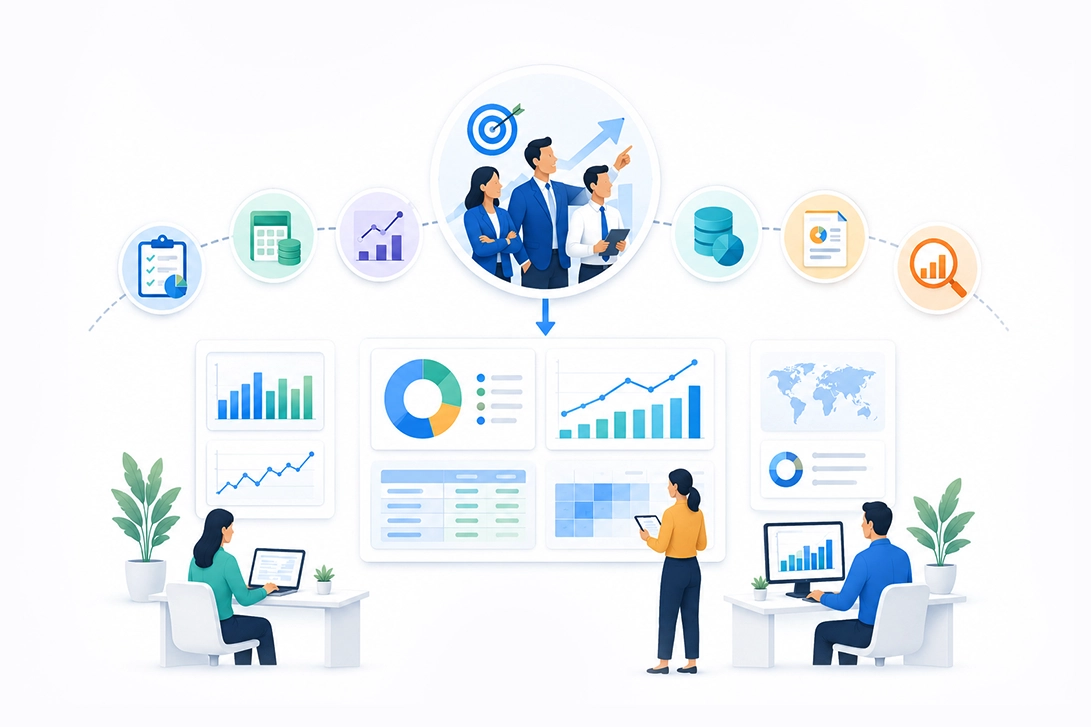
Enterprise Performance Management (EPM) is important for organizations seeking to connect business strategy with operational execution through planning, budgeting, forecasting, financial consolidation, reporting, and performance analysis. EPM leverages integrated financial data and processes to connect strategic planning with operational execution, enabling comprehensive analysis, proactive management, and informed decision-making across the organization. EPM helps organizations align their strategies across all departments to manage and improve overall performance and achieve strategic goals.
In today’s rapidly changing business environment, organizations need EPM to align strategy with execution, improve decision-making, and drive sustainable growth.
This complete guide explains enterprise performance management EPM for organizations that need better visibility into financial data, operational data, business performance, and enterprise performance across the entire organization.
This guide covers EPM fundamentals, core EPM processes, EPM software features, EPM vs ERP differences, cloud based EPM solutions, predictive analytics, AI in EPM, implementation methods, common challenges, and vendor evaluation considerations. It is written for CFOs, finance leaders, finance professionals, business analysts, and decision makers who are evaluating enterprise performance management solutions or improving existing performance management processes.
Enterprise performance management is a business methodology that integrates planning, budgeting, forecasting, and reporting to optimize organizational performance and drive strategic decision-making. In practical terms, EPM helps organizations align strategy, allocate resources, monitor key performance indicators, manage financial performance, and make informed decisions using trusted financial and operational data.
By the end of this guide, you will have answers to common questions about EPM, including its definition, benefits, key components, differences from ERP systems, and best practices for successful implementation. Whether you are new to EPM or looking to enhance your current processes, this guide will provide the clarity and actionable insights you need.
Next, let’s establish a clear understanding of EPM’s core definition and strategic purpose.
Book a Free DemoAt its core, EPM is a closed-loop process. Strategy is defined first, then translated into financial planning, operational planning, budgets, forecasts, and measurable key performance indicators. Execution then produces financial data and operational data, which are compared against targets through reporting processes, variance analysis, dashboards, and scenario modeling. The insights from that analysis are fed back into planning, allowing leaders to adjust the business strategy before small performance issues become major financial outcomes.
EPM provides a strategic framework that ensures that a business’s overarching objectives are in sync with day-to-day operations, allowing for better measurement and analysis of performance against real-time operational and financial data.
This is why corporate performance management, business performance management, and enterprise performance management are often used as related terms. Each describes a discipline focused on improving business performance through better planning, measurement, reporting, and decision making. EPM platforms provide a management layer designed for forward planning, forecasting, and profitability optimization.
The strategic purpose of EPM is not just to create reports. It is to enable finance teams and business units to make better choices faster. Data-Driven Decision Making allows teams to make fast, evidence-based choices by pulling trusted data into a centralized location. Enhanced Collaboration merges siloed data, enabling multiple departments to work together under a unified planning process. Increased Agility through real-time scenario modeling allows businesses to quickly test different market conditions and adjust forecasts accordingly.
EPM also improves financial transparency. When financial statements, financial reporting, operational metrics, and management reports are based on governed data, finance leaders can build trust in the numbers. This matters for risk management, regulatory reporting, audit readiness, cash flow visibility, cost management, investment planning, and long-term enterprise performance.
With a clear understanding of EPM’s strategic purpose, let’s dive deeper into the fundamentals that underpin effective enterprise performance management.
EPM is not just a software solution but a strategic framework that aligns business strategy with operational execution. Enterprise Performance Management (EPM) helps organizations align their strategies across all departments to manage and improve overall performance and achieve strategic goals. EPM provides a strategic framework that ensures that a business’s overarching objectives are in sync with day-to-day operations, allowing for better measurement and analysis of performance against real-time operational and financial data.
Enterprise performance management is the integration of business processes, management processes, methodologies, and technologies used to plan, measure, analyze, and improve business performance. It brings together financial and operational plans, enterprise data, financial transactions, operational metrics, and strategic targets so the organization can evaluate performance against business strategy in a consistent way.
By integrating financial and operational data, EPM enables organizations to make data-driven decisions that align operational activities with strategic objectives, enhancing resource allocation and performance management.
Modern EPM systems consist of five core business process components. These usually include strategic planning, budgeting and forecasting, financial consolidation and close, reporting and compliance, and performance and profitability analytics. Together, these key components create a management layer above existing systems and existing databases, helping finance teams turn historical data and transactional data into management insights.
With the fundamentals in place, the next step is to understand the key components and architecture that make EPM effective.
The key components of EPM are interconnected rather than isolated.
Planning, Budgeting, and Forecasting translates high-level strategic goals into actionable financial and operational targets, allowing for real-time adjustments and scenario modeling. Budgeting & Forecasting automates resource allocation across business units and deploys rolling, driver-based, or predictive forecasts using historical and market trends. EPM enables driver-based planning that links operational metrics to financial outcomes, improving forecast accuracy and helping teams understand how their decisions impact the bottom line.
Strategic Modeling & Planning defines long-term corporate goals, identifies risk variables, and establishes a baseline roadmap for the entire organization.
Profitability and Cost Management analyzes expenses and revenues to identify value drivers and optimize costs.
Performance & Profitability Analytics evaluates operational key performance indicators (KPIs) and applies multidimensional modeling to check margins by customer, location, or SKU.
Financial Consolidation and Close streamlines and automates the process of gathering financial results across global entities, intercompany eliminations, and statutory reporting. Financial Close & Consolidation automates ledger reconciliations, intercompany eliminations, and period close-outs to maintain audit-ready financial statements. Account Reconciliation automates the matching of data across sub-ledgers and bank statements to ensure financial data integrity.
Reporting & Compliance generates mandatory corporate filings, multi-departmental analysis, and localized statutory requirements. Tax Reporting manages integrated tax accounting and transfer pricing to increase transparency and ensure compliance with global regulations. Narrative Reporting provides automated solutions for drafting, formatting, and distributing financial statements that combine quantitative data with contextual commentary.
A modern EPM architecture usually connects ERP data, CRM data, human resources information, supply chain data, market indicators, tax data, ESG data, and other enterprise data sources. Enterprise Data Management (EDM) ensures reporting consistency by synchronizing and governing reference data across disparate systems.
Databases facilitate real-time “What-If” scenario planning and instant consolidation of extensive corporate trees. Unified Dashboards consolidate enterprise data into role-based Key Performance Indicators (KPIs) for monitoring cash flow and profitability. Role-Based KPI Dashboards are configurable visualization consoles allowing executives to quickly track performance against strategic benchmarks.
With an understanding of EPM's core components, let's explore how these have evolved and are applied in modern organizations.
The key to navigating disruption is adaptability. Whether disruptions stem from external factors like new regulations or global events, or internal market shifts such as a product’s sudden success or failure, organizations that respond swiftly maintain a competitive edge. Modern EPM solutions empower you to understand when, where, and how to adjust to these changes effectively.
In a dynamic regulatory landscape, rapid adaptation to new requirements is critical. EPM streamlines the financial close, enabling you to deliver timely and accurate insights confidently to stakeholders.
Account reconciliation often causes delays unrelated to data issues during the financial close. EPM leverages automation to manage global account reconciliation securely and mitigate associated risks comprehensively.
The digital economy demands more than isolated spreadsheets and siloed plans. EPM aligns planning across the entire organization, facilitating agile forecasting for all business units and faster, more effective responses to change.
To thrive amid uncertainty, understanding cost and profitability drivers is vital. EPM provides insights that help prioritize investments and allocate limited resources wisely.
With evolving tax laws, global organizations must manage tax affairs differently. EPM integrates tax reporting with financial planning, close, and regulatory processes for greater transparency and control.
Regardless of the number of reporting requirements, you need confidence that your reports are accurate, complete, and current. EPM minimizes reliance on multiple reporting systems.
Whether migrating to the cloud, operating in hybrid environments, or leading financial transformation, an enterprise data management platform ensures data accuracy and alignment across your organization’s master data.
The concept of Enterprise Performance Management (EPM) has been around for decades, with early processes managed manually before the advent of computers. Before dedicated EPM software, finance teams relied on ledgers, paper worksheets, manual data entry, and fragmented reporting processes that were slow and error-prone.
The first EPM software applications became available in the 1970s, allowing for the collection of budgeting and financial information for reporting purposes. Spreadsheets, introduced in the 1980s with software like Lotus 1-2-3 and VisiCalc, automated budget and report creation, replacing manual worksheets and improving collaboration. In practice, spreadsheets allowed finance teams to work faster, but they also created version control problems, formula errors, and fragmented planning models.
In the 1990s, the first EPM software packages began to automate financial consolidation and reporting processes, marking a significant evolution in EPM technology. EPM systems evolved from on-premises solutions in the 1990s to cloud-based applications in the 2010s, significantly enhancing accessibility and collaboration. Today, cloud based EPM solutions and web browser based applications allow distributed finance teams and business units to collaborate on planning, forecasting, financial close, and reporting from anywhere.
Modern EPM applications now include artificial intelligence, machine learning, advanced analytics, ESG reporting, tax reporting, predictive analytics, and real-time dashboards. ESG (Environmental, Social, and Governance) Management captures ESG data and drives carbon accounting to meet statutory compliance. With this foundation in place, the next important question is how EPM systems differ from ERP systems and why the two are strongest when integrated.
Understanding the relationship between EPM and ERP is crucial for implementation success because many organizations confuse transactional systems with performance management systems. ERP systems, accounting systems, and operational tools capture the activity of the business. EPM systems analyze that activity, compare it with plans, and help leaders decide what to do next.
Enterprise Resource Planning (ERP) systems automate and optimize day-to-day operational activities, while Enterprise Performance Management (EPM) focuses on strategic analysis, budgeting, forecasting, and reporting. EPM systems leverage data from ERP systems to provide insights that help organizations plan and manage their performance more effectively. While ERP serves as the backbone for day-to-day finance operations, EPM transforms operational data into forward-looking insights that guide strategic decision-making.
Enterprise resource planning is primarily designed for transaction processing and operational control. ERP systems manage activities such as accounts payable, procurement , inventory , sales orders, payroll , general ledger postings, and financial transactions. ERP is the system of record for daily operations.
EPM software is designed for financial management , planning, forecasting capabilities, performance analysis, and strategic decision making. While ERP captures what happened, EPM explains what it means and what could happen next. ERP data becomes more valuable when an EPM system uses that data for rolling forecasts, scenario modeling, financial consolidation, cost management, cash flow planning , and executive reporting.
This distinction is important for finance leaders. ERP improves operational efficiency and compliance. EPM improves business value by helping leaders assess financial performance, model future outcomes, allocate resources, evaluate risk, and align financial and operational plans with business strategy.
EPM systems typically pull data from ERP systems and combine that information with non-ERP sources such as CRM , human resources, supply chain systems , operational planning tools, market data, tax systems, ESG systems, and existing databases. This creates a broader view of enterprise data than ERP alone can provide.
A typical EPM data flow includes:
Modern EPM systems automate and connect planning, budgeting, and forecasting into a continuous process, allowing finance teams to collaborate across departments and align financial plans with business goals. Real-time integration and automated consolidation processes reduce manual data entry, improve reporting consistency, and enable finance teams to respond quickly when conditions change.
Cloud-based EPM solutions enable real-time collaboration across distributed teams, allowing finance teams to work together more effectively and respond quickly to changes in the business environment. The adoption of cloud EPM systems has been linked to improved financial performance, as they provide organizations with the agility needed to adapt to market changes and uncertainties. Cloud EPM solutions reduce the need for extensive IT infrastructure, allowing organizations to lower operational and capital expenses while reallocating resources to growth opportunities.
ERP and EPM are not competing systems. They serve complementary roles in an integrated business planning architecture.
| Criterion | ERP Systems | EPM Systems |
|---|---|---|
| Primary function | Automate operational and financial transactions | Plan, forecast, analyze, consolidate, and report performance |
| Data focus | Transactional data, operational data, accounts payable, inventory, payroll, general ledger | Financial and operational data, historical data, forecasts, strategic assumptions, key performance indicators |
| Main users | Operations teams, accounting teams, procurement, sales, HR, finance function | CFOs, FP&A teams, finance leaders, executives, department owners, finance professionals |
| Core value | Operational efficiency, control, compliance, process automation | Strategic planning, performance management, decision making, risk management, profitability optimization |
| Typical outputs | Invoices, purchase orders, ledger entries, payroll records, inventory records | Budgets, forecasts, dashboards, consolidated financial statements, scenario models, management insights |
| Time orientation | Current and historical operations | Historical analysis plus forward-looking planning |
| Best deployment role | System of record | Strategic management and performance layer |
The optimal deployment strategy is to use ERP as the operational foundation and EPM as the analytical and planning layer. A well-designed EPM system deployed on top of reliable ERP data helps avoid data silos, improves financial reporting, and gives leaders a shared source of truth.
For many organizations, the right EPM solution is one that integrates cleanly with existing systems, supports cloud solutions, provides strong governance, enables advanced analytics, and scales as business units, entities, and reporting requirements grow.
With the distinction between EPM and ERP clarified, let’s examine the essential processes and best practices for implementing EPM in your organization.
EPM processes work best when they form a connected workflow rather than separate annual exercises. Strategic planning informs budgets. Budgets inform forecasts. Forecasts inform scenario modeling. Actual performance informs reporting, variance analysis, and the next planning cycle.
The core EPM workflow connects strategic planning, financial planning, budgeting, forecasting processes, financial consolidation, financial close, reporting, compliance, and performance analytics. The objective is to turn enterprise data into repeatable management insights that improve financial outcomes and business performance.
Driver-based planning is one of the most important EPM methods. Instead of building a budget only from last year’s numbers, finance teams identify the operational drivers that influence financial performance. These drivers may include sales volume, average selling price, headcount, utilization, cost per unit, store count, production capacity, churn rate, or working capital days.
Because EPM enables driver-based planning that links operational metrics to financial outcomes, finance teams can see how a change in one assumption affects revenue, expenses, cash flow, profitability, and resource needs. Scenario modeling in EPM allows finance teams to test ‘what-if’ scenarios with confidence, enabling them to model multiple outcomes and see the financial impact instantly.
A practical driver-based planning process includes:
Gather financial data, operational data, historical data, market assumptions, ERP data, and inputs from business units. Validate the data for completeness, consistency, accuracy, and alignment with the chart of accounts.
Translate business strategy into measurable financial and operational targets. These may include revenue growth, gross margin, cash flow, cost management, ESG goals, customer retention, and productivity targets.
Build driver-based budget templates, assign targets to business units, connect operating assumptions to financial outcomes, and create budget versions for different scenarios.
Route budgets and forecasts to department owners, finance teams, and executives for review, challenge, revision, and final approval.
Budgeting & Forecasting automates resource allocation across business units and deploys rolling, driver-based, or predictive forecasts using historical and market trends. Planning, Budgeting, and Forecasting translates high-level strategic goals into actionable financial and operational targets, allowing for real-time adjustments and scenario modeling.
Financial consolidation brings together results from multiple entities, currencies, ledgers, cost centers, geographies, and reporting structures. In a spreadsheet-led close, this process can take weeks because teams manually collect data, validate submissions, reconcile accounts, eliminate intercompany transactions, and prepare financial statements.
Modern EPM solutions automate much of this work. Financial Consolidation and Close streamlines and automates the process of gathering financial results across global entities, intercompany eliminations, and statutory reporting. Financial Close & Consolidation automates ledger reconciliations, intercompany eliminations, and period close-outs to maintain audit-ready financial statements.
A faster financial close process usually includes:
The business value is significant. Organizations that move from manual close processes to automated EPM workflows can reduce close-cycle delays, improve control, and give finance leaders more time for analysis instead of reconciliation.
Forecasting is where EPM becomes a forward-looking finance engine. Rolling forecasts update expected results throughout the year rather than waiting for the annual budget cycle. This allows finance teams to adjust revenue, expense, cash flow, and resource plans as market conditions change.
Predictive analytics are transforming EPM from a backward-looking tool into a forward-looking finance engine by analyzing operational data, historical data, market indicators, and operational drivers to make forecasts with remarkable accuracy. Modern EPM systems utilize AI-powered predictive analytics models that can identify trends and forecast outcomes using real-time data, enabling finance leaders to anticipate outcomes like cash-flow shortfalls or demand surges before they happen.
The integration of predictive analytics in EPM systems allows finance teams to move from educated guesses to data-driven predictions, enhancing forecasting accuracy by identifying patterns in historical data and external factors. Machine learning can support anomaly detection, trend recognition, statistical forecasting, and sensitivity analysis.
Scenario modeling is equally important. Modern EPM systems facilitate scenario modeling, which supports strategic planning, risk management, and investment decisions by providing a safe environment to explore options without committing resources. The ability to conduct scenario modeling is critical in uncertain markets, as it allows organizations to prepare for various potential outcomes and make informed decisions based on modeled scenarios.
Common EPM scenario models include:
Artificial intelligence and advanced analytics do not remove the need for finance judgment. Instead, AI in EPM gives finance teams better signals, faster forecasts, and stronger evidence for decision making.
EPM reporting converts planning, consolidation, and forecasting outputs into actionable management insights. Real-time dashboards, role-based KPI views, variance reports, and self-service analytics help leaders understand where performance is ahead of plan, behind plan, or exposed to risk.
Unified Dashboards consolidate enterprise data into role-based Key Performance Indicators (KPIs) for monitoring cash flow and profitability. Role-Based KPI Dashboards are configurable visualization consoles allowing executives to quickly track performance against strategic benchmarks. Performance & Profitability Analytics evaluates operational key performance indicators (KPIs) and applies multidimensional modeling to check margins by customer, location, or SKU.
Good EPM reporting connects operational metrics to financial outcomes. For example, customer churn may explain revenue variance, overtime hours may explain labor cost variance, supplier delays may explain lower production output, and inventory levels may explain cash flow pressure. This connection between operational performance and financial performance is what makes EPM more powerful than static financial reporting.
EPM systems also support regulatory, statutory, and tax reporting needs. Reporting & Compliance generates mandatory corporate filings, multi-departmental analysis, and localized statutory requirements. Tax Reporting manages integrated tax accounting and transfer pricing to increase transparency and ensure compliance with global regulations. Narrative Reporting provides automated solutions for drafting, formatting, and distributing financial statements that combine quantitative data with contextual commentary.
With a solid grasp of EPM processes and implementation methods, let’s address the common challenges organizations face and how to overcome them.
EPM adoption can deliver strong business value, but implementation is not just a software project. It affects financial processes, business practices, data governance, collaboration models, user behavior, and executive decision making. The most common EPM implementation challenges are data quality, user adoption, and technology selection.
The challenge is that enterprise data often lives in multiple ERP systems, spreadsheets, operational tools, human resources systems, data warehouses, and existing databases. Inconsistent charts of accounts, manual data entry, missing mappings, duplicate dimensions, and disconnected reporting processes can reduce trust in the EPM system.
Solution:
Implement robust data governance frameworks with automated validation and standardized mapping protocols. Enterprise Data Management (EDM) ensures reporting consistency by synchronizing and governing reference data across disparate systems. Organizations should define common data dictionaries, ownership rules, master data policies, security controls, reconciliation logic, and automated data-quality checks.
Integration should be designed early. APIs, ETL or ELT pipelines, real-time connectors, middleware, and cloud integration tools can help connect EPM software with ERP systems, operational planning tools, and external data sources. Clean data is the foundation for accurate forecasting, financial consolidation, reporting, and scenario modeling.
The challenge is that finance teams and business units may resist EPM adoption because spreadsheets feel flexible, familiar, and fast. Some users may distrust automated forecasts, AI outputs, or standardized workflows. Others may see EPM as an additional reporting burden rather than a tool that improves decision making.
Solution:
Invest in comprehensive training programs and demonstrate personal value benefits to drive organizational buy-in. Executive sponsorship is essential, but adoption also depends on practical usability. Users should understand how EPM reduces manual work, improves forecast quality, shortens close cycles, supports collaboration, and gives each department better visibility into performance.
A phased rollout often works best. Start with a focused use case such as budgeting, financial consolidation, rolling forecasts, or role-based dashboards. Build internal champions across business units. Use early wins to expand adoption. Enhanced Collaboration merges siloed data, enabling multiple departments to work together under a unified planning process
The challenge is choosing a platform that fits the organization’s complexity without creating unnecessary cost, rigidity, or vendor lock-in. Some organizations need multi-entity consolidation, global currencies, tax reporting, transfer pricing, ESG reporting, AI-enabled forecasting, and advanced security. Others need fast deployment, easier budgeting, and cloud collaboration for midsize finance teams.
Solution:
Conduct thorough needs assessments and prioritize scalability, integration capabilities, and cloud-based deployment options. The right EPM solution should support driver-based planning, financial consolidation, rolling forecasts, scenario modeling, predictive analytics, role-based dashboards, workflow automation, data governance, and strong integration with existing systems.
When evaluating EPM solutions, consider:
A successful technology decision balances functionality, implementation effort, total cost of ownership, security, governance, vendor roadmap, and expected business value.
With these challenges and solutions in mind, let’s see why LOGIC ERP stands out as a partner for EPM success.
Selecting the right Enterprise Performance Management (EPM) solution is critical to driving strategic growth and operational excellence. LOGIC ERP offers a comprehensive enterprise software platform designed to help organizations evaluate, implement, and optimize EPM systems tailored to their unique business needs.
LOGIC ERP stands out for its deep integration capabilities, connecting seamlessly with existing ERP , CRM , and operational systems to provide a unified data environment. This integration ensures accurate, real-time financial and operational data flows, enabling more reliable planning, forecasting, and reporting .
The platform’s user-friendly interface and configurable dashboards empower finance teams and business leaders with actionable insights through customizable KPIs and role-based views. LOGIC ERP supports advanced features such as driver-based planning, predictive analytics powered by AI and machine learning, scenario modeling, and automated financial consolidation tools essential for modern EPM success.
Moreover, LOGIC ERP’s cloud-based deployment offers scalability, enhanced collaboration across distributed teams, and reduced IT overhead. Its robust security framework meets industry compliance standards, ensuring data integrity and governance.
By choosing LOGIC ERP, organizations gain access to expert guidance, best practices, and continuous support throughout the EPM evaluation and implementation journey. This comprehensive approach helps businesses accelerate decision-making, improve financial performance, and align operations with strategic objectives effectively.
Discover how LOGIC ERP can be your trusted partner in selecting and leveraging the best enterprise performance management solution to unlock your organization’s full potential.
Book a Free ERP DemoEnterprise performance management is a strategic enabler for data-driven performance management. It connects strategy, financial planning, operational planning, budgeting, forecasting, financial consolidation, reporting, predictive analytics, and decision making into one continuous management process.
EPM is most valuable when it helps the entire organization align daily operations with long-term goals. ERP systems capture the transactions that run the business. EPM systems transform that data into forward-looking insight, allowing finance leaders to improve financial performance, manage risk, optimize costs, model scenarios, and allocate resources with more confidence.
To move forward:
Related topics worth exploring include AI-enhanced EPM, cloud deployment strategies, integrated business planning, ESG reporting with EPM, predictive forecasting, and industry-specific EPM applications.
Call at +91-73411-41176 / +91-73411-41175 or send us an email at sales@logicerp.com to book a free demo today!
Enterprise Performance Management (EPM) is a strategic framework and software solution that helps organizations plan, budget, forecast, consolidate financial data, and analyze business performance to align operations with strategic goals.
ERP (Enterprise Resource Planning) systems manage day-to-day transactional data and operations, while EPM focuses on strategic planning, forecasting, performance analysis, and reporting by leveraging data from ERP and other sources.
Core components include planning, budgeting, forecasting, financial consolidation and close, reporting and compliance, and profitability analytics, all designed to improve decision-making and business performance.
Cloud EPM solutions offer real-time collaboration, scalability, reduced IT costs, and faster deployment, enabling organizations to adapt quickly to market changes and improve financial agility.
Predictive analytics uses AI and machine learning to analyze historical and real-time data, improving forecast accuracy, identifying trends, and enabling proactive decision-making.
Driver-based planning links operational metrics to financial outcomes, allowing organizations to create more accurate budgets and forecasts by understanding how business drivers impact financial performance.
EPM automates data collection, intercompany eliminations, currency conversions, and reconciliations, reducing errors and accelerating close cycles for audit-ready financial statements.
Scenario modeling allows finance teams to test “what-if” scenarios, assess risks, and evaluate potential outcomes to make informed strategic decisions in uncertain market conditions.
EPM is primarily used by CFOs, finance leaders, FP&A teams, and business managers to align financial planning with business strategy and improve performance management.
Benefits include improved decision-making, better alignment of strategy and operations, enhanced forecasting accuracy, faster financial close, regulatory compliance, and increased organizational agility.
Enterprise performance management solutions are software tools and processes that help organizations plan, budget, forecast, consolidate financial data, and analyze enterprise data to align with business strategy and improve overall performance.
An EPM system deployed effectively enhances the finance function by automating planning, budgeting, forecasting, tax reporting, and cost management, enabling finance teams to focus on strategic decision-making supported by advanced analytics and integrated data from existing databases.
Cost management is a critical aspect of enterprise performance management as it helps organizations analyze expenses, optimize resource allocation, and improve profitability through detailed performance insights and advanced analytics.
Advanced analytics in EPM systems process large volumes of enterprise data to uncover trends, forecast outcomes, and provide actionable insights that support proactive decision-making and align financial plans with business strategy.
Tax reporting within EPM ensures compliance with regulatory requirements by integrating tax accounting and transfer pricing into the financial consolidation and reporting processes, providing transparency and accuracy across all entities.
Integration with existing databases allows EPM solutions to access comprehensive and accurate enterprise data, ensuring consistency in reporting, improving data governance, and enabling seamless planning and analysis across the organization.
Enterprise performance management connects financial and operational data to business strategy by translating strategic goals into measurable targets, enabling continuous monitoring, scenario modeling, and adjustment to achieve organizational objectives.
Enterprise Performance Management (EPM) utilizes enterprise data by integrating financial and operational information from various systems across the organization. This integration enables comprehensive analysis, accurate forecasting, and informed decision-making by providing a unified view of performance metrics, key performance indicators (KPIs), and strategic goals. Effective use of enterprise data in EPM ensures consistency, transparency, and alignment between business strategy and operational execution.
Use these resources and frameworks to continue evaluating EPM software and implementation options:
Popular Products