Known Value Item Guide

What is a Known Value Item (KVI)?

A Complete Guide for Retailers

Learn what Known Value Items (KVI) are, why they matter in retail, how to identify and price them effectively, and how to use retail software to manage KVI pricing strategies for better customer trust and margins.
What is a Known Value Item (KVI)? A Complete Guide for Retailers

✨ Summarize this article with AI

Introduction: Quick Answer for Busy Retailers

A known value item (KVI) is a product whose price customers commonly remember and actively compare across retailers. Also called a key value item, it is the product that shapes whether shoppers think your store is cheap, fair, or expensive. Every retailer, whether running a neighborhood grocery shop or a 200-store supermarket chain, lives or dies by how well they price these items.

Quick Answer: Known value items typically represent 8–15% of a retailer’s product range, yet they drive the majority of customer price perception. Products like milk, eggs, bread, and bananas are classic KVIs in grocery retail. Getting KVI pricing right builds trust, pulls foot traffic, and protects margins. Getting it wrong pushes shoppers to competitors, sometimes permanently.

KVI pricing, competitor pricing, and data analytics must work together. You cannot win on value image by gut feel alone, and you cannot protect profit margins without understanding which items customers actively notice and which they do not.

This guide covers everything a retail professional needs: what a known value item is, real-world examples, how to identify KVIs, how to build a KVI pricing strategy, common mistakes, how to manage KVIs across multiple stores and channels, and how retail POS and ERP software like LOGIC ERP makes all of this operationally feasible.

What is a Known Value Item (KVI) in Retail?

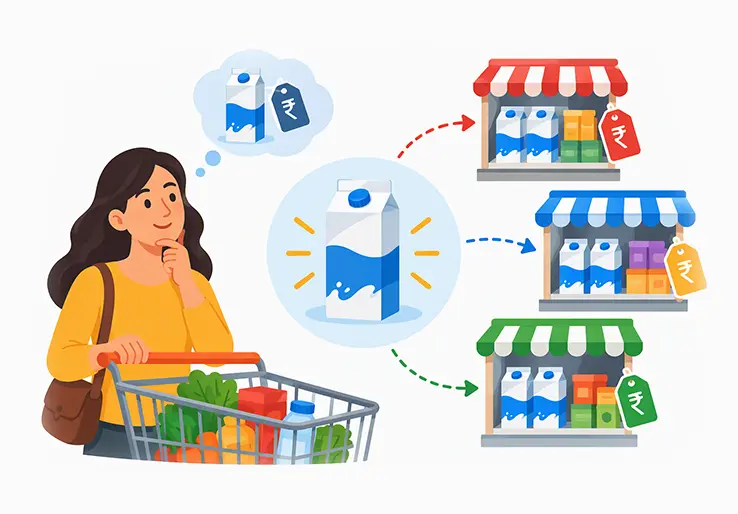
A known value item is a product whose price shoppers can recall within a narrow range and actively compare across retailers before or during a shopping trip. Key value items KVIs are not random best-sellers. They are the specific products that create a price image for the entire store.

Here is how that works: if a customer sees that 1L toned milk, a 500g bread loaf, and 1kg sugar are all fairly priced at your store, they assume the rest of your assortment is also fairly priced. This inference, sometimes called the "halo effect" of pricing, means that KVIs act as price anchors for the thousands of other products on your shelves.

  • KVIs are products with high visibility, frequent purchase, and easy price comparison. In an Indian grocery context, think 1L toned milk, 1kg wheat flour, or 1kg basmati rice. In a Western supermarket, think eggs, bananas, and bottled water.
  • Key value items KVIs are not just top sellers. A niche bulk pack might sell in high volume but have low price awareness among most shoppers, disqualifying it as a KVI.
  • KVIs typically represent 5–15% of SKUs depending on banner, format, and country, but they can influence over 50–80% of perceived price competitiveness.
  • Shoppers judge overall affordability based on a select few KVIs. If those prices look right, customers perceive the entire store as affordable.

What Makes a Product a Known Value Item?

KVI identification starts with shopper behavior, not with internal labels or supplier priorities. The question is not "What do we sell the most of?" but rather "Which products do customers actively notice, remember the price of, and compare before choosing where to shop?"

Here are the characteristics that define a known value item:

  • High Purchase Frequency: Items bought weekly or biweekly — like milk, bread, rice, or cooking oil — stay fresh in customers’ memories. High purchase frequency allows KVIs to significantly influence customer loyalty because shoppers encounter these prices repeatedly.
  • High Customer Awareness: The product is bought by a broad cross-section of shoppers, not just a niche segment. Most households purchase it.
  • Easy Price Comparison: KVIs are typically products that are easily compared across competitors. Standard pack sizes, well-known brands, and wide availability make comparison straightforward. A 1L pack of branded sunflower oil is easy to benchmark; a 375ml artisan olive oil is not.
  • Strong Demand and Basket Presence: KVIs appear in many shopping baskets across many trips. They are basket drivers that draw customers into the store.
  • Wide Competitor Availability: The same or equivalent item is stocked by most competitors, making it a natural benchmark.
  • Sensitivity to Price Changes: Shoppers react visibly to even small price moves on these items. If your milk costs ₹5 more than the store next door, customers notice.

Some products are seasonal or situational KVIs. Air conditioners become KVIs in May–June in India. Hand sanitizers became KVIs globally during COVID-19 in 2020–2021. KVI lists are not static; they shift with market trends and customer behaviour.

Examples of Known Value Items by Retail Format

Key value items differ by key value categories and retail format, but they follow the same logic everywhere: high visibility, high memorability, and easy comparison.

Grocery and Supermarket KVIs

  • Milk, eggs, bananas, bread, sugar, rice, cooking oil, bottled water, cola, staple detergents, toothpaste, and diapers

Electronics Retail KVIs

  • Consumer electronics KVIs include flagship smartphones and laptops, popular earbuds, and bestselling power banks. These are the items shoppers research and compare prices on extensively.

Fashion and Apparel KVIs

  • Core T-shirts, basic jeans, and everyday footwear — items with standardized sizing and wide availability that shoppers can compare across brands and stores.

Pharmacy KVIs

  • Basic painkillers, toothpaste, and common OTC medications that customers buy regularly and know the going rate for.

Online Marketplaces

  • Amazon uses best-selling products as KVIs to drive additional purchases. The most-viewed, most-compared items on a platform function as digital KVIs.

Notable Brand Examples

  • Walmart uses milk and bread as KVIs to attract customers and reinforce its everyday low price image.
  • Starbucks’ Pumpkin Spice Latte is a KVI that boosts sales during its seasonal window, acting as a traffic driver for the entire menu.
  • IKEA prices breakfast at €2.29 to attract customers into stores, using the meal itself as a KVI that sets a "great value" tone for the rest of the visit.

Each retailer should build its own KVI list from data analytics rather than copying a generic industry list. What qualifies as a KVI varies by market, customer segment, and store format.

Known Value Items vs What KVIs are Not

Retailers often confuse KVIs with loss leaders or simply with top sellers. These are different things, and the distinction matters for pricing decisions.

A loss leader is a product intentionally sold at or below cost to draw customers into the store. A KVI is about price perception. Some KVIs may occasionally be used as loss leaders during promotions, but most KVIs are simply priced competitively without being sold below cost. The goal is fairness and memorability, not sacrifice.

A KVI is not simply a top seller by volume. Some high-volume items — for example, niche bulk packs or highly differentiated specialty products — may have low price awareness among most shoppers. If customers do not remember or compare the price, the item is not functioning as a KVI regardless of its sales volume.

KVIs are not fixed forever. They change with channel mix (online vs offline), region, and time. Instant noodles became a KVI in several markets post-2020. New competitor entry or a cost spike can shift which products customers pay attention to.

KVIs usually represent 2% to 5% of a store’s assortment but influence 30% of price perception, according to some analyses. Other studies peg the range higher at 10–20% of SKUs influencing up to 80% of perception. The exact number depends on the format and methodology, but the principle is the same: a small number of items carry a disproportionate weight.

Warning: treating the whole assortment as key items dilutes focus and compresses margins across the board. If everything is a KVI, nothing is.

Why Known Value Items Matter for Retailers

The reason KVIs matter so much is rooted in how shoppers actually make decisions. Customers do not memorize 10,000 prices. They remember a handful — maybe 20 to 50 — and use those as shortcuts to evaluate your entire store. This mental shortcut is what pricing experts call price image, and it is shaped almost entirely by known value items.

  • Store Choice and Traffic: KVIs can drive traffic into stores or e-commerce platforms. A shopper who sees that your milk and bread are priced right is more likely to walk through your doors for the rest of their list. 83% of buyers research prices online before purchasing, making KVI visibility on online platforms and apps just as critical as in-store signage.
  • Customer Price Perception: KVI pricing shapes customer perception of store value. If a retailer prices KVIs too high, customers assume the entire store is overpriced — even if 90% of products are competitively priced.
  • Trust and Loyalty: Keeping KVIs competitively priced convinces shoppers the entire store is affordable. This builds long-term trust and turns first-time visitors into loyal customers.
  • Competitive Positioning: In the ever evolving retail landscape, KVIs are the front line of competition. Mispricing KVIs can erode revenue and reduce customer traffic, pushing shoppers toward discounters or online alternatives.
  • Profitability: KVI pricing can enhance customer trust and store traffic, which in turn lifts basket size. Retailers accept thinner margins on key value items while earning higher margins on less price sensitive, complementary products. The net result, when executed well, is improved overall profitability.
  • Basket Effect: When customers trust your KVI prices, they add more items to their cart during each shopping trip. Those additional items — premium snacks, private-label goods, impulse purchases — often carry much healthier margins.

How KVI Pricing Works in Practice?

The typical KVI pricing flow follows a clear sequence: KVI identification → competitor pricing tracking → set KVI price rules → monitor sales and basket data → adjust KVI pricing regularly.

KVI pricing (sometimes written as KVI pricing in industry shorthand) usually aims to keep prices at or very near the market-competitive level for key SKUs. Many retailers target a narrow index band — for example, 98–102% of the primary competitor’s price on core KVIs. This means you do not always need the lowest price; you need to be close enough that shoppers do not perceive a meaningful gap.

Retailers strategically utilize KVIs depending on the industry and shopping mission. A convenience store might focus KVI pricing on cold beverages and snacks, while a hypermarket focuses on staple groceries and household essentials.

  • Combine KVI Pricing with Basket Margin Targets: Sharp pricing on 1L milk at thin margin, paired with premium cheese, flavored yogurt, and organic butter at comfortable margins. The basket, not the individual KVI, is where you make money.
  • Promotions Reinforce Value Perception: BOGO deals, bundle discounts, and multi-buy offers ("3 for ₹100") are often focused on key value items. These mechanics reinforce the shopper’s perception that the store delivers value.
  • KVI Pricing Strategies can Enhance Overall Profitability when the margin trade-off is managed deliberately. Accept thin margins on visible KVIs, recover margin on less visible products.
Example Scenario: A supermarket prices 1L toned milk at ₹28 (competitor is ₹27), absorbing a 10% margin. In the same dairy aisle, premium imported cheese carries a 45% margin. A shopper who walks in for the fairly priced milk also picks up the cheese. The basket is profitable.

KVI Pricing vs Regular Product Pricing

KVIs require a fundamentally different pricing process than the long tail of your assortment. Here is how they differ:

  • Review Frequency: Pricing teams review KVI prices weekly or even daily. Regular products may be reviewed monthly or quarterly. In digital environments, some more sophisticated retailers reprice top KVIs multiple times per day.
  • Competitor Focus: KVI pricing is directly linked to competitor pricing and price zones. Regular items are often priced using markup or category-margin rules with less competitor benchmarking.
  • Elasticity Modeling: Price elasticity and cross-elasticity are explicitly modeled for KVIs. A 2% price increase on milk might cost you 5% of volume; understanding that trade-off is essential. Non-KVIs are managed with simpler rules.
  • Guardrails and Rules: KVI pricing typically has tighter guardrails — maximum price gaps vs competitors, minimum margin floors, and automated alerts when prices drift out of band. Regular products have wider acceptable ranges.
  • Operational Intensity: Managing KVI prices absorbs disproportionate attention from pricing teams, but this focus delivers disproportionate returns in value perception and traffic.

How to Identify Known Value Items (KVI Identification)?

KVI identification is a structured, data-driven process — not a one-off judgment call or a simple sales ranking exercise. The most frequently purchased products are a starting point, but not every high-seller qualifies.

Here is how to build a KVI list from your own data:

  • Units Sold and Purchase Frequency: Pull POS data to find items bought by the most customers, most often. Look for products appearing in a high percentage of baskets.
  • Price Sensitivity Signals: Analyze how sales volume responds to price changes. Items where a small price move creates a noticeable volume shift are strong KVI candidates. This is price elasticity in action.
  • Basket Data and Penetration: Identify items with high basket penetration — products that appear in many different shopping trips across many different customer segments.
  • Competitor Transparency: Products widely available at competitors and easily compared (same brand, same size) score higher. Use competitive data from price-check services and online platforms.
  • Search and Comparison Behavior: For omnichannel retailers, track site search terms, click-through rates, and app-based price-check activity. Items customers search for by price are likely KVIs.
  • Promotion Response: Measure promotional uplift. Items with strong sales spikes during promotions signal high price sensitivity.

KVI lists should be refreshed continuously, not annually. Market conditions, competitor actions, and customer behaviour shift constantly. Best-practice retailers update KVI lists monthly or quarterly. Retailers can manage over 1,000 KVIs dynamically when supported by the right technology and pricing process.

A U.S. grocery chain identified approximately 800–1,200 items as KVIs (about 6% of SKUs). These items accounted for roughly 38% of transaction volume and 62% of active price-comparison behavior measured via exit surveys.

Using Data Analytics to Refine KVI Lists

Raw sales data will get you a starting KVI list. Data analytics and BI tools help you distinguish true KVIs from "false positives" — items that sell well but whose prices shoppers do not actively track or compare.

Here are the analytical techniques that matter:

  • Price Elasticity Analysis: Quantify how demand responds to price moves for each item. High-elasticity items are KVI candidates. Low-elasticity items, even high-volume ones, may not be.
  • Basket Analysis: Examine which items co-occur in baskets, which items anchor trips, and which are impulse additions. Basket drivers and traffic drivers are more likely to be true KVIs.
  • Competitor Pricing Comparison: Track how your KVI prices compare to key competitors over time. Items where competitors are also pricing aggressively confirm KVI status.
  • Cluster Analysis by Price Zone: Different regions and store clusters may have different KVI profiles. A tier-1 metro store may have different assortment perception drivers than a tier-3 town outlet.
  • Time-Series Tracking: Monitor how volume and margin shift after price moves. This helps detect when a product’s KVI status is weakening or strengthening.

Known value items serve as a link between physical resources and financial information. When you can connect what is on the shelf to how customers perceive your pricing, you make smarter decisions. Combining KVI pricing with advanced analytics allows retailers to simulate scenarios — "what if we raise the price by 2–3%?" — before going live.

LOGIC ERP supports this by providing detailed retail analytics and transaction data exports that feed directly into BI tools, enabling data driven decision making and continuous KVI refinement.

Known Value Items in Grocery and Supermarket Retail

Grocery and supermarkets are the classic use case for key value items KVIs. Shoppers buy staples weekly, know their prices intimately, and use them to judge every store they visit. KVIs include everyday staples like milk, eggs, and bread — items that appear in nearly every household’s basket.

Here are typical grocery KVI examples by category:

  • Staples: Wheat flour (atta), rice, lentils (dal), sugar
  • Dairy: Milk, curd, butter, paneer
  • Bakery: Bread, buns, rusk
  • Produce: Bananas, potatoes, onions, tomatoes
  • Packaged foods: Noodles, biscuits, breakfast cereals
  • Beverages: Cola, tea, coffee, bottled water
  • Cleaning and household: Detergent, dishwashing liquid, floor cleaner

The KVI composition in a neighborhood supermarket will differ from a hypermarket, discount chain, or online grocer — even in the same city. A hypermarket’s KVI list may emphasize bulk staples and family packs, while a convenience store focuses on single-serve beverages and quick snacks.

Supermarkets can segment KVIs by key value categories — for example, "Daily Essentials," "Breakfast Staples," "Baby Care," and "Household Cleaning" — to make KVI management operationally manageable. This prevents the pricing team from drowning in a flat list of 800+ items and instead focuses attention category by category.

KVI Pricing Strategy: From Basics to Advanced

A KVI pricing strategy is the deliberate combination of aggressive pricing on key value items with margin optimization on non-KVIs and complementary products. It is not about having the cheapest price on everything. It is about being priced competitively where it matters most and earning where customers are less sensitive.

Here is a step-by-step framework:

  1. Define Key Value Categories: Identify the 8–12 categories that matter most for price perception in your format (e.g., dairy, staples, beverages, household care).
  2. Select Key Value Items KVI Within Each Category: Use the identification criteria above — purchase frequency, basket penetration, competitor availability, and price elasticity.
  3. Set Price Roles: Decide whether each KVI will be a price leader (lowest in market), follower (matching key competitor), or parity (within a tight band like 98–102%).
  4. Define the Competitor Set: Not every competitor matters equally. Identify 2–4 primary competitors whose prices your shoppers compare against. Use competitive pricing intelligence to monitor them.
  5. Design Rules for Promotions vs Regular Prices: Separate base KVI prices from promotional KVI prices. Promotions should be temporary, targeted, and create surprise value — not permanent markdowns.
  6. Incorporate Psychological Price Points: Pricing a KVI at ₹99 instead of ₹102 may seem trivial, but customers perceive different price points very differently. These price anchors matter.

Mispricing a KVI can erode revenue and weaken price image. A successful pricing strategy balances short-term competitive pressure against long-term price image. Avoid matching every competitor on every KVI if your positioning (premium, convenience, specialty) allows selective differentiation. A dynamic pricing strategy that adjusts KVI prices based on demand fluctuations and competitor moves is increasingly the norm among more sophisticated retailers.

Managing KVI Pricing Without Destroying Margins

The core challenge is straightforward: KVI prices must be sharp enough to look competitive, but over-discounting erodes already thin retail margins, especially in grocery where net margins often sit between 1–3%.

Here are practical tactics:

  • Limit the Number of KVIs: Aim for 5–15% of your assortment. Going beyond dilutes focus and gives up margin unnecessarily. Each KVI you add is a product where you accept thinner profit margins.
  • Focus on Visible Pack Sizes: Price the 1L milk pack competitively. The 5L bulk pack can carry a better margin because fewer shoppers compare that size.
  • Protect Margins on Non-KVIs: The entire store does not need to be priced aggressively. Complementary products, premium variants, and impulse items should maintain healthy margins.
  • Engineer Profitable Baskets: Ensure that KVI-driven trips include higher-margin add-ons. Merchandising, cross-selling, and strategic shelf placement help here.
  • Use Private Label Strategically: Some retailers develop private-label KVIs that offer lower shelf prices while maintaining acceptable gross margins. Store-brand milk or sugar can function as a KVI with better margin than the national brand equivalent.

Accurate valuation of known value items helps prevent financial discrepancies between expected and actual margins. KVIs play a foundational role in financial reporting and risk management because mispricing them affects not just perception but actual P&L outcomes.

Avoid common traps: copying a competitor’s KVI list blindly, ignoring cost inflation on KVIs for too long, or treating 40–50% of SKUs as KVIs. Each of these destroys margin without proportional benefit.

Common KVI Pricing Mistakes and How to Avoid Them

Even experienced pricing teams make avoidable errors with known value items. Here are the most damaging ones:

  • Selecting KVIs Based Only on Sales Volume: High volume does not equal high price awareness. Validate KVI status with elasticity data and customer research, not just units sold.
  • Keeping Static Annual KVI Lists: Customer behaviour, competitor landscapes, and market trends shift constantly. A product that was a KVI last year may not be one today. Refresh quarterly at minimum.
  • Not Separating Base KVIs From Promotional KVIs: Some items function as KVIs only during promotions. Mixing these with permanent KVIs confuses your pricing process.
  • Applying the Same KVI Set to All Regions and Channels: A metro supermarket and a small-town outlet serve different shoppers with different reference prices. One-size-fits-all KVI lists lead to mispricing in at least some locations.
  • KVI Creep: Under supplier pressure or merchant judgment calls, more and more items get labeled as KVIs. This dilutes focus and compresses margins. Set clear rules for KVI re-entry and exit.
  • Ignoring Competitor Pricing Moves: When a discounter or online player enters your local market and undercuts key items, failing to respond on those specific KVIs damages price value perception quickly.

Remedies: Use analytics to validate KVI status regularly, limit the number of KVIs per category, set clear governance for additions and removals, and automate monitoring through retail POS software.

KVI vs Private Label vs Loss Leader: How They Work Together

These three concepts are related but distinct. Confusing them leads to muddled pricing decisions.

A KVI is a price image anchor — the item that shapes how customers perceive your store’s overall pricing. A private label is a retailer-owned brand designed to offer differentiation and better margins. A loss leader is a product sold at or below cost to draw customers into the store, sometimes temporarily.

Here is how they interact:

  • Supermarkets often create private-label KVIs. Store-brand milk, bread, or sugar can serve as the visible low-price option on the shelf, offering the shopper a fairly priced alternative while delivering better margin to the retailer than the national brand equivalent.
  • Retailers occasionally turn a KVI into a temporary loss leader during festivals or major sales events (Diwali, Black Friday, Christmas) to grab market share or clear seasonal inventory. This is a deliberate, time-limited tactic — not a permanent pricing posture.
  • Not every loss leader is a KVI, and not every KVI is a loss leader. A retailer might use a niche imported product as a loss leader to attract customers without it being a price-remembered item. Conversely, most KVIs are priced competitively but profitably.

Scenario: A supermarket manages national-brand 1kg sugar as a KVI at 8% margin — tight but positive. It positions its own private-label 1kg sugar 5% cheaper with a 15% margin. During Diwali, the private-label sugar drops to cost price as a loss leader, pulling in more customers and filling baskets with higher-margin festive items. Three strategies, one category, working together.

How Retail POS & ERP Software Help with KVI Management?

Managing known value items across thousands of SKUs and multiple stores is not a spreadsheet job. Modern retail POS and ERP platforms like LOGIC ERP make KVI management scalable and consistent.

Here are the capabilities that matter for key value items KVI:

  • Centralized Product and Price Master: Maintain a single source of truth for all SKU pricing across stores and channels. Update KVI prices centrally and push them to every POS terminal.
  • Store-Wise and Zone-Wise Pricing: Set different prices for different price zones, reflecting local competitor landscapes without losing central control. LOGIC ERP’s multi-store POS capabilities support this natively.
  • Customer and Party-Wise Pricing: Configure optimized prices for different customer segments, including loyalty tiers, wholesale buyers, or institutional customers.
  • Promotion Setup and Management: Create, schedule, and track KVI-focused promotions (BOGO, bundle, multi-buy) across stores with automatic start and end dates.
  • Real-Time Sales Data and Margin Tracking: Monitor how KVI price changes affect sales volume, basket composition, and margins in near real-time.
  • Inventory Visibility: Inventory managers prioritize stocking KVIs to avoid stockouts that damage trust. An ERP system that flags low KVI stock before it runs out is essential for protecting price image.

Combining KVI pricing with LOGIC ERP’s data and controls helps retailers keep KVIs competitive without losing view of overall margins and stock levels. The system provides the sales data and reports needed for ongoing KVI identification and performance monitoring.

KVI Management for Multi-Store and Omnichannel Retailers

Chains operating multiple stores, regions, and channels face specific KVI challenges. Different stores compete against different retailers, serve different demographics, and may need different KVI lists.

  • Centralized Policy, Localized Execution: Head office defines the KVI framework — criteria, governance, margin floors. Regional or zone managers adjust specific KVI lists and prices based on local competitive data and customer demand patterns.
  • Price Zone Consistency: Customers who visit multiple locations or compare prices on online platforms expect consistency. Wildly different KVI prices across stores in the same city damage price transparency and trust.
  • Channel Alignment: The same KVI priced at ₹30 in-store and ₹35 on the app creates friction. An omnichannel experience requires aligned KVI pricing across brick and mortar stores and digital channels.
  • Supply Disruption Handling: When a KVI ingredient faces a cost spike or supply shortage, centralized systems allow rapid, coordinated price adjustment or temporary substitution — preventing one store from raising prices while another holds.
  • Regional Variation: A tier-1 metro supermarket might list branded olive oil as a KVI, while a tier-3 city store in the same chain lists mustard oil instead. The KVI framework is the same; the items within it reflect local shopping behavior.

LOGIC ERP’s multi-store management capabilities allow retailers to synchronize price changes while maintaining the flexibility to localize KVI selections by store cluster.

Key Metrics and KPIs for KVI Performance Tracking

You cannot manage what you do not measure. Here are the key items every pricing team should track for KVIs:

  • KVI Sales Volume: Track units sold per KVI per week. Rising volume after a price adjustment confirms the move worked. Declining volume signals a problem.
  • KVI Contribution to Total Revenue: Understand how much of your top-line comes from KVIs vs non-KVIs. This helps size the impact of pricing moves.
  • Gross Margin on KVIs: Monitor margin at SKU level. You expect thin margins on KVIs, but they should not turn negative unless part of a deliberate loss-leader promotion.
  • KVI Price Index vs Competitors: Benchmark your KVI prices against 2–4 key competitors. Stay within your target band (e.g., 98–102%). Drifting above signals risk.
  • Price Variance by Store: Detect inconsistent KVI pricing across locations. Unexplained variance damages customer satisfaction and trust.
  • Promotion Uplift: Measure how much volume increases during KVI promotions. If a promotion does not generate meaningful uplift, it is wasting margin.
  • Customer Purchase Frequency: Track how often customers who buy KVIs return. High frequency indicates strong loyalty driven by perceived value.
  • Price Elasticity Over Time: Detect when shoppers stop reacting to minor price changes on a KVI — this may signal that the item’s KVI status is weakening.

Retail analytics dashboards connected to your POS and ERP systems can surface these indicators at store, zone, and chain level, giving pricing teams the data driven insights they need for ongoing KVI management.

Conclusion: Turning KVI Insight into a Pricing Advantage

A small set of known value items drives most of a retailer’s price image. Key Value Items shape customers’ perception of store prices, influence where they choose to shop, and determine whether they come back. In a market where 83% of buyers research prices online before purchasing and competitive transparency keeps increasing, precise KVI identification and KVI management are no longer optional — they are essential for remaining competitive.

The retailers winning on value in the ever evolving retail landscape are the ones who combine KVI pricing with competitor pricing intelligence, data analytics, and modern retail software. They do not try to have the lowest price on everything. They price aggressively where it matters — on the items customers remember — and earn margin where customers are less price sensitive.

Start by auditing your current KVI list. Validate it with actual basket data and purchase frequency, not assumptions. Remove false positives, add items your competitors are pricing sharply, and set clear governance for how KVI lists get updated. Then explore how LOGIC ERP’s retail POS and ERP capabilities can operationalize a more disciplined, data-backed KVI pricing strategy across every store and channel you operate.

Call at +91-73411-41176 / +91-73411-41175 or send us an email at sales@logicerp.com to book a free demo today!

Frequently Asked Questions About Known Value Items (KVI)

A known value item is a product whose price shoppers strongly remember and use to judge overall store pricing. KVIs typically represent 8–15% of a retailer’s product range but shape the majority of customer price perception. They are central to any retail pricing strategy because they influence where customers choose to shop.

KVI stands for Key Value Item or Known Value Item. In retail, it refers to products that customers perceive as benchmarks for whether a store offers good value. KVIs directly affect a retailer’s price image and value perception among shoppers.

Common KVI examples include milk, bread, eggs, bananas, sugar, rice, cooking oil, toothpaste, and detergent in grocery retail. In electronics, flagship smartphones and popular laptops serve as KVIs. Actual KVIs vary by region, store type, and customer segment.

KVIs influence store choice, foot traffic, and customer trust by shaping price perception. When KVIs are priced right, shoppers perceive the entire store as affordable, giving retailers a competitive advantage. Mispricing even a few KVIs can push customers to competitors and erode revenue.

Retailers identify KVIs by analyzing POS and sales data for purchase frequency, basket penetration, price elasticity, and competitor pricing. Products that many customers buy frequently and whose prices they actively compare across stores are strong KVI candidates.

KVI pricing is the practice of setting sharp, competitive prices on key value items while balancing margins on non-KVIs. The goal is to maintain a strong price image and attract customers without eroding overall profitability. It combines competitor benchmarking with margin management.

Shoppers extrapolate from a small set of KVI prices to judge the entire store. If key items like milk, bread, and rice are fairly priced, customers assume everything else is too. Even a few overpriced KVIs can damage the price image and send customers elsewhere.

No. A KVI is about price perception and customer memory, while a loss leader is a product intentionally sold at or below cost to drive traffic. Some KVIs may temporarily serve as loss leaders during promotions, but most KVIs are priced competitively without being sold below cost.

Supermarkets should benchmark KVI prices against 2–4 primary competitors regularly, stay within a narrow competitive index on core staples, avoid extreme underpricing that destroys margin, and review the impact on basket size, customer traffic, and overall margins frequently.

POS and ERP systems like LOGIC ERP centralize pricing across stores, provide real-time sales and margin data, support store-wise and zone-wise pricing rules, and integrate with analytics tools. This enables faster KVI identification, consistent price updates, and better margin monitoring across the entire retail operation.

Key value items (KVIs) are products that significantly influence customer price perception across various retail sectors. They are frequently purchased, widely recognized, and used by shoppers to judge overall store pricing. KVIs help retailers shape their value perception and competitive positioning in the market.

Market understanding is critical for effective KVI strategy as it helps retailers identify which products customers actively compare and remember. By analyzing market trends, competitor pricing, and customer behavior, retailers can tailor their KVI lists to reflect true value perception drivers and optimize pricing accordingly.

A universal key value item list is difficult because value perception drivers vary by region, store format, and customer segment. KVIs must be dynamically updated to reflect local competitor pricing and shopper preferences, ensuring the list remains relevant and effective for pricing strategies.

Competitor pricing directly influences KVI pricing decisions. Retailers monitor competitor prices on key value items to maintain competitive positioning and manage customer perceptions. Adjusting KVI prices in response to competitor moves helps protect margins while sustaining customer trust.

Yes, retailers often combine KVI pricing with other strategies such as promotional pricing, private label pricing, and dynamic pricing. This integrated approach allows them to balance competitive pricing on KVIs with margin optimization across the broader product range.

Key value categories group products that contain multiple KVIs and share similar price sensitivity. Managing KVIs within these categories helps retailers focus pricing efforts on the most impactful items, improving efficiency and enhancing overall price image.

KVIs serve as price anchors that shape customer value perception. When KVIs are priced competitively, customers perceive the entire store as offering good value, which drives foot traffic and increases basket size. Mispricing KVIs can damage trust and reduce store visits.

Retailers should update KVI lists regularly, ideally quarterly or monthly, to reflect changes in market conditions, competitor pricing, and customer shopping behavior. Continuous updates ensure that KVI strategies remain aligned with current value perception drivers.

Combining KVI pricing with competitor pricing allows retailers to maintain a competitive edge by setting prices close to market benchmarks. This strategy helps protect profit margins while ensuring customers perceive the store as affordable and trustworthy.

Key value categories (KVCs) organize products into groups with similar pricing dynamics, making it easier to identify and manage KVIs. By focusing on KVCs, retailers can apply tailored pricing rules that optimize value perception and profitability across categories.

Logic ERP Bot