Discover how party-wise pricing in ERP software enables businesses to manage customer-specific rates, discounts, and price lists automatically. Learn the benefits, setup process, and key features to streamline pricing management and improve sales accuracy.
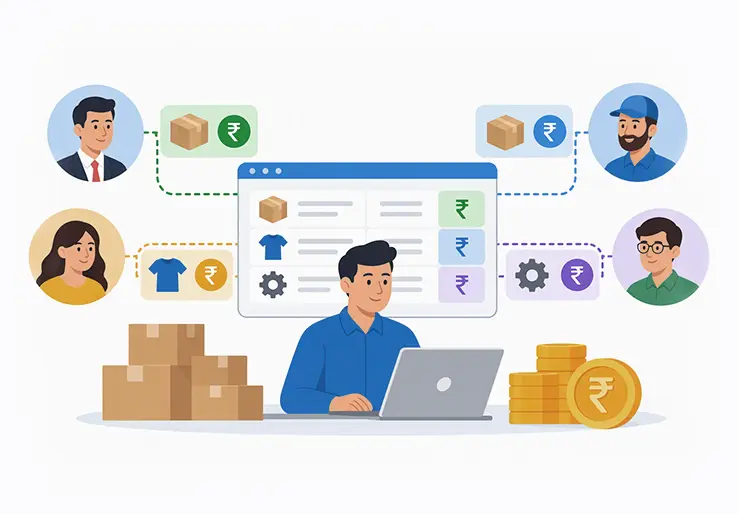
If you run a distribution, wholesale, or manufacturing business with more than a handful of customers, you already know that one price does not fit all. Party-wise pricing in ERP is the structured way to assign, manage, and automatically apply customer-specific rates, discounts, and price lists — so the right customer always gets the right price on every invoice.
Party-wise pricing means that each party — whether a customer, distributor, retailer, stockist, or branch — can have its own dedicated price list, item-level overrides, discounts, and validity dates inside your ERP system. In LOGIC ERP, this customer specific pricing is applied automatically during billing. When a salesperson selects a party name during a sale transaction, the system pulls the correct wise price without any manual rate lookup.
Typical use cases include FMCG distributors managing dealer-wise rates across North India in 2025–2026, pharma wholesalers handling hospital vs. retail pharmacy pricing, electronics retailers with negotiated key-account rates, and manufacturing companies with annual B2B contracts.
Party-wise pricing ensures pricing consistency for specific customers. The immediate benefits:
Most Indian distributors and manufacturers start with a single, simple price list. One rate per product, applied uniformly. It works when you have 20 customers and 50 SKUs. But the moment your business scales — more dealers, more regions, more products, more schemes — that single list breaks down.
Different customers need different prices because the business relationship with each is different. A distributor buying 5,000 units monthly has earned a lower rate than a retailer ordering 50 units. A key account locked into a two-year contract in FY 2025–26 expects a rate that does not change mid-year. A stockist in Chennai operates under different market conditions than one in Delhi.
Without an ERP-driven system, these price variations live in spreadsheets, WhatsApp messages, and the memory of sales staff. The result is pricing errors, customer disputes, and margin leakage that compounds month after month. Many SMEs struggle with maintaining separate price lists across customer types, often leading to operational chaos.
LOGIC ERP is designed to centralize and automate party-wise pricing for multi-location, multi-channel businesses — so your pricing processes run on rules, not guesswork.
Party-wise pricing is per-customer pricing managed inside the ERP, not just per-product pricing. Instead of a single standard rate for an item, each party can have its own wise price — the customer-specific net rate after applying party-level rules, overrides, and discounts.
Here is a concrete example. Suppose you sell Item X with an MRP of ₹120 and a standard list price of ₹100:
All three rates exist simultaneously in LOGIC ERP, mapped to different party profiles.
Key concepts to understand:
A modern ERP like LOGIC ERP stores party-wise pricing through interconnected masters: party profiles, item masters, price lists, discount rules, and date ranges. Here is how these pieces fit together.
First, you create party (customer) profiles with attributes like pricing category, region, channel type (dealer, distributor, retailer, institutional), GST registration, credit limits, payment terms, and a default price list assignment. This customer data forms the foundation for all pricing logic.
Next, you define price lists. Each price list is a named collection of item-wise rates with effective from and to dates. For example, "Distributor-North-2025" might cover April 2025 to March 2026 with rates for 500 SKUs. You then assign each party to one or more price lists.
During sales order or sale voucher entry, the ERP follows a clear hierarchy to determine the price:
The system does all of this automatically. No manual lookup, no phone calls to confirm rates, no flipping through old emails. The wise price appears the moment a salesperson selects the customer and adds an item.
When a price revision occurs, you define a new effective date. The old price list version remains in history for audit and reference. Every change is logged with the user, date, and reason — giving you a complete audit trail.
One-price-for-all rarely works for B2B and distribution businesses in 2025–2026. Here is why different customers require different prices.
Volume-based differentiation is the most obvious driver. A customer buying 10,000 units per month generates enough revenue to justify a lower per-unit rate. A customer buying 100 units cannot receive the same rate without eroding your margins. Costs scale directly with headcounts in per-person pricing models, and the same principle applies to product volumes.
Channel-based pricing adds another layer. Dealers, distributors, retailers, online marketplace sellers, and institutional buyers each operate at different margin structures. Each channel needs its own wise price logic. Factors that influence party pricing include guest count and demographics — and in B2B terms, this translates to order size, customer category, and purchase frequency.
Geographic and tax-based drivers also matter. A product priced at ₹100 in North India might need to be ₹110 in the South due to freight costs, local competition, or state-level scheme variations. Complex pricing structures can lead to millions of pricing scenarios when you combine products, customers, regions, and time periods.
Additionally, negotiated rates for key accounts, government tenders, and long-term contracts must be enforced precisely. An error on a government tender invoice can result in penalties and blacklisting. Similarly, seasonal promotions like Diwali 2025 offers or March 2026 year-end clearance need time-bound pricing rules that activate and expire automatically — without manual overrides.
Different types of parties are usually priced using different models, just as different types of events — from corporate functions to private gatherings — follow distinct pricing structures.
Most SMEs start with Excel price lists and WhatsApp-forwarded PDFs. Initially, it feels manageable. But as you add more customers, more price categories, and more product lines, the spreadsheets multiply.
Typical spreadsheet issues include:
These issues directly cause pricing errors: the wrong price on an invoice, an expired promotional rate still being applied, a revised cost-based price that was never updated after a supplier increase.
Manual pricing systems create operational chaos and inefficiencies. The real-world impact is measurable. One industrial supplier in Rajkot estimated losses of ₹12–15 lakh per year in margins, freight, and goodwill due to wrong entries and order rework from WhatsApp and email-based orders. Delayed receivables touched ₹3.5 crore because of invoice disputes and statement issues. Pricing errors can lead to significant margin losses that compound quarter after quarter.
Every credit note, every re-billed invoice, every "sorry, that rate was wrong" call erodes customer relationships and trust. Party-wise pricing inside ERP is the practical way to end this spreadsheet-driven chaos.
If you are evaluating price list management software in 2025–2026, here is what LOGIC ERP delivers for party-wise pricing:
LOGIC ERP offers both simple and advanced configuration so companies can start basic and scale complexity as the business grows. You can maintain different customers under separate price lists — for example, A-Category Retailers on one list and B-Category Retailers on another.
Each feature is detailed below.
A price list in LOGIC ERP is a named set of item prices with defined rules. Examples: "Retail-List-2026," "Distributor-List-North-2025," or "Contract-ABC-2025."
You map each customer to a default price list using the party-wise price list feature. Once mapped, every sale voucher for that customer automatically pulls rates from the assigned list.
| Customer | Category | Assigned Price List | Example Rate (Item X) |
|---|---|---|---|
| Sharma Traders | Retailer | Retail-List-2026 | ₹100 |
| Gupta Distributors | Distributor | Distributor-North-2025 | ₹92 |
| Metro Corp | Key Account | Contract-Metro-2025 | ₹88 |
This mapping forms the backbone of customer specific pricing and eliminates the need to manage manually across branches.
Party-wise item price is a per-item, per-customer rate that overrides the generic price list when needed. Party-wise item prices must be enabled in item settings, and batching must be disabled to use party-wise item pricing — a configuration requirement to keep in mind during setup.
Concrete scenario: A pharma customer signs an annual MoU in January 2026 for special rates on 20 fast-moving SKUs. You enter those 20 overrides against that customer’s profile. During invoicing, the system first checks for a party-wise item price. If one exists, it uses that rate. If not, it falls back to the assigned price list.
This is essential for businesses where select products carry negotiated rates for select customers, while the rest follow standard lists.
LOGIC ERP supports multiple pricing levels: MRP, list price, dealer price, distributor price, institutional price, and online price. These levels can be linked to price categories, which are then mapped to parties.
For example:
| Product | MRP | Dealer Price | Distributor Price | Institutional Price |
|---|---|---|---|---|
| Item A | ₹150 | ₹130 | ₹120 | ₹115 |
| Item B | ₹200 | ₹175 | ₹160 | ₹150 |
A dealer-category party automatically sees dealer prices; a distributor sees distributor prices. This is how LOGIC ERP handles "different price categories for my products" at scale. Much like tiered ticketing in events, which increases prices in phases based on demand, multiple pricing levels let you control rate visibility by customer tier.
The ERP can maintain discount structures at the customer level, item level, and price list level. Examples include:
Discount rules can be date-effective and are applied automatically during sales voucher entry, preventing manual calculation errors. This feature pairs with LOGIC ERP’s billing and invoicing capabilities to ensure discounts flow correctly into the final invoice value.
Bulk pricing tiers adjust the unit price based on quantity brackets. You configure these per customer group or individual customer.
| Quantity Bracket | Unit Price (Distributor Category) |
|---|---|
| 1–99 units | ₹100 |
| 100–499 units | ₹95 |
| 500+ units | ₹90 |
LOGIC ERP applies the correct tier automatically at the time of order, eliminating negotiation confusion and manual recalculation. Guest count usually drives major cost variations in event pricing, and similarly, order quantity drives rate variation in B2B distribution.
Each party-wise price list or customer rate has a from date and to date. For example, a contract priced from 01-Apr-2025 to 31-Mar-2026 remains active only within that window.
The ERP automatically stops applying expired rates. Expired pricing agreements can cause margin leakage — and LOGIC ERP prevents this by enforcing validity dates at the system level. Season and date of events can influence pricing due to demand variations, and the same logic applies to seasonal pricing in distribution: summer schemes, festival offers, and cost-based upward revisions effective from a specific date after supplier price hikes.
During order entry, LOGIC ERP pulls rates automatically from the central pricing engine. There is no dependence on memory, notebooks, or old emails.
The system provides margin visibility: cost, selling price, and gross margin percentage are shown line-wise and invoice-wise in real time. Control features include minimum margin rules, approval workflows for below-threshold prices, and alerts when manual overrides conflict with standard party-wise rates. This helps ensure your sales team cannot accidentally sell below cost.
This section walks you through the implementation steps — aimed at power users, accountants, and ERP admins setting up party-wise pricing.
The process covers: enabling settings, defining price lists, mapping them to parties, and testing in sale vouchers.
High-level steps:
Navigate from the Main Menu to the Setup or Configuration module in LOGIC ERP. Open the Party or Account master related options, then access "Set Party-Wise Price List" in the Party-Wise Settings area. From here, you can view all parties and their current price list assignments in a single screen, or press Enter to open or confirm the Party-Wise Price List screen.
Select a customer from the accounts list and click refresh to ensure the latest data is visible before assignment.
You can assign price lists individually or in bulk to customers:
Best practices: group customers by category before assigning, double-check mappings against your pricing policy document, and keep a log of changes for audit trails.
Go to Main Menu → Sale Voucher Configuration, select the appropriate voucher series, and open Other Settings. Access Column Locks or Field Permissions and enable or unlock the "Price List" field so it is visible at the voucher header or line level. Enable price list field in sale voucher for automatic application of the correct rates.
Keep the field visible if salespeople occasionally need to override (with approval), or keep it system-controlled for strict policy enforcement.
Test by creating a sale bill: select a customer with a defined party-wise price list, insert an item, and confirm that the wise price is populated automatically. Run through multiple scenarios:
Testing edge cases before go-live prevents surprises during actual billing.
Distributors and wholesalers manage separate rates for dealers, retailers, and key accounts across multiple cities and depots. A wholesale billing software without party-wise pricing support is incomplete for this segment.
Manufacturers who sell to both distributors and direct institutional customers require channel-wise and contract-wise pricing structures. For example, Haldiram went live with LOGIC ERP’s B2B App to give distributors and sales staff access to their entitled pricing — eliminating manual rate checks entirely.
Specific segments where party-wise pricing is critical:
The benefits: consistency across sales teams, reduced disputes, simple rollout of region-wise promotional price lists, and better leverage during negotiations with both customers and suppliers.
Standard pricing uses a single rate for all customers. Party-wise pricing assigns different rates per customer. Here is how they compare:
| Dimension | Standard Pricing | Party-Wise Pricing |
|---|---|---|
| Price lists | One or very few | Multiple, customer/segment-specific |
| Flexibility | Low — same price across all buyers | High — differentiated by party, channel, region, volume |
| Complexity | Simple to set up and maintain | Higher setup effort but structured ongoing management |
| Margin control | Prone to leakage from ad-hoc discounting | Strong control with rules, overrides, and audit trails |
| Discount management | Manual, inconsistent | Systematic, rule-based, date-effective |
| Suitability | Small retail shop with uniform pricing | Regional distributor with 500+ customers and negotiated rates |
| Scalability | Breaks down as business grows | Scales with additional customers, products, and channels |
LOGIC ERP supports both models. A small business can start with simple standard pricing and evolve to party-wise pricing as it grows — without migrating to a different system.
ERP-based party-wise price management is a strategic tool for profitability, not just a data entry feature.
Financial benefits are equally important. You get margin protection through minimum price rules, visibility into item-wise and party-wise profitability, and the ability to run targeted schemes for your most valuable customers.
Operationally, LOGIC ERP’s centralized pricing database acts as the single source of truth across billing, inventory, and finance modules — synchronizing pricing across branches and warehouses. This delivers measurable value during month-end closing when your accounts team no longer chases down which rate was used on which invoice.
Without systematic party-wise pricing, businesses face daily friction:
These issues create a time consuming cycle of error-correction that wastes hours every week. They directly hurt customer relationships when buyers receive invoices that do not match their expectations. And they make it nearly impossible to calculate true profitability by customer or product.
FMCG businesses run scheme-based discounts, region-wise price variants, and party-specific item bundles. A Delhi-based FMCG distributor might have separate price lists for 15 dealer territories, each with seasonal adjustments and volume slabs derived from 2023–2025 purchase data.
Pharma distributors handle party-wise rates for hospitals vs. retail pharmacies, near-expiry stock discounts applied to selected parties only, and mandatory tracking of contract prices under regulatory price ceilings.
Manufacturers with long-term rate contracts — say with engineering companies — define item-wise negotiated prices and annual price escalation per agreed formulas. Private gatherings are usually priced based on labor, scale, and vendor coordination; similarly, B2B manufacturing pricing depends on production cost, volume, and customer-specific service requirements.
Event and party pricing relies on cost structures and service models that vary dramatically by customer type. Menu sophistication affects the per-person price for food and beverage, while catering style and menu complexity dictate pricing based on the type of gathering. Catering often varies by the type of gathering and complexity of the theme.
Weddings involve high customization and complex logistics — from venue requirements that heavily influence the overall budget, to decoration and immersion levels that impact the cost, to theme complexity that affects the cost due to details like custom backdrops and lighting. The execution level affects theme costs significantly in event planning. Customization of invites and party favors adds to the overall event cost. The duration of an event can lead to additional cost factors.
For corporate functions, businesses factor in business ROI and professional AV needs. Entertainment options vary in cost based on the level of talent and production. Logistics, staffing, and permits drive up costs for large-scale gatherings. Venue choice can significantly impact the overall budget.
Pricing models for hiring vendors include flat-rate, per-person, and percentage-based pricing. Cost-plus pricing calculates total expenses divided by expected attendance for ticketed events. Public gatherings rely on revenue models designed to cover overhead and secure profit.
Event companies managing party-wise pricing in LOGIC ERP can assign per-customer rate cards based on event type, scale, and contracted terms — ensuring every quote matches the agreed pricing structure.
Central HQs define brand-wise retail price lists, with store- or franchise-wise adjustments controlled centrally via LOGIC ERP. This ensures the head office retains pricing control while allowing region-specific fine-tuning.
Storing all party-wise and item-wise prices in the ERP enables rich reporting that manual systems cannot deliver.
Key reports include:
Use date range filters — say Q1 FY 2025–26 vs. Q4 FY 2024–25 — to compare trends, optimize price lists, and design new slab structures. These analytics support data-driven negotiations rather than gut-feel pricing decisions, creating an opportunity to adjust rates proactively before margins erode.
When evaluating ERP software for party-wise pricing, follow this checklist:
LOGIC ERP meets these criteria with both on-premise and cloud options, offering ongoing support and regular feature updates. The goal is to find software that delivers accuracy, control, and scalability as your customer base grows.
Party-wise pricing in ERP transforms pricing from a reactive, error-prone process into a structured, data-driven capability. Every invoice reflects the right rate for the right customer. Margins are protected by rules, not hope. And your sales team spends time selling, not verifying rates.
LOGIC ERP centralizes party-wise price lists and customer-wise item rates, enabling scalable growth across regions, channels, and customer segments. Whether you are an FMCG distributor, a pharma wholesaler, or a B2B manufacturer, the ability to define, control, and automatically apply customer-specific pricing is no longer optional — it is essential.
Businesses that implement robust party-wise price management today will be better positioned to compete in increasingly data-driven markets through 2026 and beyond. If your current system still relies on spreadsheets and memory, the cost of inaction only grows.
Call at +91-73411-41176 / +91-73411-41175 or send us an email at sales@logicerp.com to book a free demo today!
Party-wise pricing is a feature in ERP software that lets you define and automatically apply different prices for different customers. Each party (customer, dealer, distributor) can have its own price list, item-wise rate overrides, and discount structures. The ERP applies the correct wise price during every sale transaction.
There is no practical difference. "Party-wise" and "customer-wise" are used interchangeably. In ERP terminology, "party" refers to any business entity you transact with — customers, suppliers, or agents. Customer-wise pricing is simply the customer-facing application of party-wise pricing rules.
Yes. LOGIC ERP can maintain separate price lists, item-level overrides, bulk pricing tiers, and date-effective rates for each customer. The system applies these automatically, so you do not need to manage manually or rely on memory.
Absolutely. You can define fixed-percentage discounts, slab-based discounts, promotional schemes, and payment-term-based discounts at the customer or party group level. These automatically apply during billing along with the party-wise price.
Distributors typically serve dealers, retailers, and institutions — each expecting different rates. Party-wise pricing eliminates the need for separate Excel files, reduces pricing errors on invoices, and lets the entire sales team operate from a single source of truth. It also enables quick rollout of new schemes or price revisions across the distribution network.
In LOGIC ERP, party-wise pricing is natively integrated with billing, stock, and accounting modules. When a sale is billed, the correct rate is pulled from the pricing engine, the invoice is generated, inventory is updated, and the accounting entry is posted — all in one process.
If you have more than two or three customer categories receiving different rates, or if pricing errors and disputes are becoming frequent, it is time to move from simple price lists to structured party-wise pricing. The implementation effort pays for itself quickly in reduced errors, faster processing, and margin protection.
Popular Products