Material Requirements Planning (MRP) is a computer-based production planning and inventory control system that determines what materials are needed, in what quantities, and when they must be available to fulfill manufacturing operations.
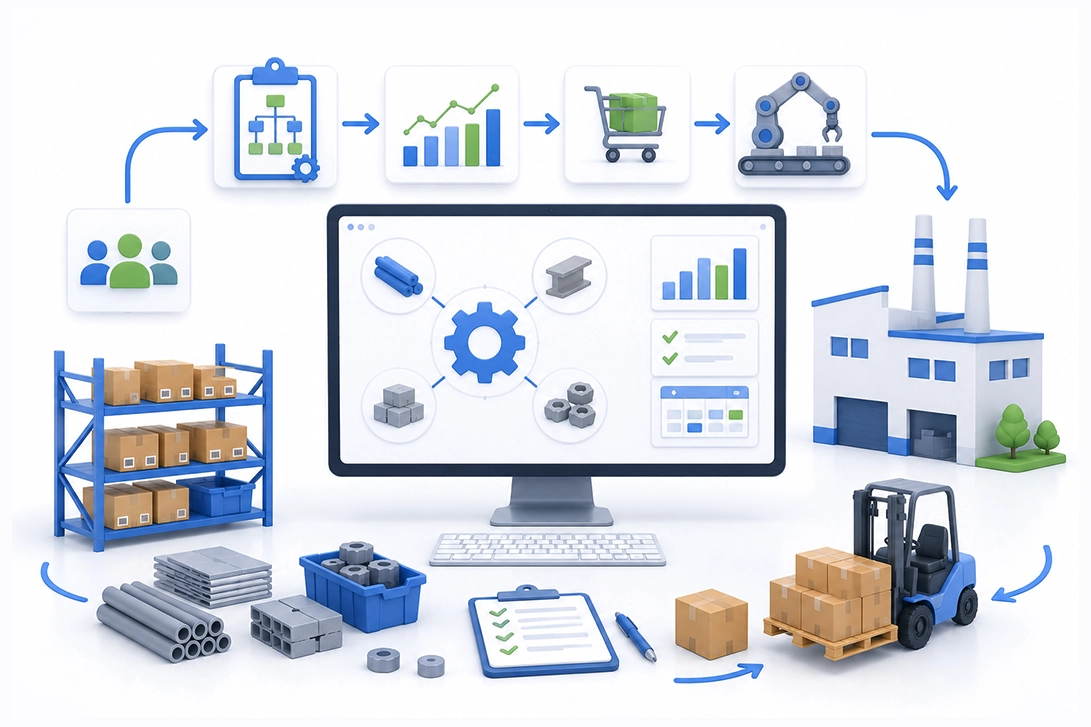
Material Requirements Planning (MRP) is a computer-based production planning and inventory control system that determines what materials are needed,in what quantities, and when they must be available to fulfill manufacturing operations. This foundational technology connects customer demand with procurement and production activities, enabling manufacturing companies to optimize inventory levels while meeting delivery commitments, and effectively manage inventory throughout the manufacturing process by ensuring raw materials are available when needed and minimizing excess stock.
This comprehensive guide covers MRP fundamentals, implementation processes, benefits, and integration strategies for manufacturing businesses of all sizes. MRP and ERP systems are essential to tools for any manufacturing business seeking to improve efficiency, inventory control, and supply chain management . Whether you operate a small production facility or manage complex multi-site operations, understanding MRP principles is essential for achieving manufacturing efficiency. The target audience includes production managers, supply chain professionals, manufacturing executives, and operations teams seeking to optimize material planning processes and reduce operational costs.
By reading this guide, you will gain:
Material Requirements planning MRP is a push-based production planning system that transforms customer demand into detailed material procurement and production schedules. Unlike reactive inventory management approaches, MRP proactively calculates all the raw materials and components needed before production begins, ensuring materials arrive at the right time to support the manufacturing process.
MRP’s role centers on balancing supply and demand while minimizing excess inventory and preventing material shortages. It helps manufacturers manage inventory more effectively throughout the supply chain by optimizing inventory levels and ensuring the right materials are available when needed. By connecting forecasted demand with inventory data and production capacity, the system enables manufacturers to plan production with precision and confidence.
The MRP system relies on three essential inputs that work together to generate accurate Material Requirements and purchase orders.
Master Production Schedule (MPS) specifies the quantity and timing of all finished goods to be manufactured. This top-level schedule drives all downstream planning activities, translating sales forecasts and customer orders into concrete production targets. The MPS serves as the primary demand driver for material calculations, determining what needs to be produced, when, and in what quantities.
Bill of Materials (BOM) defines the complete structure of components, subassemblies, and raw materials required for each finished product. This multi-level representation includes quantities, units of measure, and component relationships. MRP systems calculate the materials needed using information from the bill of materials , and maintaining an updated BOMis crucial for accurate supply forecasting and planning, as outdated BOMs can result in reworks and increased waste.
Inventory Status File (ISF) consists of real-time records showing what is currently stock, what is on order, and whatis already allocated to other builds. This component provides visibility into current stock levels, scheduled receipts, safety stock buffers, and lead times for procurement and manufacturing.
Understanding demand types is fundamental to how MRP calculates Material Requirements effectively.
Independent demand applies to finished goods driven by customer orders and market forecasts. This demand comes directly from external sources, customers placing orders or sales teams projecting future requirements. Independent demand must be forecasted or derived from order backlogs.
Dependent demand refers to raw materials and components whose requirements are calculated from finished goods needs. When you know how much of a finished product you need, the BOM explosion determines exactly how much raw material and components are required. MRP determines these dependent requirements automatically through its calculation engine.
This distinction matters because MRP excels at managing dependent demand. The system calculates precisely what components you need based on your production schedules. Understanding this relationship directly impacts material availability and production process efficiency.
Building on these foundational concepts, successful MRP implementation requires systematic attention to data preparation, system configuration, and organizational change management.
Data accuracy forms the foundation of effective MRP operations. MRP systems rely heavily on accurate data inputs, including sales forecasts, inventory levels, and bills of materials, to function effectively and avoid costly production delays.
Inventory data cleansing involves verifying on-hand quantities against physical counts, identifying discrepancies, and establishing accurate baseline records. Industry best practices target inventory accuracy of 95% or higher through regular cycle counting procedures.
BOM structuring and maintenance requires auditing component relationships, validating quantities and units of measure, and ensuring version control for engineering changes. Target BOM accuracy should reach 98% or higher before system go-live.
Lead time establishment involves measuring actual supplier delivery performance and production cycle times rather than using estimated values. Accurate lead times are critical for the MRP process to generate realistic planned order dates that align with material availability and production constraints.
The MRP process can be broken down into four major steps: identifying requirements to meet demand, checking inventory and allocating resources, scheduling production, and identifying issues and making recommendations.
Gross requirements calculation begins with the MPS and explodes BOMs to determine total component and raw material needs across all planned production. The first step of the MRP process is identifying customer demand and the requirements needed to meet it, which starts with inputting customer orders and sales forecasts.
Net requirements determination applies Inventory Netting, which subtracts on-hand inventory and incoming shipments from total demand to calculate net requirements. Once the Material Requirements are identified, MRP compares that list against the current inventory status to determine what needs to be ordered and when, ensuring that purchasing decisions align with material availability and production constraints.
Planned order generation creates purchase orders and production orders timed according to lead times, lot sizing rules, and production capacity constraints. MRP outputs include recommendations for when to release orders to meet production needs while optimizing inventory levels.
Modern MRP systems integrate data across multiple business functions to maximize planning accuracy and operational efficiency.
ERP system integration enables seamless data flow between financial management , sales, and production modules . This connectivity ensures that production schedules reflect actual customer orders and that purchasing activities align with cash flow considerations.
Manufacturing execution system (MES) connectivity provides real-time production feedback, allowing MRP to respond to actual shop floor status rather than planned assumptions. This integration reduces the gap between planned and actual production, improving scheduling accuracy.
Implementation timelines vary based on organizational complexity. For mid-size manufacturers with moderate complexity, core MRP functionality typically achieves go-live within 4-6 months when data preparation is prioritized. Projects involving complex BOMs, multiple plants, or extensive integrations may extend to 8-12 months.
Moving beyond basic implementation, MRP supports complex manufacturing scenarios and strategic business objectives when properly configured and maintained.
Organizations should undertake MRP implementation projects when manual planning processes create production bottlenecks, excess inventory ties up working capital, or production delays impact customer satisfaction. Once the Material Requirements are identified, MRP compares that list against the current inventory status to determine what needs to be ordered and when, ensuring that purchasing decisions align with material availability and production constraints.
Conduct comprehensive data audit and cleansing of inventory records, BOMs , and supplier information to establish accurate baseline data that supports reliable MRP calculations
Design master production schedule aligned with sales forecasts and production capacity, ensuring the MPS reflects realistic manufacturing capabilities and market demand.
Configure MRP parameters including safety stock levels, lead times, and lot sizing rules based on actual performance data rather than theoretical estimates.
Execute pilot testing with selected product lines (typically 20% of SKUs by revenue) before full system deployment to validate configurations and identify issues.
Train users on MRP processes and establish ongoing data maintenance procedures, designating MRP champions in each department to drive adoption and maintain data quality.
Understanding when to choose MRP versus comprehensive ERP solutions helps manufacturers align technology investments with business requirements. MRP systems focus specifically on production planning and inventory control , while ERP systems take a broader approach to business management, integrating all aspects of operations into one platform. ERP systems extend beyond production, often including modules for financial management , customer relationship management , human resources, and supply chain management , whereas MRP is primarily concerned with Material Requirements. While MRP is primarily used for managing production schedules and inventory in manufacturing, ERP covers the whole business, integrating various functions like sales, finance, and HR.
| Criterion | MRP System | ERP System |
|---|---|---|
| Primary Focus | Material planning and inventory control | Enterprise-wide business process integration |
| Implementation Complexity | Moderate, focused on production data | High, requires cross-departmental coordination |
| Cost Investment | Lower initial costs, focused modules | Higher investment, comprehensive functionality |
| Scalability | Limited to production and inventory | Scales across all business functions |
| Integration Scope | Manufacturing and supply chain focused | Finance, HR, CRM, and operations integrated |
| Typical Timeline | 4-6 months for core functionality | 6-18 months for full deployment |
MRP systems focus specifically on production planning and inventory control, while ERP systems take a broader approach to business management, integrating all aspects of operations into one platform. ERP systems extend beyond production, often including modules for financial management , customer relationship management , human resources, and supply chain management , whereas MRP is primarily concerned with Material Requirements.
While MRP is primarily used for managing production schedules and inventory in manufacturing, ERP covers the whole business, integrating various functions like sales, finance, and HR. The evolution from MRP to MRP II (called Manufacturing Resource Planning) to enterprise resource planning represents increasing scope; MRP II added machine and labor capacity planning, while modern ERP systems encompass all business processes.
Manufacturers should choose standalone MRP when operations are focused, budget is constrained, and enterprise integration requirements are limited. ERP becomes necessary when business complexity increases, multiple departments need shared data, and competitive advantage requires cross-functional visibility.
Despite clear benefits, manufacturers face typical obstacles during MRP adoption and ongoing operations that require proactive management.
Inaccurate data can lead to material shortages or excess inventory, which can disrupt production schedules and negatively impact cash flow. Implement robust data governance procedures with regular cycle counting and inventory audits to maintain 95%+ accuracy levels. Establish clear ownership of BOM maintenance and version control processes. Schedule periodic audits of lead times and supplier performance data to ensure MRP calculates requirements based on current conditions.
Production teams accustomed to manual scheduling often resist systematic MRP approaches. Develop comprehensive training programs with hands-on workshops that demonstrate how MRP simplifies daily decisions. Establish MRP champions in each department to provide peer support and drive adoption. Show early wins by piloting on product lines where MRP delivers visible improvements in managing production schedules.
Connecting MRP with existing accounting software , customer relationship management systems, and shop floor systems presents technical challenges. Create phased integration approaches with API connectivity and data migration strategies to bridge old and new systems effectively. Prioritize critical data flows first inventory transactions, purchase orders, and production reporting before adding secondary integrations.
Suppliers may not deliver as promised, causing MRP plans to become invalid. MRP improves supplier collaboration through transparent data regarding Material Requirements. Establish supplier performance metrics tracking on-time delivery and lead time consistency. Update MRP lead times dynamically based on actual supplier performance rather than quoted estimates. For critical materials, build safety stock buffers that account for supplier variability.
Proper planning and execution overcome these common implementation challenges, enabling manufacturers to realize the full benefits of systematic Material Requirements planning.
Material Requirements Planning (MRP) software offers a wide range of benefits that significantly enhance manufacturing operations and supply chain management. These benefits include:
MRP software ensures that materials and components are available exactly when needed, minimizing downtime caused by material shortages. This synchronization of materials with production schedules leads to smoother workflows and better utilization of labor and machinery.
By accurately calculating Material Requirements based on demand forecasts and current inventory, MRP helps maintain lean inventory levels. MRP software enables manufacturers to manage inventory efficiently, ensuring the right balance between supply and demand. This reduces carrying costs, limits excess stock, and decreases the risk of obsolete inventory.
MRP systems provide transparent and timely data on material needs, enabling better communication and coordination with suppliers. This transparency helps in negotiating better terms, improving delivery reliability, and managing lead times effectively.
By optimizing production schedules and ensuring timely material availability, MRP software helps reduce customer lead times. Manufacturers can provide more accurate delivery commitments, enhancing customer trust and satisfaction.
Advanced MRP systems identify potential shortages, bottlenecks, or scheduling conflicts early in the planning process. They provide actionable recommendations, allowing teams to adjust production plans or procurement activities proactively.
Through better inventory management, reduced emergency orders, and improved resource utilization, MRP software contributes to significant cost reductions across procurement, storage, and production.
Real-time data updates and integration with other business systems enable MRP to quickly respond to changes in customer demand, supplier performance, or production capacity. This agility supports dynamic manufacturing environments and competitive markets.
MRP facilitates JIT inventory by scheduling material deliveries to coincide closely with production needs, minimizing storage requirements and working capital tied up in inventory.
MRP systems track every material movement from purchase to production, offering detailed visibility and audit trails that support quality control and regulatory compliance.
In summary, MRP software acts as a central planning tool that links demand forecasting, inventory control, and production scheduling. Its implementation leads to improved operational efficiency, cost savings, and enhanced customer service, making it indispensable for modern manufacturing enterprises.
By aligning material supplies tightly with production needs, MRP promotes leaner inventories, which lowers carrying costs and allows companies to offer more competitive pricing.
LOGIC ERP Manufacturing Software offers a comprehensive Material Requirements Planning (MRP) solution designed specifically to meet the complex needs of modern manufacturing operations. Our MRP module integrates seamlessly with production scheduling , inventory control , and procurement , providing real-time visibility and actionable insights to optimize your entire supply chain.
With LOGIC ERP, manufacturers gain:
Powered by advanced analytics, ensuring materials are planned precisely to meet customer orders and market trends.
Tracks stock levels, allocations, and incoming orders across multiple locations, reducing excess inventory and preventing stockouts.
Aligned with master production schedules and lead times, enabling just-in-time (JIT) manufacturing and minimizing downtime.
Through transparent Material Requirements and purchase order management, improving delivery reliability and reducing lead times.
Tools that identify potential shortages or bottlenecks early, allowing proactive adjustments to maintain smooth production flows.
Synchronization that automatically aligns BOM, production orders, and inventory data across departments, ensuring up-to-date material availability and eliminating planning discrepancies.
LOGIC ERP’s MRP system is scalable and configurable to fit manufacturers of all sizes and industries, from discrete manufacturing to complex assembly operations. Our user-friendly interface and comprehensive training support ensure a smooth implementation and rapid adoption across your teams.
Choose LOGIC ERP Manufacturing Software for your Material Requirements Planning needs to drive operational efficiency, reduce costs, and enhance customer satisfaction through optimized material flow and production control.
Get Manufacturing ERP DemoMaterial Requirements Planning remains an essential manufacturing tool for optimizing material flow, reducing inventory costs, and improving production efficiency. Implementing an MRP system can improve manufacturing efficiency and productivity by ensuring that the right materials are available in the right quantities when needed, which minimizes downtime and enhances resource utilization.
MRP systems enable organizations to quickly respond to changes in customer demand or market conditions, enhancing the agility of supply chains and improving overall operational efficiency. Real-time data updates in MRP provide managers with insights needed to respond swiftly to market shifts or supply chain disruptions. MRP identifies potential shortages early, allowing for proactive adjustments to production schedules. By aligning material supplies tightly with production needs, MRP promotes leaner inventories, which lowers carrying costs and allows companies to offer more competitive pricing.
MRP helps reduce customer lead times and enhances customer satisfaction by optimizing inventory and production schedules, allowing manufacturers to provide more accurate delivery commitments.
Immediate actionable next steps:
Related pics worth exploring include advanced planning systems (APS) for complex scheduling scenarios, lean manufacturing principles that complement MRP approaches, and Industry 4.0 technologies including AI-enhanced demand planning and IoT-enabled real-time inventory visibility that are transforming modern MRP systems.
Call at +91-73411-41176 / +91-73411-41175 or send us an email at sales@logicerp.com to book a free demo today!
The three main MRP inputs are the Master Production Schedule (MPS), which specifies what finished goods to produce and when; the Bill of Materials (BOM) , which defines all components and raw materials needed for each product; and the Inventory Status File (ISF), which tracks current stock levels, allocated materials, and scheduled receipts.
MRP is a push-based system that plans material procurement based on forecasted demand and production schedules, generating purchase orders in advance. JITis a pull-based approach that triggers replenishment based on actual consumption. Many manufacturing companies combine both approaches, using MRP for supply chain planning while applying JIT principles on the production floor.
Manufacturing businesses with complex products, multiple components, and variable demand benefit most from MRP. Industries including auto motive, electronics, machinery, aerospace, and consumer goods manufacturing see significant improvements in inventory management and production efficiency. Any manufacturing process involving assembly of components from raw materials into finished goods can leverage MRP benefits.
For mid-size manufacturers with moderate complexity, core MRP functionality typically achieves go-live within 4-6 months when data preparation is prioritized. Projects involving complex BOMs, multiple production lines, or extensive system integrations commonly extend to 8-12 months. Focused implementations with well-prepared inventory data and clean BOMs can achieve limited functionality in shorter timeframes.
Essential KPis include inventory turnover ratio (documented improvements of 50-60%in case studies), on-time delivery rate (improvements from low 80s to mid-90s percentages), forecast accuracy, supplier lead time variance, inventory holding costs, production schedule adherence, stockout rate, and order fulfillment lead time. These metrics demonstrate how well MRP optimizes the balance between material availability and inventory investment.
Modern MRP systems and ERP systems provide integration capabilities with various business functions including accounting , customer relationship management , and supply chain management applications. MRP and ERP systems connect through APIs, middleware, or direct database connections. Integration enables sales forecasts to flow into production planning while purchase orders update financial systems automatically.
MRP systems recalculate Material Requirements when demand changes, generating exception messages that alert production managers to needed adjustments. The system identifies impacts on scheduled orders, recommends date or quantity changes, and highlights potential material shortages or excess inventory situations. Modern MRP systems support frequent replanning cycles to respond quickly to demand variability.
Cloud-based software offers continuous updates, easier scalability for multi-site operations, lower upfront investment, and accessibility from any location. On-premise solutions provide more control over data and customization but require internal IT resources for maintenance. The majority of newer MRP systems are cloud-native, delivering advantages in deployment speed and ongoing operational efficiency, though some regulated industries still prefer on-premise deployments for data control.
Material Requirements Planning (MRP) is a computer-based system used in manufacturing to determine the quantity and timing of raw materials and components needed to meet production schedules. It ensures that materials are available when required, minimizing inventory costs and avoiding production delays.
MRP calculation involves determining gross requirements from the master production schedule, subtracting available inventory and scheduled receipts to find net requirements, and then planning purchase or production orders considering lead times and lot sizes.
MRP is a planning tool that calculates material needs based on production schedules. For example, if a company plans to produce 100 bicycles, and each bicycle requires 2 wheels, MRP calculates that 200 wheels are needed, schedules their procurement, and ensures delivery aligns with production timing.
to do MRP, start by preparing accurate data inputs: master production schedule, bill of materials, and inventory status. Then, use MRP software to explode BOMs, calculate net Material Requirements, schedule orders, and continuously update plans based on real-time data.
Material Requirements Planning is a systematic approach to manufacturing planning that calculates the materials and components needed to produce finished goods, ensuring timely availability and optimizing inventory levels.
MRP stands for Material Requirements Planning, a computerized system that integrates production schedules, inventory control , and purchasing to plan and manage material needs efficiently in manufacturing.
MRP (Material Requirements Planning) is a production planning method that determines the required materials and components, their quantities, and timing to fulfill manufacturing orders, reducing inventory costs and improving workflow.
The primary purpose of MRP is to ensure that the right materials are available at the right time in the correct quantities to meet production schedules while minimizing inventory costs and avoiding production delays.
Safety stock is incorporated in MRP as a buffer quantity added to inventory levels to protect against uncertainties in demand or supply delays, ensuring production continuity even when actual usage exceeds forecasts.
Companies implement MRP by integrating sales forecasts, production schedules, and inventory data into an MRP system. The system calculates material needs, schedules purchases and production orders, and updates plans dynamically to align with operational realities.
Holding costin EOQ (Economic Order Quantity) within MRP is calculated by multiplying the average inventory level by the per-unit holding cost, reflecting expenses related to storage, insurance, and obsolescence.
Demand requirements are converted into detailed material plans by exploding the master production schedule using the bill of materials, calculating net requirements, and scheduling procurement and production orders accordingly.
to create an MRP format, design a structured document or spreadsheet that includes fields for item description, gross requirements, scheduled receipts, on-hand inventory, net requirements, planned order receipts, and planned order releases.
Creating MRP involves gathering accurate data on demand, inventory, and BOMs, inputting this data into an MRP system, running the calculation engine to generate Material Requirements and order schedules, and continuously monitoring and adjusting plans.
Material Requirements planning is decided based on production demand forecasts, current inventory levels, supplier lead times, and production capacity to ensure materials are available when needed without excess stock.
The overtime period in MRP is determined by analyzing production schedules and capacity constraints; if demand exceeds regular capacity, overtime is planned to meet material delivery deadlines and production targets.
Planning Material Requirements involves forecasting demand, analyzing BOMs, checking inventory status, calculating net material needs, scheduling orders considering lead times, and monitoring execution to adjust as needed.
MRP outputs include planned order releases, purchase orders, production schedules, inventory status reports, and exception messages highlighting shortages or delays.
A key feature of MRP is its ability to link production schedules with inventory and procurement activities, providing automated, time-phased Material Requirements that optimize inventory levels and production flow.
An MRP system is a computerized tool that integrates data on production schedules, bills of materials , and inventory to calculate and schedule material needs for manufacturing operations.
a materials requirements planning (MRP) system automates the planning and control of material procurement and production to ensure timely availability of components and raw materials in manufacturing.
Lot size in MRP refers to the quantity of materials ordered or produced in a single batch, determined by factors such as demand, production capacity, and inventory holding costs.
Material Requirements Planning 1 typically refers to the initial phase or basic concept of MRP, focusing on calculating material needs based on production schedules and inventory levels.
Material Requirements Planning 2 often denotes an advanced or extended MRP system, sometimes called MRP II, which includes additional features like capacity planning and scheduling beyond basic Material Requirements.
In ERP systems, Material Requirements planning is a module that integrates MRP functionality with other business processes like finance, procurement, and sales to provide a comprehensive manufacturing management solution.
MRP is a system designed to plan and control material procurement and production schedules. Its purpose is to ensure materials are available for manufacturing at the right time and quantity, minimizing inventory costs and preventing production delays.
A Material Requirements planning PDFis a document format that explains MRP concepts, processes, and best practices, often used as a reference or training material in manufacturing.
A Material Requirements planning PPTis a presentation file that provides an overview of MRP systems, explaining their functions, benefits, and implementation steps, typically used for training or informational purposes.
Material Requirements Planning means a systematic approach to calculating and scheduling the materials needed for manufacturing to ensure efficient production and inventory control.
Material Requirements Planning refers to the process of determining the materials required, their quantities, and timing to support manufacturing operations effectively.
MRP is important because it optimizes inventory levels, reduces carrying costs, prevents production delays , improves customer service by ensuring on-time delivery, and enhances overall manufacturing efficiency.
Real-time data updates in MRP provide managers with insights needed to respond swiftly to market shifts or supply chain disruptions.
Maintaining an updated bill of materials (BOM) is crucial for accurate supply forecasting and planning, as outdated BOMs can result in reworks and increased waste.
The MRP process can be broken down into four major steps: identifying requirements to meet demand, checking inventory and allocating resources, scheduling production, and identifying issues and making recommendations.
The meaning of Material Requirements Planning is a computerized method for planning and controlling the materials needed in manufacturing to meet production schedules efficiently.
The main system components involved in MRP include the Master Production Schedule (MPS), Bill of Materials (BOM), Inventory Status File (ISF), and the MRP calculation engine that processes these inputs to generate material plans.
The master production schedule (MPS) is a detailed plan that specifies the quantity and timing of finished goods to be produced. It drives production planning by translating customer demand and sales forecasts into concrete manufacturing targets.
MRP streamlines the manufacturing process by ensuring raw materials and components are available when needed, reducing downtime and improving production efficiency.
Effective management of raw materials ensures that the right quantities are available at the right time, preventing production delays and minimizing excess inventory costs.
MRP supports supply chain management by coordinating purchasing and production activities, optimizing inventory levels, and improving supplier collaboration for timely material availability.
Production planning aligns material availability, labor, and equipment schedules to meet manufacturing targets, reducing bottlenecks and enhancing overall production efficiency.
Inventory control provides real-time data on stock levels and usage, enabling MRP systems to accurately calculate net Material Requirements and prevent stockouts or overstocking.
The inventory status file (ISF) is a real-time record of inventory on hand, allocated stock, and scheduled receipts, serving as a critical input for accurate material planning.
Manufacturing resource planning (MRP II) extends basic MRP by including additional modules such as capacity planning, labor scheduling, and financial management for integrated production control.
By ensuring materials are available for on-time production and delivery, MRP helps manufacturers meet customer expectations and improve overall satisfaction.
Supply chain visibility allows manufacturers to anticipate delays, adjust production schedules, and maintain optimal inventory levels, which enhances responsiveness and reduces risks.
MRP improves production efficiency by minimizing downtime, optimizing resource utilization, and aligning material availability with production schedules.
Human resources support MRP by ensuring adequate labor availability and skills are aligned with production schedules, contributing to smooth manufacturing operations.
Enhanced inventory control ensures that materials are available when needed, reducing stockouts and minimizing excess inventory. This leads to smoother production flows, lower carrying costs, and improved resource utilization.
Materials management plays a crucial role in effective MRP systems by coordinating the procurement, storage, and usage of raw materials and components. It ensures that materials are available when needed to support production schedules, helps optimize inventory levels to reduce carrying costs, and prevents production delays caused by material shortages. Effective materials management integrates closely with MRP processes to maintain accurate inventory data, facilitate timely purchasing, and support smooth manufacturing operations.
Scheduling production based on MRP involves using the master production schedule to determine the timing and sequence of manufacturing activities. The MRP system calculates how much time and labor are needed for each production step and schedules these tasks to ensure that production occurs without delays. It also identifies the machinery and workstations required, generates appropriate work orders and purchase orders, and coordinates subassembly production times to maintain a smooth and efficient production flow. This scheduling ensures that materials are available just in time for each stage of the manufacturing process, minimizing downtime and optimizing resource utilization.
Material Requirements planning (MRP)in operations management is a system that ensures the timely availability of materials needed for production by coordinating inventory control, procurement, and production scheduling.
The MRP process involves identifying Material Requirements based on demand, checking inventory levels, scheduling production activities, and monitoring for issues to make necessary adjustments.
The primary objective of MRP is to ensure that the right materials are available in the right quantities at the right time to meet production schedules while minimizing inventory costs.
Objectives of MRP include optimizing inventory levels, preventing material shortages, improving production efficiency, reducing lead times, and enhancing supplier coordination.
Popular Products