Learn what pin to pin distance means in an e-way bill, how distance is calculated, its impact on e-way bill validity, rules, examples, and common mistakes.
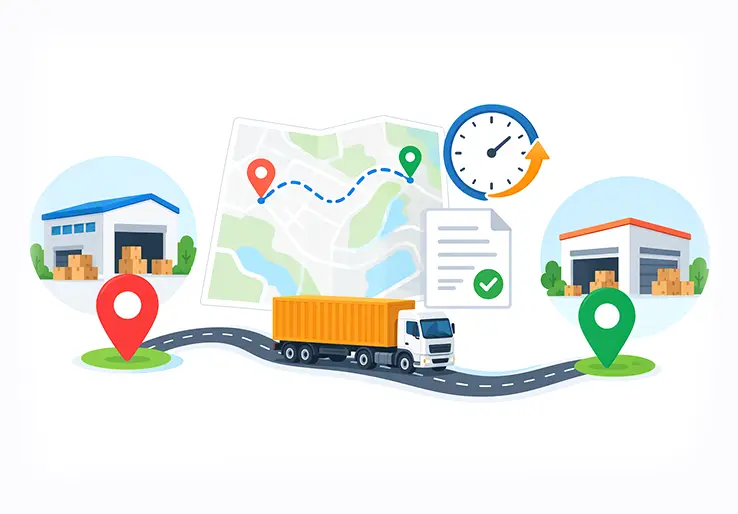
Pin to pin distance in e way bill means the motorable road distance between the dispatch PIN code and the delivery PIN code, and the GST system uses this distance to determine the e way bill validity period. For businesses, transporters, logistics teams, and compliance officers handling GST movement of goods in India, this is not just a data field—it decides how long the e way bill stays valid during transit.
A wrong distance can cause the e way bill to expire before the vehicle reaches its destination, which can lead to shipment delays, detention of goods, and penalties. In this guide, you’ll see how pin to pin distance is calculated, which distance should be entered, how it affects validity under current GST rules, common mistakes to avoid, tools to check distance between real PIN codes, and how LOGIC ERP helps automate distance validation and compliance.
Every consignment of goods valued above ₹50,000 moving across or within Indian states requires an e way bill under GST. One field in the e way bill form decides how long the bill remains valid: the distance between the dispatch PIN code and the delivery PIN code. Get this number wrong, and the bill can expire mid-transit, exposing goods to detention and penalties.
This guide covers pin to pin distance in e way bill generation; how the e way bill system calculates it, the current validity rule (1 day per 200 km for standard cargo; 1 day per 20 km for over dimensional cargo), what happens when the distance entered is incorrect, and how to avoid common errors. All figures reflect GST and e-way bill portal rules as of 2026. Where rules can change, we note the provision to check.
Throughout this article, we use real Indian PIN codes and routes (Delhi to Mumbai, Bengaluru to Chennai, Pune to Mumbai) to illustrate calculations. LOGIC ERP automates e way bill generation and distance validation for businesses that process high volumes of shipments; we touch on that where relevant.
Pin to pin distance is the road distance between two PIN codes: the dispatch location’s PIN code and the delivery location’s PIN code. It is not a straight line measurement. The GST system uses an approved mapping engine that considers the motorable road network (national highways, state highways, district roads) to calculate this figure.
When you enter the source pin code and destination pin codes on the e way bill portal, the system returns a calculated distance based on the centroids of those PIN code areas. This system-generated distance is what compliance checks and audits treat as the benchmark.
Here is what pin to pin distance is used for:
For example, if goods move from PIN 110001 (New Delhi) to PIN 400001 (Mumbai), the portal computes the approximate distance based on shortest motorable route. That figure, roughly 1,400 to 1,450 km depending on the route version in the portal’s database, sets the validity window.
Distance affects validity directly. Under Rule 138(10) of the CGST Rules, the validity period of an e way bill is tied to the distance entered. A shorter distance means fewer valid days; if the actual route takes longer than those days allow, the bill expires before delivery.
Pin-to-pin distance is a core compliance variable under GST regulations. Audits verify declared distances against system-generated distances for compliance, and inspecting officers compare the declared distance on the e way bill with the portal’s own calculation to assess whether the movement is genuine.
Here is why accurate distance matters:
The e-way bill portal calculates distances using PIN codes. When both codes are entered during e way bill generation, the system looks up its internal distance database, which stores motorable road distances between PIN code centroids. If the two pin codes are found in the database, the system returns a suggested distance. If not, it alerts the user to enter a distance manually.
The system allows a deviation of up to 10% in the declared distance from the auto-calculated distance. You can enter less than the system distance, but entering more than 110% of it triggers a rejection.
The source pin code must correspond to the actual location where goods begin moving: the factory gate, the warehouse, or the godown. Using the billing-office PIN code when dispatch happens from a different location is a common error.
Example: A company’s registered office is in Delhi (PIN 110001), but its warehouse is in Gurugram (PIN 122001). If goods ship from Gurugram, the dispatch PIN code must be 122001. Entering 110001 would distort the calculated distance for every consignment, potentially by 25 to 30 km.
Multi-location businesses can maintain separate "Dispatch From" PIN codes in their ERP or billing software to prevent this mismatch.
The destination PIN code must be the actual delivery point, not the billed-to address. In bill-to-ship-to scenarios, the delivery location drives the distance calculation.
Example: An invoice is billed to a distributor in Mumbai (PIN 400001), but goods are delivered to a dealer in Thane (PIN 400601). The correct pin code for the e way bill is 400601. A single wrong digit in the destination PIN code alters the road distance the system computes, potentially shifting validity by a full day.
Maintain validated "Ship To" delivery pin codes in your master data. Wrong destination entries are among the most frequent causes of distance errors.
Once both PIN codes are entered, the e way bill system proposes a distance figure from its pin distance calculator. This figure represents the shortest motorable route in the portal’s database.
Businesses should compare this figure with their own route knowledge. Google Maps or GPS-based route planners help verify whether the system’s approximate distance based on its mapping data is realistic for the planned path.
Small differences are expected. For hilly regions, over dimensional cargo routes avoiding low bridges, or city-specific restrictions, the actual road distance can exceed the system figure. In such cases, the manual distance entry can go up to 10% above the system calculated distance.
Before clicking "Generate," verify the final distance. The portal lets you accept the system distance or adjust it within the allowed 10% margin.
Key checks before submission:
For large or sensitive consignments, save a screenshot of the route plan or maps output as internal documentation. In many ERP systems, including LOGIC ERP, the distance can be auto-fetched from portal APIs, reducing manual entry and the risk of typing errors.
The distance entered should reflect the realistic estimated road distance for the actual movement of goods between the dispatch and delivery pin codes. It should not be a random number, an inflated figure to gain extra validity days, or a deflated number to minimize paperwork.
When the actual route is longer than the system’s shortest-route estimate, enter a distance that covers the planned path but stays within the portal’s tolerance (system distance + 10%). If the planned route exceeds that margin, the system will not accept the entry. In such edge cases, check whether the correct pin codes have been used and consult the e-way bill portal FAQs for guidance.
Distance must match system-approved distance for compliance. If the portal’s suggested distance seems too low, verify both pin codes, confirm the route, and check whether NIC has updated its distance database recently. For routes not in the database, the system prompts you to enter a distance manually; that manual entry must still be reasonable and defensible.
E-way bill validity is 1 day for every 200 km distance for regular (non-ODC, non-multimodal-ship) cargo. For over-dimensional cargo, validity is 1 day per 20 km. Both rules follow "or part thereof" logic: any fraction of the slab adds a full additional day.
Distance affects the validity period of the e-way bill under GST regulations as follows:
| Distance (km) | Regular Cargo Validity | ODC Validity |
|---|---|---|
| 1 to 200 | 1 day | 10 days |
| 201 to 400 | 2 days | 20 days |
| 401 to 600 | 3 days | 30 days |
| 601 to 800 | 4 days | 40 days |
| 801 to 1,000 | 5 days | 50 days |
| 1,001 to 1,200 | 6 days | 60 days |
| 1,201 to 1,400 | 7 days | 70 days |
| 1,401 to 1,600 | 8 days | 80 days |
E-way bills are valid from the moment of generation, specifically when Part B (vehicle number or transport details) is first entered. The validity period expires at midnight of the last valid calendar day. If a bill is generated at 3 PM with 1-day validity, it expires at midnight of the following day, and where multiple consignments move together under a consolidated document, each individual e-way bill must remain valid for the entire movement.
This rule was updated by Notification No. 94/2020-CT, effective January 1, 2021, which changed the slab from 100 km per day to 200 km per day for regular cargo. The ODC slab of 20 km per day remained unchanged.
The current validity rule under Rule 138(10) of the CGST Rules is:
These slabs are the applicable validity rules under GST for different cargo types.
The maximum distance for an e-way bill is 3,000 km as a practical distance limit on the portal. The EWB API’s transDistance field technically accepts up to 4,000 km, but for most road consignments, 3,000 km covers the longest routes within India.
When both dispatch and delivery pin codes are identical (e.g., intra-city movement within the same PIN code area), the portal does not accept zero. The minimum distance in such cases must be at least 1 km, and the maximum is capped at 100 km. If the source and destination share the same PIN code, the maximum distance allowed is typically 100 km.
The portal’s 10% tolerance means that if the system approved distance between two pin codes is 500 km, you can enter up to 550 km but not more. Entering a lower distance is allowed but carries the risk of validity running short.
E-way bills are generated based on consignment value thresholds and the nature of movement. Distance alone does not determine whether a bill is needed; the value threshold and type of supply do.
A frequent confusion: "Is there a minimum distance below which no e way bill is needed?" Under GST law, there is generally no blanket minimum distance exemption. If the consignment value meets the threshold, an e way bill is required regardless of whether goods move 5 km or 500 km.
E-way bills are mandatory for goods over ₹50,000 in consignment value for inter-state movement. For intra-state movements, several states and each union territory set their own thresholds. Some states have raised the intra-state limit (e.g., to ₹1,00,000 or ₹2,00,000). Always verify the current state-specific threshold before relying on any fixed number.
Situations where e way bills apply regardless of distance or value:
Short-distance movements (10 to 40 km within the same state or same city) still require an e way bill if the value threshold and supply conditions are met. The only relaxation that sometimes applies is the exemption from filling Part B for movements within a certain radius (e.g., 50 km within a state), but this varies by state notification and is separate from the requirement to generate the bill itself.
Three worked examples using real Indian PIN codes.
Example 1: Same State (Pune to Mumbai, Maharashtra)
If the consignment is standard goods with a value above ₹50,000, this e way bill is valid for 1 day from the time Part B is updated.
Example 2: Inter-state (New Delhi to Mumbai)
The bill covers 8 calendar days of transit. If the transporter’s actual route via NH48/NH44 runs closer to 1,400 km, the same distance still produces 7 days (1,400 ÷ 200 = 7.0 exactly). Entering the exact distance matters here because 50 km difference changes validity by a full day.
Example 3: Different Actual Route (Bengaluru to Chennai)
If the truck takes a longer detour via Vellore due to road work, the actual road distance may reach 400 km. The transporter can enter up to 385 km (350 + 10%) on the portal. At 385 km, validity remains 2 days. If the remaining distance exceeds what 2 days cover, the transporter should plan for a validity extension or check whether a different route pair of PIN codes better reflects the actual movement.
The official e way bill portal (ewaybillgst.gov.in) provides a free pin to pin distance calculator under "Search → Pin to Pin Distance." A pin to pin distance calculator ensures compliance with GST regulations because it returns the same distance the system uses during bill generation.
Step-by-step process:
Businesses processing high volumes can use integrated ERP solutions. LOGIC ERP, for instance, can call the EWB API to fetch the system-approved distance automatically, eliminating the need to manually look up each route.
Keep transport documents (LR, truck receipt, GPS logs) consistent with the declared distance for audit readiness.
E way bill distance is the system-approved PIN-to-PIN figure declared during generation. Actual transportation distance is the ground route the vehicle takes. These two numbers rarely match exactly.
| Factor | E Way Bill Distance | Actual Transportation Distance |
|---|---|---|
| Based on | Dispatch & delivery PIN codes via portal mapping | Actual road route driven |
| Purpose | GST compliance and validity calculation | Logistics execution and fuel planning |
| Used for | E way bill generation, inspection, audit | Fleet management, driver pay, toll planning |
| Can they differ? | Yes, within 10% tolerance | Yes, due to diversions, closures, city rules |
Common reasons for difference: highway diversions, city-entry restrictions for heavy vehicles, bypass routes, seasonal road closures, and over dimensional cargo constraints that force longer paths.
Compliance checks measure against the declared e way bill distance, not the odometer reading. Minor differences do not automatically trigger penalties. Large, unexplained gaps between declared and actual distance can invite scrutiny during transit checks.
The pin to pin distance rule applies across transport modes, though practical impact is most visible in road transport.
Road Transport
Most common scenario. Vehicle number is entered in Part B. Distance and validity directly govern how long the truck can legally carry the goods.
Rail Transport
E way bill is still required for rail consignments above the value threshold. The railway receipt number is entered instead of vehicle number. Distance remains origin-to-destination PIN-based.
Air Transport
For air cargo, the airway bill number goes into Part B. Distance is still computed PIN-to-PIN, but air transit is fast enough that validity rarely becomes an issue.
Ship/Waterways
For multimodal consignments where at least one leg is by ship, the ODC validity slab of 1 day per 20 km applies.
Over dimensional cargo refers to consignments that exceed standard vehicle dimensions (length, width, height) under Rule 93 of the Central Motor Vehicles Rules, 1989. Examples include windmill blades, heavy machinery, and large fabricated structures.
ODC validity: 1 day per 20 km or part thereof. A 45 km ODC movement gets 3 days of validity (0-20 km = day 1, 21-40 km = day 2, 41-60 km = day 3). Because ODC moves slowly and requires special permits, correct pin distance entry is critical. Understating by even 10 km can cost a full day of validity.
Incorrect PIN codes can lead to distance calculation errors. Here are the most frequent mistakes and how to prevent them:
If the distance entered is too short, the e way bill expires before goods reach the delivery point. An expired e way bill exposes goods to detention under Section 129 of the CGST Act. Distance errors can lead to goods being detained under Section 129, and the penalty equal to the tax payable on those goods (or a percentage thereof) can be levied along with the tax amount.
If the distance is overstated, it does not automatically mean a penalty, but it can draw scrutiny during audits. Officers may question whether the inflated distance was intended to mask delayed movement or potential tax evasion.
Practical consequences of incorrect distance:
The key point: authorities assess the overall picture. A genuine consignment with minor distance variance and correct tax-paid documentation is treated differently from a pattern of systematic distance manipulation.
Once an e way bill is generated, the distance field cannot be edited directly. To correct the distance, you must cancel the existing bill and generate a new one. Cancellation is allowed within 24 hours of generation, provided the goods have not been verified in transit by any officer and movement has not begun.
Validity extension is available for genuine disruptions. If a vehicle breaks down, faces a natural calamity, or encounters traffic disruption that prevents delivery within the validity period, the generator (supplier, transporter, or recipient, depending on who created the bill) can request an extension.
Extension rules:
If the e way bill has already expired and the 8-hour window has passed, a new e way bill must be generated. Carrying goods on an expired e way bill is a compliance violation.
The official GST e way bill portal offers a completely free pin to pin distance calculator. This tool is the primary source for compliance; any third-party distance calculator should be validated against portal figures.
Benefits of automating distance validation inside business software:
LOGIC ERP integrates with the EWB API to auto-pull system-approved distance, populate Part B with the vehicle number and transport details, and calculate validity based on current GST rules. The system maintains validated PIN code masters for every dispatch and delivery location, reducing the chance that a wrong pin code slips through. For businesses generating e way bills at scale, this kind of automation turns a daily compliance task into a background process.
Call at +91-73411-41176 / +91-73411-41175 or send us an email at sales@logicerp.com to book a free demo today!
It is the road distance between the dispatch PIN code (supplier’s location or warehouse) and the delivery PIN code (recipient’s location), calculated using the e way bill portal’s approved mapping engine. It is not a straight line distance.
Log in to the e way bill portal, go to "Search → Pin to Pin Distance," enter both PIN codes, and the system returns the motorable route distance. You can also use the EWB API if your ERP supports it.
GST law does not exempt consignments based on distance. If the consignment value exceeds the applicable threshold (₹50,000 for inter-state; state-specific limits for intra-state), an e way bill is required even for a 5 km movement.
Yes. E-way bill validity is one day for every 200 km traveled for regular cargo, and 1 day per 20 km for over dimensional cargo. The distance entered directly determines how many days the bill remains valid.
No. The distance field is locked after generation. You must cancel the bill (within 24 hours, before transit verification) and regenerate with the correct distance.
If distance is understated, the bill may expire before delivery, risking detention under Section 129 and associated e way bill penalties. Overstated distance can trigger audit questions but does not automatically attract penalties if the movement is otherwise genuine.
The maximum distance for e-way bill entry is 3,000 km on the portal. The API technically supports up to 4,000 km in the transDistance field.
ODC gets 1 day per 20 km or part thereof. A 45 km ODC consignment receives 3 days of validity.
Yes. Distance alone does not exempt a consignment. If the value threshold is met and the movement qualifies under GST provisions, an e way bill must be generated regardless of whether the delivery point is 30 km or 300 km away.
When both PIN codes are the same, the portal requires you to enter a positive distance (at least 1 km) and caps the entry at 100 km.
Pin to pin distance in an e-way bill refers to the motorable road distance between the dispatch PIN code and the delivery PIN code. This distance is calculated using the e-way bill portal’s approved mapping engine and is essential for determining the validity period of the e-way bill under GST regulations.
The e-way bill distance is calculated by entering the source and destination PIN codes into the GST e-way bill portal. The system uses an approved mapping engine to compute the shortest motorable road distance between these two points. This calculated distance is then used to determine the e-way bill’s validity.
To calculate the distance between two PIN codes for an e-way bill, log in to the official e-way bill portal, navigate to the "Search" section, and select "Pin to Pin Distance." Enter the source and destination PIN codes, and the system will display the estimated motorable distance, which should be used for e-way bill generation.
The distance entered in an e-way bill should reflect the actual estimated motorable road distance between the dispatch and delivery PIN codes. It should be consistent with the system-generated distance or within the allowed 10% deviation to ensure compliance with GST rules.
Yes, the distance entered in an e-way bill directly determines its validity period. For standard cargo, the validity is 1 day for every 200 km or part thereof. For over-dimensional cargo, it is 1 day for every 20 km or part there of. Accurate distance entry ensures the e-way bill remains valid throughout the transportation.
No, once an e-way bill is generated, the distance cannot be changed directly. If an error is found before the vehicle starts moving, the e-way bill can be canceled within 24 hours and regenerated with the correct distance. After movement begins, only validity extensions can be requested under specific circumstances.
If the distance entered is incorrect, especially understated, the e-way bill may expire before the goods reach their destination, leading to detention and penalties under Section 129 of the CGST Act. Overstated distances can trigger audit scrutiny but do not automatically result in penalties.
Yes, entering the correct pin-to-pin distance is mandatory for e-way bill generation as it is a key compliance parameter under GST. The system uses this distance to calculate the validity and ensure the movement of goods is tracked accurately.
You can check the distance between two PIN codes by using the "Pin to Pin Distance" feature on the official e-way bill portal. Enter the source and destination PIN codes, and the system will display the approved motorable road distance used for e-way bill calculations.
The maximum distance allowed for an e-way bill entry on the GST portal is 3,000 km. Distances beyond this limit are generally not accepted for e-way bill generation, ensuring compliance with practical transportation limits within India.
E-way bill distance calculation is done by entering the source and destination PIN codes into the GST e-way bill portal, which then calculates the estimated distance based on the motorable road network between these PIN codes.
The distance entered in an e way bill should be the estimated distance reflecting the actual motorable road distance between the dispatch and delivery PIN codes, ensuring compliance with GST rules and e-way bill validity requirements.
Popular Products