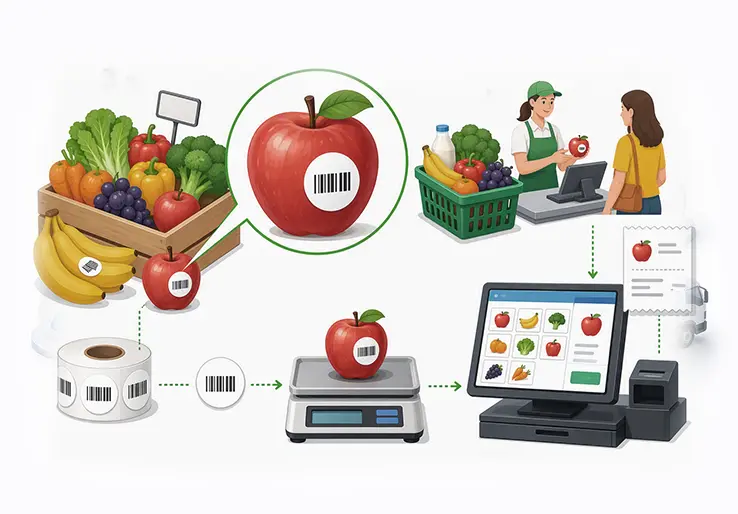
A PLU code, or Price Look-Up code, is a standardized 4- or 5-digit number printed on loose fresh produce to identify bulk items at checkout and pull the right price and product details in the POS system.
Introduction: PLU Codes and Why They Matter in Retail
A PLU code, or Price Look-Up code, is a standardized 4- or 5-digit number printed on loose fresh produce to identify bulk items at checkout and pull the right price and product details in the POS system. For retailers, grocery store operators, supermarket managers, POS software providers, and supply chain teams handling produce billing and retail operations, PLU codes are a core part of faster billing, accurate pricing, cleaner inventory records, and smoother customer checkout.
This guide explains what PLU codes mean, how their number structure and types work, where they are used across grocery and supermarket environments, and how they differ from barcodes, SKUs, and UPC/EAN codes. It also covers practical examples, setup and management best practices, common challenges, environmental concerns, and how LOGIC ERP helps businesses manage PLU code-based billing efficiently.
A PLU code is a standardized 4- or 5-digit numerical identifier printed on a small sticker affixed to loose fresh produce such as fruits and vegetables. These produce codes are used in grocery stores, supermarkets, and fresh produce departments worldwide to identify bulk produce at checkout. If you have ever noticed a tiny numbered sticker on an apple or a banana, you have seen a PLU label in action.
PLU codes exist to solve a fundamental problem in retail: fresh produce rarely comes in scannable packaging. Unlike boxed cereal or canned goods, a loose mango or a bunch of spinach has no barcode printed on a box. The PLU system gives cashiers and POS systems a fast, reliable way to identify the specific product, pull up its price, and complete the transaction, whether the item is sold by weight or by unit.
Here is what makes PLU codes essential for modern grocery retail:
They allow POS terminals to instantly retrieve the correct price for any variety of fresh fruit or vegetable.
They distinguish between conventionally grown produce and organically grown produce using different digit prefixes.
They reduce errors at check out by replacing guesswork with standardized numeric lookup.
They feed accurate data into inventory and sales analytics, helping retailers track demand at the variety level.
PLU codes are not the same as UPC codes or barcodes. UPC barcodes are typically printed on product packaging and scanned optically, while PLU codes are entered manually or selected from a touchscreen at the register. PLU codes handle loose produce items; barcodes handle packaged goods.
For retailers, farm suppliers, and POS software providers like LOGIC ERP, understanding and managing PLU codes correctly is critical in 2026. Getting the PLU system right means faster billing, fewer pricing errors, tighter inventory control, and better customer experience across every store.
What is a PLU Code? Meaning, Purpose, and How It Works
A price look up code — commonly called a PLU code — is a human- and machine-readable numeric identifier linked to a product master record inside a retailer’s POS database. PLU codes identify produce sold in retail stores by mapping a short number to a detailed product entry that the system uses for billing, inventory, and reporting.
Each PLU entry in a retail system typically stores:
Commodity: The general category, such as apples, bananas, or potatoes.
Variety: The specific type, such as Fuji, Gala, or Granny Smith.
Size or grade: Some items have separate PLU numbers for small, medium, and large.
Pricing method: Whether the item is priced per kilogram, per pound, or per each (unit).
Tax rules: GST or sales tax configuration relevant to that produce item.
PLU codes are entered into point-of-sale systems to retrieve the corresponding price. The workflow at checkout works like this:
The cashier (or self-checkout customer) places the produce on the scale.
They type the PLU number from the sticker or select the item from a touchscreen menu.
The POS system finds the matching product record and applies the correct price per weight or per unit.
The line item, including weight and total cost, is added to the bill.
PLU codes were implemented in 1990 and regulated by the International Federation for Produce Standards (IFPS), which coordinates PLU assignment globally. PLU labeling is voluntary and not a government-mandated requirement. It is an industry-driven standard adopted because it works.
Real checkout example: A supermarket cashier picks up a bunch of yellow bananas, sees "4011" on the sticker, keys it in, and the POS shows "Bananas - ₹45/kg." The scale reads 1.2 kg, and the system adds ₹54 to the bill. No guesswork, no price memorization needed.
What Does a PLU Code Look Like? Four- and Five-Digit PLU Codes
PLU codes follow a simple numeric structure. Understanding how digit PLU codes are formatted helps retailers, cashiers, and consumers quickly decode what they are buying.
Four digit PLU codes are the standard format for conventionally grown produce. These codes usually fall in the 3000 and 4000 series. For example, 4011 is the globally recognized PLU for yellow bananas, and 4131 is the code for a conventionally grown Fuji apple.
Five-digit PLU codes starting with 9 indicate organically grown produce. The organic version is created by adding a "9" prefix to the conventional 4-digit code. So organic bananas become 94011, and an organically grown Fuji apple is 94131. These appear on PLU stickers on fruit and vegetables certified as organic.
Five-digit codes in the 83000–84999 range were originally reserved to designate genetically modified produce (using an "8" prefix). However, some 5-digit codes starting with 8 were historically designated for genetically modified produce but are now rarely used. In 2015, the IFPS formally dropped the GMO designation and opened codes 83000–84999 for general use after GMO growers declined to adopt the system.
Here are common examples to illustrate the format:
4011 → Conventional yellow bananas
94011 → Organic yellow bananas
4131 → Conventional Fuji apple (large)
94131 → Organic Fuji apple (large)
4046 → Conventional Hass avocado (small)
4072 → Russet potatoes (conventional)
The pattern is consistent: if you see a 4-digit code, the item is grown conventionally. If the code has five digits and starts with 9, it is organic. This simple convention lets anyone — cashier, consumer, or system — quickly identify the growing methodology at a glance.
Types of PLU Codes: Conventional, Organic, and Retailer-Assigned
Not all PLU codes come from the same source. Understanding the three main types helps retailers configure their POS correctly and avoid coding conflicts.
Standard (Conventional) PLU Codes: Four-digit PLU codes in the 3000–4999 range assigned by IFPS for conventionally grown produce. These are the most common codes and cover items like regular potatoes (4072), green bell peppers (4065), and lemons (4033). Conventional produce uses four-digit PLU codes in the 3000-4000 series, and the same PLU code is used globally for the same fruit or vegetable to ensure consistency.
Organic PLU Codes: Organic produce has a five-digit PLU code starting with a 9. When a retailer needs to differentiate organic carrots from conventional carrots, the organic version simply gets the "9" prefix. Five-digit PLU codes indicate organically grown produce. For example, organic lemons are 94033 while conventional lemons remain 4033. This distinction allows stores to charge different prices for organic and conventional versions of the same commodity.
Retailer-Assigned PLU Codes: For produce items not yet covered by an IFPS-assigned global code, retailers can use designated retailer-assigned blocks. These internal produce codes are useful for local specialties — say, a regional mango variety or an in-house prepared salad mix. The key risk: if a retailer picks a code outside the designated blocks, it may conflict with a globally assigned PLU number, causing billing or subsidy-validation errors.
Numbering Rules and Global PLU Code Conventions
The IFPS manages the global PLU system and currently maintains over 1,400 unique PLU codes assigned to produce items. Here are the key numbering conventions every retailer should know:
PLU codes are assigned randomly within the 3000 and 4000 series for conventionally grown items. There is no sequential logic — 4011 for bananas has no numeric relationship to 4012 (which is a different item entirely).
Adding a "9" prefix converts any conventional 4-digit code into its organic counterpart, creating a 5-digit code in the 90000–94999 range.
The 83000–84999 series, originally held for GMO-designated items, is now available for general use (both conventional and organic) after the IFPS dropped the GMO prefix plan in 2015.
To qualify for a new global PLU, a produce variety must meet specific criteria: it must be a unique variety (not just a regional brand), be available in at least multiple countries, and have documented production and sales volumes. The IFPS application process typically takes about three months and costs USD 2,000 for members or USD 3,000 for non-members.
The IFPS board reviews applications through its Produce Identification Committee, with national users providing initial input before global-level approval.
Size breaks (small, medium, large) for the same variety may each receive a separate PLU number, meaning item size matters in the coding system.
Over 1,400 unique PLU codes exist for fruits and vegetables, with IFPS publishing an updated list that retailers and growers can consult for further information and to address harmonization across markets.
Where are PLU Codes Used? Grocery Stores, Markets, and Beyond
PLU codes show up wherever loose fresh produce is sold. Here are the primary retail environments:
Grocery Stores and Supermarkets: The most common setting. Cashiers enter PLU codes hundreds of times per shift to bill fresh fruits and vegetables that lack individual barcodes.
Fresh Produce Departments: Within larger stores, dedicated fruit and vegetable sections rely almost entirely on PLU-based billing for items sold by weight or by unit.
Farmers’ Markets and Specialty Retailers: Vendors who sell to retail grocers or directly to consumers use PLU stickers to maintain pricing consistency, especially when their products enter larger supply chains.
Self-checkout Kiosks and Self-service Scales: Customers key in or search for the correct PLU at weighing stations. Many kiosks display visual produce guides to help customers find the right code quickly.
Institutional Food Service: School cafeterias, hotel kitchens, and hospital food services purchase produce from wholesalers using PLU-based catalogs, making the system relevant beyond traditional retail.
In each of these environments, the core interaction is the same: someone identifies the produce, enters or selects the PLU number, and the system handles the rest.
How PLU Codes are Used at Checkout in Grocery Billing?
The purpose of PLU codes is to ensure fast and accurate checkout. Here is how the process works step by step:
The cashier or customer places the produce item on the scale at the POS terminal.
They enter the PLU code from the sticker (or select the item from a touchscreen menu).
The POS system retrieves the product record, including description, price, and unit of measure.
If sold by weight, the system multiplies the scale reading by the price per kilogram or per pound.
The calculated total is added as a line item on the receipt.
Inventory is automatically deducted.
Example 1 (India): A customer buys 1.5 kg of conventional bananas (PLU 4011) priced at ₹50 per kg. The POS calculates: 1.5 × ₹50 = ₹75. The receipt shows "Bananas 4011 - 1.5 kg - ₹75."
Example 2 (United States): A customer buys 2.3 lb of organic bananas (PLU 94011) priced at $0.79 per lb. The POS calculates: 2.3 × $0.79 = $1.82. The receipt distinguishes this from conventional bananas because the PLU is different.
PLU codes enable accurate billing for loose products where each piece has no individual UPC barcode. The same digit PLU can be used across multiple stores within a chain, ensuring consistent pricing and reporting in centralized POS and ERP systems. This consistency is what makes PLU-based billing scalable from a single-store grocery to a 200-location supermarket chain.
PLU Codes and POS Systems: How Modern Retail Software Handles Produce Codes
Every PLU code in a retail system is backed by a product master record containing the description, tax configuration, unit of measure, and pricing rules. Modern POS and ERP systems turn this simple number into a powerful operational tool.
Here are the key POS functions related to PLU and produce codes:
PLU Database and Product Master: A centralized repository where every PLU number is mapped to its commodity, variety, various attributes, price, and tax treatment.
Weighing-scale Integration: POS terminals connect directly to electronic scales, receiving weight data in real time. Some scales have their own PLU tables and print barcode labels that the POS then scans.
PLU Search by Name: Cashiers can type "apple" into the grocery POS system and see all apple-related PLUs — Fuji, Gala, Granny Smith — with codes and prices listed.
Touchscreen Produce Buttons: Frequently sold items (bananas, tomatoes, onions) get dedicated buttons for one-tap lookup.
Multi-store Price Management: Centralized systems sync PLU prices across all locations, allowing head office to update pricing once and push changes everywhere.
GST and Tax Configuration: In markets like India, PLU records carry the correct GST rate so that billing is tax-compliant from the first scan.
Promotions and Discounts: POS can apply time-based or quantity-based discounts on specific PLU items — for example, 10% off all organic produce on Wednesdays.
Sales Analytics and Reporting: Every PLU transaction feeds into reports that show sales volume, revenue, and margins by specific product variety.
Benefits of PLU Codes for Retailers and Grocery Stores
PLU codes deliver measurable operational advantages for any retailer handling fresh produce. Here are the key benefits:
Faster Checkout: PLU codes can improve checkout speed and reduce transaction times. Instead of describing and manually pricing each item, cashiers enter a short code and move on. During peak hours, this adds up to significantly shorter queues.
Accurate Product Identification: PLU codes eliminate the need for cashiers to manually identify different varieties of produce. A cashier does not need to know the difference between a Gala and a Fuji apple by sight — the PLU sticker handles identification.
Reduced Price Memorization: PLU codes reduce the need to memorize fluctuating prices for produce items. Prices change with seasons, suppliers, and promotions. The PLU system ensures the POS always applies the current correct price.
Fewer Misrings and Less Shrink: Correct identification via PLU codes cuts misrings that cause revenue leakage. Ringing up organic produce as conventional, for instance, costs the retailer the price premium on every transaction.
Granular Inventory Tracking: PLU codes enhance inventory management by providing precise data on consumer demand. Retailers can see exactly how many kilograms of Fuji apples versus Granny Smith apples were sold today, enabling smarter replenishment.
Shrinkage and Waste Monitoring: PLU codes help track inventory turnover and monitor shrinkage and waste, making inventory control easier across the produce department.
Detailed Sales Analytics: PLU codes help in detailed sales analytics and preference tracking, letting retailers understand consumer buying patterns at the variety level — not just "apples" but which type of apple sells best.
Standardized operations across branches: The same PLU database can be deployed across all store locations, simplifying training, auditing, and pricing consistency.
Better Customer Experience: Accurate pricing and faster checkout directly improve customer satisfaction and trust.
One of the most common questions in the produce sector is whether a PLU code is the same as a barcode. The short answer: no.
Here is how these identifiers differ:
PLU Code (Price Look-Up Code)
Primarily for loose, unpackaged fresh produce
4 or 5 digits
Usually printed on a small sticker on the fruit or vegetable
Entered manually at POS or selected from a touchscreen
Assigned globally by IFPS for produce standards
UPC Code (Universal Product Code)
Primarily for packaged consumer goods
12 digits in North America (UPC-A)
Printed as a scannable barcode on product packaging
Scanned optically at POS
Assigned by GS1 (a different standards body)
EAN (European Article Number)
Similar to UPC codes but uses 13 digits
Standard in Europe, Asia, and most markets outside North America
Also a scannable barcode on packaging
SKU (Stock Keeping Unit)
An internal code created by each retailer or ERP system
Can be any length or format — alphanumeric is common
Used for internal tracking, not standardized across retailers
A single SKU in one store’s system may map to a PLU code, a UPC, or both
The key distinction: PLU codes handle the produce aisle. UPC codes and barcodes handle packaged goods. SKUs are the retailer’s own internal language. A robust retail POS system needs to support all three seamlessly.
Real-World Examples of Common PLU Codes in Fresh Produce
Over 1,400 unique PLU codes are currently assigned globally, covering a wide range of fresh fruits and vegetables. Here are some of the most commonly encountered examples:
4011 - Yellow Bananas (Conventional): The most widely recognized PLU in the world. A supermarket cashier sees this sticker on virtually every bunch of bananas that comes through the register.
94011 - Yellow Bananas (Organic): The organic counterpart. Grown organically, these bananas command a premium price, and the "9" prefix ensures the POS applies the correct organic rate.
4131 - Fuji Apples, Large (Conventional): A conventionally grown Fuji apple carries this code. The PLU lets the system distinguish Fuji from Gala (4135) or Granny Smith (4017).
94131 - Fuji Apples, Large (Organic): The organic version of the same variety.
4225 - Hass Avocados (Conventional): The PLU code for conventional Hass avocados is 4225, one of the most popular codes in produce departments.
94225 - Hass Avocados (Organic): The organic PLU code for Hass avocados is 94225.
4072 - Russet Potatoes: A staple in North American grocery stores.
4065 - Green Bell Peppers: Another high-frequency PLU at checkout.
In each case, the PLU sticker on the produce tells the cashier or self-checkout system exactly what the item is. The consumer sees a small sticker with a number; the POS sees a gateway to the correct product record, price, and tax treatment. Some PLU labels also carry branding, country of origin, and small marketing graphics alongside the numeric code.
Setting Up and Managing PLU Codes in a Retail POS or ERP System
For grocery IT managers and store owners, setting up PLU codes correctly from day one prevents billing errors and reporting headaches. Here is a practical setup checklist:
Step 1
Define the Product in the Master Database
Enter the commodity (e.g., apples), variety (e.g., Fuji), and any relevant attributes like size or grade.
Step 2
Assign the PLU Code
Use the IFPS-standard PLU number for globally recognized items. For local specialties, use retailer-assigned code blocks.
Step 3
Set the Pricing Unit
Decide whether the item is sold by weight (per kg or per lb) or by unit (per each, per bunch). This directly affects how the POS calculates the bill.
Step 4
Configure Tax Rule
In India, set the correct GST rate. In the US, most fresh produce is tax-exempt, but rules vary by state.
Step 5
Link the Weighing Scale
If the item is sold by weight, configure the POS to read weight data from the connected electronic scale. Test that the scale and POS agree on units.
Step 6
Map to Internal SKUs
If your ERP uses internal SKU numbers, map each PLU to the corresponding SKU so that inventory, purchasing, and reporting all reference the same product.
Step 7
Sync to All POS Terminals
Push the PLU data to every checkout terminal and self-service kiosk across all store locations.
Step 8
Test with Sample Transactions
Ring up test purchases, verify the printed receipt shows the correct product name, weight, price, and total. Confirm that inventory records update accurately.
Step 9
Monitor and Refine
Review PLU sales reports in the first week to catch any misconfigured items before they cause significant revenue impact.
Retailer-Assigned Produce Codes, Custom Labels, and Branding
When no global PLU exists for a specific product, retailers step in with their own codes.
Retailer-assigned PLU ranges are designated blocks within the IFPS system specifically reserved for internal use. Retailers must pick codes from these blocks — choosing random numbers risks colliding with an existing globally assigned PLU.
Common use cases include in-house salad mixes, locally sourced specialty fruits (e.g., a regional mango variety), prepared produce packs, and bakery items sold by weight.
Produce labels and PLU stickers serve double duty: beyond price look up, they carry branding, origin claims (e.g., "Product of India" or "Locally Grown"), and promotional messaging. A regional chain might use customized stickers for its premium tomatoes to reinforce brand recognition at the shelf.
POS and ERP platforms like LOGIC ERP can store both global PLU codes and internal retailer-assigned codes, linking each to different label templates used by in-store printers. This lets a single system handle standardized and custom items without conflict.
Environmental Concerns Around PLU Stickers and Produce Labels
PLU stickers are small, but their environmental footprint is a growing concern.
Traditional PLU stickers are made from plastic films with non-compostable adhesives. When consumers toss fruit peels or vegetable scraps into compost bins, these stickers contaminate the organic waste stream.
Many composting facilities reject produce with non-biodegradable labels still attached, leading to additional sorting costs or diversion to landfill.
The IFPS has published guidance on PLU sticker safety and sustainability, acknowledging the issue and encouraging innovation.
Emerging solutions include:
Biodegradable stickers made from cellulose or other compostable materials.
Water-dispersible adhesives that dissolve during composting.
Laser marking directly onto the produce skin (already used on some organic avocados and sweet potatoes in Europe), eliminating the sticker entirely.
Retailers and suppliers need to balance operational needs — the sticker enables fast, reliable price look up at checkout — with sustainability goals and increasing regulatory pressure around food packaging waste.
Common Challenges and Errors With PLU Codes in Grocery Operations
Even a simple system like PLU codes can go wrong. Here are the most common operational problems:
Wrong PLU Entry: A cashier enters 4135 (Gala apple) instead of 4131 (Fuji apple). The item is misidentified, and the customer may be charged the wrong price. Across 1,000 transactions, even a 2% missing rate translates into measurable revenue leakage.
Organic Coded as Conventional: When the leading "9" prefix is skipped — whether by accident or habit — the store loses the organic price premium on every affected transaction. On a product priced 30–50% higher than its conventional equivalent, this adds up quickly.
Duplicate or Conflicting PLU Codes: If a store assigns a retailer-specific code that overlaps with an IFPS-standard PLU, two different products share one code. The POS cannot distinguish them, causing billing chaos.
Outdated Prices: PLU records with stale prices lead to overcharging or undercharging. Fresh produce prices fluctuate with seasons and supplier costs, so failing to update PLU pricing regularly creates margin erosion or customer complaints.
Poor Scale Integration: When weighing scales and POS terminals are not properly linked, cashiers may enter weights manually — introducing rounding errors and slowing down checkout.
Inconsistent Coding Across Branches: A chain with 50 locations may have slightly different PLU configurations per store if updates are not pushed centrally, leading to reporting discrepancies.
Large Catalog Management: With over 1,400 global PLUs plus retailer-assigned codes, maintaining a clean, current database requires ongoing attention and dedicated processes.
Best Practices for Managing PLU Codes and Produce Data
Effective PLU management is not a one-time setup task. It requires ongoing discipline. Here are actionable best practices for grocery managers:
Maintain a Centralized Produce Master in your ERP where every PLU code, price, tax rule, and unit of measure is stored and version-controlled. LOGIC ERP users can manage this from a single back-office module that syncs across all locations.
Avoid Duplicate Codes by cross-referencing any new retailer-assigned PLU against the current IFPS global database before activation.
Schedule Regular Price Reviews — monthly or quarterly — to verify that active PLUs reflect current supplier costs, seasonal adjustments, and promotional pricing.
Train Every New Cashier on the 20–30 most common PLUs in your store, how to search by name in the POS, and why accuracy in produce codes directly affects the store’s bottom line.
Integrate Weighing Scales with POS so that weight data flows automatically. Manual weight entry should be the exception, not the norm. This ties into broader inventory control best practices.
Audit PLU Transactions Periodically by reviewing exception reports: items sold at zero weight, unusually high void rates on produce, or PLU codes with no transactions in 90 days.
Standardize Units of Measure across all stores. If one branch prices bananas per kg and another per lb, centralized reporting becomes meaningless.
Use POS Analytics to identify related items with frequent misreadings and retrain staff on those specific codes.
Keep the PLU Database Lean: Remove discontinued items, merge redundant entries, and archive seasonal products when they are out of stock.
How LOGIC ERP Helps Retailers Manage PLU Codes, Billing, and Inventory?
Managing hundreds of PLU codes across multiple store locations is complex. LOGIC ERP’s grocery POS and retail ERP platform is built to simplify this for grocery stores and supermarkets.
Centralized PLU and SKU Management: Define all PLU codes, map them to internal SKUs, and manage pricing from a single back-office interface. Changes propagate to every terminal instantly.
Multi-store Synchronization: Whether you operate 5 stores or 500, LOGIC ERP ensures every location uses the same PLU database with store-specific price overrides where needed.
Weighing-scale Integration: LOGIC ERP connects directly to electronic scales, reading weight data in real time and eliminating manual entry errors during produce billing.
Support for PLU Codes and UPC Barcodes: The system handles both loose produce (PLU) and packaged goods (barcode) in a single unified checkout flow.
GST and Tax Configuration: For Indian retailers, LOGIC ERP applies the correct GST rate to each PLU item automatically, ensuring tax compliance without manual calculation.
Store-wise Price Management: Set different produce prices by region, store, or customer type while maintaining a single master PLU list.
Analytics on Fresh Produce Margins and Wastage: Track sales, margins, and shrinkage at the individual PLU level, helping produce managers make data-driven replenishment and markdown decisions. Explore how supermarket POS analytics track top-selling products for deeper insight.
Mobile POS with PLU Lookup: Floor staff can look up PLU codes, check prices, and even process transactions from mobile devices during peak hours.
For retailers handling high volumes of fresh produce, combining PLU-based identification with LOGIC ERP’s integrated billing and inventory capabilities means fewer errors, faster checkout, and tighter control over one of the most perishable — and profitable — departments in the store.
Conclusion: Why PLU Codes Still Matter in the Age of Modern Retail Tech
PLU codes have been a quiet workhorse of grocery retail since 1990. Over three decades later, they remain essential for fresh produce identification, fast checkout, and accurate retail analytics. The system is simple by design — a short number on a small sticker — but the operational impact is enormous when multiplied across millions of daily produce transactions worldwide.
The key distinctions are worth remembering: PLU codes handle loose produce items, UPC codes handle packaged goods, and SKUs are each retailer’s internal tracking language. Global standard codes assigned by the International Federation for Produce Standards ensure consistency, while retailer-assigned digit PLU ranges provide flexibility for local and specialty items.
As self-checkout technology, AI-powered produce recognition, and digital scales continue to evolve, PLU codes will coexist with these newer identification methods rather than be replaced by them. The standard is adapting too — IFPS guidance now covers 2D barcodes on PLU stickers, and sustainability innovations are addressing the environmental concerns around labels.
For grocery retailers, the practical takeaway is clear:
Get your PLU database right from the start.
Keep it maintained, audited, and synced across every terminal.
A PLU code is a standardized 4- or 5-digit number used to identify bulk fresh produce at checkout. PLU codes are used to identify bulk fresh produce items in grocery stores, enabling the POS to retrieve the correct price and product information.
PLU stands for Price Look-Up. The full term is price look up code.
Most PLU codes are 4 digits for conventional produce or 5 digits for organic produce. Four-digit PLU codes are for conventionally grown produce, while five-digit PLU codes indicate organically grown produce.
The PLU code 4011 identifies conventional yellow bananas. Organic bananas use 94011.
No. PLU codes are short numeric identifiers typically entered manually at POS, while barcodes (UPC codes or EAN) are optically scanned from printed labels on packaged products.
A PLU code is a 4- or 5-digit produce identifier for loose items. A UPC code is a 12-digit barcode for packaged consumer goods. They serve different product categories and use different identification methods.
A PLU is a globally standardized produce code. An SKU is an internal stock-keeping unit created by each individual retailer for their own inventory system.
No. PLU labeling is voluntary. However, most grocery stores and supermarkets use PLU stickers on loose produce because they make checkout faster and more accurate.
Yes. Retailers can use designated retailer-assigned PLU ranges for products not covered by the global IFPS standard, such as local specialty fruits or prepared produce items.
A cashier or customer enters the PLU number at the POS terminal. The system retrieves the product record, applies the correct price (by weight or unit), and adds the item to the bill. PLU codes were implemented in 1990 for produce identification and are now used by retailers worldwide.
A PLU code is entered at check out to quickly identify fresh produce items and retrieve their correct price, ensuring fast and accurate billing.
A four digital PLU code is a 4-digit number used to identify conventionally grown produce at retail checkouts.
Organic produce is identified by a five-digit PLU code that starts with the number 9, distinguishing it from conventional produce.
PLU codes are managed by the International Federation for Produce Standards, which coordinates the assignment globally to ensure consistency.
For more information or to contact the organization responsible for PLU codes, visit the official IFPS website’s contact page or the PLU codes resource page.
Book a Free Demo
LOGIC ERP | India's #1 ERP Software for Retail | Distribution | Manufacturing | WMS