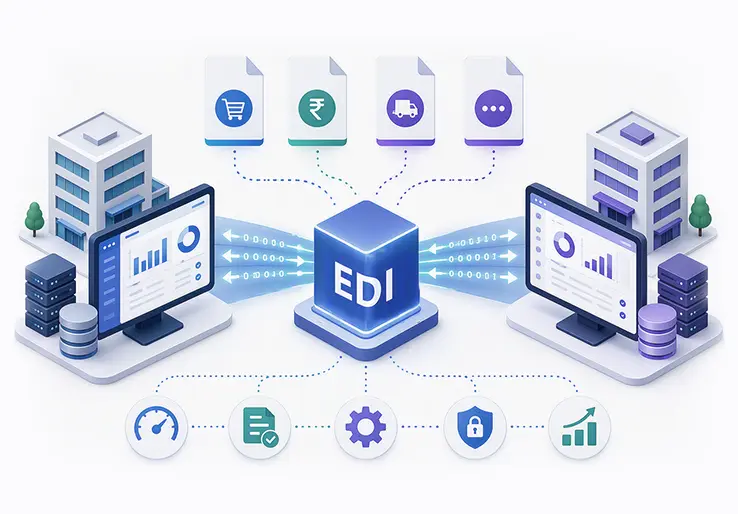
EDI is the computer-to-computer exchange of business documents in a standardized electronic format — moving purchase orders, invoices, and ship notices directly between your systems and your partners' systems for automated processing without human intervention.
Every day, businesses lose hours re-keying purchase orders from emails, chasing down missing invoices, and correcting data entry errors that cascade through their supply chain. Paper based processes and manual processing cost real money — and the problem scales with every new trading partner you add.
If you need to define electronic data interchange, EDI is the computer to computer exchange of business documents in a standardized electronic format, so purchase orders, invoices, advance ship notices, and other transactions move directly between your systems and your partners' systems for automated processing without human intervention. Instead of relying on email, fax, postal mail, or manual data entry, EDI replaces paper-driven workflows with faster, more accurate document exchange.
The result is measurable: document processing drops from days to minutes, transaction costs can fall by 35%, and data errors decrease before they ripple through purchasing, fulfillment, billing, or compliance. For growing manufacturers, healthcare organizations, retail suppliers, logistics companies, financial institutions, and any business exchanging high volumes of documents with trading partners, that turns document exchange from an operational bottleneck into a competitive advantage and strengthens partner relationships at the same time.
This guide explains how EDI works, where businesses use it, which standards and communication protocols support it, what implementation options and costs to expect, and how EDI compares with other data exchange methods. Whether you're onboarding your first major retail partner or evaluating automation across a larger operation, EDI is the proven foundation for automated, accurate, and fast document exchange.
Electronic data interchange (EDI) is the computer to computer exchange of business documents in a standard electronic format that allows automated processing without human intervention. Rather than sending paper documents - or even PDFs and spreadsheets - between organizations, EDI transmits structured electronic data directly from one system to another using agreed-upon standards.
At its core, EDI electronic data interchange replaces every manual touchpoint in document exchange. When your ERP system generates a purchase order, EDI translation software converts it into EDI data in a standardized EDI format, transmits it securely to your trading partner's system, and their software automatically parses and integrates that data — no re-keying, no printing, no scanning.
EDI automates the exchange of business documents electronically, covering everything from purchase orders and invoices to shipping notices, payment remittance, and inventory reports.
The concept isn't new. EDI has been transforming business communications since the 1960s, when it first emerged to streamline military and logistics operations. By the late 1970s, formal standards began taking shape — the American National Standards Institute chartered ANSI ASC X12 in 1979 for inter-industry use across North America. The United Nations followed with EDIFACT for international trade. Today, EDI technology underpins millions of edi transactions daily across every major industry worldwide.
What makes an electronic data interchange system powerful is its reliance on standardized formats. Every data element — from item quantities to shipping addresses to payment terms — occupies a predefined position within the EDI format. This eliminates ambiguity, prevents misinterpretation, and enables seamless integration between enterprise resource planning platforms and the systems of any trading partner who supports the same standard.
Here's what makes EDI different from every other approach to exchanging documents between organizations:
Instead of forcing your team to manually interpret emails and re-enter data into multiple systems, EDI gives you a seamless data exchange pipeline that operates with minimal human involvement.
Getting from paper documents to automated exchange doesn't require complexity. The EDI process follows a straightforward three-step workflow:
Business documents are collected from internal systems — your ERP, warehouse management system, databases, or accounting platform. EDI software then converts these internal data formats into standardized EDI formats.
EDI requires translation software to convert documents into standardized formats. Data mapping engines align your internal fields (product codes, quantities, addresses, dates) with the corresponding data elements defined by standards like ANSI X12 or EDIFACT. This translation enforces structure, validates field formats, and ensures every EDI document leaving your system conforms precisely to what your trading partners expect.
Once translated, EDI documents are transmitted through protocols designed for secure data transfer. The most common options include:
EDI maintains confidentiality, integrity, and authenticity between organizations through encryption, digital signatures, and secure protocols. Trading partner agreements support that process by defining which protocol, encryption ciphers, and acknowledgment processes both parties will use.
Recipient EDI systems automatically receive and validate incoming EDI documents through syntax, structural, and semantic checks. Invalid files trigger error acknowledgments (like TA1 or 997 in X12), ensuring problems are caught immediately rather than propagating downstream.
Once validated, translation software converts the standardized EDI format back into the recipient's internal system format. The data flows automatically into their ERP, accounting, or inventory control systems — no manual data entry required at any point.
This automated exchange process eliminates latency, formalizes error handling, and ensures accurate data exchange across every transaction.
Not all data exchange is created equal. Here's how EDI compares to alternatives:
Results speak louder than claims. Here's what the data shows across industries:
Healthcare Claims Processing: A Blue Cross Blue Shield organization migrated from paper-based claims submission to EDI-based processing using the 837 standardized format. The result: better than 99% data accuracy and cost reductions of approximately 30%. EDI eliminates costs associated with paper-based processes and brings measurable improvements to every transaction cycle.
Freight and Logistics: In an ESI freight management deployment documented by the U.S. DOT, automation of dray invoicing via EDI cut invoicing costs by 98%. Manual container status inquiries dropped by 5%, freeing administrative staff for higher-value work.
Industry-Wide Evidence: EDI facilitates real-time visibility into supply chain operations and transaction statuses. According to industry research, organizations using EDI consistently report cost savings edi delivers — from eliminating paper handling to reducing dispute resolution time by up to 85%. EDI is widely used in industries including retail, manufacturing, logistics, finance, and healthcare.
Scalability Under Pressure: Mid-sized organizations using cloud-managed EDI have reported the ability to scale up to 300% volume increases during peak seasons without adding infrastructure — a critical advantage for supply chain management during demand spikes.
EDI enhances supply chain efficiency through automated processes. A simulated supply chain study found variable cost savings of 3.5-15% of product value solely from reduced manual document handling and fewer errors when EDI was implemented.
EDI is essential for retail and manufacturing companies managing complex supply chains and high transaction volumes. Major retailers require suppliers to support specific X12 transaction sets — 850 for purchase orders, 856 for advance ship notices, 810 for invoices — typically transmitted via AS2. Automotive manufacturers often use sector-specific standards alongside X12 or EDIFACT. Odette is a standard for the European automotive supply chain, while RosettaNet is an XML-based standard for high-tech industries.
Healthcare providers use EDI extensively for HIPAA-compliant exchange of patient data, claims (837), eligibility verification (270/271), and remittance advice (820). HIPAA EDI transactions are used for healthcare data exchange across the healthcare industry, making EDI non-negotiable for organizations in this sector.
Logistics and transportation companies rely on EDI for shipping notices, freight bills, rate quotes, shipment status updates, and customs documentation. EDI facilitates real-time tracking of shipments in supply chains, and performance hinges on the accuracy and timeliness that only automated exchange can deliver. Organizations managing complex distribution operations depend heavily on EDI for coordination.
Financial institutions use EDI for payment processing, remittance advice, and financial transactions including cross-border payments and regulatory reporting.
Any business exchanging more than 100 documents monthly with trading partners benefits from EDI automation. Research suggests that processing more than approximately 15 orders per week manually becomes inefficient compared to EDI — a threshold most growing businesses hit quickly. Common documents exchanged via EDI include purchase orders and invoices. EDI supports purchase orders, invoices, and shipping notices as core document types.
Choose the implementation model that matches your business needs and growth stage. Initial costs for EDI can be high due to software and hardware needs, but the right approach minimizes upfront investment while maximizing return.
Perfect for small to medium businesses starting their EDI journey. Cloud-based (SaaS) EDI platforms require minimal infrastructure, offer quick onboarding, and provide subscription or per-transaction pricing. Includes standard document types, basic edi integration, and trading partner onboarding templates. Cloud EDI adoption is accelerating — with some analysts projecting 85% adoption rates — due to scalability, reduced capital expense, and faster time to value.
Designed for businesses with complex requirements, multiple trading partners, and limited internal EDI expertise. A managed EDI provider handles data mapping, partner onboarding, monitoring, and ongoing support. This model ensures seamless integration without requiring dedicated in-house EDI staff.
Custom solutions for high-volume, mission-critical EDI operations. Enterprise implementations offer full control over custom mappings, on-premise infrastructure options, advanced security (certificate management, zero-trust models), and 24/7 support. Best for organizations with stringent compliance requirements or highly customized edi processes.
If you're ready to eliminate manual document processing and accelerate your business processes, EDI integration is the proven path forward. EDI reduces transaction processing costs by 35%, minimizes errors by 30-40%, and transforms document exchange from a bottleneck into a competitive advantage.
LOGIC ERP's EDI capabilities ensure seamless integration with your existing business systems to automate the exchange of business documents with trading partners across your entire supply chain. Our platform supports all major edi standards — ANSI X12, EDIFACT, and industry-specific formats — along with secure communication protocols including AS2, SFTP, and value added network connectivity.
Whether you need e-procurement integration, warehouse management coordination, or end-to-end order management, LOGIC ERP provides the scalability edi systems demand and the integration tools your business operations require.
Contact LOGIC ERP today to discover how implementing EDI can transform your document exchange, strengthen trading partner relationships, and deliver measurable cost savings across every transaction.
Call at +91-73411-41176 / +91-73411-41175 or send us an email at sales@logicerp.com to book a free demo today!
EDI supports over 300 standardized document types. In ANSI X12 alone, common transaction sets include purchase orders (850), invoices (810), advance ship notices (856), payment remittance advice (820), and PO acknowledgments (855). EDIFACT offers similarly broad coverage for international trade. EDI uses standardized formats like ANSI X12 and EDIFACT to ensure consistency across all document types. Industry-specific formats cover everything from healthcare claims to inventory data and customs declarations.
Cloud-based EDI can be operational within 2-4 weeks with basic trading partner connections. Complex enterprise implementations — involving many partners, custom business logic, and legacy ERP system integration — may take 3-6 months. The timeline depends on how many edi standard format variations your partners require and the complexity of your internal systems.
Yes. EDI enhances data security through encryption and secure protocols. AS2 uses S/MIME encryption with digital signatures and MDNs for non-repudiation. Common ciphers include TLS with AES-128 or AES-256, and signing algorithms like SHA-256. These secure internet protocols often exceed the security levels of standard email. EDI systems must adhere to industry-specific data protection regulations including HIPAA, GDPR, and SOX requirements to protect sensitive business information.
No. Trading partners don't need the same internal software. What matters is agreement on the edi standard format, transaction sets, enveloping and routing rules, and communication protocols. Translation and data mapping software bridges internal systems to the shared standard. ANSI ASC X12 is the primary EDI standard in North America, while EDIFACT is the international EDI standard developed by the United Nations — partners simply need to agree on which standard and protocol to use.
EDI excels at batch processing structured business documents at scale with built-in compliance, audit trails, and regulatory adherence. APIs are better suited for real time data exchange, ad hoc queries, and modern application-to-application integration. Most forward-thinking organizations use both: EDI handles the heavy lifting of high-volume standardized document exchange, while APIs manage lightweight, synchronous interactions. This hybrid approach is becoming the industry standard for 2026 and beyond.
ANSI ASC X12 is a common EDI standard in North America. EDIFACT is an international EDI standard developed by the United Nations and dominates in Europe and Asia-Pacific. HIPAA EDI standards focus on healthcare data exchange compliance in the United States. Odette is a standard for the automotive supply chain in Europe, and RosettaNet is an XML-based standard for high-tech industries. Emerging standards include AS4 for web-service-based exchange and XML/JSON formatted standards that make EDI more accessible for smaller business partners.
SOAP is a protocol used for exchanging structured information in web services, including some EDI implementations. It provides a standardized messaging framework that supports secure data transmission over networks, enabling reliable communication between trading partners.
Secure data transmission in EDI involves encrypting electronic documents during transfer using protocols like AS2, SFTP, or VPNs. This ensures confidentiality, data integrity, and authentication between business partners, protecting sensitive business documents from interception or tampering.
EDI supports a wide range of electronic documents including purchase orders, invoices, advance ship notices, payment remittance advice, and inventory reports. These standardized business documents facilitate automated document exchange and streamline business operations.
The EDI format refers to the standardized structure and syntax used to encode business documents for electronic exchange. Common standards include ANSI X12, EDIFACT, and industry-specific formats, which define how data elements are organized to ensure interoperability between systems.
Key EDI processes include document preparation, data mapping, translation to and from EDI format, secure transmission, receipt and validation, and integration into internal business systems. These processes automate document exchange and reduce manual intervention.
EDI electronic data interchange is the computer-to-computer exchange of business documents in a standardized electronic format, enabling automated processing without manual data entry. It streamlines communication and improves accuracy in business transactions.
EDI automates the exchange of business documents, reducing processing time, minimizing errors, lowering costs, and enhancing supply chain visibility. This leads to more efficient business operations and stronger trading partner relationships.
Data mapping is the process of aligning data fields from internal business systems to the corresponding elements in the EDI format. It ensures that information is correctly translated and structured for seamless document exchange between different systems.
Document exchange in EDI refers to the automated transfer of standardized electronic business documents between trading partners. This replaces manual paper-based processes, accelerating transactions and improving data accuracy.
Common communication protocols in EDI include AS2, SFTP, FTP, VAN, and AS4. These protocols facilitate secure and reliable transmission of electronic documents between business partners over the internet or private networks.
An EDI provider is a company or service that facilitates EDI integration, offering software, translation services, network connectivity, and support to enable businesses to exchange electronic documents efficiently and securely.
EDI integration is the process of connecting EDI systems with internal business applications such as ERP, CRM, or warehouse management systems. This integration enables seamless automated document exchange and real-time data synchronization across business operations.
Business documents in the context of Electronic Data Interchange (EDI) refer to standardized electronic files that represent common commercial transactions exchanged between trading partners. These include purchase orders, invoices, advance shipping notices, payment remittances, and inventory reports. EDI replaces traditional paper-based or manual data entry processes by transmitting these documents in a structured electronic format directly between computer systems. This automation improves accuracy, reduces processing time from days to minutes, lowers transaction costs by up to 35%, and minimizes errors by 30-40%. By using standardized formats like ANSI X12 and EDIFACT, business documents exchanged via EDI ensure seamless integration across diverse enterprise systems, enhancing supply chain efficiency and strengthening partner relationships.
Electronic Data Interchange (EDI) in e-commerce refers to the automated exchange of business documents between trading partners through standardized electronic formats. It streamlines transactions such as purchase orders, invoices, and shipping notices, enabling faster, more accurate, and cost-effective communication between online retailers, suppliers, and logistics providers. EDI eliminates manual data entry, reduces errors, and accelerates order processing in e-commerce environments.
The main components of Electronic Data Interchange include EDI translation software that converts internal business documents into standardized EDI formats, communication protocols such as AS2 or SFTP that securely transmit data, and integration systems that connect EDI data with enterprise resource planning (ERP) or other internal applications. Additionally, trading partner agreements define standards and protocols for document exchange, while value-added networks (VANs) or direct connections facilitate message routing and delivery.
Electronic Data Interchange is a technology that enables the computer-to-computer exchange of business documents in a standardized electronic format between organizations. It replaces paper-based communication by automating document preparation, translation, secure transmission, and integration into business systems. EDI improves efficiency, accuracy, and security, reducing transaction costs and accelerating business cycles across industries.
An example of Electronic Data Interchange is when a retailer's ERP system automatically generates a purchase order that is translated into an EDI standard format and securely sent to the supplier's system. The supplier's system receives, validates, and processes the order without manual intervention, then sends an electronic invoice back through EDI. This exchange eliminates paper documents and accelerates the order-to-payment cycle.
Electronic Data Interchange architecture consists of several layers including document preparation and translation, communication protocols for secure data transmission, and integration with internal business applications. It typically involves EDI translation software, communication networks such as VANs or direct connections, and middleware that manages message routing, validation, and error handling to ensure seamless and reliable document exchange.
Electronic Data Interchange services encompass solutions that facilitate the setup, management, and operation of EDI systems. These include cloud-based EDI platforms, managed EDI providers, VAN services for message routing and storage, translation and mapping tools, and support for compliance and security. EDI service providers help businesses onboard partners, maintain standards adherence, and ensure reliable document exchange.
Electronic Data Interchange is widely applied across industries for automating business document exchange such as purchase orders, invoices, shipping notices, payment remittances, and inventory reports. It supports supply chain management, logistics coordination, healthcare claims processing, retail order fulfillment, automotive manufacturing, and financial transactions, improving speed, accuracy, and cost efficiency in business operations.
Notable providers include LOGIC ERP that supports various EDI standards and protocols, offer integration with ERP systems, and deliver scalable solutions for businesses of all sizes.
Electronic Data Interchange means the computer-to-computer exchange of standardized business documents in an electronic format that enables automated processing without manual intervention. It transforms traditional paper-based workflows into efficient, accurate, and secure digital exchanges, facilitating faster business transactions and stronger collaboration between trading partners.
Popular Products