Streamline inventory, sales, finance, and operations with India's trusted ERP platform that helps small and medium enterprises scale effectively.
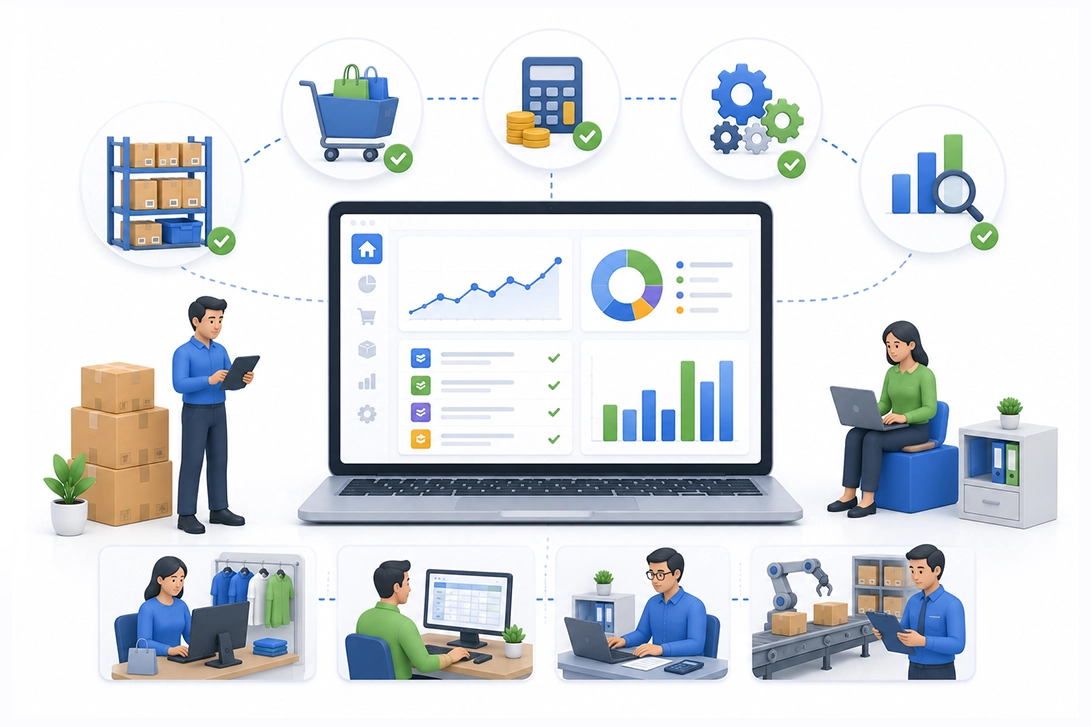
Small and medium enterprises (SMEs) form the economic backbone of virtually every nation, representing businesses that operate between solo startups and large corporations. SME stands for Small and Medium-sized Enterprises, a classification system that categorizes businesses based on employee count, annual turnover, and balance sheet total to determine eligibility for government assistance, financial support, and regulatory treatment. SMEs are vital drivers of a country's economy and play a crucial role in shaping the nation’s socio-economic fabric.
This comprehensive guide covers SME definitions across major economies including the European Union, United States, and India, examining classification criteria, economic significance, and practical applications for business owners. Special attention is given to Indian SME frameworks, highlighting that supporting SMEs is a driving force behind India's economic prosperity, fueling employment, rural development, and the overall socio-economic fabric. Whether you’re an entrepreneur determining your business classification, a policy maker designing support programs, or a student researching economic development, this resource addresses the complete SME landscape with current data and actionable insights.
By reading this article, you will:
Small and medium enterprises represent the vast majority of business operations worldwide, serving as the primary engine for employment generation and sustainable growth in both developed and developing countries. Understanding SME classification matters because it directly affects your eligibility for credit guarantee fund schemes, technology upgradation fund schemes, and favorable regulatory treatment. SMEs are also a cornerstone of the Indian economy, contributing significantly to economic growth and employment across the country.
An SME is defined using specific measurable criteria: employee count, annual turnover (or operating revenue), and balance sheet total. These thresholds vary by jurisdiction but typically position SMEs between micro enterprises and large enterprises in the business size spectrum.
Small enterprises generally employ between 10 and 49 workers with modest annual revenue, while medium enterprises employ between 50 and 249 people with higher turnover limits. Key characteristics include flexible management structures allowing rapid decision-making, limited resources compared to large firms, and often a direct focus on local communities or specialized market niches.
The SME sector encompasses manufacturing enterprises, service enterprises, and businesses across retail sectors from neighborhood restaurants to technology startups to regional manufacturing businesses serving supply chains for large corporations.
Micro businesses represent the smallest formal business category, typically employing fewer than 10 people with minimal annual turnover. Large companies and large enterprises exceed SME thresholds significantly, often operating on a global scale with thousands of employees and billions in revenue.
The relationship between SMEs and MSME (Micro, Small, and Medium Enterprises) classification reflects regional terminology preferences. India uses MSME classification to explicitly include micro enterprises within the small and medium sized business framework, while the European Commission and European Union frameworks treat micro businesses as a distinct subcategory within the broader SME definition.
Understanding these distinctions proves essential when navigating government initiatives, as programs often target specific size categories within the broader small and medium businesses landscape.
The classification of SMEs can vary by country, with some nations like India using the term MSME (Micro, Small, and Medium Enterprises) to include micro enterprises, while others may have different thresholds for employee count and revenue.
In the European Union, an SME is defined as a business that employs fewer than 250 people and either has an annual turnover of less than €50 million or a balance sheet total under €43 million. This framework, established by the European Commission, creates clear boundaries for the internal market.
The EU classification breaks down further:
A new Small Mid-Cap (SMC) category addresses businesses transitioning beyond traditional SME thresholds up to 1,000 employees with turnover around €200 million reducing “cliff-edge” regulatory impacts when small companies grow into medium sized companies and beyond.
In the United States, the Small Business Administration (SBA) classifies small businesses based on industry type, with definitions varying significantly; for example, a manufacturing business may be classified as small even with several hundred employees depending on its operating revenue.
Unlike the unified EU approach, US classification operates through industry-specific size standards under NAICS codes:
The SBA framework determines eligibility for government assistance, federal contracting preferences, and SBA-backed business loans. Businesses must be independently owned, operated for profit, and not dominant in their field to qualify.
The classification of SMEs can vary by country, with some nations like India using the term MSME (Micro, Small, and Medium Enterprises) to include micro enterprises, while others may have different thresholds for employee count and revenue.
India's MSME Classification (effective April 1, 2025):
| Category | Investment in Plant & Machinery | Annual Turnover |
|---|---|---|
| Micro | ≤ ₹2.5 Crore | ≤ ₹10 Crore |
| Small | ≤ ₹25 Crore | ≤ ₹100 Crore |
| Medium | ≤ ₹125 Crore | ≤ ₹500 Crore |
These revised thresholds represent significant increases in investment limits roughly 2.5× higher and turnover limits approximately 2× higher than previous standards reflecting India’s commitment to supporting the nation’s socio economic fabric through continued MSME growth.
Canadian classification relies primarily on employee count with regional variations, while many developing countries follow World Bank Group guidelines that typically define micro enterprises as having fewer than 10 employees, small enterprises up to 50, and medium sized businesses up to 300 employees.
The economic significance of small and medium enterprises extends far beyond their individual operations. SMEs collectively shape employment patterns, drive innovation ecosystems, and determine the resilience of national economies during disruptions. As a cornerstone of the nation's socio-economic fabric, SMEs play a crucial role in employment generation, rural development, and national economic growth, strengthening the overall social and economic structure of the country. SMEs are vital for fostering innovation and entrepreneurship, as they adapt quickly to market changes and create dynamic environments for new ideas, significantly influencing economic and social progress and the country’s economy.
Understanding SME economic impact informs policy decisions, investment priorities, and business strategy development across the private sector.
Small and medium-sized enterprises (SMEs) are vital to fostering innovation and entrepreneurship, generating jobs, and promoting regional development. SMEs represent about 90% of all businesses and contribute significantly to employment and GDP in many countries, with estimates showing they account for over 50% of total employment in developing economies.
Statistical Comparison Table
| Region | % of All Businesses | % of Workforce | % of GDP/Value Added |
|---|---|---|---|
| European Union | 99.8% | 63% | 52–58% |
| Global Average | ~90% | ~70% | ~50% |
| Developing Countries | ~90% | ~50%+ | ~40% |
| OECD Countries | ~99% | ~45% | ~33% |
Small and medium-sized enterprises (SMEs) are vital to fostering innovation and entrepreneurship, as they adapt quickly to market changes and create dynamic environments for new ideas, significantly influencing economic and social progress.
Job creation through SMEs represents more than half of global employment opportunities, particularly in emerging markets where large corporations have limited presence. The agricultural sector in rural development contexts and informal sector self employment ventures often transition into formal SMEs, creating pathways for sustainable growth and country’s economic growth.
SMEs contribute substantially to local communities through localized hiring, community reinvestment, and support for regional supply chain management networks. Many globally recognized large businesses including technology giants began as small enterprises before scaling.
SME contributions to a country’s economy vary by development stage but remain consistently significant. In India, SMEs are a driving force behind India's economic prosperity, playing a pivotal role in employment generation, rural development, and shaping the overall socio-economic fabric of the nation. In the European Union, medium enterprises SMEs generate approximately 52-58% of total value added. In developing countries, SMEs contribute roughly 40% of GDP while providing critical employment generation.
Beyond domestic impact, SMEs increasingly participate in international trade, driving export diversification and strengthening supply chains. This participation further fuels India’s economic prosperity and similar growth trajectories across emerging markets, where business associations and business partners help small companies access international opportunities.
Despite their economic importance, SMEs face structural challenges that threaten sustainability and limit growth potential. Understanding these obstacles and proven solutions helps entrepreneurs and policy makers create more favorable environments.
SMEs often struggle with limited access to financing, as traditional banks view them as risky due to their smaller balance sheets and revenues, making it difficult to secure loans.
Solution:
Alternative financing has expanded significantly through fintech platforms, peer-to-peer lending networks, and equity crowdfunding. Government-backed credit guarantee fund schemes reduce lender risk, while central bank policies in many countries now encourage SME lending through preferential treatment and dedicated funding windows.
Many SMEs face challenges in adopting new technologies, as they typically lack the financial resources and expertise that larger firms possess, hindering their ability to innovate and compete.
Solution:
Cloud-based software eliminates large upfront investments, while modular systems allow gradual implementation. By 2025, approximately 67% of small businesses had adopted at least one cloud solution. Government technology upgradation fund schemes provide financial assistance for digital transformation, and industry associations offer training programs addressing skills gaps.
Complex compliance requirements affect SME business operations disproportionately, as administrative costs represent a higher percentage of revenue for smaller firms than for large corporations.
Solution:
Government initiatives for SMEs often include credit guarantees, technology adoption support, and self-employment promotion to create a favorable environment for their growth. Simplified tax filing systems, one-stop registration portals, and reduced reporting requirements for small businesses help level the playing field.
Competition with large firms presents ongoing challenges for medium sized companies lacking scale economies, brand recognition, and distribution networks.
Solution:
Strategic positioning in niche markets, leveraging local market knowledge, and participating in supply chains as specialized suppliers to large enterprises creates sustainable competitive advantages. Regional business associations provide collective bargaining power and market access opportunities.
LOGIC ERP software solution helps to meet the unique needs of small and medium enterprises (SMEs), offering a comprehensive, scalable, and user-friendly solution that streamlines business operations. With its modular architecture, LOGIC ERP allows SMEs to customize features according to their industry requirements, whether in manufacturing, retail, or service sectors.
Key benefits include real-time data access, which enhances decision-making and operational efficiency. The software integrates financial management , inventory control , sales, and customer relationship management into a single platform, reducing manual errors and improving productivity. LOGIC ERP also supports compliance with regulatory standards, helping SMEs navigate complex tax and reporting requirements smoothly.
Moreover, LOGIC ERP’s cloud-based deployment ensures cost-effective implementation and easy accessibility from anywhere, empowering SMEs to adapt quickly to market changes. Its robust security measures protect sensitive business data, fostering trust and reliability.
Choosing LOGIC ERP enables SMEs to leverage technology for growth, optimize resource allocation, and maintain competitive advantage in today’s dynamic business environment.
Drive Higher Efficiency for Your SMESmall and medium enterprises represent approximately 90% of global businesses while generating roughly half of worldwide employment making accurate SME classification essential for accessing appropriate financial support, regulatory treatment, and growth opportunities. Whether measured by employee count, annual revenue, or balance sheet criteria, understanding your business’s position within SME frameworks directly affects available resources and compliance obligations.
Immediate actionable steps:
Related topics worth exploring include MSME registration processes for accessing India’s support ecosystem, SBA certification for US government contracting opportunities, and technology solutions enabling sustainable growth across manufacturing business and service enterprise operations.
Call at +91-73411-41176 / +91-73411-41175 or send us an email at sales@logicerp.com to book a free demo today!
Book a Free DemoSME stands for Small and Medium-sized Enterprises, referring to businesses that fall between micro enterprises and large corporations based on employee count, annual turnover, and balance sheet total criteria that vary by country and region.
In the European Union, an SME is defined as a business that employs fewer than 250 people and either has an annual turnover of less than €50 million or a balance sheet total under €43 million.
MSME (Micro, Small, and Medium Enterprises) explicitly includes micro enterprises as a distinct category, while SME terminology sometimes subsumes micro businesses within the “small” category. India uses MSME classification, while the EU and many other regions use SME.
The US Small Business Administration classifies businesses by industry-specific standards. A manufacturing business may qualify as small with several hundred employees, while service firms typically face revenue-based thresholds ranging from approximately $2.25 million to $47 million.
SMEs account for approximately 90% of businesses globally, employ roughly 70% of workers, and generate about 50% of GDP. They drive job creation, foster innovation, support local communities, and provide supply chain resilience.
Key challenges include limited access to traditional financing, difficulty adopting new technologies due to cost and expertise constraints, cash flow management issues from payment delays, and competition with large corporations possessing scale advantages.
In many countries, governments recognize the importance of SMEs and offer incentives such as favorable tax treatment and better access to loans to help sustain these businesses. Specific programs include credit guarantees, technology subsidies, simplified registration, and preferential government contracting access.
Thresholds vary by region: the European Union caps medium enterprises at fewer than 250 employees, while US manufacturing businesses may qualify as small with up to 500 or even 1,500 employees depending on industry classification.
SMEs represent approximately 90% of all businesses globally. In the European Union, SMEs account for over 99.8% of all businesses, demonstrating their dominance across virtually all economic sectors.
Small and medium enterprises provide more than half of total employment in most economies, approximately 63% in the European Union and over 50% in developing countries making them the primary source of job creation worldwide.
Medium sized enterprises are generally classified based on employee count, annual turnover, and total assets, but these thresholds vary globally. In the European Union, medium enterprises have fewer than 250 employees with turnover under €50 million or a balance sheet total below €43 million. In the United States, definitions depend on industry; manufacturing businesses may qualify as small or medium with up to 500 employees or more, depending on revenue. India uses the MSME classification, where medium enterprises have investment limits up to ₹125 crore and turnover up to ₹500 crore. These regional differences reflect local economic structures and regulatory frameworks.
Small and medium sized enterprises (SMEs) contribute significantly to economic growth by creating jobs, fostering innovation, and supporting local communities. Globally, SMEs represent about 90% of all businesses and generate roughly 50% of employment. In the European Union, SMEs produce around 58% of GDP and employ over 60% of the workforce. SMEs drive entrepreneurship by adapting quickly to market needs, promoting regional development, and participating in export activities. Their flexibility and innovation help diversify economies and sustain long-term growth.
Many SMEs face challenges in adopting new technologies, as they typically lack the financial resources and expertise that larger firms possess, hindering their ability to innovate and compete. SMEs in developing countries often face limited access to financing due to perceived risks by traditional lenders. Cash flow management is a significant challenge for SMEs, as they often depend on timely payments from clients, and delays can disrupt their operations and financial stability. Additionally, regulatory compliance can be complex and costly relative to their size. These challenges restrict SMEs’ growth potential and sustainability, emphasizing the need for targeted government support and alternative financing solutions.
Medium sized enterprises sit between micro and large enterprises based on size and financial thresholds. Micro enterprises usually have fewer than 10 employees and minimal turnover, focusing on local or niche markets. Medium enterprises employ up to 250 people with higher revenue and asset limits, enabling more complex operations and broader market reach. Large enterprises exceed these thresholds substantially, often operating globally with extensive resources and formalized management structures. SMEs maintain flexibility and faster decision-making compared to large corporations, while having more capacity than micro businesses.
The European Union plays a vital role in supporting SMEs by defining clear classification standards and implementing policies that facilitate access to finance, innovation, and market expansion. The EU provides funding programs, credit guarantees, and regulatory simplifications tailored to SMEs. Initiatives like the Small Business Act and Horizon Europe promote entrepreneurship, research, and digital transformation. The EU also encourages cross-border trade and reduces administrative burdens to enhance SME competitiveness within the single market.
Business loans provide essential capital for SMEs to invest in equipment, technology, inventory, and expansion activities. Access to affordable financing helps overcome cash flow constraints and supports operational stability. Loans backed by government credit guarantee schemes reduce lender risk, improving approval chances. With adequate funding, SMEs can adopt innovative solutions, enter new markets, and increase production capacity, driving sustainable growth and job creation.
A midsize enterprise is distinguished by its employee count, revenue, and asset size, falling between small and large businesses. Unlike small businesses, midsize enterprises have more employees (typically up to 250) and higher turnover, enabling more complex operations and market reach. Compared to large businesses, midsize firms have simpler management structures and more agility but lack the extensive resources and global presence of large corporations. This balance allows midsize enterprises to innovate while scaling efficiently.
Governments worldwide offer various initiatives to support SMEs, including financial assistance, tax incentives, and training programs. Common measures include credit guarantee schemes, subsidized loans, and grants to ease access to capital. Technology upgradation funds help SMEs adopt digital tools, while simplified registration and compliance processes reduce administrative burdens. Many governments also promote entrepreneurship through skill development and self-employment schemes, fostering a favorable environment for SME growth and sustainability.
The Government of India has implemented various schemes and programs to support the growth of small and medium enterprises (SMEs), providing financial assistance, subsidies, and incentives.
Small and Medium-sized Enterprises (SMEs) are businesses that fall between micro enterprises and large corporations based on specific measurable criteria such as employee count, annual turnover, and balance sheet total. These thresholds vary by country but generally include businesses with fewer than 250 to 500 employees and revenue below certain limits. SMEs typically have flexible management structures, operate in diverse sectors including manufacturing and services, and play a vital role in local economies.
A small and medium-sized enterprise is defined as a business that meets certain size and financial thresholds set by regulatory authorities in different countries. Commonly, small enterprises employ between 10 and 49 people, while medium enterprises have between 50 and 249 employees. Annual turnover and balance sheet totals are also used to classify SMEs. This definition helps determine eligibility for government support, financing, and regulatory treatment.
An SME business is a small or medium-sized company that operates with limited resources compared to large corporations but contributes significantly to economic growth, employment, and innovation. These businesses can range from local retail shops and service providers to regional manufacturers and technology startups. SMEs are known for their agility, niche focus, and ability to adapt quickly to market changes.
MSME stands for Micro, Small, and Medium Enterprises and is a classification used primarily in India to explicitly include micro enterprises alongside small and medium businesses. SME (Small and Medium-sized Enterprises) is a more general term used globally that sometimes subsumes micro businesses within the small category or treats them separately. MSME definitions typically include specific investment and turnover limits for plant and machinery, while SME definitions vary by country and may rely on employee count and revenue thresholds. Thus, MSME is a more detailed classification system focused on India’s economic context, whereas SME is a broader international term.
Popular Products