Proof of delivery (POD) is a document or digital record that confirms a shipment was delivered to the right recipient at the correct address, on a specific delivery date and time — the final confirmation in any delivery process.
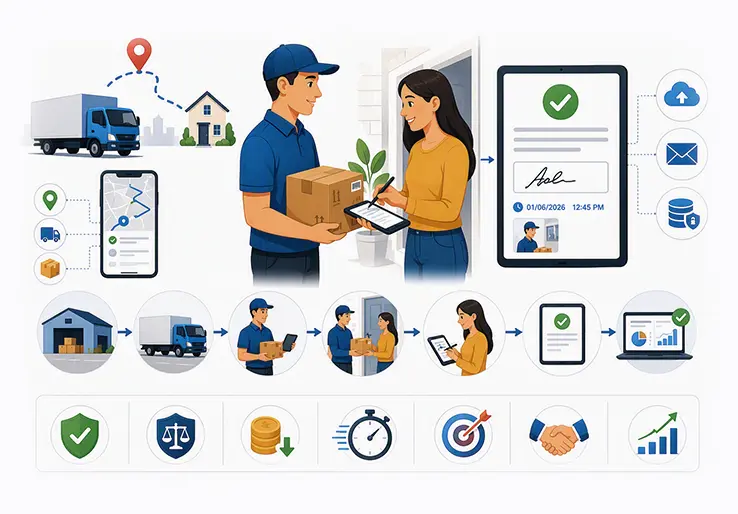
Every business that ships products faces one critical question after dispatch: did the customer actually receive the order? Proof of delivery answers that question with verifiable evidence. In this guide, we break down what proof of delivery means, the difference between paper and digital POD, the end-to-end delivery process, and how to implement best practices that reduce disputes, speed up billing, and improve customer satisfaction.
Proof of delivery, commonly abbreviated as POD, is a document or digital record that confirms a shipment was delivered to the right recipient at the correct address, on a specific delivery date and time. It serves as the final confirmation in any delivery process, formalizing the handover and acceptance of goods or services.
POD stands for "proof of delivery" and can exist as either a paper based proof or an electronic proof of delivery captured through delivery software or a delivery app on a mobile device. It provides an unbroken chain of custody that enhances accountability across every stage of a shipment.
Core elements of a standard POD include:
A valid proof of delivery includes recipient name and signature, making it the definitive record that goods were received by the correct recipient. It is important to distinguish POD from proof of shipment: proof of shipment shows goods were dispatched or handed to a courier, while POD confirms reception by the consignee.
Proof of Shipment (POS) documents that an order left the origin or was handed to a carrier. It sits earlier in the logistics chain than proof of delivery pod and serves a different purpose.
Consider a 2026 ecommerce order shipped from Delhi to Mumbai. The proof of shipment is created when the courier picks up the parcel in Delhi and scans it against the tracking number. The proof of delivery is generated when the intended recipient in Mumbai signs for the package, confirms the quantity, and notes its condition.
Both POS and POD work together for chargebacks, insurance claims, and customer service investigations. POS establishes what left the origin; POD establishes what arrived and in what condition. Without both, companies struggle to resolve disputes or provide proof of correct delivery to payment processors.
Reliable POD underpins last mile delivery, high-volume ecommerce, pharmaceutical distribution, food delivery, and B2B distribution management. Here is why it matters strategically:
For businesses using LOGIC ERP, robust delivery data is critical for GST-compliant billing, returns management, and audit trails.
There are two broad categories of POD, with many delivery businesses now running hybrid models:
Traditional paper POD:
Electronic proof of delivery (ePOD):
Common sub-types of digital POD include:
Various methods of delivering POD include electronic signatures and photo evidence, and POD can include photographic evidence of the package at the delivery location. From 2024 to 2026, many fleets have moved from paper pod to digital pod for scalability and compliance reasons.
In a paper POD system, the workflow is straightforward but labor-intensive:
Typical fields on a paper delivery note include shipment number, consignment note reference, SKU codes, quantities dispatched versus delivered, receiver name and signature, and remarks on visible damage.
Advantages:
Limitations:
Some regulated sectors still require physical copies, but companies increasingly mirror them with scanned or digital records via systems like LOGIC ERP to maintain compliance without losing efficiency.
Electronic proof of delivery means capturing all delivery confirmation data digitally via a delivery app or e-pod app on a handheld or mobile device, with instant sync to back office systems like LOGIC ERP.
Common data points captured include:
Electronic proof of delivery allows for rapid evidence availability and reduces paperwork. It captures electronic signatures and offers real-time updates, providing real-time visibility into delivery status for dispatchers and customers alike.
Contactless ePOD, adopted widely from 2020 onwards, removes the need for physical contact. Instead of a pen-and-paper signature, drivers capture a geo-stamped photo at the doorstep, verify the recipient by OTP or name capture, and the record is instantly uploaded to the system.
In a typical ePOD workflow, the delivery software assigns a job to the driver, who navigates to the address, scans items, collects digital pod data on-site, and syncs everything in real time. If connectivity drops, the app stores data locally and syncs when the connection is restored. LOGIC ERP can act as the system of record, linking ePOD to orders, invoices, and returns for retailers, distributors, and manufacturers.
Switching from paper to electronic proof of delivery delivers measurable advantages across operations, finance, and customer relations. Here are the key benefits:
POD is one of several documents in the shipping lifecycle, and understanding the differences prevents confusion:
In a multimodal shipment, a BOL may be issued at origin, a consignment note generated for road segments, and a POD created at final hand-over. Digital ecosystems such as LOGIC ERP integrated with transport partners can map BOL, consignment note numbers, and digital POD into a single shipment record for complete auditability.
Understanding the end-to-end delivery process helps businesses identify gaps and optimize. Here is a standard workflow for both paper and digital flows:
If your business is planning or optimizing an ePOD rollout, follow this checklist:
LOGIC ERP offers end-to-end integration between orders, inventory, transport assignments, and electronic proof of delivery records. Here is how it works in practice:
Looking ahead, digital POD in LOGIC ERP lays the foundation for AI-driven delivery optimization, predictive customer communication, and automated exception management.
Whether your business handles 50 or 5,000 deliveries daily, transitioning from traditional paper-based proof of delivery to a digital proof of delivery system is essential in today’s competitive logistics landscape. Digital POD not only reduces costly disputes by providing accurate, timestamped, and geotagged evidence but also accelerates cash flow by enabling faster invoicing and billing cycles. It enhances operational efficiency by minimizing paperwork, human errors, and administrative delays, allowing drivers and back-office teams to focus on higher-value tasks.
Moreover, digital proof of delivery significantly boosts customer trust and satisfaction through real-time delivery updates, contactless confirmation options, and reliable evidence of delivery conditions. This transparency fosters long-term client relationships and strengthens your brand reputation.
LOGIC ERP’s integrated delivery management solutions empower businesses to seamlessly adopt electronic proof of delivery with features like mobile apps for digital signatures, photo capture, GPS tracking, and instant synchronization with back-office systems. By leveraging LOGIC ERP, companies gain complete visibility from dispatch to delivery confirmation, enabling smarter decision-making, improved compliance, and scalable growth.
Take the next step toward transforming your delivery operations and gaining a competitive edge in 2026 and beyond.
Call at +91-73411-41176 / +91-73411-41175 or send us an email at sales@logicerp.com to book a free demo today!
Yes. In India under the IT Act and in the U.S. under the ESIGN Act, an electronic signature carries the same legal weight as a handwritten one, provided identity, intent, and record integrity are maintained. A digital signature on a delivery form is legally admissible.
Drivers can capture photo proof of the package at the delivery point, confirm via OTP, or record the recipient name of an authorized person. The ePOD app logs a reason code for "customer absent" with GPS and timestamp evidence.
In many cases, yes — especially for contactless delivery. The photo should clearly show the item and location, supported by GPS and time metadata. Acceptance depends on your client contracts and regulatory requirements.
POD itself is typically a delivery receipt rather than a standalone contract, but it supports contracts, SLAs, and claims processes. It provides proof that the delivery service fulfilled its obligation.
This varies by jurisdiction and industry. Under Indian GST, businesses generally retain documents for six years. Define a retention policy that balances compliance requirements with storage costs.
Begin with an affordable delivery app that captures core data — photo, timestamp, recipient name, and signature. Integrate it with an ERP like LOGIC ERP even at a basic level. Pilot in one region, define simple SOPs, and expand as you see results.
Delivery software is a digital tool that manages and tracks shipments from dispatch to delivery. It integrates with electronic proof of delivery (ePOD) systems to capture signatures, photos, and timestamps, improving accuracy and speeding up invoicing.
A delivery app allows drivers to capture electronic signatures, scan barcodes, and upload digital PODs in real time. This enhances the delivery experience by reducing paperwork, minimizing errors, and providing customers with instant delivery confirmation.
Digital POD (Proof of Delivery) is an electronic record of delivery that includes recipient signatures, photos, geolocation, and timestamps. It improves customer satisfaction by providing transparent, verifiable delivery evidence and accelerates billing processes.
Electronic proof of delivery enhances customer satisfaction by offering real-time updates, contactless confirmation options, and reliable evidence of delivery conditions, which builds trust and reduces delivery disputes.
The consignment role refers to the responsibility of managing and tracking goods during transit. Proof of delivery confirms the successful handover of the consignment to the correct recipient, completing the chain of custody.
Yes, electronic signatures captured via delivery apps or ePOD systems are legally valid in many jurisdictions, including India and the U.S., provided they meet identity and record integrity requirements.
Barcode scanning enables quick and accurate verification of packages at each delivery point. It reduces errors, ensures the right items are delivered, and automatically updates the digital POD with scanned data.
An effective ePOD app should support electronic signature capture, barcode scanning, photo proof, GPS geotagging, offline functionality, and seamless integration with back-office delivery software to ensure real-time updates and accurate records.
The consignment note plays a crucial role in the proof of delivery process by serving as the reference document that links the shipment details from dispatch to delivery. It contains key information such as the shipment contents, sender and recipient details, and tracking numbers. During delivery, the proof of delivery document references the consignment note to confirm that the exact goods listed were received by the correct recipient. This linkage ensures traceability and accountability throughout the shipment lifecycle, facilitating accurate record-keeping, dispute resolution, and invoicing.
Popular Products