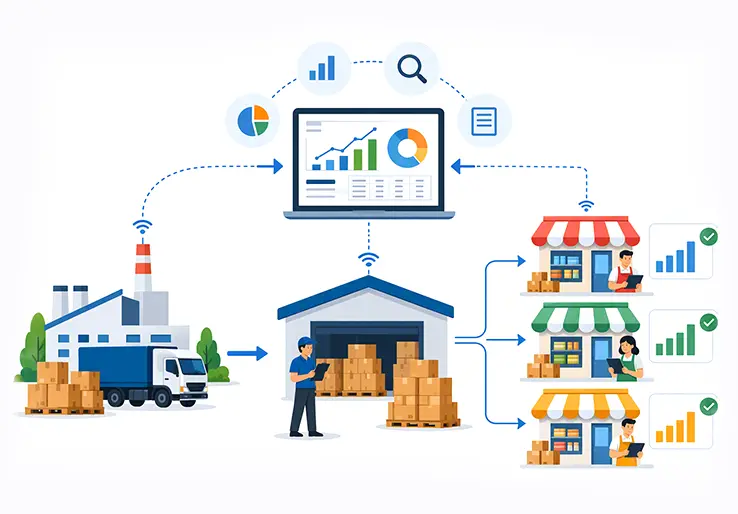
Secondary sales tracking software automates how brands capture, consolidate, and analyze distributor-to-retailer sales and stock data in real time, giving far deeper visibility than primary sales records alone.
Secondary sales tracking software automates how brands capture, consolidate, and analyze distributor-to-retailer sales and stock data in real time, giving far deeper visibility than primary sales records alone. Secondary sales tracking is the process of monitoring product movement from distributors to retailers, capturing SKU-level quantities, values, stock positions, and outlet-level details across the distribution network. It goes beyond primary sales (company-to-distributor billing) to reveal actual market demand at the retail level.
Most Indian businesses operate through layered distribution chains: CFAs, super-stockists, distributors, sub-distributors, and millions of Kirana stores. For sales leaders, CFOs, supply chain heads, and operations teams in Indian FMCG, pharma, consumer durables, and manufacturing businesses, that gap in visibility directly affects forecasting, distributor performance, inventory control, and market execution. Without secondary sales visibility, headquarters relies on dispatch data alone, which tells you what left your warehouse but not what actually sold. The result: delayed distributor reports (often 7-14 days), reliance on spreadsheets and WhatsApp, stock mismatches, blind spots in trade promotions, and guesswork in demand forecasting.
The fix is technology: a distributor management system, sales force automation via mobile apps, and secondary sales tracking software embedded in an enterprise resource planning platform like LOGIC ERP. In the sections ahead, you’ll see how the process works, how secondary sales differs from primary sales, which data points and KPIs to track, the main benefits and challenges, the features to look for in software, best practices for implementation, and how LOGIC ERP supports secondary sales tracking for stronger distribution and sustainable growth.
Secondary sales tracking is the process of capturing, consolidating, and analyzing sales transactions from distributors to retailers (and sometimes to end consumers), recording product/SKU details, quantities, values, distributor and retailer identity, territory, salesperson, and closing stock, to measure true market offtake rather than just company dispatches.
Who is involved: brand/company HQ, super-stockists, distributors, sub-distributors, retailers (general trade and modern trade), and the field force (beat sales reps, DSRs).
What data is tracked: product/SKU code, quantity sold, sales value, distributor, retailer, territory/beat, invoice date, salesperson, schemes/discounts applied, closing stock, returns, and outstanding payments.
How it differs from primary sales tracking: primary sales data comes from ERP dispatch records and measures company-to-distributor billing. Secondary sales data comes from DMS, SFA, or POS systems and measures distributor-to-retailer movement at SKU and outlet granularity. Primary tracks dispatches; secondary tracks market movement and genuine demand.
In India and other emerging markets, secondary sales tracking is now a baseline requirement for both modern trade and general trade operations.
The tracking process follows six steps from factory gate to corrective action:
Distributor Receives Stock. The company raises a primary invoice and dispatches goods from plant or warehouse to CFA or distributor. This is recorded in ERP as primary sales.
Distributor Sells to Retailers. Through van sales, beat-based orders, modern trade purchase orders, or e-commerce B2B channels, the distributor generates secondary invoices.
Sales Data is Recorded. Data entry happens via a distribution management system, SFA mobile app, POS integration, or CSV/Tally uploads. Real-time data capture allows instant visibility into daily sales and order bookings. Mobile apps enable real-time updates for sales teams and distributors working across beats.
Data is Shared with the Company. Auto-sync from distributor systems pushes secondary sales data to the brand’s central system, ideally multiple times per day. In practice, many brands still see 2-3 day lags at month-end because of manual upload behavior around scheme deadlines.
Sales and Inventory are Analyzed. The system aggregates data by distributor, retailer, SKU, and territory. It calculates stock-in-trade, fill rates, sell-through rates, and flags slow moving inventory or overstocked locations.
Management Takes Corrective Action. Based on secondary sales analysis, the sales manager reallocates stock between depots, pushes promotional schemes in lagging territories, adjusts production schedules, or redesigns beat plans for the field force.
Primary Sales vs Secondary Sales
Understanding the gap between primary and secondary sales is critical for finance, sales planning, and distribution strategy. Historically, many businesses tracked only primary sales, which masked channel stuffing, fake growth, and pipeline overhangs.
Factor
Primary Sales
Secondary Sales
Sales flow
Company → Distributor
Distributor → Retailer
Main focus
Dispatches and billing
Market offtake and shelf visibility
Data source
ERP dispatch records
DMS / SFA / POS / retailer data
Purpose
Revenue recognition, dispatch control
Demand visibility, sales strategies
Granularity
Distributor-level
Retailer-level, SKU-level, beat-level
Reporting frequency
Monthly or quarterly
Daily or real-time
Comparing primary and secondary sales by territory is one of the fastest ways to detect leakages, dumping, or unsold pipeline sitting with distributors.
Secondary sales tracking connects your business to actual market demand rather than warehouse dispatches. Here is why it matters:
Better Sales Visibility. Tracking secondary sales reveals actual offtake by outlet, category, and region. Secondary sales reveal where products move and where they stall, giving the sales team actionable insights instead of assumptions.
Improved Demand Forecasting. Secondary sales data enables accurate demand forecasting. Brands with real-time secondary visibility report 25-35% improvement in forecast accuracy. Advanced analytics tools identify trends and forecast demand accurately across seasons.
Distributor Performance Monitoring. It enables enhanced channel accountability by objectively evaluating distributor performance on fill rate, coverage, growth, and on-time reporting.
Inventory Optimization and Reduced Stock-outs. Tracking secondary sales improves inventory management and reduces stockouts. Data analytics helps optimize inventory and reduce stockouts by flagging fast-moving SKUs that need replenishment and slow-moving ones that need clearance.
Identification of Slow-moving Products. Secondary sales tracking identifies fast-moving and slow-moving products by region for targeted marketing, enabling clearance schemes, re-packaging decisions, or SKU rationalization. Bottom 40-50% of SKUs typically contribute just 8-12% of revenue while consuming disproportionate shelf space and scheme budgets.
Better Production and Replenishment Planning. Linking secondary sales visibility with supply chain planning improves safety stock settings, inventory planning, and lead time management, keeping inventory levels aligned with real consumption.
This checklist defines the data required to analyze secondary sales data accurately:
Product/SKU Code and Description for consistent identification across all distribution channels
Quantity Sold at the invoice line level
Sales Value including gross, net, and tax components
Distributor Name/code linked to master data
Retailer Name/Code with channel tag (GT, MT, e-commerce)
Territory/Beat mapped to the company’s geography hierarchy
Salesperson/DSR responsible for the outlet
Invoice Date for time-series analysis and sales trends
Scheme/Discount Applied to track trade promotions at retail level
Closing Stock at distributor for stock management reconciliation
Returns (quantity, reason, batch) for quality and expiry tracking
Outstanding Payments for credit and resource allocation decisions
LOGIC ERP maps these data points to unified master data (items, customers, territories) to prevent duplicates and inconsistencies that plague manual systems.
Key Metrics for Secondary Sales Tracking
Before implementing any secondary sales tracking system, define the key metrics your business will monitor. Real-time visibility improves decision-making in secondary sales tracking by surfacing problems before they compound.
Secondary Sales Value (₹): total revenue at distributor-to-retailer level
Sales Growth %: period-over-period growth by territory, distributor, or SKU
Distributor-wise Sales: ranking distributor networks by performance
Retailer-wise Sales: identifying top and bottom outlets
SKU-wise Sales: analytics dashboards provide insights on SKU performance across regions
Territory-wise Sales: comparing zones and routes for market penetration gaps
Stock Turnover: how quickly distributor inventory converts to secondary sales
Sales Return Rate: percentage of goods returned; signals quality or overstock issues
Average Order Value: per retailer, per beat
Sell-through Rate: ratio of secondary sales to primary dispatches
Analytics improves decision-making by providing real-time sales data across all these metrics. Compare primary vs secondary sales for each territory to detect channel stuffing or parallel distribution.
Many businesses still struggle with tracking secondary sales reliably, even in 2026:
Manual Data Collection. Dependence on Excel, emails, and phone calls creates errors and delays. It helps eliminate inventory pile-ups and reduces blind spots only when data flows digitally.
Delayed Distributor Reports. Weekly or monthly uploads make it impossible to respond to fast market changes or festival-season spikes.
Lack of Real Time Visibility. Management sees summarized reports days later, not outlet-level sales activities as they happen.
Inaccurate or Incomplete Sales Data. Missing retailer codes, wrong SKU mappings, unrecorded returns, and duplicate invoices corrupt analysis.
Multiple Distribution Channels. GT, MT, e-commerce, and institutional buyers all use different systems (Tally, local DMS, Excel, custom apps), fragmenting the data landscape across various sales channels.
Poor Inventory Visibility. No consolidated view of stock at company, CFA, distributor, and retailer locations.
Difficulty Tracking Retailer-level Schemes. Without integrated data, the brand cannot validate whether trade promotions reached target outlets or were absorbed by intermediaries.
How to Improve Secondary Sales Tracking?
These strategies directly address the challenges above:
Digitize Sales Reporting. Move distributors and sales teams from spreadsheets to mobile first workflows, a distributor management system, or an integrated ERP solution like LOGIC ERP. Sales tracking software can reduce manual data entry errors by 40%.
Centralize Distributor Data. Consolidate all secondary sales and stock data in a single management software platform for seamless data flow.
Track Sales in Real Time. Use APIs, DMS connectors, or mobile SFA to sync sales transactions multiple times per day. Real-time analytics enables quick responses to market changes.
Monitor SKU-level and Retailer-level Movement. Deeper visibility helps uncover sales trends, identify core vs long-tail SKUs, and spot white-space opportunities for market share growth.
Use Automated Reports and Alerts. Daily summaries, low-stock alerts, and deviation alerts (e.g., >20% sales drop) support real time reporting. Secondary sales data supports better decision-making for distributors who receive timely performance feedback.
Set Distributor Performance Benchmarks. Define clear SLAs: data submission within 24 hours, coverage %, fill rate, growth targets. Tie incentives to accurate secondary sales reporting.
Integrate Inventory and Sales Data. Linking inventory optimization with secondary sales tracking improves supply chain decisions and optimizing operations.
Pilot First, then Scale. Start with one region or 10 key distributors, stabilize the tracking process, then expand nation-wide.
Secondary sales software is a specialized type of sales tracking software that automates capturing, consolidating, and analyzing distributor and retailer-level sales and stock data across the distribution chain. Over 200 enterprise brands use secondary sales tracking software to replace manual processes.
It sits between field systems, distributor management systems, and the central ERP, pulling data from multiple sources into one view
It manages distributor stock ledgers, retailer invoicing, scheme automation, returns, and territory-wise reporting
In modern deployments, this functionality is part of a broader ERP like LOGIC ERP rather than a standalone point solution, enabling data driven decision making across departments
Features to Look for in Secondary Sales Tracking Software
When evaluating secondary sales management tools for 2026, prioritize these key features:
SKU-wise Analysis across regions and distribution channels to optimize marketing strategies
Territory-wise Reports for zone, region, and beat-level comparison
Automated Secondary Sales Reporting that enhances efficiency in sales tracking; secondary sales tracking software enhances reporting with customizable dashboards
Returns and Claims Management with audit trails
Order Management including van sales, pre-sales, and direct orders
Promotion/Scheme Tracking at retail invoice level for better trade spend control
Mobile Access and Offline Capability: software should enable mobile access for field teams; real-time sales data capture from distributors is essential even with patchy connectivity
ERP Integration: integration with existing ERP and CRM systems is crucial to avoid duplicate data entry; integrating ERP and CRM systems enhances secondary sales data analysis
Dashboard and Analytics: visual dashboards with drill-down from zone to retailer to SKU, enabling detailed insights on market trends
Evaluate scalability, data security, role-based access control, and audit trails before selecting a platform.
Unified Primary, Secondary, and Tertiary Sales Tracking in one platform, giving real time visibility from HQ to last-mile outlets. Real-time visibility into secondary sales enhances decision-making speed.
Distributor and Retailer Management: master data, credit limits, schemes, price lists, and performance tracking managed centrally. Real-time visibility enhances distributor performance tracking across distributor networks.
Inventory Tracking: batch-level, expiry tracking (critical for pharma/FMCG), reorder levels, and auto-replenishment based on secondary sales trends support optimizing inventory and stock management goals.
Integrated Analysis: distributor-wise, retailer-wise, SKU-wise, and territory-wise dashboards with drill-down and filters power better decision making and sales processes.
Multi-location and Multi-company Support for pan-India brands and regional players expanding to new states, supporting complex business operations.
Open Integration: LOGIC ERP ingests data from external DMS, Tally, POS, and mobile SFA tools via APIs or scheduled imports, supporting demand forecasting needs.
Benefits of Using LOGIC ERP Software for Secondary Sales Tracking
Improved sales visibility across the full distribution network, from CFA to end consumers
Faster and more accurate demand forecasting driven by real-time secondary sales data
Better monitoring of distributor and retailer performance tied to objective KPIs
Early identification of slow-moving SKUs and ability to adjust sales strategies before losses compound
Effective tracking minimizes dead stock and optimizes inventory across locations
Secondary sales tracking strengthens relationships with distributors and retailers through transparent performance metrics and customer satisfaction improvements
Effective tracking of secondary sales can reduce marketing costs by focusing schemes only where they drive incremental sales
Faster management decisions through automated dashboards and alerts, supporting business growth
Reduced manual work: fewer spreadsheets, fewer reporting errors, more time for the sales team to sell; enabling a competitive market advantage and helping businesses stay ahead
Secondary Sales Tracking Best Practices
For sales leaders, CFOs, and supply chain heads implementing secondary sales tracking in 2026:
Maintain Accurate Master Data. Distributor and retailer codes, GST numbers, and geography mappings must be clean. Secondary sales tracking improves relationships with distributors and retailers when both sides trust the data.
Track at SKU and Pack Level. Brand-level aggregates hide problems. SKU-level tracking surfaces the detailed insights needed for inventory planning and production planning.
Monitor Frequently. Daily for high-velocity FMCG and pharma; weekly for durables and industrial products.
Compare Primary and Secondary Sales. Regular reconciliation by distributor and territory catches channel stuffing, pipeline buildup, and scheme misuse.
Monitor Returns and Expiries. Link returns to route, retailer, or SKU to improve product design and scheme design.
Use Automated Dashboards. Replace manual Excel consolidation with role-based analytics for each sales manager.
Regular Audits Ensure Accuracy in Distributor and Retailer Sales Data. Quarterly reviews with clear KPIs and incentive structures tied to accurate, timely reporting drive accountability.
Businesses that rely only on primary dispatch data operate with partial visibility. Secondary sales tracking closes that gap by capturing what actually moves at the retail level, enabling the chain: Visibility → Tracking → Analysis → Better Decisions → Stronger Distribution Network → Sustainable Growth.
Achieving this at scale requires purpose-built secondary sales software, not spreadsheets and ad-hoc reports. Explore LOGIC ERP’s secondary sales tracking and distributor management capabilities to bring real time visibility to your distribution network. Book a demo to see how it works for your industry.
Frequently Asked Questions About Secondary Sales Tracking
Secondary sales tracking is monitoring and recording the sale and movement of products from distributors to retailers (and sometimes to end consumers), including quantities, values, and stock levels at each point in the distribution network. It measures true market offtake beyond primary billing.
It shows real consumer demand, supports accurate demand forecasting, improves inventory optimization, and helps monitor distributor and retailer performance. It reduces stock-outs, dead stock, and trade leakages, directly impacting revenue and profitability.
Primary sales are brand-to-distributor invoices recorded in ERP, measuring dispatches. Secondary sales are distributor-to-retailer invoices recorded in DMS or SFA, measuring market movement. See the comparison table above for a full breakdown.
Companies track secondary sales via distributor management systems, sales force mobile apps, POS integrations, or Excel uploads consolidated in ERP. Modern best practice is to use integrated tracking software like LOGIC ERP for automated, real-time data capture and analysis.
SKU, quantity, invoice value, distributor, retailer, territory/beat, salesperson, invoice date, schemes/discounts, closing stock, and returns. Consistent coding of products and parties is critical for accurate reporting.
Automated data collection from distributors, real-time visibility, fewer errors, faster reporting, better inventory optimization, and more effective sales strategies and promotions. It frees teams from manual consolidation and supports data driven decision making.
It reveals actual sell-out speed by SKU and location, enabling better demand forecasting, safety stock calculations, and replenishment planning. Companies can proactively move stock from slow to fast locations and reduce expiries and obsolescence.
Any brand selling via distributors or multi-tier channels: FMCG, food and beverage, pharma, cosmetics, agrochemicals, electronics, consumer durables, and building materials. Even regional brands expanding to new states should adopt it early.
Modern ERPs like LOGIC ERP include modules for distributor management, retail sales capture, and secondary sales reporting, integrating data from DMS, POS, and mobile apps. This integration provides a single source of truth for finance, supply chain, and sales management.
The sales force plays a critical role in secondary sales tracking by collecting real-time sales data directly from distributors and retailers. Equipped with mobile apps and sales force automation tools, they ensure accurate and timely reporting, enabling businesses to monitor market demand and optimize inventory efficiently.
By analyzing secondary sales data, businesses can identify high-performing territories, detect stock imbalances, and uncover gaps in market coverage within their distribution network. This insight allows for better allocation of resources, targeted promotions, and streamlined logistics to maximize sales and reduce stockouts.
Inventory optimization ensures the right products are available at the right locations based on secondary sales insights. It reduces excess stock and stockouts by aligning inventory levels with actual retail demand, leading to improved cash flow, reduced wastage, and enhanced customer satisfaction.
Secondary sales tracking provides real-time visibility into product movement beyond primary dispatches, enabling better demand forecasting and production planning. This transparency helps reduce lead times, minimize stock discrepancies, and synchronize supply chain activities from manufacturing to retail.
Insights from secondary sales tracking enable businesses to tailor sales strategies such as targeted promotions, dynamic pricing, and product placement based on regional demand patterns. It also supports identifying slow-moving products for clearance and prioritizing high-demand SKUs for replenishment.
Management software integrates data from distributors, retailers, and sales teams to provide real-time dashboards and automated reports. This centralized platform enables quick identification of sales trends, stock levels, and performance issues, facilitating faster decision-making and corrective actions.
Secondary sales tracking captures actual sell-through data at the retailer level, reflecting true consumer demand rather than just shipments. This granular data helps businesses forecast demand accurately, plan inventory effectively, and respond promptly to changing market conditions.
Secondary sales tracking systems provide timely and precise sales data from distributors and retailers, enabling advanced analytics to identify trends and seasonality. This improves the accuracy of demand forecasts, reduces forecast errors, and supports optimized production and inventory planning.
Best practices include maintaining clean master data for distributors and retailers, tracking sales at SKU and outlet levels, monitoring performance regularly through automated dashboards, reconciling primary and secondary sales, and setting clear KPIs and incentives to ensure accurate and timely reporting.