Discrete manufacturing is the production of distinct, countable items — such as cars, smartphones, and aircraft — by assembling individual components according to a bill of materials (BOM). It is one of the most widely adopted manufacturing types across global industries.
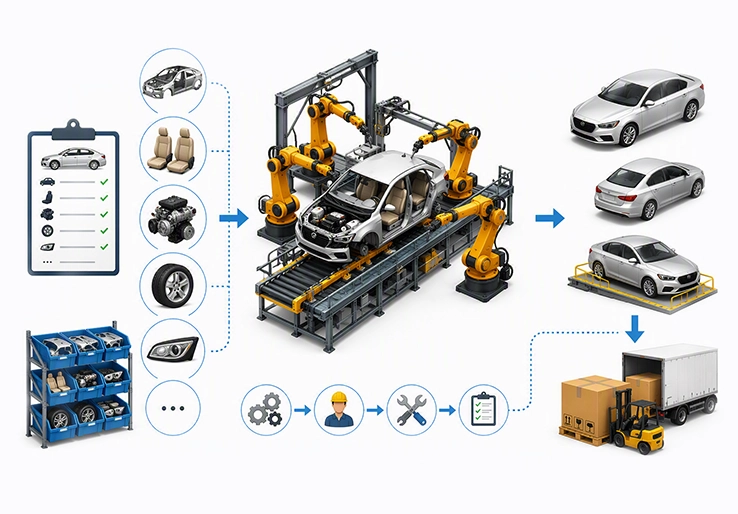
Discrete manufacturing is the production of distinct, countable items — such as cars, smartphones, and aircraft — by assembling individual components according to a bill of materials (BOM). It stands as one of the most widely adopted manufacturing types across global industries, powering everything from consumer electronics to heavy machinery.
This guide covers the full scope of the discrete manufacturing process: its foundational principles, key characteristics, real-world industry examples, implementation steps, technology solutions, measurable benefits, and common challenges with actionable solutions. The content is designed for manufacturing executives, production managers, and operations professionals who need to understand, evaluate, or optimize discrete manufacturing operations within their organizations.
In short: Discrete manufacturing produces finished products that are individually identifiable, countable, and often disassemblable — unlike process manufacturing, which creates goods by combining raw materials into homogeneous outputs measured in bulk quantities. Discrete manufacturers rely on bills of materials, production routing, and work orders to manage assembly processes from raw materials through to the final product.
By reading this guide, you will:
Before evaluating technology investments or redesigning a production line, manufacturers need clarity on what makes discrete manufacturing distinct as a production methodology — and how its key features shape every downstream decision from scheduling to quality control.
At its core, discrete manufacturing is the production of individual, countable units assembled from separate parts, components, or subassemblies. Discrete manufacturing ERP systems typically involve assembling components based on a bill of materials, with each product traceable through a serial number or lot code. Products in discrete manufacturing can often be partially disassembled back into their constituent parts — a car can be broken down into its engine, chassis, electronics, and interior components.
This stands in direct contrast to continuous manufacturing, which measures products in volume and usually cannot be individually counted. Discrete manufacturing ERP assembles distinct items like cars and electronics, where each unit moves through defined production steps that can be independently started, stopped, or modified. The manufacturing process is noncontinuous: operations run per work order rather than as an unbroken flow.
For production and operations leaders, understanding this distinction matters because it directly influences how you structure your production planning, inventory management, and quality control systems.
Four key characteristics define how discrete manufacturing operations function:
Understanding the differences between discrete and process manufacturing is essential for selecting the right manufacturing strategy for your products.
Discrete Manufacturing produces countable, identifiable items assembled from individual components. Products can typically be disassembled into their original parts. Discrete manufacturing is distinct from process manufacturing, which produces goods in batches or through continuous production where outputs are homogeneous.
Process Manufacturing produces goods by mixing raw materials — often through chemical reactions, blending, or heating — into products that cannot be easily separated back into their original ingredients. It creates products by mixing raw materials in bulk, measured by weight, volume, or concentration rather than individual units. Industries using process manufacturing include food and pharmaceuticals, as well as chemical production and consumer goods production.
| Factor | Discrete Manufacturing | Process Manufacturing |
|---|---|---|
| Output type | Countable distinct items | Bulk quantities, batches |
| Product structure | Bills of materials (BOMs) | Recipes and formulations |
| Reversibility | Products can often be disassembled | Finished products cannot be easily separated |
| Production method | Assembly processes, sequential routing | Batch processes, continuous production |
| Examples | Cars, electronics, furniture | Pharmaceuticals, food processing, chemicals |
| Measurement | Individual units, serial numbers | Volume, weight, concentration |
Process manufacturing typically involves batch production methods and relies on precise process control for consistency, while discrete manufacturing ERP systems require flexible routing, frequent changeovers, and variant management. Unlike discrete manufacturing software, process manufacturing companies often produce the same or similar products in continuous runs with fewer configuration changes.
With these fundamentals established, the next step is understanding where discrete manufacturing solutions are applied across industries — and what makes each sector's requirements unique.
The foundational concepts of BOMs, routing, and traceability manifest differently depending on the industry. Each sector below demonstrates how discrete manufacturing products range from mass production consumer goods to highly customized, low-volume assemblies.
The automotive manufacturing sector is the archetypal example of discrete manufacturing industry. Vehicle assembly involves integrating thousands of separate parts — body panels, chassis, powertrain components, wiring harnesses, and interior modules — through a complex, multi-stage production line. The discrete manufacturing process often allows for multiple product variants; a single plant may produce vehicles with different trim levels, engine options, and regional configurations (such as left-hand versus right-hand drive). Supply chain management is especially critical, as automakers coordinate with hundreds of tier-one and tier-two suppliers, and traceability down to individual components is required for safety recalls and warranty support.
Discrete manufacturing IT solutions assemble distinct items like smartphones, motherboards, IoT devices, and consumer appliances in high-mix environments where product changeover rates are rapid. BOMs in electronics manufacturing are often deeply nested with many component levels, and engineering changes are frequent as new models and variants reach the market. Product customization increases complexity in this sector, as manufacturers must manage short product lifecycle cycles while maintaining strict quality control through automated visual inspection and testing. Speed to market is a defining competitive factor, making production efficiency and real-time data visibility essential.
Aerospace represents the most complex end of the discrete manufacturing spectrum. Products undergo engineer-to-order workflows with tight tolerances, long lead times, and rigorous regulatory compliance requirements. Traceability extends to every fastener, material lot, and process step; configuration management through engineering change orders is mandatory. Discrete manufacturing solutions typically involve low-volume production of complex products in this sector, and the cost of defects or recalls is exceptionally high, making quality control across assembly processes a top operational priority.
Beyond these core sectors, discrete manufacturing software extends to medical devices (implantable devices, diagnostic systems), industrial machinery, heavy equipment for construction and agriculture, furniture, appliances, and toys. Some manufacturers operate in hybrid environments combining discrete and process manufacturing — for example, plastic injection molding (a process-type operation) feeding discrete housing assembly downstream.
With industry context established, the practical question becomes: how do you implement or optimize a discrete manufacturing process? The answer involves structured planning, the right technology stack, and a clear execution sequence.
Discrete manufacturing IT solutions often require detailed planning and scheduling to move from raw materials to finished products. The following sequential steps define the core production process:
Create accurate, multi-level bills of materials. Identify suppliers, negotiate lead times, and establish quality specifications for each component. Effective inventory management is crucial to balance holding too much or too little stock at this stage — excess inventory ties up capital, while shortages halt production lines.
Establish capacity plans, schedule operations per routing, and assign work centers, machines, and labor. Advanced analytics optimizes production planning and scheduling by analyzing historical demand patterns and machine availability to optimize resource utilization across the shop floor.
Design shop floor layouts — whether assembly lines, cellular manufacturing, job shop, or hybrid configurations. Manage changeover times between product variants, design operator workstations, and stage materials for efficient flow. High initial setup costs are common in discrete manufacturing software, but modular approaches reduce ongoing changeover overhead.
Define inspection points per routing, track first pass yield and defect rates, and manage non-conformances. Quality control issues can create high rates of rework in discrete manufacturing, making integrated quality protocols essential. Advanced analytics enhances quality control by identifying defect patterns before they become systemic.
Complete final inspections, apply serialization and labeling, package per customer or channel specifications, and hand off to logistics. After-sales traceability enables warranty support and recall management.
Manufacturers implementing discrete manufacturing operations typically evaluate several categories of manufacturing software to support these processes. The right enterprise resource planning solution serves as the backbone, but complementary systems address specific operational needs.
| Solution | Implementation Complexity | Customization & Variant Handling | Integration to Other Systems | Cost & ROI Timeframe |
|---|---|---|---|---|
| ERP Systems | High; broad departmental rollout | Strong BOM management, order model support, variant pricing | Interfaces to supply chain, finance, HR, production | ROI typically 12–36 months |
| MES (Manufacturing Execution Systems) | Technical; shop floor sensor integration | Strong routing, real-time execution and tracking | Must integrate with ERP, OT devices, sensors | ROI 6–18 months; faster visibility gains |
| Production Monitoring / IoT & Edge Analytics | Moderate; add-on to existing systems | Less variant management; more performance metrics | Needs connection to MES/ERP for full value | Shortest ROI; direct operational efficiency gains |
A compelling case study illustrates the impact: Metalworking Group increased its on-time, in-full (OTIF) delivery from roughly 75% to 86% after implementing a Discrete Manufacturing ERP solution — an 11-percentage-point jump. The company's revenue grew approximately fourfold as a result of improved manufacturing operations.
Adopting advanced technology can improve efficiency and reduce errors in manufacturing, but the key is selecting solutions that match your production scenarios — whether high-volume repetitive manufacturing or high-mix, low-volume custom assembly. An industry-specific ERP solution that supports configurable BOMs, variant routing, and integrated quality management delivers the most value for discrete manufacturers.
Emerging Technologies are accelerating transformation. Digital twin technology is being deployed across discrete manufacturing lines to simulate layouts, predict bottlenecks, and enable predictive maintenance that reduces downtime by anticipating equipment failures. A review of 57 peer-reviewed studies from 2017–2023 documented digital twin applications in discrete manufacturing software focused on layout optimization, scheduling and control systems, and predictive maintenance. Edge computing and IoT convergence enable real-time data collection from shop floor sensors, feeding into ERP and MES platforms for data-driven decision-making with minimal latency.
Even well-designed discrete manufacturing operations face structural challenges. Production complexity makes meeting fast-changing customer demands difficult in discrete manufacturing, and automation and workforce upskilling are strategies to address these challenges effectively.
Supply chain disruptions can lead to frequent delays and raw material shortages — a persistent concern when sourcing thousands of components from global suppliers. Key challenges in discrete manufacturing include supply chain precision and inventory management, compounded by component obsolescence and multi-tier supplier variability.
Solution: Develop robust supply chain management practices including dual-sourcing for critical components, maintaining safety stock based on lead time analysis, and investing in traceable component tracking at the lot and serial level. Use ERP-driven inventory control to flag component risks and automate reorder points, streamlining supply chain operations while reducing exposure to single-supplier dependencies.
The discrete manufacturing process often allows for multiple product variants, but this flexibility comes at a cost. Product customization increases complexity in discrete manufacturing — frequent engineering changes, variant-specific routings, and changeover time between production versions drive scheduling complexity and idle time.
Solution: Adopt modular design principles that enable configurable subassemblies, reducing the number of unique parts while maintaining customer-facing variety. Implement variant management systems within your ERP software to handle configuration rules systematically. Use lean tools like SMED (Single Minute Exchange of Dies) to reduce changeover time — plants combining lean improvement levers such as value stream mapping, SMED, daily kaizen, and continuous improvement initiatives often achieve productivity gains of 20–35% within 12–18 months without heavy capital investment.
Different product variants may require different inspection procedures, and manual inspection introduces error risk. Quality control issues can create high rates of rework in discrete manufacturing, and regulatory audits in aerospace, medical, and automotive sectors demand complete auditability. Workforce shortages are a challenge due to retiring experienced staff, further straining quality consistency across shifts.
Solution: Standardize quality protocols across product lines while configuring variant-specific checkpoints within your MES. Deploy automated inspection systems using machine vision and sensors for consistent, repeatable quality assessment. Energy management analytics optimize energy usage in manufacturing alongside quality monitoring, and tracking first pass yield as a core KPI provides early warning of quality drift. Use digital twins and simulations to anticipate quality issues before they reach the production line, driving operational excellence through proactive rather than reactive quality management.
Additional challenges include visibility gaps in work-in-progress status, data silos between finance, production, and supply chain systems, and resistance to technology change. A comprehensive solution involves deploying integrated platforms — ERP plus MES plus production monitoring — combined with workforce upskilling programs and pilot-based implementation approaches to validate integrations before scaling.
LOGIC ERP offers a comprehensive, industry-specific solution tailored to the unique needs of discrete manufacturers. Designed to streamline complex production processes, LOGIC ERP enables manufacturers to efficiently manage bills of materials, production routing, and scheduling systems while maintaining strict quality control and traceability.
Key benefits of choosing LOGIC ERP Manufacturing Software for Discrete Manufacturing include:
Choosing LOGIC ERP discrete manufacturing software means partnering with a solution that not only supports your current operations but also drives innovation and growth through technology tailored for discrete manufacturing excellence.
Discrete manufacturing remains the dominant production methodology for any industry producing distinct, assembled products — from automotive and electronics to aerospace and medical devices. Its defining characteristics — BOMs, production routing, serialization, and flexible order strategies — enable manufacturers to balance production volume with customization while maintaining the traceability that regulators and customers demand. Manufacturing contributes approximately 9.5% of U.S. GDP, with discrete subsectors like computer and electronic products ranking among the largest by value added.
The path forward for discrete manufacturers involves three immediate actions:
For manufacturers exploring adjacent topics, understanding the full spectrum of discrete and process manufacturing helps clarify where hybrid approaches may apply. ERP implementation strategies tailored to manufacturing and Industry 4.0 integration — including digital twins, edge computing, and AI-driven analytics — represent the next frontier for driving operational excellence and improved efficiency in discrete manufacturing environments.
Call at +91-73411-41176 / +91-73411-41175 or send us an email at sales@logicerp.com to book a free demo today!
Discrete manufacturing is the production of distinct, countable items assembled from individual components using bills of materials (BOMs). It involves transforming raw materials into finished products like cars, electronics, and machinery, often in low production quantities with make-to-order or assemble-to-order strategies.
Discrete manufacturing assembles individual components into distinct products that can be disassembled, while process manufacturing involves mixing raw materials in bulk quantities to produce homogeneous products, such as pharmaceuticals or food, measured by volume or weight using recipes instead of BOMs.
Industries such as automotive manufacturing, electronics assembly, aerospace, industrial machinery, and consumer goods predominantly use discrete manufacturing. These sectors require precise component assembly, variant management, and traceability for quality and regulatory compliance.
Discrete manufacturing improves production flexibility, supports product customization, enhances inventory control through BOM management, and enables detailed traceability for quality assurance. Advanced analytics and ERP systems optimize scheduling, reduce errors, and increase operational efficiency.
While discrete manufacturing software primarily supports assembly of distinct parts, some solutions also cater to process manufacturers by integrating recipe management, batch traceability, and production planning, enabling companies to handle both discrete and process industries efficiently.
Challenges include managing complex BOMs, supply chain disruptions affecting component availability, quality control across diverse product lines, and workforce shortages. Solutions involve advanced inventory management, automation, workforce upskilling, and leveraging production monitoring technologies.
Discrete manufacturing often deals with low to medium production quantities with frequent changeovers and product variants. Managing production quantities effectively requires flexible scheduling and inventory systems to minimize downtime and optimize resource utilization.
Pharmaceutical manufacturing is a key sector within process industries, involving batch production and strict regulatory compliance. It relies on precise recipe control, quality management, and traceability, distinguishing it from discrete manufacturing's assembly-focused operations.
In discrete manufacturing, raw materials are transformed by assembling individual parts into finished products, whereas in process industries, raw materials undergo chemical or physical transformations by mixing or blending, producing bulk homogeneous goods.
Effective inventory management balances holding sufficient components for production without excess stock that ties up capital. Managing inventory accurately through BOMs and ERP systems helps discrete manufacturers avoid production delays and reduce costs.
Discrete manufacturing produces countable, distinct items assembled from components, often using bills of materials (BOMs), while process manufacturing creates homogeneous products in bulk quantities through recipes and formulas, typically involving mixing or chemical transformations.
Discrete manufacturers manage workflows by using detailed bills of materials, production routing sequences, and work orders to coordinate assembly steps, often supported by ERP and MES software for scheduling, inventory control, and quality assurance.
Common discrete manufacturing products in automotive include vehicles assembled from thousands of parts such as engines, chassis, electronics, and interior modules, often produced with multiple variants and configurations.
Continuous improvement initiatives streamline production flow, reduce waste, standardize processes, and enhance quality control, leading to increased efficiency, reduced lead times, and higher product quality in discrete manufacturing.
Customer satisfaction drives discrete manufacturers to improve product customization, reduce errors, ensure timely delivery, and maintain high quality, which strengthens market competitiveness and brand reputation.
Discrete manufacturers face challenges including managing complex BOMs, supply chain disruptions, product customization variability, quality control across diverse lines, and workforce shortages, requiring advanced planning and technology solutions.
Predictive maintenance uses real-time sensor data and analytics to anticipate equipment failures, reducing downtime, minimizing unplanned repairs, and optimizing production schedules in discrete manufacturing.
Continuous improvement fosters ongoing process optimization, employee engagement, and quality enhancements, enabling discrete manufacturers to adapt to market changes and maintain operational excellence.
They implement standardized quality protocols, use automated inspection systems, and integrate quality checkpoints within production routing to maintain consistency despite product variants.
Strategies include leveraging flexible production scheduling, modular design for customization, advanced ERP systems for BOM and variant management, and adopting digital technologies like IoT and digital twins for operational efficiency.
Discrete manufacturing produces individual products that can be counted and assembled, while process manufacturing creates goods like chemicals, food, and pharmaceuticals through formulas or recipes. The main difference lies in how products are made and tracked.
Discrete manufacturing focuses on producing separate items in batches or units, whereas continuous manufacturing involves uninterrupted production of products like oil, paper, or chemicals. Continuous manufacturing is ideal for high-volume production.
Examples of discrete manufacturing processes include assembling automobiles, manufacturing electronics, producing furniture, fabricating industrial machinery, and building home appliances. Each product is made from individual components.
Discrete manufacturing produces individual products that can be tracked separately, while batch manufacturing produces a fixed quantity of products together before moving to the next batch. Batch manufacturing is common in food and pharmaceutical industries.
Neither method is universally better; the choice depends on the product. Discrete manufacturing is ideal for customizable products, while continuous manufacturing is best for high-volume products requiring uninterrupted production.
Repetitive manufacturing continuously produces the same product using standardized processes, whereas discrete manufacturing allows different products to be manufactured based on customer demand or production schedules. Discrete manufacturing offers greater flexibility.
Industries that use discrete manufacturing include automotive, aerospace, electronics, consumer goods, industrial machinery, furniture, and medical device manufacturing. These industries produce identifiable physical products.
The discrete manufacturing market size continues to grow due to increasing automation, Industry 4.0 adoption, IoT integration, and demand for smart manufacturing solutions. Growth varies by region and industry trends.
The discrete manufacturing process flow typically includes product design, material planning, procurement, production scheduling, assembly, quality inspection, packaging, and delivery. ERP systems help streamline each stage efficiently.
Discrete parts manufacturing involves producing individual components such as gears, bolts, circuit boards, and engine parts that are later assembled into finished products. Each part can be separately tracked and managed.
Non-discrete manufacturing, commonly known as process manufacturing, produces goods that cannot be easily separated into individual units, such as chemicals, beverages, pharmaceuticals, and food products, using formulas or recipes.
Common discrete manufacturing examples include automobiles, laptops, smartphones, household appliances, bicycles, industrial equipment, and furniture. These products are assembled from multiple individual components.
A discrete manufacturing PPT is a presentation that explains the concepts, process flow, benefits, applications, ERP integration, and examples of discrete manufacturing. It is commonly used for training and educational purposes.
Leading discrete semiconductor manufacturers include companies that produce individual semiconductor devices such as diodes, transistors, MOSFETs, and rectifiers. Major global manufacturers include Infineon, STMicroelectronics, ON Semiconductor, Vishay, and Toshiba.
Discrete manufacturing focuses on producing different products in separate production runs, while repetitive manufacturing continuously produces the same standardized products. Repetitive manufacturing emphasizes consistency and high production volumes.
IoT in discrete manufacturing uses connected sensors and smart devices to monitor machines, track production, optimize maintenance, and improve overall operational efficiency through real-time data collection and analytics.
Process manufacturing creates products using formulas, discrete manufacturing produces individual assembled products, and repetitive manufacturing continuously manufactures standardized items in large volumes. Each method is suited to different production requirements and industries.
Popular Products