Engineer to Order (ETO) is a manufacturing strategy where every product is custom-designed, engineered, and manufactured according to a specific customer's requirements — nothing is built until the customer's unique specifications are fully understood and translated into actionable engineering plans.
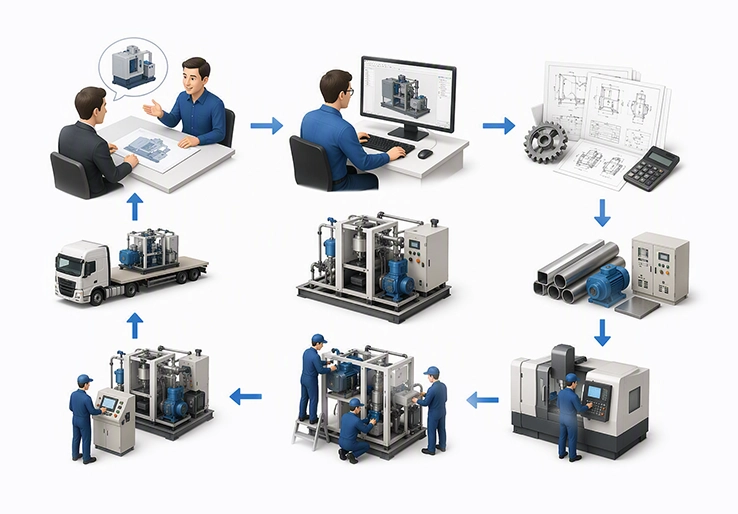
Engineer to Order (ETO) is a manufacturing strategy where every product is custom-designed, engineered, and manufactured according to a specific customer's requirements — nothing is built until the customer's unique specifications are fully understood and translated into actionable engineering plans. Unlike mass production approaches, the ETO process begins with a blank slate for each customer order, making it the most customization-intensive production method available to any manufacturing business.
This comprehensive guide covers everything you need to know about engineer-to-order manufacturing: from its foundational definition and how it compares to other manufacturing strategies, through the complete 5-stage ETO workflow, to the strategic benefits, operational challenges, and real-world examples across industries like aerospace, medical devices, and industrial equipment. Whether you're a manufacturing manager evaluating production methods, a business owner considering ETO adoption, or a professional seeking to understand how complex products are brought to life, this article provides actionable insights grounded in industry research and practice.
By the end of this guide, you will:
Engineer to order manufacturing is a production method where each product is designed, engineered, and manufactured to meet exact customer specifications. Unlike approaches that rely on a fixed design or pre-existing product templates, ETO creates unique solutions through collaborative design and engineering — every order triggers full engineering work including product design, technical specifications, material selection, and custom production planning.
The relevance of ETO in today's market cannot be overstated. Industries are demanding more customization driven by performance requirements, regulatory compliance, environmental constraints, and user experience expectations. Advances in computer-aided design (CAD), simulation tools, and digital twins have made ETO manufacturing more feasible, though the inherent complexity of producing one-of-a-kind products remains a defining challenge for ETO manufacturers.
Manufacturing strategies exist on a spectrum from full standardization to complete customization. Understanding where ETO sits relative to other approaches helps clarify when it's the right choice for a manufacturing business.
| Dimension | Make to Stock (MTS) | Assemble-to-Order (ATO) | Configure-to-Order (CTO) | Make to Order (MTO) | Engineer to Order (ETO) |
|---|---|---|---|---|---|
| Customization Level | Very Low | Low–Moderate | Moderate (variants/modules) | Moderate (existing designs customized) | Very High (new designs from scratch) |
| Design Changes Per Order | None | Minimal | Limited to configuration | Some customization | Full engineering or heavy modification |
| Finished Goods Inventory | High | Low (stocked modules) | Low–Medium | Near zero | Zero (unique product) |
| Lead Time | Days–Weeks | Weeks | Weeks–Months | Weeks–Months | Months to Years |
| Typical Industries | Consumer goods, retail | PCs, modular systems | Automotive platforms, modular machinery | Furniture, semi-custom equipment | Aerospace, industrial plants, medical devices |
Mass production in MTS is based on demand forecasts rather than individual orders, making it ideal for high-volume, low-variability products. Make to order uses existing designs with moderate customization. ATO assembles from pre-stocked modules. CTO lets customers select variants from existing configurations. ETO sits at the farthest end of the customization spectrum — engineer-to-order products are custom-designed for individual customers, with near-zero standardization and the longest lead times.
Each strategy is most appropriate based on different customer needs: MTS for commodity goods, ATO and CTO for configurable products, MTO for semi-custom items, and ETO when the customer's requirements demand entirely new engineering and design work.
Several defining characteristics set ETO apart from every other production method:
The design phase isn't a minor adjustment — it defines the entire manufactured product. Each order may involve concept design, prototyping, simulation, and compliance verification before a single component is produced.
Customers are involved throughout the ETO process providing input on design specifications. Multiple rounds of feedback, revisions, and approvals are standard. Requirements often evolve during the project, requiring constant communication to keep all parties on the same page.
The BOM doesn't exist until engineering defines it. ETO demands handling nested BOMs, frequent changes, and transformation from engineering BOM to manufacturing BOM — all while maintaining consistent part numbering across departments.
ETO projects often run months to years depending on scope, regulatory demands, and custom component sourcing. ETO often results in the slowest process due to extensive engineering and sourcing needs.
Engineering, sales teams, procurement, the production team, and finance must coordinate tightly for resource allocation, scheduling, and cost tracking. ETO requires high levels of collaboration among sales and engineering teams to achieve successful outcomes.
With these foundational concepts established, let's walk through the complete ETO process that transforms customer requests into finished products.
The ETO workflow follows a structured 5-stage process flow that moves from initial customer inquiry through engineering, manufacturing, and delivery. Each ETO order is treated as its own project with unique timelines and budgets, and every stage requires careful coordination between multiple teams. Here's how each stage works in practice.
The ETO process starts with a Request for Quote (RFQ). A potential customer approaches the manufacturer with functional, performance, regulatory, and environmental requirements for a product that doesn't yet exist in any catalog.
The sales process kicks off with the sales teams capturing detailed requirements and passing them to the engineering team for technical feasibility review. Engineers create preliminary conceptual sketches, initial BOMs, and rough routing plans. They estimate cost and lead time using historical analogs and precise cost models built from past ETO projects.
Collaboration during ETO requires iterative communication between customers and manufacturers. Quoting involves multiple rounds of refinement — trade-offs in material grade, tolerances, finishing, and delivery dates are negotiated until both parties reach agreement. Financial elements including margin estimation, risk reserves, advance payment terms, and final price structure are also finalized during this phase.
Key milestones include quote approval and technical specification agreement. Any ambiguity in the customer's requirements must be clarified before design work begins, as unclear specifications are a primary driver of cost overruns later in the project.
Design and engineering follow the RFQ approval in ETO, marking the most resource-intensive phase of the entire process. This is where the creative process of turning customer specifications into a buildable product takes shape.
The design process begins with conceptual design and moves into detailed CAD modelling, structural and thermal simulations, and regulatory compliance verification. Depending on the project, prototypes or virtual proofs of concept may be developed. Material selection, mechanical and electrical design, software development, and integration planning with existing systems all happen during this stage.
Customer input drives revision cycles throughout. The engineering team integrates feedback, evaluates cost/weight/time trade-offs, and maintains versioned documentation through PDM/PLM systems to manage changes. ETO manufacturing involves substantial upfront design and engineering hours that can be difficult to scale, making efficient engineering capacity management critical.
The stage concludes with a finalized Engineering BOM that's then transformed into a Manufacturing BOM, accounting for manufacturability, assembly sequences, and supplier availability of required materials. Accurate documentation at this stage is essential throughout the ETO process to prevent costly downstream errors.
Process planning is essential for each unique ETO project because no two products follow the same production path. This stage translates engineering outputs into actionable manufacturing plans.
Manufacturing process design includes creating customized tooling, jigs, fixtures, and specialized workflows. The production planning team determines which processes are standard and which require custom approaches. Capacity planning covers machines, skilled production work, and engineering hours, with particular attention to identifying long-lead items early — such as large forgings, specialty alloys, or components requiring regulatory approvals.
Scheduling involves creating a project timeline showing overlaps between design, procurement, and production requirements. Critical paths are identified, and what-if analysis helps assess the impact of potential delays or changes on delivery dates.
Risk management is embedded throughout: identifying points of uncertainty (supplier risk, design ambiguity, regulatory hurdles), developing contingency plans, building buffer time into schedules, and qualifying alternative suppliers. Supply chain complexity increases in the ETO process due to unpredictable procurement needs, making proactive risk planning essential.
Manufacturing in ETO involves custom components and assembly, with production workflows built specifically for each project. This is where engineering plans become physical reality.
The production process begins with setting up workflows that accommodate custom work — possibly one-off or low-volume runs that look nothing like traditional production lines. Raw materials and custom parts are procured according to the finalized BOM, with customs and import/export considerations for unique components sourced internationally.
Quality assurance is critical throughout the ETO manufacturing process. Checkpoints are established at key production stages, including in-process inspections, non-destructive testing, and regulatory testing. Customer inspections may be required at certain milestones, particularly in the aerospace industry and medical industry where safety requirements are stringent.
Final assembly integrates mechanical, electrical, and control software elements. Acceptance testing validates that the finished product meets all final specifications before it moves to delivery preparation.
The final stage of the ETO workflow extends well beyond shipping. For large industrial equipment and infrastructure projects, this stage includes installation, commissioning, and field team deployment at the customer's site.
A comprehensive documentation package accompanies every delivered product: operation manuals, maintenance guides, as-built CAD drawings, compliance certificates, and training materials for customer personnel. This accurate documentation serves as the foundation for ongoing product realization and support.
After-sale support typically includes spare parts supply, service contracts, and the ability to handle modifications or upgrades as customer needs evolve. This post-sale relationship often becomes the foundation for customer satisfaction and repeat business — a critical revenue driver for ETO companies.
With the complete process mapped out, let's examine the strategic advantages and operational challenges that define the ETO model.
ETO manufacturing offers significant strategic advantages while presenting unique operational challenges that require careful management. Understanding both sides helps organizations make informed decisions about whether the ETO model aligns with their company's inherent capabilities and market positioning.
| Benefit Category | Description | Business Impact |
|---|---|---|
| Premium Pricing | Customers pay for custom design complexity and unique solutions | Higher profit margins per project vs. commodity manufacturing |
| Competitive Differentiation | Bespoke capabilities that standard product providers cannot match | Competitive advantage in niche markets |
| Customer Loyalty | Deep collaboration builds long-term partnerships | Repeat business, reference value, and stable revenue |
| Innovation Acceleration | Each project pushes technical boundaries | Improved R&D capacity and engineering knowledge spillover |
| Market Dominance | Specialized expertise in defense, medical, satellite, process plants | Barriers to entry for generic competitors |
Advantages of ETO include high customer satisfaction and higher profit margins. Because ETO products are not commodities, strategic projects often enable cost-plus or value-based pricing that delivers substantially better margins than standard manufacturing. ETO manufacturing can provide competitive advantages in niche markets where technical excellence and the ability to deliver customized solutions define who wins contracts.
ETO allows for maximum flexibility in product design and production, enabling manufacturers to serve specialized industry requirements that no off-the-shelf product can address. The deep customer relationships formed during collaborative engineering cycles frequently yield long-term contracts and increase sales through referral and repeat business.
Despite its advantages, ETO manufacturing carries significant risks. Here are the primary challenges and proven approaches to manage them:
ETO products typically have longer lead times than standard products.
Mitigation:
Implement robust project management with defined gates and approval milestones. Use early procurement for critical-path items and maintain transparent schedule communication with customers.
Cost estimation for ETO products is often challenging due to variability. Final costs can diverge significantly from initial estimates when design complexity escalates.
Mitigation:
Build precise cost models using historical project data. Include risk reserves in quotes and establish formal change order mechanisms to capture scope expansion.
Each ETO project requires unique materials and manufacturing processes, making traditional inventory management approaches inadequate.
Mitigation:
Deploy dynamic BOM systems that adapt as engineering changes occur. Integrate procurement with engineering milestones to avoid premature ordering.
Supply chain management is critical for ETO manufacturing success, yet procurement needs are inherently unpredictable.
Mitigation:
Qualify suppliers early, develop dual-sourcing strategies for critical components, and use supplier portals for real-time visibility.
Increased complexity in design can hinder manufacturing efficiency in ETO. Engineering teams near 100% utilization experience burnout and higher defect rates. Research on ETO waste found that over-processing and waiting accounted for large portions of non-value-adding time in engineering workflows.
Mitigation:
Forecast engineering workloads, cross-train specialists, and build modularity into designs to reduce reinvention.
Limited production capacity can lead to backorders in ETO, particularly when multiple complex projects overlap.
Mitigation:
Use resource leveling tools and what-if simulation to balance workloads across ETO projects.
Higher costs are associated with ETO due to customization, but these can be managed through standardized procedures, modular design reuse, and technology-driven automation of repetitive tasks.
Technology plays a critical role in bridging the gap between ETO's complexity and operational efficiency:
ERP systems streamline the ETO manufacturing process by providing project-based architecture where all costs, revenues, and schedules are tied to individual projects. ERP enhances inventory management for ETO products and improves visibility of production costs in ETO workflows. Cloud-based ERP solutions support customization in ETO manufacturing while offering scalability as project volumes grow. ERP automates quoting and pricing for ETO manufacturers, reducing the time from RFQ to sales order.
CPQ software streamlines the ETO quoting process by using parametric models and historical data to generate accurate quotes faster — even when engineering is not fully defined.
Seamless integration between CAD/PDM/PLM systems and ERP eliminates manual data re-entry, ensures BOMs transfer accurately from engineering to production, and maintains version control across all design revisions.
These technology solutions connect directly to implementation best practices, which we'll explore after examining real-world examples.
ETO manufacturing spans multiple industries, each demonstrating how custom engineering creates value in distinct ways. ETO is common in industries like aerospace and construction, but its applications extend far beyond these sectors. Here's how various industries successfully implement ETO.
The aerospace industry is one of the most prominent ETO environments. Companies like Boeing and Airbus configure aircraft to exact airline specifications — from cabin layout and avionics packages to engine selection and fuel system design. Each aircraft order involves extensive engineering customization even when based on a common platform.
A study of Héroux-Devtek, a major aerospace landing gear supplier, found that roughly half their projects follow an ETO model. Their research revealed that project complexity — measured by uncertainty, component count, and external supplier dependencies — directly increased development time. Long-lead items such as forgings are ordered after preliminary design, and engineering structures are matrixed with temporary project teams.
Military equipment manufacturers create specialized defense systems, and satellite companies build unique mission-specific hardware — both representing pure ETO where every manufactured product is one-of-a-kind.
Custom industrial equipment manufacturing represents a core ETO application. Automation systems are engineered for specific production requirements, with mechanical design, software, and integration with existing production lines all customized per order.
In the packaging machinery sector, ETO projects for pharmaceutical and beverage companies involve stainless-steel hygiene requirements, unique product dimensions, and line integration engineering. Industry research on an energy equipment manufacturer producing custom speed reducers and multipliers showed how applying Critical Chain project management reduced overall cycle time by improving production flow through design, industrialization, supply, and manufacturing stages.
HVAC systems engineered for specific building and environmental requirements also follow the ETO model, where each installation demands unique engineering calculations, component selection, and system integration.
The medical industry relies heavily on ETO for products that must meet individual patient or facility needs. Custom prosthetics and medical implants are tailored to individual patient anatomy using advanced imaging and CAD-driven design. Each device requires unique engineering, biocompatible material selection, and rigorous regulatory compliance.
Specialized diagnostic equipment designed for specific medical applications — such as custom imaging systems or laboratory instruments configured for unique research requirements — follows the full ETO process from concept through regulatory approval. Safety requirements in medical ETO are particularly stringent, adding documentation and testing layers to every project.
Custom steel fabrication for unique architectural requirements demonstrates ETO in construction. Bridge projects designed for specific geographical conditions, soil types, and load requirements involve detailed engineering that cannot follow any standard template.
Modular construction systems adapted to client specifications represent an emerging ETO application where prefabricated building components are engineered to meet exact site conditions, energy performance targets, and aesthetic requirements. Each project demands fresh engineering analysis and custom manufacturing processes.
Successfully managing an ETO environment requires deliberate systems, processes, and cultural practices. Here are the critical success factors for ETO manufacturing optimization, distilled from industry case studies and expert guidance.
Open communication is critical for ETO success. Implement cross-functional project teams that bring sales, engineering, procurement, and the production team together with regular milestone reviews. Use collaborative platforms that keep all stakeholders on the same page — ensuring customer input flows seamlessly from sales through engineering to the manufacturing staff.
Standardized procedures can improve ETO efficiency when they focus on communication protocols: formal handoff documents between departments, regular status meetings, and shared dashboards showing project status across all active ETO projects.
Deploy ERP systems with dynamic BOM capabilities and real-time project tracking. Each ETO project should have defined gates — requirement freeze, concept approval, detailed design completion, manufacturing readiness — with formal sign-off required at each stage to limit scope creep.
Establish standardized change management procedures using formal engineering change orders (ECOs), document versioning, and full traceability. When customer requests require changes mid-project, a structured process ensures impacts on cost, schedule, and production capabilities are assessed and communicated before work proceeds. Tracking key metrics helps gauge ETO project success — monitor quote-to-order cycle time, engineering hours per project, cost variance (estimate vs. actual), and on-time delivery rates.
Maintain comprehensive project documentation with version control systems. From initial CAD drawings through final as-built records, every engineering revision must be captured and traceable. Accurate documentation is essential throughout the ETO process, serving both regulatory compliance and organizational learning.
Develop standardized quality checkpoints throughout the ETO process. While each project is unique, the quality control framework should be consistent: inspection protocols, testing requirements, and acceptance criteria defined at the process planning stage and executed rigorously during manufacturing.
Implement CPQ software to reconcile engineering complexity with sales speed. When parts of the product can be parameterized, CPQ tools allow faster quoting without sacrificing accuracy — bridging the gap between customer requests and engineering feasibility.
Use CAD integration to automate design transfer and manufacturing documentation, ensuring seamless integration between engineering outputs and production inputs. Build modular design libraries of reusable subsystems and components to reduce costs and shorten lead times on future ETO projects without sacrificing customization.
Leverage digital twins and simulation tools to accelerate the design phase, reduce physical prototyping costs, and decrease iteration cycles — especially valuable in the aerospace industry and medical device sectors where physical testing is expensive and time-consuming.
LOGIC ERP is specifically designed to address the unique complexities and challenges of Engineer to Order (ETO) manufacturing. Its project-based architecture allows manufacturers to manage each custom order as a distinct project, providing real-time visibility into costs, schedules, and resource allocation. This ensures accurate tracking from initial quoting through design, production, and delivery.
Key features that make LOGIC ERP ideal for ETO management include dynamic Bill of Materials (BOM) handling that adapts seamlessly to engineering changes, integrated quoting and pricing tools that streamline the RFQ process, and robust inventory management tailored for unique, non-standard components. Its cloud-based platform supports collaboration across sales, engineering, procurement, and production teams, enhancing communication and reducing errors.
Moreover, LOGIC ERP integrates with CAD and PLM systems to automate the transfer of engineering data into manufacturing workflows, eliminating manual re-entry and ensuring version control. Advanced scheduling and capacity planning tools help optimize resource utilization despite the variable demands of ETO projects.
By choosing LOGIC ERP, manufacturers gain a comprehensive solution that not only improves operational efficiency but also supports scalability and profitability in highly customized production environments. This up-to-date ERP system empowers businesses to deliver complex, engineered products on time and within budget while maintaining high quality and customer satisfaction.
Engineer-to-order manufacturing is the most customization-intensive production method available, enabling manufacturers to deliver unique solutions that no standard product can match. While the ETO model demands sophisticated project management, cross-functional collaboration, and technology-enabled process control, it rewards ETO companies with premium pricing, deep customer relationships, and competitive advantage in specialized markets.
To move forward with ETO or optimize your existing ETO operations:
For organizations not ready for full ETO, consider exploring Configure-to-Order (CTO) as a transitional approach — building engineering capability gradually while serving increasing customization demands. Investigate Industry 4.0 technologies including digital twins, AI-driven cost estimation, and supply chain visibility platforms to further optimize ETO performance.
Call at +91-73411-41176 / +91-73411-41175 or send us an email at sales@logicerp.com to book a free demo today!
ETO is used for complex projects like specialized machinery and aerospace. The industries that benefit most include aerospace and defense, medical devices, custom automation, infrastructure and construction, heavy machinery, energy equipment, and OEM manufacturing. Any sector where customer specifications demand unique engineering and cannot be served by off-the-shelf products is a candidate for ETO.
ETO projects often have longer lead times than standard manufacturing-ranging from several months for simpler custom equipment to 12–24 months or more for large-scale projects like industrial plants or aircraft subsystems. The timeline depends on design complexity, regulatory requirements, custom component sourcing, and the extent of customer collaboration during the design process.
ETO manufacturers need ERP systems with project-based architecture (costs and revenues tied to individual projects), dynamic BOM management, CAD/PDM/PLM integration, capacity and resource scheduling, cost estimation and quoting tools, engineering change management with revision control, real-time analytics showing planned vs. actual performance, and comprehensive supplier management capabilities.
Companies can transition gradually: start by offering configurable product lines (CTO) to build engineering flexibility, invest in CAD/PLM systems and ERP platforms that support mixed-mode manufacturing, adopt modular design practices, and begin handling small ETO projects to develop capacity and experience. Building cross-functional collaboration between sales and engineering teams is essential before taking on complex ETO projects.
ETO involves higher upfront design and engineering costs, greater working capital tied up in work-in-progress, and capital investment in engineering resources, software, and process infrastructure. Typical implementations of ETO-capable ERP systems in the mid-market range from approximately USD $75,000 to $300,000, with annual maintenance of $40,000–$150,000. However, margin per unit in ETO is often substantially higher than in standard manufacturing, and the ability to serve niche markets with unique solutions creates revenue opportunities unavailable through mass production approaches.
The ETO workflow consists of five key stages: customer requirements and quoting, design and engineering, process planning and resource allocation, manufacturing and quality control, and delivery with post-sale support. Each stage is tailored to the unique specifications of the customer, ensuring a fully customized product from concept to completion.
Inventory management in ETO manufacturing is complex due to the unique and custom nature of each product. It requires dynamic bill of materials (BOM) systems that adapt to engineering changes, precise tracking of specialized components, and close integration with procurement to avoid delays and excess inventory.
ETO products are highly customized goods designed and engineered from scratch to meet specific client requirements. They are common in industries such as aerospace, medical devices, industrial machinery, construction, and custom automation, where standard off-the-shelf products cannot fulfill the customer’s needs.
The ETO process flow begins with a Request for Quote (RFQ) and moves through iterative design and engineering phases, followed by process planning, manufacturing, quality assurance, and finally delivery and post-sale service. Each step involves close collaboration between customers and cross-functional teams to ensure the product meets exact specifications.
Accurate documentation is critical throughout the ETO process to maintain version control, ensure compliance with regulatory standards, and provide a clear reference for engineering, manufacturing, and quality teams. It helps prevent costly errors, facilitates change management, and supports ongoing product maintenance and customer support.
The design process in ETO manufacturing starts with conceptual designs based on the client’s requirements, followed by detailed computer-aided design (CAD) modeling, simulations, and iterative revisions. Customer feedback is incorporated continuously until the design is finalized and ready for manufacturing, ensuring the product precisely matches the client’s needs.
Engineer to Order is a production method in which engineering, design, and manufacturing begin only after a customer places an order. It is commonly used for custom-built products.
Common Engineer-to-Order examples include industrial machinery, custom automation systems, bridges, specialized vehicles, and large construction equipment. These products are designed specifically for each customer.
Engineer-to-Order manufacturing involves creating customized products based on customer requirements before production begins. It requires close collaboration between engineering, production, and clients.
The Engineer-to-Order meaning refers to a manufacturing strategy where products are engineered and manufactured only after receiving customer specifications. Every order is typically unique.
Engineer to Order vs Make to Order differ because ETO requires product design before manufacturing, while Make to Order produces existing designs after receiving an order. ETO involves greater customization.
The difference between Make to Order and Engineer to Order is that MTO manufactures pre-designed products, whereas ETO creates entirely new designs based on customer needs. ETO involves both engineering and manufacturing.
The Engineer-to-Order manufacturing strategy focuses on designing products according to unique customer specifications before production starts. It emphasizes flexibility and customization.
The Engineer-to-Order process flow generally includes customer inquiry, quotation, engineering design, approval, procurement, manufacturing, quality inspection, and delivery. Each stage depends on customer requirements.
Engineer to Order software helps businesses manage engineering, BOMs, project planning, production, inventory, and costing for customized manufacturing. It streamlines complex workflows.
An example of Engineer to Order is manufacturing a custom power plant, industrial crane, or specialized production line designed specifically for one customer. Each project requires unique engineering.
Make to Order vs Engineer to Order differ because MTO manufactures standard designs after receiving orders, while ETO requires new engineering before production. ETO is more suitable for highly customized products.
Engineer to Order product examples include aircraft components, custom manufacturing equipment, industrial robots, offshore platforms, and specialized medical devices. These products are engineered for specific customer needs.
Engineer-to-Order examples include customized packaging machines, power generation equipment, heavy engineering projects, and tailor-made industrial systems. These products require unique engineering.
Engineer-to-Order manufacturing enables businesses to produce highly customized products after completing engineering and design activities. It is widely used in capital equipment industries.
Engineer to Order meaning refers to producing customized products where engineering starts only after receiving a customer's order. It ensures every product meets unique requirements.
Engineer to Order vs Make to Order compares two manufacturing methods where ETO includes product design after ordering, while MTO produces existing designs based on demand. ETO provides greater customization.
The difference between Make to Order and Engineer to Order is that MTO builds products using existing designs, while ETO creates new designs before manufacturing. ETO requires engineering involvement.
Engineer to Order (ETO) allows businesses to engineer, manufacture, and deliver products based on unique customer specifications. It is commonly used in project-based industries.
The Engineer-to-Order manufacturing strategy helps companies deliver customized products by completing engineering before production. It supports complex manufacturing projects.
The Engineer-to-Order process flow starts with customer requirements and continues through engineering, procurement, manufacturing, quality checks, and delivery. Each stage is customized.
Engineer-to-Order software improves collaboration between engineering and production while managing customized manufacturing projects efficiently. It also helps control costs and timelines.
An example of Engineer to Order is designing and manufacturing a custom conveyor system or industrial processing plant based on customer specifications. Every project is unique.
To determine the firing order of an engine, identify the cylinder numbering, crankshaft configuration, and camshaft timing sequence. The manufacturer's specifications provide the exact firing order.
Make to Order vs Engineer to Order compares manufacturing methods where MTO uses standard product designs and ETO develops new designs before production. ETO is ideal for customized solutions.
Engineer to Order product examples include custom turbines, specialized mining equipment, industrial plants, marine vessels, and heavy engineering machinery. These products require customer-specific engineering.
Popular Products