Make to stock (MTS) is a production strategy where companies manufacture products in advance based on demand forecasts, holding finished goods in inventory so that customer orders can be fulfilled immediately.
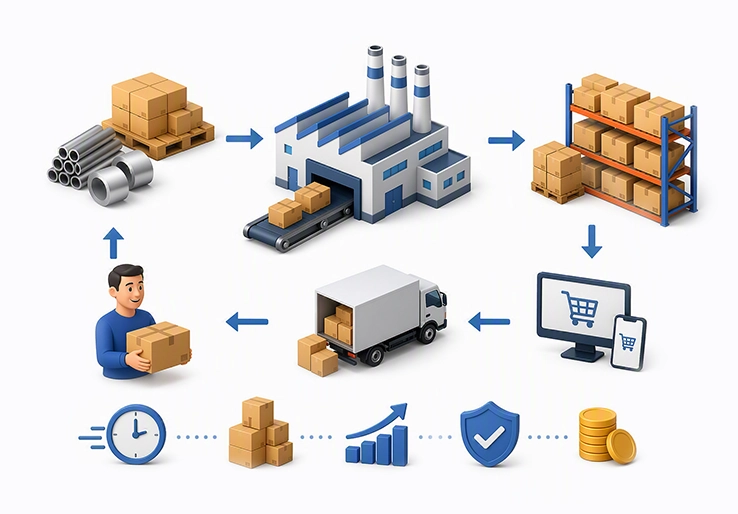
Make to stock (MTS) is a production strategy where companies manufacture products in advance based on demand forecasts, holding finished goods in inventory so that customer orders can be fulfilled immediately. Rather than waiting for a customer to place an order before starting production, MTS anticipates customer demand and builds inventory proactively — making it one of the most widely adopted manufacturing strategies for standardized, high-volume products.
This complete guide covers everything manufacturing professionals need to know about the make to stock MTS approach: how the manufacturing process works from forecast to fulfillment, its key benefits and inherent risks, step-by-step implementation guidance, real-world make to stock examples across industries, and how it compares to alternatives like make to order and assemble to order. Whether you're a manufacturing manager evaluating production strategies, a supply chain professional optimizing inventory levels, or a business owner considering ERP system integration, this guide provides the depth and actionable detail you need.
By the end of this guide, you will:
Make to stock MTS is a manufacturing strategy where production decisions are driven by anticipated consumer demand rather than by actual customer orders. Companies using this approach analyze historical sales data, market trends, and seasonal patterns to predict future demand, then schedule production accordingly. The goal is straightforward: have finished goods ready and waiting when a customer places an order, enabling rapid delivery and high product availability.
MTS differs fundamentally from other production strategies in its relationship to the customer order. In make to order manufacturing, production begins only after a customer places an order. In the MTS model, the entire production process — from procuring raw materials to final assembly — is completed before any specific order exists. This distinction makes MTS particularly relevant for modern manufacturing environments where speed of delivery and consistent demand fulfillment are competitive advantages.
The foundation of any successful make to stock strategy rests on several interconnected components:
Demand forecasting is the single most critical element. Companies use historical sales data, statistical methods (such as time-series analysis and exponential smoothing), and increasingly, AI-powered analytics to generate demand predictions. Accurate demand forecasting minimizes the risk of stockouts while preventing costly overproduction. Forecast error metrics like MAPE (Mean Absolute Percentage Error) directly determine how much safety stock a company needs to maintain.
Production planning and scheduling translates forecasts into actionable manufacturing plans. A Master Production Schedule (MPS) specifies how much to produce, when to produce it, and for which SKUs — while accounting for production capacity constraints, changeover times, and workforce availability. The ability to schedule production efficiently against forecasted demand is what separates high-performing MTS operations from those struggling with excess inventory.
Inventory management ties the entire system together. MTS operations must manage finished goods inventory, work-in-progress, and raw materials simultaneously. This involves setting safety stock levels, calculating reorder points, tracking stock levels in real time, and using classification methods like ABC analysis to prioritize manufacturing resources across the product portfolio.
Make to stock operates as a classic push system — production is "pushed" through the manufacturing process based on anticipated demand rather than "pulled" by actual customer orders. In a push system, the decoupling point (where forecast-driven planning meets order-driven execution) sits as close to the customer as possible. Products are fully manufactured and stored before any sale occurs.
This contrasts sharply with pull production systems like make-to-order (MTO), where each unit of production is triggered by a confirmed customer order. In MTO, inventory of finished goods is minimal or nonexistent; in MTS, finished goods inventory is deliberately high to ensure immediate availability.
The relationship between forecasted demand and production timing is what defines MTS performance. When demand predictions align closely with actual demand, the system operates efficiently — products flow smoothly from factory to warehouse to customer. When forecasts miss, the consequences manifest as either stockouts (lost sales and damaged customer loyalty) or overproduction (high inventory holding costs, potential inventory obsolescence, and strained cash flow).
Understanding this push-based nature is essential before moving into practical implementation, because every decision in the MTS process — from forecast methodology to safety stock calculations — flows from the fundamental premise that production must happen before demand materializes.
With the foundational concepts established, the next step is understanding how to actually implement a make to stock strategy. The MTS manufacturing process follows a structured sequence, from initial demand analysis through distribution of finished goods, supported by integrated technology systems at every stage.
MTS is best suited for standardized products with predictable demand, high volume, and relatively stable product life cycles. Here is the step-by-step process for implementation:
Assess demand stability across your entire product portfolio. Segment SKUs into categories based on volume, variability, and customization requirements. Products with consistent demand and low customization are prime MTS candidates. Use past data including sales history, seasonal patterns, and external market indicators to establish baseline demand profiles.
Apply statistical or machine learning forecasting methods to generate demand predictions for each SKU. Companies use historical sales data for demand forecasting alongside techniques like ARIMA, exponential smoothing, and hierarchical forecasting. Demand forecasting helps optimize production schedules effectively, and the quality of your forecasts determines everything downstream. Research shows SMB distributors using AI forecasting tools achieve 80–92% forecast accuracy, compared to 60–70% using spreadsheets alone.
Build a Master Production Schedule from your forecasts. Level-load production to smooth peaks and troughs, integrate changeover times between product variants, and compute capacity constraints including machine availability, workforce capacity, and supplier lead times. This is where production efficiency is either built in or lost.
Determine safety stock levels per SKU, calculate reorder points, and establish min/max inventory levels. Use ABC analysis to allocate resources — "A" items (high-value, high-volume) get the most attention. Track days-of-inventory on hand and monitor raw materials and work-in-progress to prevent bottlenecks. A robust inventory management system is essential at this stage.
During the production process, monitor scrap rates, rework levels, and yield. Collect OEE (Overall Equipment Effectiveness) data at machine and bottleneck levels using Manufacturing Execution Systems (MES). Feed actual performance data back into planning assumptions to continuously refine forecasts and production schedules.
Move finished goods into warehousing and distribution channels. Implement replenishment logic (reorder point, periodic review, or min/max) appropriate to each product category. For companies with multiple warehouse locations, location-level stock visibility becomes critical. Effective distribution management ensures products reach customers quickly.
Successful MTS implementation depends on integrated technology infrastructure:
ERP Systems must support forecast ingestion, Master Production Scheduling, order release logic, capacity planning, and multi-echelon inventory management. The ERP should enable what-if scenario simulation, connect production planning with financial planning, and provide real-time visibility across the entire supply chain. Manufacturing ERP solutions like LOGIC ERP provide these capabilities in an integrated platform.
MES (Manufacturing Execution Systems) capture real-time shop-floor data — machine cycles, downtime, scrap, quality events — and feed this information into planning systems. Without MES data, production planning relies on assumptions rather than actuals, leading to capacity miscalculations and inflated safety stock requirements.
Inventory Management Software provides dashboards for stock levels, automated alerts for stockouts or excess inventory, and tracking of safety stock and reorder points. Integration with point-of-sale data enables demand sensing for faster response to market changes.
Analytics and Forecasting Tools range from statistical forecasting modules to advanced machine learning platforms that handle demand volatility, seasonality, and promotional impacts on consumer demand.
Every production strategy involves trade-offs. MTS offers significant advantages for the right products and markets, but carries inherent risks that must be actively managed. Understanding both sides is essential for making accurate sales forecasts about whether MTS fits your business.
MTS allows for rapid delivery of products stored in inventory. Because finished goods are already manufactured and warehoused, customer orders can be fulfilled in hours or days rather than weeks. MTS reduces customer wait times by having products ready for shipment — a critical advantage in markets where immediate delivery drives purchasing decisions and customer satisfaction.
MTS can achieve economies of scale through bulk production. Producing in larger batches reduces per-unit costs through fewer machine setups, better utilization of labor and equipment, and volume discounts on raw materials. For mass production environments, these cost efficiencies can be substantial.
When demand is stable and well-forecasted, production schedules become more continuous and predictable. Fewer peaks and valleys in production mean better machine utilization, more predictable staffing needs, and reduced overtime costs. This production efficiency translates directly to lower manufacturing costs per unit.
Product availability drives customer loyalty in many markets. When customers can consistently find what they need in stock and receive faster delivery, satisfaction increases and repeat purchasing follows. MTS is common for high-volume, standard products with stable demand precisely because availability is the primary competitive differentiator.
MTS involves high inventory holding costs for storing large quantities of finished goods. In US manufacturing and distribution, carrying costs average 20–30% of inventory value per year, encompassing warehousing, capital costs, insurance, depreciation, and taxes. High inventory holding costs are a risk in MTS strategies that cannot be eliminated — only optimized.
MTS relies heavily on accurate demand forecasting to minimize risks. Inaccurate forecasts can lead to overproduction or stockouts. When forecasts overestimate demand, companies face excess inventory, potential write-downs, and strained cash flow. When forecasts underestimate actual demand, stockouts result in lost sales — globally, stockouts cost businesses approximately $1.77 trillion annually.
Products with short life cycles — particularly in consumer electronics, fashion, and technology — face the risk of inventory obsolescence before items can be sold. Seasonal goods risk expiration or becoming irrelevant, turning finished goods inventory into a liability rather than an asset.
MTS is best for standardized products with predictable demand. Once production is scheduled and stock is built, accommodating changes in customer preferences or shifting product specifications becomes difficult and expensive. Companies requiring high customization typically need alternative strategies.
Understanding the key differences between production strategies helps determine the right fit:
| Criterion | Make to Stock (MTS) | Make to Order (MTO) | Assemble to Order (ATO) |
|---|---|---|---|
| Lead Time to Customer | Very short (hours to days) | Long (weeks or more) | Moderate (days to weeks) |
| Inventory Costs | High (finished goods + raw materials) | Low (raw materials/WIP only) | Moderate (module inventory) |
| Customization Level | Low (standard products) | High (built per customer spec) | Medium (configurable) |
| Forecast Dependency | Very high (forecast-critical) | Low (order-driven) | Medium (module-level forecasting) |
| Best For | High-volume, stable demand products | Complex, customizable products | Configurable product families |
Make-to-Order produces goods only after receiving customer orders, which allows for high levels of product customization. MTO allows high customization but has longer lead times, and MTO minimizes waste by producing only what customers order. MTO is ideal for complex and customizable products where each customer places unique requirements.
In contrast, assemble to order maintains an inventory of pre-built modules and completes final assembly only when an order arrives — balancing customization with speed.
Many companies use a hybrid strategy combining MTS and MTO, segmenting their product portfolio so that high-volume standard items run under MTS logic while customizable or low-volume products follow an MTO production strategy. This hybrid approach allows businesses to meet customer expectations across different product lines without committing entirely to one model.
Make to stock is the dominant production strategy across industries where anticipated customer demand is predictable, products are standardized, and speed of delivery is a competitive requirement.
Consumer electronics manufacturers rely heavily on MTS for standard models of smartphones, laptops, tablets, and accessories. Companies like Samsung and Apple produce millions of units of flagship devices in advance of launch dates, using demand predictions built from pre-order data, market trends, and historical sales patterns.
Seasonal demand patterns — holiday shopping periods, back-to-school seasons, and product launch cycles — require manufacturers to schedule production months in advance. The production period leading up to peak selling seasons involves ramping up mass production of anticipated high-demand SKUs while maintaining safety stock of ongoing product lines.
FMCG and packaged food/beverage industries represent classic make-to-stock examples. Grocery items, personal care products, cleaning supplies, and beverages are produced weeks ahead of anticipated consumer demand, with production planning accounting for promotional campaigns, holiday spikes, and regional consumption patterns.
These products share characteristics that make MTS ideal: steady demand, short purchase decision cycles, low unit customization, and customer expectations for immediate availability on retail shelves. A food manufacturer, for example, cannot wait for a grocery store to place an order before beginning production — the supply chain requires finished goods ready for immediate sale and distribution.
Standard automotive components — filters, bearings, brake pads, hoses, and fasteners — are manufactured using MTS for both OEM assembly lines and aftermarket sales channels. These parts have predictable demand driven by vehicle population data, maintenance cycles, and replacement rates.
A notable case study from McKinsey illustrates the impact of optimized MTS: a global industrial-vehicles company reclassified 40% of its parts from buy-to-order to buy-to-stock, improved forecasting algorithms, and achieved over 90% on-time delivery while reducing inventory by 15%. In another documented case, a large MTS manufacturer implemented workload control in its order release process and reduced lead times by approximately 40% with substantially reduced lead time variation.
Optimizing MTS effectiveness requires excellence in three areas: forecasting accuracy, inventory management discipline, and technology integration. Companies that treat these as interconnected systems — rather than isolated functions — consistently outperform those that don't.
Accurate forecasting is the single most impactful lever in MTS performance. Demand forecasting is crucial for aligning production with customer needs, and companies should employ multiple approaches:
Effective inventory control prevents both the cost of excess inventory and the revenue loss from stockouts:
An integrated ERP platform transforms MTS from a manual planning exercise into a data-driven, responsive system. LOGIC ERP supports MTS operations through:
When ERP connects directly with MES shop-floor data, planning assumptions stay calibrated to actual production performance rather than drifting into inaccuracy over time.
Even well-designed MTS systems encounter obstacles. The key is having systematic solutions rather than reactive responses.
The problem:
Inaccurate forecasts can lead to overproduction or stockouts, with cascading effects on inventory costs, customer satisfaction, and working capital.
Solution:
Implement ensemble forecasting that combines multiple model outputs. Incorporate both internal data (sales history, promotional calendars) and external signals (economic indicators, competitor activity, weather patterns). Establish regular forecast consensus meetings across sales, marketing, and operations. Use machine learning tools to detect patterns that statistical models miss. Track and report forecast error (MAPE, bias) monthly, holding teams accountable for continuous improvement.
The problem:
MTS can lead to overproduction and high inventory holding costs when expected demand doesn't materialize, tying up working capital and warehouse space in slow-moving or obsolete stock.
Solution:
Implement SKU rationalization — regularly review the product portfolio and eliminate items with declining demand or poor margins. Use dynamic pricing and promotional planning to accelerate movement of slow-moving stock before it becomes obsolete. Develop supplier collaboration agreements that allow flexible production adjustments when demand signals shift. Consider modular product design or delayed differentiation to reduce the number of unique finished goods SKUs while maintaining product variety.
The problem:
Sudden market changes — economic shifts, competitive disruptions, supply chain disruptions, or rapid changes in customer preferences — can invalidate forecasts and leave companies with incorrect stock level readings relative to actual demand.
Solution:
Adopt hybrid MTS-MTO strategies for product segments where demand uncertainty is high. Maintain some SKUs under MTS for stable base demand while shifting volatile or low-volume items to make to order manufacturing. Invest in flexible manufacturing systems that can adjust production volumes and product mix quickly. Use demand sensing techniques that incorporate real-time point-of-sale data and market signals to detect demand shifts earlier. Build agile production planning processes with shorter planning cycles during periods of elevated uncertainty.
These challenges are manageable with the right combination of analytical rigor, technology support, and organizational discipline.
LOGIC ERP is designed to streamline and optimize make to stock (MTS) operations by integrating advanced demand forecasting, production planning, and inventory management into a single platform. Its robust inventory management system enables manufacturers to manage inventory effectively, reducing excess stock and minimizing stockouts. LOGIC ERP supports accurate demand forecasting using AI-powered analytics, which helps prevent overproduction and the associated high inventory holding costs common in MTS strategies.
By automating production scheduling and providing real-time visibility into inventory levels and production status, LOGIC ERP helps reduce lead times and improve manufacturing efficiency. It also facilitates better coordination across supply chain functions, ensuring that raw materials and finished goods are available when needed, which lowers higher production costs linked to inefficiencies.
Moreover, LOGIC ERP's scalable architecture supports businesses of all sizes in manufacturing products across various industries, enabling them to leverage economies of scale while maintaining flexibility. With comprehensive reporting and analytics, companies can continuously monitor key performance indicators, optimize resource allocation, and enhance overall operational performance.
Choosing LOGIC ERP for your make to stock management means gaining a competitive edge through improved production control, reduced inventory costs, and the ability to meet customer demand swiftly and reliably.
Make to stock remains one of the most effective production strategies for businesses manufacturing standardized products with predictable demand. When executed well — with accurate forecasting, disciplined inventory management, and integrated technology — MTS delivers the speed, cost efficiency, and customer satisfaction that competitive markets demand. MTS produces goods based on demand forecasts for immediate delivery, and its success depends entirely on how well each component of the system performs.
To begin evaluating or optimizing MTS for your business:
For manufacturers looking to deepen their supply chain management capabilities, related topics worth exploring include lean manufacturing principles for reducing waste within MTS operations, just-in-time procurement strategies for raw materials, and hybrid production models that combine MTS with make to order and assemble to order approaches across different product segments.
Call at +91-73411-41176 / +91-73411-41175 or send us an email at sales@logicerp.com to book a free demo today!
Make to stock is a manufacturing strategy where products are produced before customer orders arrive, based on demand forecasts. Finished goods are held in inventory so that when a customer places an order, the product is available for immediate shipment, reducing wait times significantly.
MTS is ideal for standardized products with predictable demand. Industries that benefit most include FMCG (food, beverages, personal care), consumer electronics (standard models), automotive parts manufacturing (replacement components), building materials, and household goods-anywhere products are standardized and demand is relatively stable.
Depending on scope-number of SKUs, system complexity, and organizational readiness-transitioning to or optimizing an MTS strategy typically takes 3 to 12 months. This includes forecasting system setup, ERP/MES configuration, process redesign, and pilot testing on select product lines before full rollout.
Key costs include inventory carrying costs (typically 20–30% of inventory value annually), forecasting system and ERP implementation costs, warehousing and handling expenses, and the opportunity cost of working capital tied up in finished goods. These must be weighed against benefits like reduced per-unit production costs and faster customer fulfillment.
The key differences center on timing and customization. MTS produces in advance for immediate sale from stock; MTO produces only after receiving customer orders. MTO allows high customization but has longer lead times. MTO minimizes waste by producing only after receiving orders, while MTS carries the risk of excess inventory but delivers faster. MTO is ideal for complex, customizable products; MTS suits high-volume standardized items.
At minimum, businesses need an ERP system with production planning and inventory management capabilities, demand forecasting tools (statistical or AI-based), and ideally MES for shop-floor data collection. Cloud based solutions increasingly provide these capabilities in integrated platforms accessible to mid-market manufacturers.
Companies use historical sales data combined with statistical methods, machine learning algorithms, and external data sources (market trends, economic indicators, promotional calendars) to improve accuracy. Regular forecast review cycles, consensus planning across departments, and demand sensing from point-of-sale data are proven techniques for making accurate sales forecasts.
Critical success metrics include on-time-in-full (OTIF) delivery rate, inventory turnover ratio, forecast accuracy (MAPE), stockout rate, days of inventory on hand, carrying cost as a percentage of inventory value, and OEE at production bottlenecks. These metrics collectively indicate whether the MTS system is performing efficiently.
Yes. Many companies use a hybrid strategy combining MTS and MTO, segmenting their product portfolio based on demand predictability, customization requirements, and margin profiles. High-volume standard products run under MTS while low-volume, customizable items follow MTO-allowing businesses to meet customer demand across diverse product lines without overcommitting to either approach.
MTS operations manage seasonality through advanced planning-building inventory ahead of peak periods based on historical seasonal patterns and market intelligence. Safety stock levels are adjusted dynamically for the next production period, and production capacity is ramped up or down according to seasonal forecasts. Effective ERP systems automate much of this seasonal adjustment through integrated planning modules.
Make to stock is a manufacturing strategy where products are produced before customer orders arrive, based on demand forecasts. Finished goods are held in inventory so that when a customer places an order, the product is available for immediate shipment, reducing wait times significantly.
MTS is ideal for standardized products with predictable demand. Industries that benefit most include FMCG (food, beverages, personal care), consumer electronics (standard models), automotive parts manufacturing (replacement components), building materials, and household goods—anywhere products are standardized and demand is relatively stable.
Depending on scope: number of SKUs, system complexity, and organizational readiness, transitioning to or optimizing an MTS strategy typically takes 3 to 12 months. This includes forecasting system setup, ERP/MES configuration, process redesign, and pilot testing on select product lines before full rollout.
The key differences center on timing and customization. MTS produces in advance for immediate sale from stock; MTO produces only after receiving customer orders. MTO allows high customization but has longer lead times. MTO minimizes waste by producing only after receiving orders, while MTS carries the risk of excess inventory but delivers faster. MTO is ideal for complex, customizable products; MTS suits high-volume standardized items.
At minimum, businesses need an ERP system with production planning and inventory management capabilities, demand forecasting tools (statistical or AI-based), and ideally MES for shop-floor data collection. Cloud-based solutions increasingly provide these capabilities in integrated platforms accessible to mid-market manufacturers.
Critical success metrics include on-time-in-full (OTIF) delivery rate, inventory turnover ratio, forecast accuracy (MAPE), stockout rate, days of inventory on hand, carrying cost as a percentage of inventory value, and overall equipment effectiveness (OEE) at production bottlenecks. These metrics collectively indicate whether the MTS system is performing efficiently.
Yes. Many companies use a hybrid strategy combining MTS and MTO, segmenting their product portfolio based on demand predictability, customization requirements, and margin profiles. High-volume standard products run under MTS while low-volume, customizable items follow MTO, allowing businesses to meet customer demand across diverse product lines without overcommitting to either approach.
MTS operations manage seasonality through advanced planning, building inventory ahead of peak periods based on historical seasonal patterns and market intelligence. Safety stock levels are adjusted dynamically for the next production period, and production capacity is ramped up or down according to seasonal forecasts. Effective ERP systems automate much of this seasonal adjustment through integrated planning modules.
Make to Forecast (MTF), like Make to Stock (MTS), produces goods based on demand forecasts before customer orders to keep inventory ready for immediate delivery. Both rely on accurate forecasting to avoid excess stock or shortages. However, MTF may include additional forecasting layers or methods depending on the industry, while MTS focuses specifically on finished goods inventory for direct customer fulfillment.
Make to Order (MTO) produces the entire product after customer orders, allowing full customization but resulting in longer lead times. Assemble to Order (ATO) is a hybrid strategy where components are produced and stocked based on forecasts, but final assembly happens after the order. ATO offers faster delivery than MTO while still allowing some customization. It is suitable for modular products where customers configure options from predefined components, balancing sales opportunities and inventory costs.
APS software improves production management by enabling businesses to create flexible plans that match customer demand, reduce waste, and optimize resources. It allows real-time adjustments to production schedules based on market changes, increasing responsiveness and keeping operations running smoothly.
Demand forecasting aligns production strategy with actual customer needs, reducing the risk of overproduction and stockouts. Accurate forecasts maximize resource efficiency, improve operational performance, and help businesses decide between strategies like MTS and MTO based on demand predictability and customization requirements.
Accurate forecasting is critical for make to stock (MTS) as it helps predict customer demand precisely, enabling manufacturers to produce the right quantities of products in advance. This minimizes risks of overproduction or stockouts, optimizes inventory levels, and ensures smooth production scheduling, ultimately improving operational efficiency.
Customer satisfaction is a key benefit of MTS since products are readily available in inventory, allowing for rapid order fulfillment and reduced customer wait times. High product availability and fast delivery enhance customer loyalty and competitive advantage in markets where speed is crucial.
Lean manufacturing helps reduce waste and inefficiencies in MTS by streamlining production workflows, minimizing excess inventory, and improving quality control. Applying lean techniques ensures that resources are used effectively while maintaining sufficient stock to meet forecasted demand without overproduction.
Reducing customer wait times involves maintaining optimal inventory levels through accurate demand forecasting, implementing efficient production scheduling, and using real-time inventory tracking systems. Quick replenishment and effective distribution networks also contribute to faster delivery.
Examples of MTS include consumer electronics companies like Apple and Samsung producing flagship smartphones in advance, FMCG manufacturers preparing packaged foods and beverages ahead of demand, and automotive parts suppliers stocking standard replacement components for rapid fulfillment.
Inventory levels directly influence the ability to meet customer demand promptly. Maintaining appropriate safety stock prevents stockouts, while avoiding excessive inventory reduces holding costs. Effective inventory management balances supply with forecasted demand to optimize costs and service levels.
Consumer demand directly impacts MTS by guiding the forecasting process that determines what and how much to produce. Accurate demand predictions enable companies to maintain optimal inventory levels, minimize risks of stockouts or overstock, and ensure timely delivery to customers, making consumer demand a key factor in successful MTS implementation.
A stock statement is created by listing available inventory along with quantities, values, purchase details, and stock movement information.
Popular Products