Maintenance Management
Automates preventative maintenance scheduling to reduce downtime and extend equipment lifespan. Maintenance management ensures timely upkeep, minimizing unplanned stoppages and improving overall production reliability.

A Manufacturing Execution System (MES) monitors, controls, and documents the transformation of raw materials into finished goods in real time — bridging high-level business planning and the physical machines on your shop floor, so you get complete visibility into every step of your production cycle.
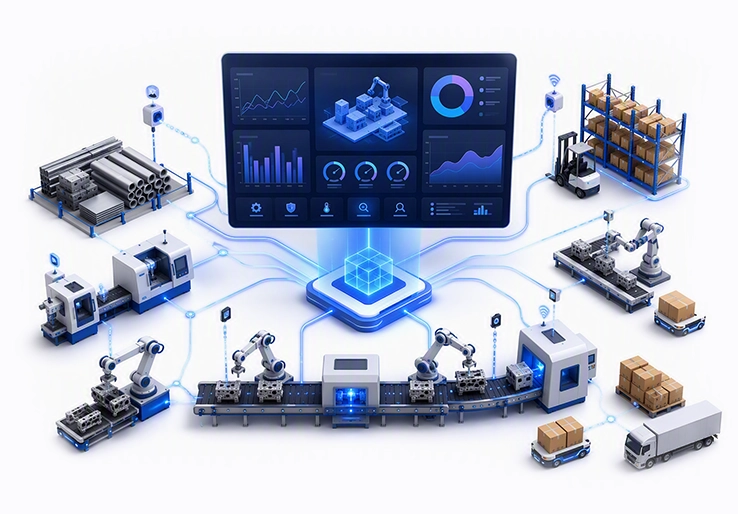
A Manufacturing Execution System (MES) is digital software that monitors, controls, and documents the transformation of raw materials into finished goods in real time. It bridges high-level business planning systems like ERP and the physical manufacturing machines on your shop floor giving you complete visibility into every step of your production cycle. For discrete manufacturers, process manufacturers, multi-plant operations, and growing manufacturers that need better production efficiency, quality management, and real-time control, MES replaces blind spots and disconnected data with live production insight you can act on.
This guide explains what MES is, how it works, which core features and use cases matter most, how it integrates with ERP systems and equipment, what implementation typically looks like, and how different MES software packages fit different manufacturing environments. If your manufacturing operations suffer from reactive decision-making, quality issues, wasted output, or limited shop floor visibility, LOGIC ERP’s MES solution is built to solve those problems at the source and turn production data into faster decisions, stronger quality control, and a clearer competitive edge.
Most manufacturers today operate with a critical gap between what their enterprise resource planning systems plan and what actually happens on the plant floor. Production schedules drift. Quality issues go undetected until it’s too late. Operators rely on spreadsheets, paper logs, and tribal knowledge to manage production execution. The result: wasted materials, missed deadlines, and eroding margins.
You’re not alone. Across the manufacturing industry, companies struggle with disconnected systems that make real time visibility impossible. Work in progress sits untracked. Defects multiply through entire batches before anyone notices. Equipment breaks down without warning, and nobody can pinpoint exactly where the production process lost efficiency.
LOGIC ERP’s manufacturing execution system was built to close that gap permanently. It delivers real-time production data from every machine, operator, and sensor directly into a unified platform — optimizing production processes, enforcing quality control measures, and reducing waste without requiring months of complex integration work. In modern manufacturing, transitioning to MES is essential for smart factory environments, and LOGIC ERP makes that transition fast, practical, and measurable.
MES solutions are critical for optimizing operational efficiency and maintaining compliance in manufacturing. Whether you run a single production line or manage operations across multiple plants, our MES software acts on live data to control and document the production of goods — giving you the operational excellence that spreadsheets and disconnected systems simply cannot deliver.
Eliminate blind spots on the shop floor with live monitoring of every machine, line, and operator. MES provides real-time visibility into plant operations, so you always know exactly where production stands against schedule. Real-time data collection enhances decision-making in manufacturing by replacing guesswork with facts.
MES integrates with ERP and other systems for seamless data exchange, eliminating data silos between planning and execution. Production orders, bills of materials, and routing flow down from ERP; actuals, scrap, quality data, and labor hours flow back up. Integration enhances overall efficiency and decision-making across your entire operation.
Reduce defects and rework through continuous monitoring with built-in quality management tools. Enhanced quality control leads to fewer defects and reworks by catching nonconformances at the source not at final inspection. Statistical process control and automated quality assurance keep every production unit within specification.
MES provides detailed inventory management to avoid shortages and minimize waste by tracking materials in real time. This ensures materials are available when needed, improving production continuity and minimizing excess stock.
Automates preventative maintenance scheduling to reduce downtime and extend equipment lifespan. Maintenance management ensures timely upkeep, minimizing unplanned stoppages and improving overall production reliability.
Optimizes allocation of machines, labor, and materials to maximize throughput and minimize idle time, improving operational efficiency.
Advanced MES platforms incorporate predictive analytics and machine learning to forecast equipment failures, optimize schedules, and enhance performance analysis for continuous improvement.
Deploy quickly with minimal disruption to existing operations. Our rapid deployment approach takes days, not the months that traditional MES implementations demand. MES automates data collection, reducing human error in ERP and across shop floor operations from day one.
Grow from single production lines to multi-plant operations effortlessly. Whether you need cloud-based MES, on-premise deployment, or a hybrid model with edge-to-cloud connectivity, the architecture scales with your business without forcing a rip-and-replace.
A manufacturing execution system MES operates at the critical layer between your ERP systems (which define what should be produced, when, and at what cost) and the process control systems that run your machines. While ERP thinks in days and weeks, MES thinks in seconds and minutes tracking production performance, managing production execution, and synchronizing operational activities on the shop floor in real time. MES collects data from machines, sensors, and operators to give you a complete digital picture of how your manufacturing process actually performs.
MES solutions are critical for optimizing operational efficiency and maintaining compliance in manufacturing. They improve production output and visibility, reduce waste by minimizing waste, and increase profitability for manufacturers. Real-time data collection enhances decision-making, while enhanced quality control leads to fewer defects and reworks. MES simplifies compliance with regulatory standards through traceability, ensuring your products meet industry requirements consistently. The system supports standard operating procedures to maintain consistency and compliance across production operations.
MES integrates with ERP for seamless data exchange, eliminating data silos between planning and execution. Production orders, bills of materials, and routing flow down from ERP; actuals, scrap, quality data, and labor hours flow back up. Integration enhances overall efficiency and decision-making across your entire operation. Successful integration requires middleware for data mapping in traditional deployments, but LOGIC ERP’s native MES integration architecture reduces complexity and maintenance overhead. This integration supports data analysis and performance analysis to impact production schedules positively.
Getting results from MES doesn’t require years of consulting, massive capital expenditure, or a team of specialists. LOGIC ERP’s implementation process is structured for speed and measurable outcomes.
We begin with a quick but thorough evaluation of your current manufacturing processes, system landscape, data readiness, and digital maturity. This includes assessing your existing systems legacy systems, PLCs, SCADA, sensors and identifying the fastest path to connectivity and value.
The onboarding process is designed to take days, not months. We standardize workflows, clean data pipelines, and configure the system for your specific production environment before anything goes live. No extended discovery phases. No scope creep.
Once connected, our MES begins automated real-time data collection from your manufacturing equipment, sensors, and operator inputs. Common protocols including OPC-UA, MQTT, barcode, and RFID are supported out of the box. MES collects real-time data from machines and sensors, processing it immediately to identify bottlenecks, downtime patterns, and optimization opportunities.
This is where the system starts delivering value. Production data flows seamlessly between the shop floor and your business systems, creating a single source of truth for every production order, every batch, and every quality checkpoint. MES automates data collection and reduces human error across every touchpoint.
Clear dashboards display Overall Equipment Effectiveness (OEE) measuring machine uptime and performance along with quality metrics, cycle times, throughput, scrap rates, and key performance indicators customized to your operation. A digital MES provides real-time decision making for production processes, turning collected data into immediate action.
You implement clear, prioritized improvements and track the results in real time. No guesswork. No waiting for end-of-month reports. Just structured, continuous progress toward operational excellence with every improvement documented and measurable.
LOGIC ERP’s MES is pre-configured for automotive, electronics, food & beverage, pharmaceutical, and discrete manufacturing environments. Important applications of MES include pharmaceuticals and aerospace industries, where regulatory compliance and traceability are non-negotiable. MES solutions help manufacturers in these regulated industries maintain product quality, ensure product traceability, and meet strict regulatory requirements efficiently.
Most MES vendors focus on technical features. LOGIC ERP focuses on business outcomes with native ERP integration, industry-specific configurations, and edge-to-cloud connectivity. Traditional MES implementations often require complex middleware and long timelines, whereas LOGIC ERP offers rapid deployment, scalable architecture, and user-friendly interfaces that empower operations managers.
| Feature | LOGIC ERP MES Systems | Other MES Systems |
|---|---|---|
| ERP Integration | Native, seamless integration without complex middleware | Often requires third-party middleware, increasing complexity and cost |
| Scalability | Supports single lines to multi-plant operations with cloud, on-premise, or hybrid deployment | Limited scalability; often requires system replacements for growth |
| Predictive Maintenance | AI and machine learning-powered predictive maintenance for proactive asset management | Primarily reactive maintenance with limited predictive capabilities |
| Deployment Speed | Rapid deployment with minimal disruption and intuitive interfaces | Lengthy implementation cycles with complex customization |
| User Experience | User-friendly, configurable dashboards and workflows tailored to diverse environments | Often complex interfaces requiring specialized training |
| Traceability & Quality Control | Comprehensive real-time tracking from raw materials to finished goods with regulatory compliance support | Varies; some systems lack full traceability or have limited quality control features |
| Data Accuracy & Real-Time Visibility | Real-time data collection and analysis for immediate decision-making | May have delays or less accurate data due to manual inputs or siloed systems |
| Resource Optimization | Advanced resource scheduling and utilization optimization | Basic scheduling with limited optimization features |
| Support for Industrial Internet | Built to leverage industrial internet technologies for enhanced connectivity and data integration | Limited or no support for industrial internet integration |
| Cost of Ownership | Lower total cost due to streamlined integration and scalable architecture | Higher due to middleware, customization, and maintenance needs |
LOGIC ERP offers tiered MES packages to match your manufacturing scale and goals:
Start with the package that fits your current needs and scale as your operation grows.
A Manufacturing Execution System (MES) is an essential tool for modern manufacturers seeking to bridge the gap between business planning and shop floor operations. By providing real-time visibility, automated data collection, and seamless integration with ERP systems, MES empowers manufacturers to optimize production efficiency, improve product quality, and reduce waste. LOGIC ERP MES solution stands out by offering rapid deployment, scalable architecture, and industry-specific configurations that simplify compliance and enhance operational excellence. Implementing MES transforms manufacturing processes into agile, data-driven workflows that drive measurable improvements in productivity and profitability. Embracing MES is not just a technological upgrade, it is a strategic move toward smarter, more competitive manufacturing in today’s fast-evolving industrial landscape.
Call at +91-73411-41176 / +91-73411-41175 or send us an email at sales@logicerp.com to book a free demo today!
A Manufacturing Execution System (MES) is a digital software system that monitors production processes in real time on the shop floor. MES software tracks and controls manufacturing processes at the operational level seconds and minutes while ERP systems handle strategic business planning, finance, procurement, and order management at the tactical level days and weeks.
An MES bridges high-level business planning systems and physical manufacturing machines. ERP tells you what to produce, when, and at what cost. MES tells you how it’s actually being produced, tracking production performance, managing production execution, monitoring equipment effectiveness, and enforcing quality standards. Core functions of MES include work order management and real-time tracking of every process step.
Most MES systems work best when tightly integrated with ERP. MES provides real-time visibility into plant operations for ERP, while ERP sends production orders, BOMs, and routing to MES. Together, they create complete manufacturing operations management.
Most manufacturers notice measurable improvements within the first 2–4 weeks after deployment. Initial benefits typically include immediate real time visibility into production status, automated data collection replacing manual logs, and early identification of downtime causes and bottlenecks.
Full ROI realization depends on scope and starting conditions, but industry data shows MES payback periods averaging approximately 14 months, with some implementations achieving payback in as little as six months. MES improves production efficiency and visibility from day one the financial returns compound as you optimize processes based on the historical data and process data the system captures.
LOGIC ERP’s MES supports standard connectivity protocols including OPC-UA, MQTT, digital I/O, barcode, and RFID for connecting to manufacturing equipment across your plant floor. Whether you’re running modern PLCs, SCADA systems, or older legacy systems, we provide the connectivity layer to capture production data without replacing your existing infrastructure.
For integration with ERP, PLM, supply chain, and other business systems, our native integration architecture enables seamless data flow without complex middleware in most configurations. MES helps optimize production schedules and resource allocation by maintaining bidirectional communication with your planning systems ensuring that production execution always reflects current demand and priorities.
No. LOGIC ERP’s MES is designed with intuitive interfaces, touch-friendly dashboards, and configurable workflows that operations managers can adapt without writing code. Modern MES user expectations have shifted toward mobile-friendly, low-code platforms and our system reflects that reality.
We provide comprehensive training during implementation and ongoing support for your team. MES software tracks and controls manufacturing processes, but operating it shouldn’t require a software engineering degree. The goal is to put production intelligence directly in the hands of the people running your shop floor operations operators, supervisors, quality managers, and plant leaders.
MES tracks production by collecting real-time data from machines, sensors, and operators at every step of the manufacturing process. It maintains detailed records of materials, components, and process parameters, enabling full traceability from transforming raw materials into finished goods. This traceability supports quality control, regulatory compliance, and effective recall management.
Yes. MES tracks production efficiency and resource utilization closely, identifying bottlenecks, downtime, and scrap causes. By optimizing workflows and enabling proactive quality management, MES reduces waste and energy consumption, supporting sustainability goals and lowering operational costs.
Artificial intelligence (AI) enhances MES by enabling predictive analytics, anomaly detection, and advanced process optimization. AI algorithms analyze historical and real-time data to forecast equipment failures, optimize production schedules, and recommend corrective actions, leading to improved uptime, quality, and operational agility.
MES is adaptable across diverse manufacturing sectors, including discrete, process, pharmaceutical, aerospace, automotive, and food & beverage industries. Its core functions production management, quality control, traceability, and resource scheduling can be tailored to meet the specific regulatory and operational requirements of each industry.
MES provides comprehensive documentation and traceability of production activities, materials, and quality checks. This data supports adherence to industry regulations such as FDA, ISO, and GMP by enabling audits, reporting, and rapid response to compliance issues. Automated workflows ensure standard operating procedures are consistently followed.
Popular Products