Discover how customer data management software helps retailers centralize customer information, connect purchase history across stores, improve customer insights, and build stronger customer relationships.
A customer walks into your apparel store in Bengaluru and asks for an exchange on a jacket bought three weeks ago at your Delhi outlet. Your billing staff has no record of the purchase. The customer has no physical receipt. After twenty minutes of phone calls to the Delhi store, someone digs up a spreadsheet with a name that almost matches. The customer leaves frustrated. Your team has wasted half an hour. And no one is confident the problem has actually been resolved.
This scenario plays out thousands of times each day across Indian retail. Fashion chains, supermarkets, pharmacies, and electronics showrooms operating across multiple cities have spent the years between 2018 and 2026 expanding aggressively, but their customer data infrastructure has not kept pace. Bills carry mismatched addresses. Repeat buyers go unrecognized at the counter. Loyalty programs run on one system while billing runs on another, and neither talks to the other.
The cost of this fragmentation is not just operational inconvenience. India’s retail market crossed 2.36 trillion by 2030. In a market of that scale, retailers who cannot identify, understand, and serve their customers across every touchpoint are leaving revenue, loyalty, and competitive advantage on the table. Research consistently shows that 80% of customers value their experience as much as the products themselves, which means every failed lookup, every duplicate SMS, every irrelevant offer, and every fragmented record that obscures customer behavior chips away at trust.
This article breaks down what customer data management software is, how a centralized customer database works in a retail environment, what types of customer data you should collect, and the features that matter most when evaluating solutions. It also covers How LOGIC ERP Helps Retailers Manage Customer Information across stores, channels, and formats. Whether you run five outlets or fifty, the principles and workflows described here will give you a practical roadmap for getting your customer data under control.
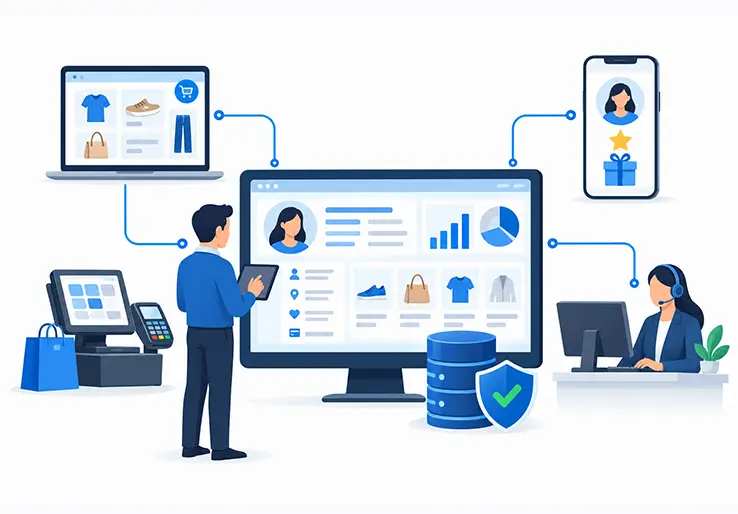
Customer data management software is a specialized system that captures, stores, organizes, updates, and secures customer information across all retail touchpoints, including point-of-sale terminals, ecommerce platforms, loyalty apps, and customer service channels. It serves as the central hub where every piece of customer data, from contact details to purchase history to communication preferences, lives in a single, accessible, and consistently updated repository.
At its core, Customer Data Management (CDM) is the practice of gathering, integrating, organizing, securing, and maintaining customer information across an organization. In a retail context, this means the software tracks the complete customer journey: from the first store visit or website browse, through purchase and payment, to returns, warranty claims, and ongoing engagement. Customer data management integrates data from various sources so that every team, whether in marketing, store operations, or finance, works from the same data.
It is worth understanding how customer data management software differs from related systems that retailers frequently encounter:
For most retail businesses, effective customer data management sits at the intersection of these tools. The centralized customer data becomes the single source of truth for marketing teams running Diwali campaigns, for store managers processing returns, and for finance departments generating GST-compliant invoices. When a customer updates their phone number at your Chandigarh outlet, that change reflects instantly in your Mumbai store’s billing screen, your ecommerce portal’s delivery records, and your loyalty module’s communication preferences.
That is what customer data management software does: it eliminates the gap between what your teams know about a customer and what they should know.
Before you can centralize anything, you need clarity on what you are centralizing. Retailers should be selective and intentional about customer data rather than hoarding every field "just in case." Not only does indiscriminate collection create storage and management burdens, it also raises compliance risks under data privacy regulations like India’s Digital Personal Data Protection Act (DPDP Act, 2023), the GDPR for EU customers, and the CCPA in California.
Customer data may include personal information, purchase history, and preferences, but the specific fields you collect should map directly to defined business purposes: billing, delivery, loyalty, personalization, or regulatory compliance.
Here are the main categories of customer data retail businesses should focus on:
Each of these deserves a closer look.
This is your foundation. The essential identity and contact fields include:
Each field serves a clear purpose. The mobile number ties a customer to their bills, enables SMS and WhatsApp communication, and acts as the primary key for lookups at POS. Email is used for sending e-invoices and digital receipts. The postal address is essential for home deliveries and accurate invoicing. GST details matter for B2B transactions and compliance.
Since around 2022, most Indian retail chains have started linking every bill to a mobile number, making it the de facto customer identifier. Best practice is to validate phone and email at the point of sale. Validating data at entry helps block invalid emails and incomplete records, saving significant cleanup effort downstream.
A simple customer profile might look like this: "Rohit Sharma, Mumbai; email: rsharma@email.com; prefers invoices via email; regular size M for tops." That level of detail, maintained accurately, is enough to improve every subsequent interaction.
Transaction-level data is where customer information transforms from a contact list into a business intelligence asset. The fields to capture per transaction include:
| Field | Example |
|---|---|
| Bill / Invoice number | INV-2025-04-8823 |
| Date and time | 14 April 2025, 3:47 PM |
| Store location | Store A, Indiranagar, Bengaluru |
| Cashier / Sales associate | Neha M. |
| Product SKUs and descriptions | Blue Denim Jacket (SKU: DJ-4421) |
| Quantity and MRP | 1 × ₹3,499 |
| Discounts applied | 15% seasonal discount |
| Payment mode | UPI |
| Return / Exchange details | None |
A centralized customer database links all of these purchases to a single customer ID, regardless of whether the transaction happened in Delhi, on your website, or at a pop-up sale. This is how you track customer purchases across cities and channels without relying on physical receipts.
Practical use cases include identifying high-value customers, calculating customer lifetime value, detecting inactivity for reactivation campaigns, and handling warranty claims. Consider an electronics retailer tracking all purchases since April 2021 for warranty verification: when a customer walks in claiming a product is under warranty, the system retrieves the original purchase date, store, and invoice in seconds.
Preference data is what separates generic marketing from meaningful personalization. The attributes vary by vertical:
These preferences are captured from multiple sources: POS notes where a store associate records "customer asked for size 32 waist," loyalty app behavior, wishlists on ecommerce portals (a practice that accelerated after 2020), browsing history, and post-purchase surveys.
When preference data is stored centrally, it feeds customer analytics and enables tailored customer experiences. For example, during festive seasons, a fashion retailer can send personalized catalogues to customers whose purchase history indicates a preference for ethnic wear, rather than blasting the same offer to the entire database.
Loyalty data captures the mechanics of your rewards program:
Engagement data tracks how customers interact with your brand beyond purchases:
Together, these data points tell you whether a customer is active, dormant, a bargain hunter, or a premium shopper. A customer data platform or CRM-like module uses this data to build segments that drive differentiated marketing campaigns.
From a POS perspective, the retail customer database must support quick lookup of loyalty status so that store staff can greet a Gold-tier customer by name and apply the right benefits without fumbling through screens.
The final category is often the most neglected, but it matters enormously for customer satisfaction. Service data includes:
When customer interactions are logged across all channels into a common system, your team avoids the painful cycle of asking "When did you buy this?" three times across three touchpoints. A centralized record means the call center agent can see the original purchase date, the return request filed at the store, and the complaint noted on WhatsApp, all in one view.
This is why connecting service modules, POS, and ecommerce systems to the same customer data management tools is not optional for retailers who want to deliver improved customer service consistently.
The short answer: because customer data that lives in five different places is not really data you can use. It is noise.
For retailers operating across multiple stores, marketplaces, and their own website, centralizing customer data is the prerequisite for omnichannel retail. Without it, each channel sees only its own fragment of the customer. The store knows what the customer bought in-store. The website knows what they browsed online. The loyalty app knows their points balance. But no one has a comprehensive view.
Before 2017 to 2019, many Indian retailers operated with standalone POS systems per store, spreadsheets for customer lists, and manual books at franchise-level outlets. That model was acceptable when a chain had two or three stores in one city. It breaks irreparably at ten stores across five cities.
Centralizing customer data reduces errors and enhances productivity. It also enables better personalization, consistent billing information, unified loyalty programs, and easier GST-compliant invoicing. Maintaining a centralized customer database improves business efficiency in ways that compound over time.
Fragmentation is the default state for most growing retailers. The ecommerce team maintains one customer list. Each store’s POS has its own database. WhatsApp orders are tracked in a separate sheet. The loyalty card system has yet another set of records.
Data silos hinder unified access to customer information. The result is a customer appearing under three different spellings in three different systems: "Anita Kumar" at Store A, "Anitha Kumar" at Store B, and "A. Kumar" in the online database. When you try to send a birthday offer or pull up purchase history, you get partial or conflicting results.
Customer data centralization merges these duplicates and assigns a single customer ID across all channels. Operational efficiency is achieved by eliminating data silos and creating that single source of truth for every team that touches the customer.
Consider a chain with outlets in Delhi, Bengaluru, and Chandigarh. A customer updates their phone number at the Bengaluru store. Without a centralized system, Delhi and Chandigarh still have the old number. SMS campaigns go to the wrong phone. Delivery calls fail. Invoices display outdated contact information.
With a centralized customer database, the update happens once and propagates to all branches and channels. This consistency reduces billing errors, improves home delivery logistics, and ensures accurate KYC data where required. For retailers planning expansion through 2024 to 2028, investing in centralized infrastructure now prevents exponentially growing data quality issues later.
There are specific moments when quick access to purchase history is not just convenient but critical:
Customer data management tools index purchase history by mobile number, loyalty ID, or email for sub-second search at POS. This benefits both the customer, who gets faster service, and the staff, who spend less time on manual lookups and face fewer disputes. Systems like LOGIC ERP link purchase history directly to the centralized customer record, making this kind of retrieval seamless.
Fragmented data does not just create internal confusion. It creates external annoyance. The same customer receives duplicate SMSs because they exist as two records. Another customer gets offers for baby products when they have never bought anything in that category. A third customer’s mobile number is inactive, and the retailer keeps spending money on undelivered messages.
A unified database supports targeted communication based on geography, recency, frequency, and monetary value. This is the foundation of RFM segmentation, one of the most effective frameworks for retail marketing.
Consider a Diwali 2026 campaign. With centralized customer data, the marketing team can send premium ethnic wear offers to high-value frequent shoppers, value deals to price-sensitive occasional buyers, and win-back coupons to lapsed customers. All of these segments draw from the same customer data platform, pulling from various channels including SMS, WhatsApp, email, and in-app notifications.
Unified customer records turn scattered information into valuable data for analysis, dashboards, and planning. Customer analytics capabilities include:
These insights drive business growth by informing where to open the next store, which assortments to expand, which loyalty offers to discontinue, and which underperforming segments need attention. Clean, unified data is the prerequisite for any serious AI or predictive modeling initiative. From 2024 onward, retailers who want to leverage data-driven insights for retailing need to solve the centralization problem first.
If your customer records live in spreadsheets, POS exports, and ad hoc CRM tools, you are already familiar with most of these problems. But it helps to name them explicitly.
Data volume increases complexity in customer data management. A single-store operation with 500 customers can be managed with a spreadsheet. A ten-store chain with 50,000 customers cannot. And yet many retailers try, because they started small and the manual approach "worked fine" until it did not.
Here are the core issues retail managers have been reporting since 2020:
Data Quality and Cleansing involves routinely updating and correcting errors in data, but when the underlying system is a collection of unconnected spreadsheets, even the most disciplined team will fall behind. Manual management cannot scale beyond a few thousand customers or more than two to three outlets without accuracy breaking down.
This is why customer data management software is not a luxury. It is infrastructure.
The mechanics of customer data management software follow a logical, six-step flow. To make it concrete, let us trace the journey of a new customer: Priya Singh visits a fashion outlet (Store A) in April 2025, buys clothes, and enrolls in the loyalty program. Over the next several months, she shops online and visits Store B in another city.
Customer Information Collection
At the POS counter, the cashier prompts Priya for her mobile number, email, name, and billing address. She opts into the loyalty program and consents to receive promotional messages. Data collection involves gathering information from multiple touchpoints, so her online browsing behavior, app activity, and any customer service interactions are also captured as they occur. AI-powered tools automate data collection and ensure accuracy in digital channels, reducing manual entry errors.
Customer Record Creation
The software generates a customer profile for Priya Singh with a unique customer ID. Her contact details, preferences noted during the sale, and loyalty enrollment status are stored immediately.
Data Consolidation and Identity Resolution
When Priya shops on the ecommerce portal using the same email and mobile number, the system detects the match and links the online purchase to her existing profile. If she was accidentally entered as "P. Singh" at Store B, the deduplication engine flags the potential duplicate for review or auto-merges it based on matching phone or email. Data integration combines siloed information from various departments into a unified view.
Purchase History Association
Every transaction, whether from Store A, Store B, or the website, is automatically logged under Priya’s profile. This includes SKUs, quantities, discounts, payment types, and any returns or exchanges.
Customer Profile Updates
If Priya moves to a new city, changes her phone number, or develops a new preference for ethnic wear during the festive season, these updates are entered once and reflected across all channels. Her loyalty tier upgrades automatically based on accumulated spending.
Data Access and Reporting
The marketing team sees Priya’s recency, frequency, and monetary value, and includes her in the "fashion frequent customers" segment for targeted offers. Store managers see her complete purchase history at POS. The finance module reconciles her loyalty points. Customer support sees her past service tickets for faster resolution.
This end-to-end flow is what transforms isolated data points into a usable, actionable customer profile, and it is the fundamental value proposition of any customer data management system.
Not every customer database management software is designed for retail. Enterprise tools built for SaaS companies or B2B services often lack the specific capabilities that store chains and consumer brands need. This section defines the must-have features for retail-ready customer data management software.
The foundation is a unified customer repository that stores all customer data in one place, accessible to every authorized branch and channel. This is not the same as having separate customer lists in each POS terminal or ecommerce platform. A centralized customer database includes:
Deduplication should be performed regularly to merge duplicate customer profiles, ideally with automated flagging and manual review for borderline cases. The database must also perform at scale. Many Indian retail chains have accumulated hundreds of thousands or millions of customer records between 2015 and 2026. The system must handle lookups and writes without slowing down, regardless of whether you have two outlets or fifty.
A 360-degree customer profile goes well beyond name and phone number. It includes identity, contact information, preferences, tags, linked loyalty accounts, and communication consents.
From a user interface perspective, store staff need simple edit screens with restricted fields for compliance-sensitive data and a clear audit trail of every change. Tagging capabilities allow retailers to categorize customers as "VIP customer," "Doctor," "Corporate client," or "Senior citizen discount" within the retail customer database.
These profiles are the building blocks for every downstream activity: marketing campaigns, in-store personalization, customer support, and financial reporting.
Purchase history tracking requires tight linkage between billing and POS systems and the customer data module. Every transaction should be logged automatically to the customer profile without manual intervention.
Analysts and store staff need filters for purchases by date range, store, product category, brand, or payment mode. Use cases include spotting high-return customers for potential fraud investigation, detecting cross-category buying patterns for bundled offers, verifying warranty eligibility without requiring a physical receipt, and powering recommendation engines.
The ability to track customer purchases across channels is what makes a centralized system fundamentally different from a store-specific POS log.
At the checkout counter during a peak Diwali or Eid sale, speed is everything. The system must support fast, fuzzy search by mobile number, customer name, loyalty ID, or even a partial address.
Specialized features to look for include duplicate suggestions when creating a new customer record, auto-detection of existing records via OTP verification, and relevance-ranked results when the search term is ambiguous. Speed and accuracy here are not just technical requirements. They directly impact customer satisfaction by preventing queues and frustration.
Built-in segmentation tools allow marketing teams to divide the customer base into actionable groups:
A concrete example: a retailer sends separate SMS offers for parents buying school uniforms in June versus customers focused on winter wear in November. Combining transactional, preference, and engagement data produces precise segments that drive more relevant marketing campaigns and better marketing efforts overall.
Loyalty is a core driver of repeat business in retail, and the loyalty module must be tightly integrated with the centralized customer database. Key capabilities include:
Integration with the centralized database prevents misuse and duplicate accounts. When loyalty and customer data live in the same system, a single loyalty ID maps to a single customer profile, eliminating the common problem of customers maintaining multiple accounts to exploit offers. For more on how this works in practice, see how loyalty program integration for supermarkets operates in a unified environment.
This is the core requirement for any retail customer data management software. Without tight integration with POS and billing workflows, your customer data is always one step behind reality.
Real-time data sync means that when a bill is generated, a return is processed, or a customer updates their phone number at the billing screen, the changes are immediately reflected across all outlets and channels. The system should also support offline billing modes for stores with intermittent internet connectivity, syncing data when the connection is restored.
Compatibility expectations include support for barcode scanners, UPI QR payment workflows, and e-invoice generation that is GST compliant.
The kinds of reports retail teams need from their customer data management system include:
| Report | Who Uses It |
|---|---|
| New vs repeat customers by month | Marketing, corporate |
| Average basket size by segment | Merchandising, store managers |
| Store-wise customer acquisition cost | Finance, expansion planning |
| Churn rate and reactivation metrics | Marketing, CRM team |
| Product affinity analysis | Category managers |
| Loyalty program ROI | Marketing, finance |
Role-based report access is essential. Store managers should see only their store-level data; regional and corporate teams see aggregates. Time-based comparisons, such as tracking year-over-year growth from FY 2023–24 to FY 2024–25, help evaluate performance and plan budgets. For retailers investing in retail analytics, clean centralized data is the non-negotiable starting point.
Customer data management involves data governance and security measures that protect both the business and its customers. Key requirements include:
From a regulatory perspective, the software must support customer rights under the DPDP Act 2023, GDPR, and CCPA. This includes enabling data access requests, corrections, and erasure. Data governance frameworks ensure compliance with GDPR and CCPA across geographies.
Together, these nine features form a retail-ready customer data management system that can handle the complexity of multi-store, multi-channel operations while keeping data secure, accurate, and actionable.
While the core principles of customer data management are universal, every retail vertical has unique data needs, customer behaviors, and compliance nuances. A pharmacy’s data requirements look very different from a fashion retailer’s. The right customer data platform must be adaptable across formats: single-store, franchise, and multi-brand outlets.
Grocery retailers deal with high-frequency, low-ticket transactions. The data points that matter most include household size indicators, monthly spend patterns, preferred brands, and payment habits (UPI-heavy versus cash-heavy customers).
Centralized customer data enables basket analysis and helps grocers understand customer behavior across regular and festive shopping cycles: which products are most frequently bought together, how basket composition changes during festivals versus regular weeks, and which customers respond to combo offers. A grocery store management system that integrates customer data with inventory and billing can identify that a specific customer buys organic pulses and ghee every Navratri and proactively send them relevant offers.
Tracking festive grocery baskets during Navratri 2025 versus normal weeks helps category managers adjust inventory and design targeted promotions based on actual purchase behavior rather than guesswork.
Fashion retail is where preference data shines. Size and fit history, style preferences, seasonal purchase patterns (wedding season, winter wear, festive ethnic wear), and brand affinity all feed into a rich customer profile.
Clienteling use cases are particularly powerful. A store associate accessing a customer profile on a tablet can suggest matching accessories based on a kurta purchased two months ago, or recommend a similar style in a new collection. This kind of informed interaction, powered by centralized customer data, turns a routine store visit into a personalized experience.
Loyalty-focused examples include exclusive previews for top-tier customers ahead of a new collection launch. An apparel POS system integrated with the customer database makes this operationally simple.
Electronics retail involves high-value purchases with long service cycles. The data priorities include warranty registration, serial numbers, IMEI tracking, and purchase behavior patterns.
Centralized customer records help with extended warranty management, annual maintenance contracts, and cross-selling accessories. A customer who bought a smart TV in 2023 receiving a targeted offer for soundbars in 2024 is only possible when the purchase history is linked to a persistent customer profile.
For electronics retailers, the ability to verify warranty eligibility instantly at any branch, without requiring the customer to produce a physical bill, is a significant driver of customer satisfaction.
Pharmacy retail introduces sensitive data dimensions: prescription records, chronic medication history, doctor details, refill schedules, and dosage information. The compliance constraints are correspondingly tighter.
Centralized data supports refill SMS alerts, dosage adherence programs, and senior citizen discount management. A cloud-based pharmacy retail system that ties prescriptions to customer profiles can automatically flag when a patient is due for a refill, improving health outcomes and building loyalty.
Extra care around data privacy, masking, and consent is non-negotiable. Health data requires encryption, stricter access controls, and explicit consent management in line with both industry best practices and emerging regulations.
Lifestyle and footwear retailers track attributes like shoe size, preferred brands, comfort and gait preferences, and the purchase frequency of accessories such as belts and bags.
Cross-store benefits are a major value driver. A customer who buys running shoes in one city should be able to access exchange or warranty services seamlessly at another outlet. This requires the customer profile and purchase history to be accessible chain-wide.
Curated product recommendations also depend on centralized data. A customer who consistently buys sports footwear should not receive promotions for formal shoes, and vice versa. Getting this right is a direct function of how well the retail customer database captures and applies preference data.
With dozens of customer database management software options available, retailers must align their choice with their size, vertical, and growth plans. A solution that works for a single-store boutique will not scale to a chain of fifty outlets, and a tool built for SaaS companies will miss the specific workflows that retail demands.
Retailers should evaluate each option as part of a broader customer data management strategy, not as a standalone tool purchase.
Here are the evaluation criteria that matter most:
POS and Billing Integration. This is non-negotiable. The software must integrate directly with your POS terminals so that every transaction automatically updates the customer profile. Ask vendors whether they support real-time sync, offline billing with deferred sync, and compatibility with barcode scanners and UPI QR workflows. Retailers evaluating multi-store POS solutions should prioritize this integration.
Customer Purchase History Tracking. The ability to retrieve any customer’s complete purchase history, across all stores and channels, by searching on a mobile number or loyalty ID, is fundamental.
Multi-Store Customer Database. Ensure the system supports a centralized platform with local flexibility: central data governance with the ability for individual stores to manage their own promotions, pricing, and staff access.
Reporting and Analytics. Look for built-in customer analytics dashboards with role-based access. The system should support RFM segmentation, cohort analysis, and time-based comparisons without requiring external BI tools.
Data Security and Access Permissions. Verify that the software supports RBAC, audit trails, encryption, and compliance with relevant data privacy regulations. Ask how it handles data access and erasure requests.
Scalability and Customization. Evaluate whether the system can grow with you from five stores to one hundred. Can it handle millions of customer records without performance degradation? Can it be configured for different retail verticals (apparel, grocery, pharmacy) within the same platform?
Involve stakeholders from IT, operations, marketing, and finance when assessing solutions. The best customer data management software is the one that serves all of these teams from a single, consistent data layer.
LOGIC ERP is a retail-focused ERP and POS platform with built-in customer data management software capabilities. It is designed for the specific workflows of Indian retail: multi-store operations, GST-compliant billing, loyalty programs, and omnichannel customer management.
Here is how LOGIC ERP addresses the requirements outlined in this article:
Centralized Customer Records. LOGIC ERP provides customer master data governance, ensuring consistent customer data across sales, billing, service, credit control, and CRM-loyalty management modules. The Customer Master supports multiple billing and shipping addresses ("ship-to" and "bill-to"), which is essential for retailers dealing with B2B and B2C transactions.
Customer Information Connected with Retail Transactions. Every bill generated at the POS is automatically linked to the customer profile. Returns, exchanges, and warranty claims are logged against the same profile, creating a complete transaction history. This eliminates the scenario where a customer’s purchase exists in the billing system but is not connected to any identifiable profile.
Customer Purchase History and Insights. LOGIC ERP’s sales and marketing module includes customer sales history that can be filtered by store, date range, product category, and payment mode. Staff at any branch can look up a customer’s full purchase record by mobile number or loyalty ID.
Loyalty Points, Coupons and Gift Voucher Management. Loyalty management is tightly integrated with billing, so points accrue automatically at checkout, vouchers are applied during payment, and tier upgrades happen based on accumulated activity. This integration prevents the common problem of loyalty and billing operating as separate systems.
Multi-Store and Multi-Format Support. LOGIC ERP supports multi-location data control with central governance plus local flexibility. Both cloud and on-premises deployments are available. For stores with limited or intermittent connectivity, offline or scheduled data synchronization ensures that customer data is never lost.
Reporting and Business Insights. Role-based reporting gives store managers, regional heads, and corporate teams the views they need without exposing data they should not see. Audit logging tracks all transactions and user actions, supporting both internal governance and regulatory compliance.
LOGIC ERP integrates with leading loyalty and CRM platforms including Capillary, Easyrewardz, and OptCulture, giving retailers flexibility in how they build their customer engagement stack while maintaining LOGIC ERP as the central data backbone.
When a retailer moves from fragmented spreadsheets to a centralized customer data management system, the impact shows up in measurable business outcomes within six to eighteen months.
Effective CDM drives growth, efficiency, and customer loyalty across the organization. Here are the specific improvements retailers should expect:
Higher Repeat Purchase Rates. Targeted campaigns based on accurate customer data typically deliver a 10 to 15 percent uplift in repeat purchases. When you know what a customer bought, when they bought it, and what they are likely to need next, your outreach converts better.
Better Marketing Campaign ROI. CDM enhances marketing ROI by providing accurate customer insights. Segmented campaigns using RFM data can deliver 20 to 30 percent higher conversion rates compared to untargeted mass messaging. This means less marketing spend wasted on irrelevant audiences.
Reduced Return Fraud and Disputes. With complete purchase history accessible at any counter, invalid return claims are easier to identify and legitimate claims are processed faster. Fewer disputes mean better customer trust and lower operational costs.
Faster Service at Counters. When staff can retrieve a customer’s profile, purchase history, and loyalty status in seconds, the average transaction time drops. Estimates suggest a 30 percent reduction in average handle time at billing and service counters.
Stronger Loyalty Program Metrics. Higher redemption rates, increased average spend per loyalty customer, and more customers moving up tiers are all outcomes of integrating loyalty with centralized customer data.
Personalized customer experiences can be enhanced by consolidating customer data, and these experiences feed directly into long-term retention. Effective CDM improves customer understanding and satisfaction, and effective customer data management enhances customer experiences and loyalty in a virtuous cycle.
Looking further ahead, centralized customer data is the foundation for strategic initiatives like customer analytics, AI-based recommendations, and data driven decision making that informs store expansion planning.
Moving to centralized customer data management does not happen overnight. Here is a realistic four-to-six-step roadmap.
Review Your Current Customer Data Management Strategy
Audit your existing data assets to see where customer information lives, how it flows between your POS systems, ecommerce platform, loyalty apps, and call center tools, and where the gaps are. Identify duplication rates, missing fields, and inconsistent formats. This assessment creates your baseline.
Clean and Deduplicate
Standardize address formats, normalize names, merge duplicates, and establish naming and address conventions. Validate phone numbers and email addresses. This cleanup is labor-intensive but essential. Without it, you are simply centralizing dirty data.
Select Software
Shortlist customer data management solutions that offer the features discussed in this article: customer master management, loyalty integration, POS sync, data security, and compliance with the DPDP Act. Include LOGIC ERP in your shortlist and evaluate against your specific vertical and scale requirements.
Integrate POS, ecommerce, Loyalty and Call Center
Ensure all channels push data into the centralized customer module. Support both real-time and offline sync. Confirm that purchase, return, and service data flows seamlessly into the customer profile.
Train Teams and Define SOPs
Cashier training on capturing correct contact information is critical. Define standard operating procedures for handling profile updates, consent capture, and data entry at POS. Consider incentives for accurate data capture to drive adoption.
Monitor KPIs and Iterate
Set baseline metrics: repeat purchase rate, campaign response rates, data quality scores (percentage of missing fields, duplicate rate). Run a pilot across two to five stores, validate improvements against 2023 to 2024 data, then scale across the chain. Businesses should regularly monitor and audit their data management practices to ensure ongoing accuracy and compliance.
Start with a pilot, measure ruthlessly, and roll out only when the numbers confirm the approach works.
LOGIC ERP can guide this roadmap through implementation support, but the most important factor is internal commitment to treating customer data as a strategic asset.
Collecting and centralizing customer data comes with serious responsibilities. In the current regulatory environment, compliance with data privacy regulations is a major challenge that retailers must address proactively rather than reactively.
The key regulations affecting retail customer data practices from 2024 onward include:
CDM helps businesses comply with data privacy regulations by building consent tracking, purpose limitation, and erasure workflows directly into the customer data management system.
Beyond legal compliance, ethical principles matter for long-term brand trust:
Robust CDM practices minimize the risk of costly data breaches. Data security breaches can erode customer trust significantly, and the reputational damage often exceeds the financial penalties.
Periodic internal reviews of data practices are important for compliance. This includes auditing who has access to what data, whether consent records are up to date, and whether third-party vendors (payment gateways, logistics partners, analytics providers) are handling data in accordance with your policies.
Customer data management ensures compliance with data privacy regulations when implemented with the right governance framework, and retailers who invest in privacy-first data practices build the kind of trust that translates into lasting customer loyalty.
The gap between retailers who manage customer data well and those who do not is growing wider every year. On one side are businesses where a customer’s identity, preferences, purchase history, and loyalty status are available at every touchpoint, enabling businesses to deliver relevant, timely, and personalized interactions. On the other side are retailers still piecing together information from disconnected POS systems, spreadsheets, and fragmented databases, losing customers and revenue in the process.
Moving from scattered files to a centralized customer data platform is not a technology upgrade. It is a fundamental shift in how a retail business understands and serves its customers. The retailers who get this right in 2026 are the ones who will lead their markets in 2027 and beyond. In a competitive market where 80% of customers value their experience as much as the products themselves, organized customer information is the foundation of enhanced customer experiences, stronger customer engagement, and sustained business growth.
If you are evaluating how to centralize your customer data across stores and channels, explore how LOGIC ERP’s customer data management capabilities can be configured for your specific retail format and scale. The right system, implemented well, pays for itself in customer loyalty, operational efficiency, and valuable insights that drive business growth.
Call at +91-73411-41176 / +91-73411-41175 or send us an email at sales@logicerp.com to book a free demo today!
Customer data management software is a centralized system that captures, stores, organizes, updates, and secures customer information across all retail touchpoints, including POS, ecommerce, loyalty programs, and customer service channels. It creates a single, unified customer profile that all authorized teams and branches can access, replacing scattered spreadsheets and disconnected databases with a reliable, up-to-date information source.
A centralized customer database eliminates duplicate records, ensures consistent customer information across stores and channels, and enables quick access to purchase history for returns, warranty claims, and personalized service. Without centralization, retailers deal with data silos that prevent a comprehensive view of individual customers, leading to wasted marketing spend, billing errors, and poor customer experiences.
Retailers should collect basic customer information (name, mobile number, email, address), purchase and transaction data, customer preferences (sizes, brands, categories), loyalty and engagement data (points, tier, campaign responses), and customer service interaction records (complaints, returns, feedback). All data collection should align with defined business purposes and comply with applicable data privacy regulations.
The software follows a six-step process: it collects data from various channels (POS, website, app), creates a customer record with a unique ID, consolidates and deduplicates profiles through identity resolution, associates purchase history with each profile, enables real-time profile updates across all branches, and provides reporting and analytics for data-driven insights. This flow ensures that every customer interaction, from first visit to repeat purchase, is captured in one centralized system.
Customer relationship management (CRM) software focuses primarily on managing sales interactions, support tickets, and marketing outreach. Customer data management software, by contrast, focuses on capturing, unifying, and maintaining customer data across all channels and systems. While 92% of marketing teams use CRM tools for data unification, a dedicated customer data management system goes further by resolving identity across touchpoints, managing master data governance, and serving as the single source of truth for all customer-facing operations.
Retailers manage customer data across multiple stores by implementing customer data management software that creates a single customer ID linked to all transactions, regardless of branch or channel. Customer data centralization ensures that address changes, loyalty updates, and purchase records are synced in real time across all outlets. Solutions like LOGIC ERP support multi-location data control with central governance and local flexibility, including offline sync for stores with intermittent connectivity.
POS integration ensures that every billing transaction automatically updates the customer profile in the centralized database. When a bill is generated, a return is processed, or a customer updates their contact details at the counter, the change is instantly reflected across all branches and channels. This tight integration eliminates the manual step of exporting POS data and importing it elsewhere, which is the primary source of fragmented data and data quality issues in retail environments.
Centralized customer data helps sales teams and marketing teams get a clearer view of customer behavior, making it easier to create relevant marketing strategies. By connecting customer support teams with the same customer profile, retailers can improve customer interactions and deliver consistent service across channels.
Key strategies for managing data include collecting only necessary information, validating records at entry, removing duplicates, setting clear access permissions, and regularly reviewing data quality. These practices protect data integrity and make customer data management tools more reliable.
Retailers can analyze valuable data by reviewing purchase patterns, engagement, and service history. Data analytics helps teams identify trends, monitor key metrics, and make informed business decisions about promotions, assortment, and customer retention.
First party data is information customers share directly through purchases, loyalty programs, surveys, and other interactions. Retailers should use secure data storage, clear retention policies, and appropriate access controls to protect this information and keep it accurate.
A customer data platform CDP combines customer information from multiple sources into unified profiles. A customer data platform can bring together data from social media platforms, POS systems, ecommerce, and service channels. Customer relationship management focuses more on managing interactions and workflows, while customer data management tools help organize and maintain customer information across systems. A customer data platform cdp may also connect with data lakes to support broader analysis.
Customer analytics reveals how shoppers move between channels, what they buy, and where they encounter problems. These insights help retailers improve the customer journey, personalize customer experiences, and support business growth.
Customer data management tools support business growth by combining customer details, purchase history, preferences, and loyalty activity in one accessible profile. Retailers can use these insights to personalize offers, identify repeat-purchase patterns, improve service, and make more informed decisions about promotions and product assortments. POS and billing integration helps keep records current across stores, while reporting tools help teams measure campaign and customer trends.
Centralized customer data management helps retailers recognize customers across branches and channels, reduce duplicate records, and access accurate purchase history. This makes it easier to deliver relevant communications, resolve service requests, and build customer loyalty. By using reliable customer information to guide marketing and operational decisions, retailers can improve efficiency and focus resources on opportunities that support sustainable business growth.
Popular Products