FOCO (Franchise Owned, Company Operated) is a hybrid franchise model where the franchisee invests capital and owns the outlet, while the franchisor manages daily operations, staffing, training, and inventory — offering investors a structured path to passive income backed by an established brand.
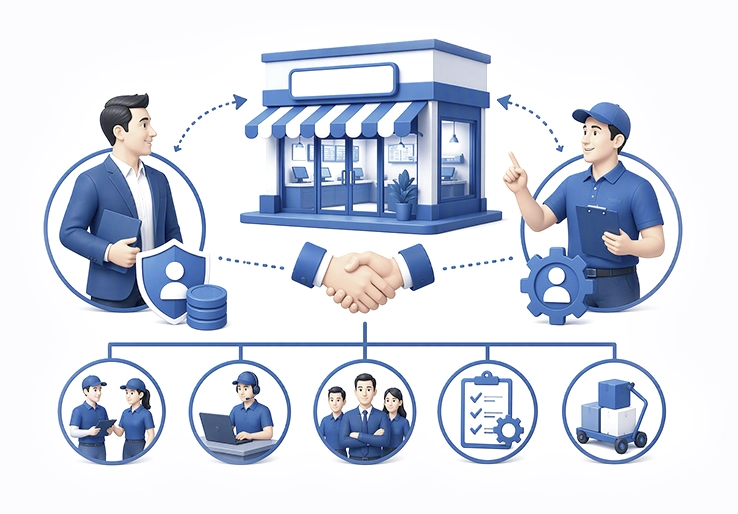
FOCO stands for Franchise Owned, Company Operated — a hybrid franchise model where the franchisee invests capital and owns the outlet, while the franchisor manages daily operations, staffing, training, and inventory management. This model bridges the gap between traditional franchise models and fully company operated outlets, offering investors a structured path to passive income backed by an established brand.
The FOCO model has gained significant traction across India's retail industry, food service sector, and cloud kitchens, attracting entrepreneurs and investors who want exposure to proven systems without the burden of day to day management. Whether you're evaluating franchise opportunities in retail brands, food chains, or service-based businesses, understanding the FOCO franchise model is essential before committing capital.
By reading this guide, you will gain clarity on:
The FOCO model emerged as an evolution from traditional franchise models, which typically required the franchisee to handle both investment and operations. As retail brands and food chains expanded into new markets, they recognized that operational consistency suffered when franchise partners lacked professional management experience. The FOCO model franchise structure solves this by keeping operational control with the franchisor while allowing external capital through franchise partners.
This framework is particularly relevant for investors, first-time entrepreneurs, and business owners in India who want to explore franchising offers from trusted brand names without the complexity of handling operations themselves.
In a franchise owned company operated structure, the roles split cleanly. Franchisees invest in the outlet's infrastructure and capital — covering costs like store setup, interiors, equipment, and location deposits. The franchisor manages daily operations in the FOCO model, including staffing, training, and inventory management. This means the franchisor handles everything from quality control to enforcing brand guidelines and service standards.
Investment ranges from ₹10 lakhs to ₹2 crores depending on the brand, location, and outlet type. Franchisees earn 8–20% of revenue as profit share, with exact terms defined in the franchise agreement. The FOCO model reduces operational risks for franchisees significantly because the brand's proven systems and professional management teams run the business.
The ownership component is straightforward: the franchisee owns the physical outlet and its infrastructure, while the franchisor retains operational authority. This is what distinguishes a franchise owned company operated model from a purely company operated store (where the brand owns everything) or a FOFO model (where the franchisee manages operations independently).
Because the franchisee invests capital but doesn't manage operations, this creates a lower risk investment profile compared to models demanding active involvement. The relationship between clear ownership and consistent quality outcomes is direct — when the franchisor controls operations, brand standards remain uniform across all outlets.
The franchisor's role extends beyond just running the store. They manage the supply chain, enforce quality control, handle marketing at the brand level, and ensure every outlet meets service standards. This operational consistency is what makes franchise owned company operated outlets attractive to customers — the experience at one location mirrors another.
For brands expanding rapidly into new markets, this structure prevents the inconsistencies that plague traditional franchise models where independent franchise owners may deviate from brand guidelines. The FOCO model allows the franchisor to maintain the same standard across hundreds of outlets.
Understanding these foundational elements sets the stage for examining real FOCO franchise opportunities and the practical strategy behind launching one.
The FOCO franchise model has been adopted across multiple sectors in India, from food service to retail to eyewear. These examples demonstrate how the model works in practice and what investment levels franchise partners should expect.
The food industry has been one of the biggest adopters of the FOCO model in India. WOW! Momo's investment starts at ₹20–40 lakhs, making it accessible for mid-tier investors. Chai Point requires an investment of ₹15–30 lakhs and operates its franchise outlets with full company management, covering everything from staff training to inventory. Cloud kitchens have also embraced this model, where the franchisee invests in kitchen infrastructure while the brand handles menu execution, delivery logistics, and quality control.
In each case, the franchisor manages daily operations and staffing, leaving the franchisee with a passive income stream proportional to revenue performance.
Lenskart's investment ranges from ₹25–50 lakhs for its FOCO franchise outlets. As one of India's fastest-growing retail brands, Lenskart uses the franchise owned company operated structure to maintain consistent quality across its store network. The franchisor handles everything from staff recruitment to visual merchandising to inventory management, while the franchise partner provides the capital and store location.
This pattern is common across the retail industry — brands prefer operational control to protect their customer experience while leveraging external capital to expand faster into new markets.
For newer brands and co-founders looking to expand, the FOCO model offers a strategy to grow without diluting equity or taking on massive debt. The brand maintains its proven systems and operational playbook while franchise partners fund the expansion. This is why franchising offers through the FOCO structure have become popular among emerging food chains, D2C retail brands, and service businesses across India.
FOCO franchise investment ranges from ₹10 lakhs to ₹2 crores depending on the sector, brand maturity, and outlet format — from small kiosks to full-format stores.
Moving from understanding the model to actually launching a FOCO franchise requires a structured approach. Whether you're a brand designing a FOCO program or an investor evaluating one, these steps provide a clear roadmap.
This sequential process applies whether you're an entrepreneur exploring your first franchise or a brand building its FOCO expansion strategy:
Identify your capital range, preferred geography, and target brand. Investment ranges from ₹10 lakhs to ₹2 crore depending on the brand and format.
Review profit-sharing terms (franchisees earn 8–20% of revenue as profit share), duration, renewal clauses, exit conditions, and the franchisor's operational responsibilities.
Confirm that the brand has proven models for supply chain management, staff training, quality control, and ongoing support. The franchisor handles staffing, training, and inventory management — verify their track record.
After the outlet goes live, track revenue metrics, customer satisfaction, and operational efficiency. Profits are shared between franchisee and franchisor based on agreement terms.
In a FOCO model, the team structure is defined by the franchisor. The brand appoints store managers, trains staff, and deploys its operational playbook. The franchise owner's role is primarily that of an investor — providing capital, ensuring the location lease is maintained, and monitoring financial performance.
This is fundamentally different from a FOFO model, which requires the franchisee to manage operations independently, including hiring, training, and day to day management. The FOCO structure's professional management removes the need for active involvement in operations.
| Criteria | Traditional Franchise (FOFO) | FOCO Model |
|---|---|---|
| Operational Control | Franchisee manages all operations | Franchisor manages daily operations |
| Investment | Franchisee invests capital + manages business | Franchisee invests capital only |
| Brand Consistency | Variable — depends on franchisee capability | High — franchisor enforces brand standards |
| Risk Level | Higher — operational + financial risk | Lower risk — operational risk sits with franchisor |
| Income Type | Active business income | Passive income through profit share |
| Scalability | Limited by franchisee's management bandwidth | Scalable — franchisor's systems handle growth |
| Staff Management | Franchisee handles hiring and training | Franchisor handles staffing, training, and inventory management |
The FOCO model reduces operational risks for franchisees by removing the operational burden entirely. For investors seeking passive income from an established brand without the complexity of running a business, the FOCO franchise model is the stronger choice. For entrepreneurs who want full operational control and higher potential margins, traditional models may suit better.
While the FOCO model is fundamentally a business framework, its success depends heavily on design and branding principles that ensure every outlet delivers a consistent customer experience.
"Foco" design principles prioritize directing attention to a specific point of interest — and this applies directly to how FOCO franchise outlets are designed. Visual hierarchy prioritizes critical information through size, color, or placement, ensuring customers navigate the store or menu intuitively. Every franchise owned company operated outlet follows strict brand guidelines for signage, interiors, and product display.
Effective marketing collateral focuses on a single clear message, and FOCO brands apply this principle across all touchpoints — from storefront design to digital presence. Using contrast guides the viewer's eye to the most important element first, whether that's a promotional offer or a signature product.
Focal points organize spaces with clear visual anchors like windows or fireplaces — in retail, this translates to hero product displays, checkout counters, and experiential zones. Architectural layouts prioritize how occupants feel and navigate through space, which directly impacts retail performance metrics.
"Foco" in graphic design involves layout techniques to guide the viewer's eye, and the same principle governs how FOCO franchise outlets arrange product shelves, menu boards, and service counters. Whitespace usage enhances focus by surrounding important elements with empty space, preventing visual clutter. Balance in design can be achieved through symmetrical or asymmetrical arrangements, and successful FOCO outlets use both strategies depending on the brand aesthetic.
Intentional movement controls how the viewer's eye travels across a layout — this applies to both digital interfaces and physical spaces. Contrast and repetition create distinction and familiarity in design, which is why FOCO brands deploy identical design systems across every outlet. Minimalism focuses on removing unnecessary elements to avoid clutter in design, and brands like Lenskart exemplify this with clean, minimal store layouts that let products speak for themselves.
For brands managing multiple retail outlets through the FOCO model, maintaining design consistency at scale requires systematic approaches — from standardized fixture specifications to centralized marketing asset management.
Some franchise partners expect more control over their investment. When the franchisor manages daily operations and the franchisee has limited say in staffing or product decisions, friction can develop.
Solution: Set expectations clearly before signing the franchise agreement. Brands should provide transparent documentation of the operational structure, profit-sharing mechanics, and the franchisee's rights. Regular reporting and communication channels — monthly P&L reviews, quarterly business reviews — keep franchise owners informed without disrupting operational control.
FOCO franchise investment ranges from ₹10 lakhs to ₹2 crores, and many investors underestimate ancillary costs like location deposits, pre-launch marketing, and working capital buffers.
Solution: Build a financial model that accounts for 3–6 months of operating runway beyond the initial setup investment. Evaluate the franchisor's ongoing support infrastructure — brands with established systems for operational efficiency will reach break-even faster.
Quantifying returns from a FOCO franchise can be opaque if the franchisor doesn't share granular operational data. Franchisees earn 8–20% of revenue as profit share, but understanding what drives revenue — foot traffic, average transaction value, repeat purchase rates — matters for evaluating long-term viability.
Solution: Insist on access to key performance dashboards. Modern POS and ERP systems provide real-time data on sales, inventory turnover, and customer metrics. Franchise agreements should specify what data the franchisee receives and at what frequency.
Choosing LOGIC ERP software for the FOCO model ensures seamless integration of franchise operations with robust technology support. LOGIC ERP offers comprehensive modules tailored to manage multi-outlet franchises, enabling real-time tracking of sales, inventory, and financial performance across all FOCO outlets. Its user-friendly interface simplifies monitoring profit shares, automates reporting, and enhances supply chain efficiency, which is critical when the franchisor handles daily operations.
Additionally, LOGIC ERP supports compliance with brand standards through centralized control and consistent data management, reducing operational risks for both franchisees and franchisors. By leveraging LOGIC ERP, FOCO franchise partners gain transparency, improved decision-making, and scalable growth potential, making it the ideal software solution to optimize the franchise owned company operated business model.
The FOCO model — Franchise Owned, Company Operated — offers a compelling path for investors who want to put their money into proven brands without the operational complexity of running a business. By separating capital ownership from operational control, it creates a structured partnership where both parties play to their strengths: the franchisee invests, the franchisor operates.
To move forward with a FOCO franchise investment:
Related topics worth exploring include franchise management through ERP systems, supply chain optimization for multi-outlet brands, and how technology platforms enable operational consistency across franchise networks.
Call at +91-73411-41176 / +91-73411-41175 or send us an email at sales@logicerp.com to book a free demo today!
In the FOCO model, "franchise operated" refers to the franchisee owning the outlet and investing capital, while the franchisor operates the daily business activities. This hybrid approach allows franchisees to benefit from brand ownership without managing day-to-day operations.
An "owned franchise operated" model typically means the franchisee both owns and manages the outlet independently. In contrast, the FOCO model separates ownership and operation: the franchisee owns the outlet, but the franchisor operates it, reducing the franchisee's operational responsibilities.
Yes, the FOCO model is flexible and can be adapted to various business ideas, especially those requiring consistent operational standards, such as food chains, retail stores, and service outlets. The key is that the franchisor has the capacity to manage daily operations effectively.
Investing in a FOCO franchise operated business offers benefits like lower operational risk, professional management by the franchisor, brand consistency, and a passive income stream through profit sharing. Franchisees focus on capital investment while the franchisor handles operations.
Investment ranges widely depending on the brand and sector, typically from ₹10 lakhs to ₹2 crores. For example, food brands like WOW! Momo require ₹20–40 lakhs, while retail brands like Lenskart ask for ₹25–50 lakhs.
Yes, the FOCO model is ideal for first-time investors who want exposure to established brands without managing daily operations. It offers a structured, lower-risk investment opportunity with professional operational support.
Profits in the FOCO model are usually shared between the franchisee and franchisor based on a pre-agreed percentage, often ranging between 8–20% of revenue as profit share for the franchisee.
The franchisor manages all operational aspects, including staffing, training, inventory management, marketing, and quality control, ensuring brand standards are maintained across all outlets.
Yes, cloud kitchens are a growing use case for the FOCO model. Franchisees invest in kitchen infrastructure, while the franchisor manages menu execution, delivery logistics, and daily operations, making it a scalable and efficient model.
Since the franchisor handles all daily operations and management, franchisees are shielded from operational risks like staffing issues, inventory shortages, or inconsistent service quality, allowing them to focus on investment and financial returns.
FOCO stands for Franchise Owned, Company Operated, a model where the franchisee owns the outlet and invests capital, while the franchisor manages daily operations.
The FOCO model lowers risk by shifting operational responsibilities to the franchisor, allowing franchisees to focus on investment and profit sharing without managing daily business activities.
FOCO franchise opportunities span sectors like food service, retail, and cloud kitchens, offering investors passive income through professionally managed outlets.
Investment in a FOCO franchise typically ranges from ₹10 lakhs to ₹2 crores, depending on the brand, location, and outlet size.
Unlike traditional models where franchisees operate the business, the FOCO franchise model separates ownership and operations, with the franchisor handling day-to-day management, resulting in lower operational risk.
Yes, FOCO design principles emphasize visual hierarchy, focal points, and minimalism to create consistent and engaging customer experiences across franchise outlets.
Yes, the FOCO franchise model is ideal for first-time investors seeking lower-risk franchise opportunities with professional operational support.
Profits are shared between franchisee and franchisor based on a pre-agreed formula, with franchisees typically earning 8–20% of revenue as profit share.
Popular Products