FOFO (Franchise Owned, Franchise Operated) is a franchise business model where the franchisee invests in, owns, and independently manages an outlet under an established brand — while the franchisor provides brand licensing, training, marketing support, and standardized operational systems.
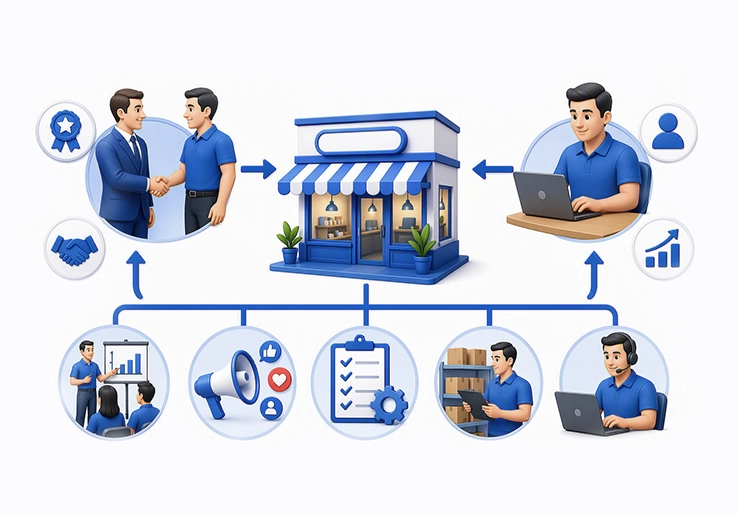
FOFO stands for Franchise Owned, Franchise Operated — a franchise business model where the franchisee invests in, owns, and independently manages an outlet under an established brand's umbrella. Unlike models where the parent company retains full control or manages daily operations, the FOFO franchise model places both financial commitment and operational responsibilities squarely on the franchise owner, while the franchisor provides brand licensing, training, marketing support, and standardized operational systems.
Interestingly, the term "fofo" has different meanings in various contexts beyond franchising. FOFO also describes a culture where truths and risks are avoided — standing for the "Fear of Finding Out," often framed as a counterpart to FOMO (Fear of Missing Out). In Portuguese, "fofo" simply means cute or soft. This article focuses exclusively on FOFO as a franchise business model.
Key outcomes from this guide:
The FOFO franchise model stands as one of the most widely adopted structures in modern franchising, particularly in markets experiencing rapid organized retail growth. At its core, the model separates brand ownership from outlet ownership — the franchisor retains the brand, intellectual property, and system standards, while the franchisee owns the physical business and manages all operations independently.
This structure is distinct from the COCO model (Company Owned, Company Operated), where the company owns and operates all outlets with complete control, and from FOCO and COFO arrangements where ownership and operations are split between parties. With the global franchise market projected to grow to USD 307.15 billion by 2033, understanding these distinctions is critical for anyone entering the franchise business.
The FOFO model rests on clearly defined roles. The franchisee invests in everything required to launch and sustain the outlet — franchise fees (typically ₹2–10 lakhs in Indian markets), setup and equipment costs (₹5–15 lakhs), and working capital (₹2–5 lakhs or more). This financial commitment covers real estate or rent, interiors, furniture, equipment, initial inventory, and staff recruitment.
Operational independence is a defining feature. The franchisee owns the hiring decisions, manages daily operations, controls local marketing initiatives, and drives the profit-and-loss statement. This level of operational control allows franchise owners to adapt to local customer preferences, optimize staffing, and respond quickly to market conditions.
However, this independence comes with brand compliance obligations. The franchisor sets consistent brand standards — covering everything from store design and service protocols to product quality and customer experience benchmarks. Franchisees must adhere to these brand guidelines, submit to periodic audits, and participate in mandatory training programs. The franchise agreement serves as the legal backbone, specifying duration, territory rights, royalty structures, performance metrics, and renewal conditions.
Understanding where FOFO sits among franchise models is essential for choosing the right model. Here is a comparison of the four primary structures:
| Criterion | COCO | COFO | FOCO | FOFO |
|---|---|---|---|---|
| Outlet Ownership | Company owns | Company owns | Franchisee owns | Franchisee owns |
| Operations | Company manages operations | Franchise operated | Company manages | Franchisee operates |
| Capital Investment | Entirely from parent company | Company-funded assets | Franchisee invests | Franchisee invests |
| Operational Control | Full control by company | Franchisee manages daily operations | Franchisor has operational control | Full franchisee control |
| Risk Profile | Full risk on company | Shared operational risk | Shared financial risk | High franchisee risk |
| Profit Distribution | 100% to company | Performance-based for operator | Shared model (60–70%) | 85–90% retained after royalties |
In the COCO model, the company owns and operates everything — maximum control, maximum investment. The COFO model (company owned franchise operated) reverses operational responsibility, with franchisees running company-owned assets, reducing the franchisee's capital requirement. FOCO (franchise owned company operated) positions the franchisee as a more passive investor — the franchisee invests in the outlet, but the company manages operations, ensuring operational consistency but reducing the franchisee's autonomy. FOCO allows franchisees to own outlets while the company manages operations, making it attractive for those seeking lower involvement.
The FOFO model offers the highest entrepreneurial freedom and profit retention potential, but also carries the greatest financial risk and operational burden for the franchise owner.
The FOFO (Franchise Owned, Franchise Operated) model is characterized by several distinct features that define its operational and financial dynamics for both franchisors and franchisees.
In the FOFO model, the franchisee fully owns the outlet and has complete control over day-to-day operations. This includes managing staff, inventory, customer service, and local marketing efforts. The franchisee's autonomy allows for quick decision-making and adaptation to local market conditions while operating under the franchisor's brand guidelines.
Franchisees bear the entire financial responsibility for their outlets, including initial franchise fees, setup costs, ongoing operating expenses, and working capital. This high level of investment means franchisees assume significant financial risk but also stand to gain greater profit retention compared to other franchise models.
While franchisees operate independently, franchisors provide essential support such as brand licensing, standardized operational procedures, training programs, marketing assistance, and supply chain access. This support helps maintain brand consistency and equips franchisees with tools to succeed.
Despite operational independence, franchisees must adhere strictly to the franchisor's brand standards. Regular audits, mandatory training updates, and compliance checks ensure uniform customer experience and product quality across all FOFO outlets.
The FOFO model enables franchisors to expand their brand footprint rapidly without heavy capital investment. Since franchisees fund and operate their own outlets, the franchisor's financial risk is minimized, allowing scalable growth across diverse markets.
FOFO offers franchisees the opportunity to own and run a business with the backing of an established brand. This model suits entrepreneurs who seek full operational control, flexibility, and the potential for higher returns in exchange for active management and financial commitment.
These key features collectively make the FOFO franchise model a popular choice for brands aiming for fast growth and franchisees desiring operational independence within a proven business framework.
The FOFO model offers compelling advantages for both sides of the franchise equation, which explains why approximately 70% of franchises in certain Indian market segments have adopted this structure.
The most powerful advantage for franchisors is capital-light, rapid expansion. Because each franchisee funds their own business, the franchisor can scale across multiple locations and new markets simultaneously without deploying significant corporate capital. The FOFO model allows for rapid brand expansion with low financial risk to the parent company.
This translates into reduced operational overhead. The franchisor doesn't hire frontline staff, negotiate individual store leases, or manage business operations at the unit level. Instead, resources focus on brand development, marketing support, training systems, and quality monitoring. Revenue flows from franchise fees, ongoing royalties, and sometimes supplier partnerships — creating a scalable income model that grows with each new location.
Geographic diversification becomes achievable at speed. Brands can penetrate tier-2 and tier-3 cities through local entrepreneurs who understand regional consumer behavior, regulatory environments, and supply chain dynamics. This local knowledge is something a centralized company operation rarely matches.
For entrepreneurs, the FOFO model offers the chance to run their own business under an established brand with proven systems. This significantly reduces the marketing and customer acquisition costs that independent startups face. Brand recognition and brand loyalty are built-in assets from day one.
Franchisees benefit from structured training programs, standardized operational systems, and ongoing support — reducing the learning curve that typically accompanies launching a new business. The franchisor provides professional management frameworks, supply chain access, and marketing campaigns that individual operators couldn't afford independently.
The profit retention potential in FOFO is substantially higher than in shared models. After paying royalties and franchise fees, the franchisee owner retains the remaining earnings. Under efficient management, this creates significant upside — particularly compared to the FOCO model where 30–40% of profits may be shared with the franchisor for operational management.
FOFO franchisees also enjoy operational independence to adapt menus, service hours, local promotions, and staffing to match their specific market. This flexibility to customize within brand guidelines often drives stronger local customer experience and repeat business.
Global franchise giants demonstrate the FOFO model's scalability. McDonald's, Subway, and KFC have used FOFO extensively for international expansion, empowering local franchise partners to own and operate outlets while maintaining global brand standards. These companies operate thousands of franchisee-owned locations across dozens of countries.
In the Indian market, brands like G-Fresh Mart use the FOFO model for supermarket franchise expansion, enabling local entrepreneurs to own and run stores with brand-provided setup guidance, training, and supply chain access. Regional food chains, Ola Car Wash, Buyzaar Mart, and numerous QSR brands have similarly adopted FOFO to penetrate underserved markets rapidly.
Technology and service sectors — including fitness studios, education centers, beauty and wellness brands — increasingly favor FOFO because franchisees in these industries want full control over service delivery, staff management, and customer relationships.
Moving from understanding FOFO benefits to actually implementing the model requires careful planning, clear financial analysis, and structured execution. Whether you're a franchisor designing a FOFO program or an entrepreneur evaluating franchise opportunities, the implementation process follows a predictable sequence.
Businesses should consider FOFO model adoption when they have strong brand equity, a proven and replicable business model, and want expansion without owning or operating every unit. For franchisees, the model suits active entrepreneurs willing to commit both capital and management expertise to the venture.
Analyze local demand, competitor landscape, real estate costs, labor availability, and supply chain logistics. Franchisors should identify potential franchise partners with adequate financial capacity, relevant experience, and commitment to brand standards.
Define terms covering fees, royalty structures, territory exclusivity, duration (typically 5–10 years), performance metrics, audit protocols, and renewal conditions. This franchise agreement is the legal foundation protecting both parties.
Follow franchisor design guidelines for site selection, store layout, interiors, and equipment installation. Franchisors typically provide approval criteria; franchisees handle execution and funding.
Complete mandatory training programs (costs can range ₹50,000–₹2 lakhs depending on intensity), recruit and train staff, establish supply chain relationships, and configure inventory management and POS systems.
Establish regular audit schedules, refresher training cycles, marketing coordination, and cloud-based reporting systems for real-time performance visibility across all FOFO outlets.
The financial commitment varies significantly based on brand, industry, and market. Here's how FOFO compares with the FOCO alternative:
| Investment Factor | FOFO Model | FOCO Alternative |
|---|---|---|
| Initial Capital | ₹5 lakhs – ₹2 crores | ₹10 lakhs – ₹3 crores |
| Operational Control | Full franchisee control | Shared with franchisor |
| Profit Retention | 85–90% after royalties | 60–70% shared model |
| Risk Level | High franchisee risk | Shared risk model |
| Management Involvement | Full-time active management | Passive or semi-passive |
| Operational Expenses | Borne entirely by franchisee | Split or managed by franchisor |
Entrepreneurs with higher risk tolerance, hands-on management expertise, and strong local market knowledge typically thrive in FOFO. Those preferring a more passive investment with predictable (if lower) returns may find the FOCO model more suitable. Under high inflation or volatile cost regimes — as seen in India during 2025–26 — FOFO rewards agile franchisees who can optimize locally, while FOCO models may better protect passive investors from operational cost swings.
Since FOFO owners retain full profits after fees and royalties, ROI depends heavily on location selection, sales volume, and rigorous cost control. There is no minimum guarantee of fixed returns — business success is directly tied to the franchisee's execution quality.
While the FOFO model offers significant advantages, it presents real operational risks that franchisors and franchisees must address proactively. Low operational oversight in FOFO can lead to brand inconsistencies — a challenge that requires systematic solutions.
Maintaining consistent brand standards across independently operated locations is the most persistent challenge in FOFO. When each franchise owner manages their own business operations, variations in service quality, product standards, and customer experience inevitably emerge.
Solution: Implement comprehensive training programs before launch and continuous refresher cycles post-launch. Conduct regular audits covering operations, hygiene, service speed, and brand compliance. Tie performance metrics to contract renewal — franchisees who consistently fail brand audits face non-renewal. Detailed operational manuals and SOPs, updated regularly, provide the benchmark for ensuring consistency across all locations.
Choosing the wrong franchise partners can damage brand reputation and lead to financial losses. Franchisees in FOFO must manage day-to-day operations independently, which requires genuine management expertise, financial discipline, and commitment.
Solution: Develop strict eligibility criteria covering financial capacity verification, prior business experience, local market knowledge, and time commitment expectations. Implement structured onboarding with mentorship during the first 90 days. Create incentive systems rewarding high performers and establish clear consequences for underperformance. Ongoing support systems — including dedicated franchise relationship managers — help identify and address issues before they escalate.
Without careful planning, opening too many outlets in close proximity cannibalizes sales and creates friction between franchise partners operating in the same way within overlapping markets.
Solution: Establish clear territorial boundaries using population-based allocation formulas and geographic mapping. Include non-compete clauses in franchise agreements restricting franchisees from opening competing businesses. Define minimum distances between outlets based on market density analysis, protecting each franchisee's investment and ensuring sustainable unit economics.
Operational consistency across multiple locations requires unified technology infrastructure. Franchisees operating independently may resist technology investments or use incompatible systems, creating data silos and management blind spots.
Solution: Mandate unified POS systems and retail billing software across all outlets. Implement cloud-based inventory management for real-time stock visibility and automated reordering. Require regular technology upgrades and provide centralized IT support. These systems give franchisors performance data across the network while helping franchisees reduce operational costs, minimize waste, and improve decision-making through analytics.
LOGIC ERP software is the best solution for managing FOFO franchise models due to its comprehensive features tailored to support the unique needs of franchise-owned and operated businesses. It offers robust tools for inventory management, multi-store POS integration, and real-time data analytics, enabling franchisees to maintain operational control while ensuring brand consistency across all outlets.
The software facilitates seamless communication between franchisors and franchisees by providing centralized reporting, audit capabilities, and compliance monitoring. This helps franchisors enforce brand standards and quality controls despite the operational independence of franchisees in the FOFO model.
Additionally, LOGIC ERP supports scalable growth by simplifying the onboarding of new franchisees, automating supply chain processes, and streamlining financial management. Its cloud-based architecture ensures accessibility and security, allowing franchise owners to manage their outlets efficiently from anywhere.
By choosing LOGIC ERP, FOFO franchise businesses gain a powerful technology partner that enhances operational efficiency, improves decision-making, and drives sustainable growth within the franchise network.
The FOFO franchise model represents the most entrepreneurially empowering franchise structure available — combining the independence of owning your own business with the proven systems and brand power of an established franchisor. For brands seeking rapid retail expansion without heavy capital deployment, and for entrepreneurs wanting operational control with built-in brand loyalty, FOFO delivers a compelling value proposition. With the global franchise market projected to reach USD 307.15 billion by 2033, the opportunities within this model continue to expand across industries and geographies.
However, FOFO demands active involvement, genuine management expertise, and willingness to bear financial risk. It is not a passive investment. Business success in FOFO correlates directly with the franchisee's ability to execute within brand guidelines while adapting intelligently to local conditions.
Immediate next steps for prospective FOFO participants:
Related topics worth exploring: franchise legal compliance across jurisdictions, multi-unit franchise development strategies, supermarket POS and ERP trends for 2026, and international expansion planning for brands considering cross-border FOFO deployment.
Call at +91-73411-41176 / +91-73411-41175 or send us an email at sales@logicerp.com to book a free demo today!
FOFO stands for Franchise Owned, Franchise Operated. The franchisee owns the outlet and handles all daily operations independently, while the franchisor provides brand rights, training, and support systems.
In the FOFO model, the franchisee owns and operates the outlet with full operational control. In the FOCO model (franchise owned company operated), the franchisee invests in the outlet but the company manages operations, making it a more passive investment.
Investment varies widely by brand and industry. In India, typical ranges include ₹2–10 lakhs for franchise fees, ₹5–15 lakhs for setup and equipment, and ₹2–5 lakhs for working capital. Total investment can range from ₹5 lakhs to ₹2 crores depending on scale.
FOFO franchisees typically pay regular royalties (monthly or quarterly, often a percentage of revenue), marketing fees for national brand campaigns, and sometimes commissions on centralized supply chain purchases. These are separate from the initial franchise fee.
FOFO can work for first-time entrepreneurs if the franchisor provides robust training and support. However, it requires management expertise, financial discipline, and active daily involvement. Franchisees in FOFO must manage day-to-day operations independently, so prior business or management experience is advantageous.
FOFO is widely adopted in supermarkets and grocery retail, quick-service restaurants and cafes, beauty and wellness, fitness centers, education services, and consumer retail. Any sector with replicable operations and strong brand value can leverage FOFO.
Most FOFO franchise agreements run 5–10 years, with renewal options contingent on performance metrics, brand compliance audits, and mutual agreement. Terms, territory rights, and renewal conditions are specified in the franchise agreement.
Key risks include high capital exposure with no guaranteed returns, operational complexity requiring active management, sensitivity to cost fluctuations (rent, labor, supplies), and maintaining brand consistency without direct franchisor oversight. Franchisees bear financial risks but benefit from brand recognition.
Many brands allow multi-unit FOFO ownership for high-performing franchisees. Policies vary — some franchisors encourage it for faster expansion, while others limit it to ensure quality control. Multi-unit operators benefit from economies of scale but need stronger management systems.
Yes. FOFO also stands for the Fear of Finding Out — describing a psychology where people avoid seeking information due to fear of what they might discover. In daily life, this might involve ignoring car warning lights, avoiding bills, skipping medical checkups, or delaying difficult conversations in relationships. In finance, people may avoid checking bank accounts or investments out of fear. In Portuguese, "fofo" simply means cute or soft.
FOFO meaning stands for Franchise Owned, Franchise Operated. It is a franchise business model where the franchisee both owns and operates their outlet independently, unlike other business models such as Company Owned Franchise Operated or Franchise Invested Company Operated.
The FOFO model gives full control to the franchisee to manage day-to-day operations, whereas the FICO model (Franchise Invested Company Operated) involves the franchisee investing capital but the company operates the business. Understanding these key differences helps in choosing the right franchise model.
Choosing FOFO as the right franchise model offers franchisees full control over their business operations and inventory management, enabling them to adapt locally and drive sustainable growth for long term success.
In the FOFO franchise business model, the franchise invested company (franchisee) typically invests in setup costs, inventory management, and working capital, bearing full financial responsibility to operate the business independently.
Yes, a franchise invested company can own and operate multiple outlets under the FOFO model, giving them full control over each business location while benefiting from the franchisor's brand and support.
The key differences lie in ownership and control: FOFO grants full operational control to the franchise invested company, while Company Owned Franchise Operated models retain ownership and operational control within the parent company.
Effective inventory management is crucial in the FOFO model since the franchisee fully operates the business. Proper systems help maintain brand standards and profitability across independently managed outlets.
Understanding how the business operates — whether franchise invested company or company owned — is essential to select the right franchise model that aligns with your management style, investment capacity, and long term goals.
The FOFO model ensures full control by allowing franchise invested companies to manage daily operations, staffing, and marketing independently, unlike models where the company owns or operates the outlets.
The FICO model complements FOFO by offering an alternative structure where the franchise invested company provides capital but the company operates the business, suitable for investors seeking less operational involvement.
The Owned Company Operated (COCO) franchise model entails the company owning and operating all outlets directly. In this model, the parent company retains full control over processes, branding, staffing, and customer experience. The company bears all costs associated with running each store, including hiring employees, providing training, stocking products, and managing day-to-day operations. This centralized ownership allows for maximum control and consistency of the brand across all locations.
Popular Products