COCO (Company-Owned, Company-Operated) is a franchise business model where the parent company owns and operates every outlet — retaining full control over branding, operations, staffing, and the customer experience. It is the most centralized structure available for business expansion.
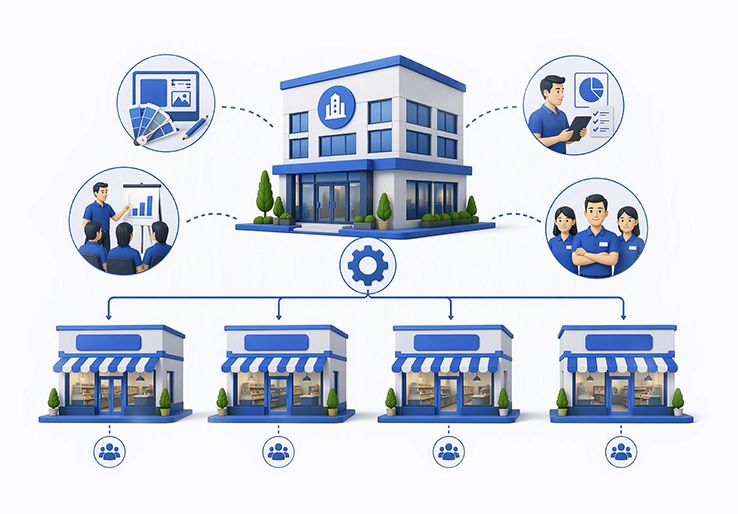
The COCO model — Company-Owned, Company-Operated — is a franchise business model where the parent company owns and operates every outlet, retaining full control over branding, operations, staffing, and customer experience. Unlike franchise owned company operated or franchise owned franchise operated models that distribute ownership or management to external partners, COCO keeps everything in-house, making it the most centralized structure available for business expansion.
By reading this article, you will gain:
The COCO model represents the purest form of centralized ownership in the franchise business landscape. Under this structure, every store, outlet, or unit is financed, built, staffed, and managed directly by the company — with no external franchisee involvement. This approach gives organizations complete control over day-to-day operations, pricing, promotions, supply chain logistics, and every customer touchpoint.
Historically, COCO has served as the foundation for brands looking to establish benchmarks before scaling. Companies often launch with COCO outlets to perfect their operational consistency, then later expand through hybrid or franchise invested company operated models to accelerate growth.
COCO stands for Company-Owned, Company-Operated model. The parent company bears all capital expenditure (capex) and operating expenditure (opex) for every location. There is zero franchising in terms of ownership — all investment, risk, and reward sit with the company.
Three key features define the COCO structure:
This level of control makes the COCO model especially attractive for brands where quality, brand identity, and customer experience are non-negotiable differentiators.
Understanding COCO requires comparing it against the three other dominant franchise business models:
FOFO (Franchise Owned Franchise Operated): Under the FOFO model, franchisees pay for the store and manage operations, using the brand's guidelines while paying fees and royalties. FOFO allows rapid expansion with minimal financial commitment from the franchisor. Brands like McDonald's and Subway use the FOFO model. However, the FOFO model offers low operational oversight for franchisors, which increases the risk of inconsistency in customer experience.
FOCO (Franchise Owned Company Operated): In the FOCO model, the franchisee invests in the store setup, but the company manages all daily operations. FOCO enhances brand credibility through consistent customer experience. Brands like Bistro 57 use the FOCO model for expansion. This franchise invested company operated approach reduces operational risk for the investor while keeping quality standards high.
COFO (Company Owned Franchise Operated): In the COFO model, the company invests in the physical asset while a franchisee handles daily operations. This company owned franchise operated approach lets brands deploy capital while leveraging local entrepreneurial expertise — useful in markets where centralized management is impractical.
The COCO model sits at the opposite end of the spectrum from FOFO: maximum control with maximum capital commitment.
Running a successful COCO operation requires robust infrastructure across three pillars:
Capital investment and financial responsibilities: COCO requires heavy initial investment — site selection, real estate or leases, store build-out, technology systems, and inventory stock, all financed by the company. Ongoing operational expenses include employee wages, utilities, maintenance, supply chain logistics, marketing, and inventory risk. The company absorbs all losses as well as gains.
Staffing, training, and HR management: Because the company operates directly, it needs internal staff hiring, training programs, performance management, and payroll systems. This is significantly more complex than a franchise business where many HR functions are decentralized. Standardized training ensures every employee delivers the same quality of service.
Brand standards enforcement and quality control: COCO provides complete control over store design, product presentation, pricing, and customer experience. Any modifications — new promotions, layout changes, product launches — can be rolled out immediately across all units. Monitoring systems like mystery shopping, centralized customer feedback, auditing, and ERP-based KPI tracking are essential for maintaining operational consistency at scale.
Understanding these components reveals why the COCO model delivers unmatched brand control — and why its advantages are substantial for the right type of business.
The strategic advantages of the COCO model make it the preferred structure for companies that prioritize brand integrity, quality assurance, and long-term revenue capture over rapid expansion. Here is where COCO delivers its greatest value.
Because the company owns and operates every unit, there is maximal consistency in customer experience — uniforms, layout, offers, promotions, and inventory are identical across locations. No variation is introduced by franchisee interpretation or local deviation from company guidelines.
This level of control means messaging, marketing campaigns, and pricing changes can be implemented uniformly without coordinating with external business owners. A well established franchise brand using COCO can adapt faster to market shifts, launch new products simultaneously across outlets, and maintain a cohesive identity that strengthens consumer trust.
For example, Starbucks initially used the COCO model for quality control, ensuring that its coffee experience was consistent before selectively introducing licensed and franchise operated stores in certain markets.
COCO allows direct management of every touchpoint in the customer journey. The company hires employees to its own standards, trains them through centralized programs, conducts regular internal audits, and creates direct feedback loops between customers and corporate leadership.
Product control is tighter under COCO: direct sourcing, standardized supply chain management, and centralized inventory control reduce variation. When a quality issue arises, the company can respond immediately without navigating franchisee agreements or approval processes.
This direct oversight is particularly important in industries where service quality and product integrity define the brand — premium retail, technology, hospitality, and food service.
Under the COCO model, all revenue generated flows directly to the company, minus operating and investment costs. There are no franchise fees, royalties, or revenue-sharing arrangements to dilute earnings.
Profit margins can be higher per unit when the company achieves operational efficiency and economies of scale. However, this financial risk cuts both ways — expenses and losses are entirely on the company. The business strategy must account for both the upside of full revenue capture and the downside of bearing 100% of financial risk across all outlets.
Companies that can manage operational expenses tightly and drive high sales volumes per location stand to benefit most from COCO's revenue structure.
The COCO model plays a critical role in franchise brand development. By controlling every aspect of store operations and customer experience, companies can build a strong, consistent franchise brand identity that resonates with consumers.
This centralized development approach enables rapid iteration on store concepts, product offerings, and marketing strategies without the delays or compromises often faced in franchised outlets. It also allows for tighter integration of digital and physical channels, enhancing omnichannel customer engagement.
Brands often use COCO outlets as flagship stores to showcase the brand's values and standards, setting benchmarks that franchise partners must meet. This strategy supports robust franchise brand development and long-term growth.
Moving from theory to practice, the COCO model proves most effective in specific industries and implementation scenarios. Understanding where COCO thrives — and how to launch it — is critical for any business owner considering this structure.
Premium and luxury retail: High-end fashion, jewelry, and electronics brands use COCO because brand image and product knowledge are central to the customer experience. Apple stores and Tesla showrooms are prominent examples — both companies operate their retail outlets directly to ensure every detail aligns with brand standards.
Technology and consumer electronics: Companies that need to ensure service, warranties, technical support, and inventory standards benefit from COCO. For example, mobile phone retailers using the COCO model have implemented centralized procurement, demand forecasting, and inventory allocation per outlet, managed through proprietary ERP software.
Luxury hospitality and fine dining: Restaurants, boutique hotels, and experiential dining establishments where ambiance, service quality, and brand presentation are core differentiators. The COCO model ensures these elements remain consistent without relying on external operators.
Footwear and fashion retail: Relaxo, the Indian footwear brand, operates over 250 COCO stores, maintaining strong control over layout, inventory, and brand presence across its retail network. The company later planned to add franchising for further expansion.
Companies should consider the COCO model when brand identity and customer experience are strategic priorities and sufficient capital is available.
Estimate capex and opex needs, build cash flow forecasts, and decide whether to fund via internal accruals, debt, equity, or a mixed approach. Factor in real estate, build-out, inventory, and technology system costs. Proper financial management planning is essential at this stage.
Conduct cluster mapping, analyze customer demographics, foot traffic, and competition. Decide between owned vs. leased real estate. Ensure compliance with local regulations and design stores to brand specifications.
Define roles, hire managers and frontline employees, create training manuals aligned with brand values. Establish feedback loops and bring executives to pilot stores for alignment. Standardize HR processes for scalable operations.
Deploy SOPs, execute marketing launch, and install systems for ERP, inventory management, POS integration, and CRM. Implement performance metrics covering sales, costs, labor efficiency, and customer satisfaction. Embed auditing and feedback mechanisms from day one.
A phased roll-out is recommended: start with flagship COCO stores, stabilize systems and processes, then consider hybridizing with franchise owned company operated or other franchise business models to scale faster across new markets.
| Criterion | COCO | FOFO | FOCO | COFO |
|---|---|---|---|---|
| Investment Level | Highest (company invests everything) | Lowest for franchisor (franchisee invests) | Franchisee invests in setup; company operates | Company invests; franchisee operates |
| Control | Full control by company (complete control) | Lowest control by company | High control (company operated) | Moderate control (company owned franchise operated) |
| Speed of Expansion | Slowest (capital and management constraints) | Fastest (rapid expansion via franchisees) | Moderate | Moderate |
| Risk Level | All financial risk on company | Risk distributed to franchisee | Capex risk on franchisee; operational risk on company | Capex risk on company; operational risk on franchisee |
| Revenue Model | 100% revenue retained | Royalty/licensing fees to franchisor | Revenue sharing or management fees | Revenue sharing arrangements |
Choosing the right business model: Use COCO when brand identity, customer experience, and operational consistency are non-negotiable. Choose the FOFO model when rapid expansion with limited capital is the priority. The FOCO model suits passive investors wanting ownership without operating challenges — the franchise owned company operated structure works well for investors seeking returns with lower operational involvement. The COFO model is useful in markets where local entrepreneurship is strong and centralized operations are impractical.
Many successful retailers adopt a hybrid business model, combining COCO flagship stores with franchise operated outlets in secondary markets to balance complete control, risk, and growth speed.
Despite its advantages, the COCO model presents real obstacles that companies must address proactively. Here are the most common challenges and practical strategies to overcome them.
COCO demands significant upfront investment — store build-out, capital leases or property acquisition, inventory, and technology systems. This ties up capital and increases financial risk, with ROI payback periods typically longer than franchise alternatives.
Solutions: Adopt a phased expansion strategy, launching pilot flagship stores before committing to large-scale rollouts. Lease space rather than purchasing property to reduce capex. Consider mixed financing — internal accruals, debt, and equity. Some companies begin with COCO to establish brand standards, then introduce FOFO or FOCO outlets in lower-margin or less strategically critical markets to free up capital.
Running all business operations across every unit — HR, logistics, supply chain, inventory management, quality control — is resource-intensive. Scaling up multiplies this complexity exponentially.
Solutions: Invest in centralized management systems and technology. ERP platforms with modules for inventory tracking, demand forecasting, HR/payroll, and multi-store retail management are essential. Define comprehensive SOPs, build dedicated central operations teams, and use data-driven KPIs to identify and correct inefficiencies before they cascade across locations.
Because the company must fund and manage every outlet, geographic expansion is inherently slower than franchising. Companies must also develop deep managerial talent pipelines and supply chain infrastructure across each new market.
Solutions: Adopt hybrid business model considerations — combine company owned operated stores with franchise opportunities in select markets. Build strategic partnerships for specific regions. Invest in systematic process standardization to reduce per-unit overhead and management burden. Prioritize markets where COCO delivers the highest strategic return and use franchise business model variants elsewhere.
LOGIC ERP offers a comprehensive franchise management software solution tailored to the COCO model's unique needs. Its robust inventory management, centralized control, and real-time analytics empower companies to maintain strict franchise brand standards and operational consistency.
The software supports franchise brand development by streamlining store setup, employee training, and performance monitoring. LOGIC ERP's scalable architecture ensures that as your COCO operations grow, your technology infrastructure keeps pace, reducing operational expenses and enhancing daily operations management.
The COCO model provides full control and operational consistency for franchise brands that prioritize quality and brand integrity over rapid expansion. While it requires significant capital investment and involves greater financial risk, companies that can manage these challenges benefit from complete control over revenue and customer experience.
To leverage the COCO model effectively:
Exploring related franchise business models such as FOFO, FOCO, and COFO can provide strategic flexibility to expand and optimize your franchise business.
Call at +91-73411-41176 / +91-73411-41175 or send us an email at sales@logicerp.com to book a free demo today!
A well established brand is one that has built significant market recognition, customer trust, and operational stability. The COCO model is often preferred by such brands because it allows them to maintain strict control over branding and customer experience, ensuring consistent quality and reinforcing their market position.
The COCO model contributes to franchise success by providing complete operational control, which leads to consistent customer experiences and strong brand integrity. This centralized approach helps companies quickly adapt to market changes, maintain high-quality standards, and retain all revenue, which are critical factors for long-term success.
Key challenges include the need for significant capital investment, high operational complexity, and slower expansion compared to franchise-based models. Managing all aspects of operations internally requires robust infrastructure and experienced management to mitigate financial risks and scalability limitations.
Yes, many companies adopt a hybrid business model, combining COCO flagship stores with franchise operated outlets in other regions. This approach balances the benefits of full control and operational consistency with faster expansion and reduced capital risk.
Operational consistency ensures that every customer receives the same high-quality experience regardless of location. In the COCO model, centralized management and standardized processes help maintain this consistency, which strengthens brand reputation and customer loyalty.
LOGIC ERP provides comprehensive franchise management software tailored to the COCO model's needs. It offers centralized inventory control, real-time analytics, and performance monitoring tools that help companies maintain strict brand standards, optimize operations, and reduce costs across all company-owned outlets.
The company owned franchise operated (COFO) model involves the company owning the outlet or property while the franchisee manages daily operations. This structure offers a balance between company investment and leveraging local franchisee expertise, providing moderate control and operational flexibility.
In the franchise invested company operated model (also known as FOCO), the franchisee invests in the store setup and assets, but the company manages daily operations. This reduces operational risk for the franchisee while maintaining high brand consistency through company oversight.
Under the franchise invested company model, the franchisee is responsible for capital expenditures such as store build-out and equipment, while the company bears operational costs like staffing, inventory management, and customer service.
When the company owns all outlets in the COCO model, it retains complete control over branding, staffing, operations, and customer experience. This centralized ownership ensures uniformity and quality across all locations.
Company operated models, such as COCO, require significant capital and operational resources, which can slow expansion speed. Managing all outlets internally increases complexity and financial risk, making rapid scaling more challenging.
The FOCO model is advantageous when a brand wants to maintain operational control for quality assurance but prefers to share capital investment with franchisees. This model helps ensure consistent customer experiences while reducing the company's financial burden.
The FOFO (franchise owned franchise operated) model allows franchisees to invest in and operate their own outlets, enabling the brand to expand quickly without significant capital expenditure. However, this comes with less direct operational control for the franchisor.
In the COFO model, the company owns the outlet but delegates daily operations to franchisees under strict guidelines. This allows the company to maintain control over property and strategic decisions while leveraging franchisee management for operations.
Popular Products