Cut order planning calculation is the method garment factories use to determine exact fabric requirements and cutting quantities from customer orders, size ratios, marker layouts, and marker efficiency, so the cutting room produces the right pieces with minimum waste.
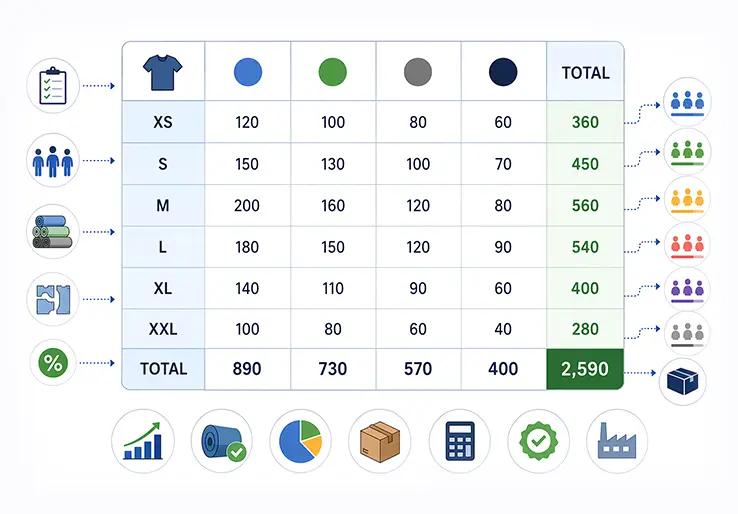
Fabric costs account for 50-60% of total production expenses in the apparel industry. For certain garment types with high wastage or pattern-matching requirements, that share climbs to 70%. A single percentage point of improvement in how fabric is used during cutting can shift margins across an entire season’s production.
Cut order planning calculation is the method garment factories use to determine exact fabric requirements and cutting quantities from customer orders, size ratios, marker layouts, and marker efficiency so the cutting room produces the right pieces with minimum waste. Cut order planning is the process of converting customer orders into optimized cutting instructions that specify how many pieces to cut, in which sizes and colors, across how many fabric lays and markers. A cut order is the resulting instruction sheet sent to the cutting room.
For production planners, cutting room supervisors, industrial engineers, production managers, and apparel factory decision-makers, poor planning creates compounding problems. A misaligned size-color ratio means the factory cuts 200 extra Medium Black T-shirts nobody ordered, while falling short on Large White units that the buyer needs. Wrong lay planning wastes fabric ends. Incorrect marker combinations leave usable fabric on the floor as off-cuts. These errors cascade into excess inventory, urgent re-orders of raw materials, higher production cost, and missed delivery dates.
Competitive garment factories in India, Bangladesh, and Vietnam now treat digital cut planning as standard practice. Here is what that shift looks like:
This guide explains the full scope of cut order planning calculation, including what cut order planning means, the step-by-step planning process, fabric and cost calculation methods, the benefits of accurate planning, common challenges, improvement strategies, software options, best practices, and how LOGIC ERP supports cut order planning in apparel manufacturing.
Cut order planning is the upstream planning process in garment production that translates customer orders (style, size, color, quantity) into efficient cutting instructions. These instructions define how many markers to prepare, how many plies per lay to spread, which marker combinations to use, and the exact number of pieces to cut per size and color, all designed to minimize fabric cost and production waste.
A cut order is a detailed instruction sheet for the cutting department. It specifies:
Cut order planning sits between order planning and the actual cutting process. Once a garment factory receives a confirmed purchase order, the planner maps it into a size-wise and color-wise cut quantity matrix. That matrix feeds into marker planning, where pattern pieces for different sizes are arranged within usable fabric width. Only then does fabric spreading and cutting begin.
Key terms in this workflow:
Style
the specific garment design with its own set of patterns
Size Set
the range of sizes (S, M, L, XL, etc.) required by the buyer
Colorway
each color variant for a style
Marker
the layout of pattern pieces arranged to maximize fabric utilization
Lay
a spread of fabric plies stacked to be cut together using one marker
Fabric Width
the usable distance between selvedges, which determines marker width
Cut order planning affects 70% of garment production costs because it governs how fabric, the largest single expense, is consumed. A factory that plans poorly will lose margin on every order it ships, regardless of how efficient its sewing lines are.
Fabric costs represent about 50-70% of garment production costs. Optimal cut planning minimizes fabric costs by 50-60% of total waste through better marker composition and lay design. Here is how:
The following table describes the typical cut order planning workflow in a garment factory, from the moment a production order arrives to the point where cut bundles reach the sewing floor.
Analyze Customer Purchase Orders
review each PO for style, PO number, delivery date, size ratio, and color breakdown. Confirm quantities with merchandising.
Review Style Details
verify pattern availability, size range, fit approvals, and any special cutting instructions such as nap direction, stripe matching, or placement prints.
Check Fabric Availability
audit roll-wise stock by fabric type, width, shade group, and shrinkage percentage. Determine whether fabric comes from in-house production or external suppliers.
Calculate Fabric Requirements
use marker length and expected marker efficiency to estimate meters needed for each style-color-size combination. Effective COP balances fabric width, marker length, and ply count to reach target quantities without excess.
Prepare the Cut Order
decide marker combinations (which sizes go together), number of lays, and number of plies per lay. Assign cut quantities per lay for each size and color.
Optimize the Cut Plan
group compatible orders sharing the same fabric type. Align size curves to build efficient markers. Respect table length and maximum lay height limits imposed by certain constraints of the equipment.
Release to the Cutting Department
send finalized cutting instructions (printed or digital) to the cutting section. Include marker references, spreading mode, and bundle labels.
Track Cutting and Production Progress
compare daily cut quantity against plan. Update balance-to-cut status. Feed cut bundle data into the production process for sewing and finishing.
Accurate cut order planning depends on several master data and order parameters. Missing or incorrect inputs create errors that compound through the entire production process.
Consider a customer order for 900 pieces of Style TS-101 across 2 colors (Black, White) and 4 sizes (S, M, L, XL). The specified size ratio is S:M:L:XL = 1:2:2:1, and the colour ratio is Black:White = 5:4.
Size ratio calculation converts ratios into quantities. Total order quantity is divided by the sum of ratios. Here, the sum of the size ratio is 1+2+2+1 = 6. For each color, multiply the result by the ratio of a specific size.
The following table shows the quantity breakdown:
| Style | Color | S | M | L | XL | Total |
|---|---|---|---|---|---|---|
| TS-101 | Black | 83 | 167 | 167 | 83 | 500 |
| TS-101 | White | 67 | 133 | 133 | 67 | 400 |
| Total | 150 | 300 | 300 | 150 | 900 |
From here, the planner determines marker combinations and lays:
Fabric requirement and fabric cost are central outcomes of cut order planning in the garment industry. The calculation starts with marker data.
Suppose marker length for Style TS-101 is 6.3 meters (for a 4-size combination). The formula for total fabric requirement:
Total fabric = marker length × total number of plies across all lays
If the Black cut requires 83 plies across 2 lays, the fabric needed is 6.3 × 83 = 522.9 meters for Black alone. The planner validates that the marker width fits actual fabric rolls (e.g., 150 cm usable width) to avoid selvedge waste or fabric loss.
Fabric consumption includes marker waste and allowances for defects and splices. Account for fabric defects to avoid running short in production. Factories typically add a 3-8% buffer for shrinkage, end loss, and defective portions in rolls.
To compute fabric cost: if fabric is priced at Rs. 35 per meter, then 522.9 meters costs Rs. 18,302 for Black fabric alone. The total fabric cost across both colors becomes the baseline against which the planner optimizes.
Minimizing total cost requires considering fabric costs, labor, waste, and penalties. Including labor and setup costs is crucial for an efficient cut order plan. Spreading cost, marker making cost, and cutting cost together add 5-10% to total manufacturing cost. A 1% improvement in marker efficiency, given fabric is 60% of garment cost, reduces total cost by roughly 0.6% per order.
An efficient cut order plan is a major lever for cost reduction in apparel manufacturing, especially for factories running 5,000+ pieces per day across multiple styles.
Many apparel manufacturing firms still run cut order planning on Excel sheets, paper notes, or isolated CAD systems disconnected from inventory and order data. The following problems are common.
The following checklist targets production planners, industrial engineering teams, and cutting room managers looking for actionable improvements.
Cut order planning software is a digital tool that automates order analysis, fabric requirement calculation, cut quantity planning, and cut order generation for the garment industry. It replaces manual spreadsheets and disconnected calculations with structured, error-checked workflows.
Such software is often part of an apparel ERP system or integrated with CAD and marker making systems within the fashion technology ecosystem. Computer-aided design improves marker efficiency and reduces waste by testing thousands of pattern arrangements digitally. CAD systems enhance pattern making and marker planning efficiency by storing patterns for quick adjustments. Computer-aided design systems store patterns for quick adjustments across different orders.
The software automates:
Computerized marker planning reduces fabric wastage by eliminating guesswork in pattern placement and enabling data-driven decisions across complex multi-style, multi-fabric scenarios.
When evaluating cut order planning software, production heads and IT teams should look for the following capabilities in apparel manufacturing software:
LOGIC ERP is an integrated platform designed for apparel and garment manufacturing operations. It connects the data points that cut order planning depends on into a single system.
High-performing cutting rooms in the apparel industry follow these practices consistently:
Many factories are transitioning from manual spreadsheets to digital, ERP-driven cut order planning. The difference affects accuracy, speed, and cost.
| Factor | Manual Planning | Digital Planning (e.g., LOGIC ERP) |
|---|---|---|
| Calculations | Manual formulas in Excel | Automated with validation checks |
| Fabric visibility | Based on last stock count | Real-time roll-wise data |
| Error risk | Higher due to manual data entry | Lower with system-enforced rules |
| Order changes | Requires reworking sheets | Updates cascade through the plan |
| Reporting | Time-consuming, assembled manually | Automated dashboards and reports |
| Production visibility | Limited to cutting room records | Integrated across cutting, sewing, finishing |
| Marker optimization | Dependent on planner experience | Supported by CAD integration and data |
Digital cut order planning reduces planner workload, catches quantity mismatches before fabric is spread, and provides management with visibility into room processes without waiting for end-of-day reports. For factories handling 20+ styles per month across multiple buyers, the manual approach creates a bottleneck that digital tools remove.
The flow is straightforward: Order Analysis, then Fabric Planning, then Cut Order, then Optimized Markers and Lays, then Reduced Waste, then Efficient Garment Production. Each step depends on the accuracy and completeness of the one before it. Factories that treat cut order planning as a core discipline, not a clerical task, protect their margins on every order.
Digital, ERP-driven solutions handle the complexity that modern apparel production demands: dozens of styles, hundreds of size-color combinations, multiple fabric types, and tight delivery windows. The cost involved in poor planning is too high to leave to spreadsheets.
Optimize garment production and bring greater control to cut order planning with LOGIC ERP.
Call at +91-73411-41176 / +91-73411-41175 or send us an email at sales@logicerp.com to book a free demo today!
Cut order planning is the process of converting style-wise and order-wise requirements into efficient cutting instructions that minimize fabric waste. It bridges customer orders, fabric availability, and marker/cut plans in the garment manufacturing process.
Cut order planning directly controls fabric consumption, which accounts for 50-60% of garment cost. Accurate planning reduces production cost, prevents size/color shortages, and supports timely order fulfillment.
The core steps are: analyze customer orders, review style and pattern details, check fabric stock, calculate fabric requirement, create the cut order with marker and lay details, release to the cutting department, and track progress against plan.
Planning optimizes marker composition, lay height, and roll usage, which increases marker efficiency and reduces off-cuts. Grouping compatible orders also helps use fabric ends and remnant pieces more effectively, helping to minimize fabric wastage.
Essential data includes: style, fabric type and fabric width, size range, size ratio, colorways, total order quantity, delivery dates, and any special cutting instructions (nap, stripes, placement prints). Accurate fabric stock and marker data are also referenced.
It is a specialized application, often part of an ERP or CAD suite, that automates order analysis, fabric calculation, marker selection, and cut order generation. Benefits include reduced errors, faster planning, and better visibility into fabric consumption.
ERP software connects sales orders, style masters, BOMs, inventory, and production data, allowing planners to generate accurate, real-time cut orders. LOGIC ERP, for example, provides integrated modules for order planning, fabric planning, and cutting workflows in a single platform.
Cut order planning focuses on how much to cut, how to spread, and how to use fabric efficiently. Production planning focuses on scheduling sewing lines, finishing, and packing to meet delivery dates. Both should be integrated but address different stages in apparel manufacturing.
Use optimized markers through CAD software, maintain calibrated cutting equipment, train spreading and cutting operators, and adopt digital cut order planning tools. Regularly review plan vs actual fabric consumption to refine planning parameters and minimize time lost to rework.
Cut order planning calculation involves determining the exact quantity of fabric and garment pieces to be cut based on customer orders, size ratios, and marker layouts. This calculation ensures that fabric consumption is optimized while meeting production requirements, minimizing waste, and aligning with inventory levels. It is a critical part of the marker making stage in apparel manufacturing.
The marker making stage is where pattern pieces for different garment sizes and styles are arranged on fabric width to maximize utilization. This stage uses cut order planning calculations to create optimal markers that guide fabric cutting. Efficient marker planning reduces fabric wastage and supports an efficient cut order plan, which is essential for cost control in the apparel industry.
Fabric cutting is the physical process of spreading fabric lays and cutting garment pieces according to the cut order plan and marker layouts. Proper coordination with inventory levels and marker planning ensures that fabric cutting is done efficiently, minimizing errors and fabric consumption. Advanced fashion technology, including CAD systems, supports precision in fabric cutting.
Inventory levels of fabric rolls and finished goods directly impact cut order planning. Accurate and real-time inventory data allows planners to match fabric availability with production orders, preventing shortages and excess stock. Integrating inventory management with cut order planning leads to a more efficient cut order plan and reduces fabric wastage.
Optimal cut order planning balances fabric width, marker length, ply count, and size ratios to create the most efficient cutting instructions. It aims to minimize fabric consumption and labor costs while meeting production deadlines. Using advanced market planning and fashion technology, manufacturers can achieve an efficient cut order plan that reduces overall production expenses.
Fabric consumption is the largest cost driver in the apparel industry, often representing 50-70% of total production costs. Efficient cut order planning and marker making reduce fabric consumption by maximizing marker efficiency and minimizing waste. Lower fabric consumption translates to reduced costs and higher profitability for garment manufacturers.
An efficient cut order plan optimizes marker layouts, fabric spreading, and cutting sequences to reduce waste and labor time. It incorporates accurate cut order planning calculations, considers inventory levels, and uses fashion technology tools for market planning. This leads to better fabric utilization, lower production costs, and timely order fulfillment in the apparel industry.
Marker planning determines how garment patterns are placed on fabric to maximize utilization. It directly influences fabric consumption and cutting efficiency. Effective marker planning uses cut order planning calculations and fashion technology to create markers that reduce fabric wastage and support an efficient cut order plan.
Fashion technology, including CAD and ERP systems, automates and optimizes cut order planning processes. It facilitates precise marker making, fabric consumption calculation, and inventory level tracking. These tools enable apparel manufacturers to create efficient cut order plans, reduce errors, and improve overall production efficiency.
Popular Products