The COGS formula is the foundational equation every inventory-based business uses to determine how much it costs to produce or acquire the goods it sells. COGS = Beginning Inventory + Purchases During Period − Ending Inventory.
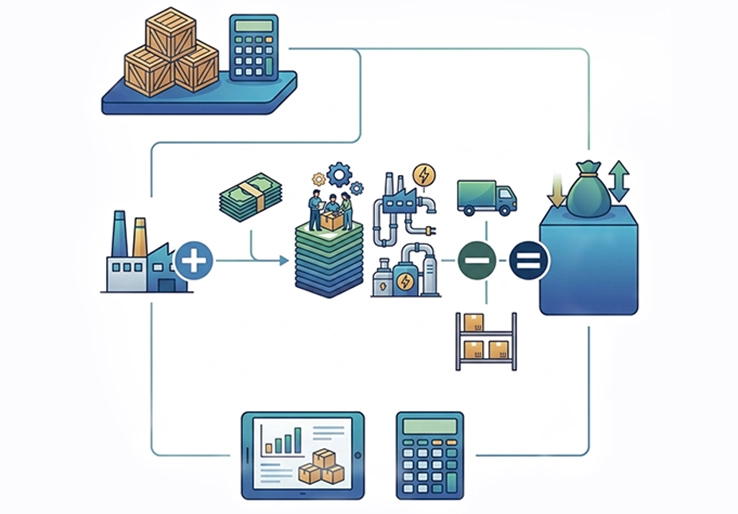
The COGS formula is the foundational equation every inventory-based business uses to determine how much it costs to produce or acquire the goods it sells. Cost of goods sold (COGS) represents the direct costs attributable to products sold during a specific accounting period, and calculating it accurately is essential for financial reporting, pricing strategies, and profitability analysis.
This guide covers the complete COGS formula — its components, step-by-step calculation methods under different inventory valuation approaches, and practical solutions to common challenges. It is written for business owners, financial managers, and accounting professionals who manage inventory-based operations and need to calculate COGS reliably for their income statement, balance sheet, and tax reporting.
COGS is subtracted from revenue to calculate gross profit, making it one of the most consequential figures in your financial statements.
By working through this guide, you will:
COGS refers to the direct costs incurred in producing or acquiring the goods a company sells during a given accounting period. It does not capture all inventory held — only the inventory sold. This distinction is critical: costs for unsold products are not included in COGS but remain as assets on the company's balance sheet until those items are sold.
The relationship between COGS and profitability is direct. Gross profit is calculated by subtracting COGS from total sales revenue. Higher COGS results in lower gross profit margins, which flows through to operating income and net income. Because COGS is recorded as an expense on the income statement, any error in its calculation distorts reported profitability, financial ratios, and income tax obligations. Managing COGS is critical for maintaining profitability and running a profitable business.
COGS represents the direct expenses involved in producing the goods a company sells. This accounting metric is essential for calculating gross profit, informing pricing decisions, and supporting tax reporting. Additionally, understanding COGS allows businesses to assess production efficiency and overall financial performance.
COGS offers businesses valuable insights into the direct expenses associated with their production processes. By examining COGS, companies can make informed decisions regarding cost control, product development, and operational enhancements, all crucial for long-term growth and sustainability. The insights derived from COGS influence multiple facets of business operations, including:
COGS includes direct costs of producing goods sold. These are the direct costs involved in bringing a product to a saleable condition:
COGS includes direct costs like materials and labor for production. These direct expenses form the core inputs to the COGS formula.
Indirect costs and period costs do not belong in the COGS calculation. Operating expenses are not directly tied to production costs and must be reported separately:
Operating expenses include selling, general, and administrative costs. Indirect costs like rent and marketing are excluded from COGS. Accurate cost categorization directly affects how reliably you can calculate COGS — misclassifying indirect costs as direct costs inflates COGS and understates gross margin, while the reverse overstates it. This distinction is the foundation for applying the formula correctly.
With a clear understanding of which costs belong in the calculation and which do not, the next step is examining the three core elements of the COGS formula. COGS is calculated as Beginning Inventory plus Purchases minus Ending Inventory. Each component must be valued accurately for the formula to produce meaningful results.
Beginning inventory is the total value of all goods available for sale at the start of an accounting period. It equals the ending inventory from the prior period, carried forward under the same inventory valuation method. Beginning inventory includes finished goods, work-in-progress, and raw materials (for manufacturers), or merchandise on hand (for retailers).
A weak or inaccurate beginning inventory figure cascades through the entire formula. If beginning inventory is overstated, COGS will be overstated and gross profit understated — and vice versa. Consistency in how inventory values are determined from period to period is non-negotiable for reliable financial reporting.
Purchases refer to the total cost of new inventory acquired during the period. This encompasses all costs incurred to get goods ready for sale or production:
Beginning inventory plus purchases equals "Goods Available for Sale" — the total pool of inventory cost from which COGS and ending inventory are derived. Many businesses overlook ancillary costs like freight and duties, which can meaningfully affect the accuracy of the formula.
Ending inventory is the value of all unsold inventory at the end of the accounting period. It is subtracted in the formula to isolate the cost of only those goods that were actually sold. The ending inventory balance depends on two factors: the physical count of items remaining and the inventory valuation method used to assign cost to those items.
The three components work together as a system. When purchases rise or the valuation method changes, ending inventory shifts, which directly alters COGS. Understanding how inventory affect COGS through valuation is the next critical piece.
The inventory valuation method a business selects determines which cost layers are assigned to COGS and which remain in ending inventory. Inventory valuation methods significantly impact reported COGS, gross profit, and tax liability. The three primary inventory accounting methods are FIFO, LIFO, and the average cost method.
The first in first out method assumes the oldest inventory is sold first. FIFO is most appropriate for businesses where goods have a natural physical flow — perishable products, technology, or fashion items where older stock genuinely moves first.
Step-by-Step FIFO Calculation:
Impact on COGS: FIFO sells oldest inventory first, lowering COGS during inflation because older, cheaper costs flow to the income statement. This produces higher gross profit and higher taxable income during periods of rising prices.
The last in first out method assumes the most recently purchased units are sold first. LIFO is used primarily for tax purposes in the United States, where it is permitted under U.S. GAAP. IFRS prohibits LIFO, so companies operating internationally must consider regulatory constraints.
Step-by-Step LIFO Calculation:
Impact on COGS: LIFO sells newest inventory first, increasing COGS during inflation because the most recent, higher-priced costs flow to the income statement. This reduces gross income and taxable income, generating tax savings during rising costs.
The average cost method blends all inventory costs to create a single weighted average cost per unit. This approach is ideal for homogeneous goods where individual batch tracking is impractical, and it smooths out the impact of price fluctuations on COGS and profitability.
Step-by-Step Average Cost Calculation:
The Average Cost Method smooths out price fluctuations in COGS, producing results between FIFO and LIFO during inflationary periods.
Valuation methods for inventory include FIFO and LIFO, along with the weighted average and special identification method. The special identification method tracks specific costs for unique items — practical for high-value, serialized goods but impractical for mass-produced products sold at volume.
| Method | Best Use Case | COGS Impact (Rising Prices) | Tax Implications | Regulatory Status |
|---|---|---|---|---|
| FIFO | Perishable goods, tech, fashion | Lower COGS → higher profit | Higher taxable income | GAAP & IFRS |
| LIFO | U.S. tax deferral strategy | Higher COGS → lower profit | Lower taxes during inflation | U.S. GAAP only; prohibited under IFRS |
| Weighted Average | Homogeneous goods, price volatility | Smoothed COGS | Moderate tax impact | GAAP & IFRS |
| Specific Identification | Unique, high-value items | Exact actual cost | Reflects actual cost basis | GAAP & IFRS |
Choosing the right method depends on your industry, cost trends, and jurisdiction. Service companies and service based businesses typically have minimal COGS since they do not sell physical inventory — their primary business expenses fall under operating expenses instead. For inventory-heavy operations, the valuation method you select shapes every downstream metric: gross margin, operating income, net income, and income tax for income tax purposes.
COGS varies with production volume while operating expenses are fixed, which is why accurate inventory cost tracking under a consistent accounting method is essential for separating variable costs from fixed costs in financial analysis.
Every accountant familiar with spreadsheets should be able to recall the basic COGS formula effortlessly. At first glance, it appears straightforward, involving just three variables: beginning inventory, purchases, and ending inventory. However, each component has underlying complexities that require careful consideration to determine their accurate values.
The standard formula for calculating COGS is:
To delve deeper into the COGS formula, there are four key steps typically handled by accounting and tax professionals, often supported by specialized software. Nevertheless, all managers should understand these steps:
Identify the beginning inventory of raw materials, work-in-progress, and finished goods, based on the previous period's ending inventory figures.
Calculate the cost of raw material purchases made during the period, including freight-in, trade discounts, and cash discounts.
Determine the ending inventory balance, usually based on physical cycle counts and aligned with the company's chosen inventory valuation method.
Account for any additional direct production costs in the inventory valuation.
As shown by the COGS formula, inventory management is closely linked to calculating COGS. Therefore, the methods used to identify and value beginning and ending inventory significantly affect COGS. Most companies conduct regular physical inventory counts to verify the quantity on hand at period-end. This physical verification serves as a check against recorded inventory levels and helps detect damaged, obsolete, or missing ("shrinkage") items.
Once inventory quantities are confirmed, management assigns values to calculate the final inventory balance using an accounting method compliant with GAAP.
The beginning inventory for the current period is the ending inventory from the previous period. Additionally, under GAAP, purchases made during the year must be recorded using accrual accounting.
Periodic physical counts and valuations are essential for accurately determining ending inventory.
There are various inventory valuation methods under GAAP, each affecting inventory values differently and significantly impacting COGS and profitability.
Below are three commonly used inventory valuation methods under GAAP:
First In, First Out (FIFO): FIFO assumes that the oldest inventory items are sold first. This approach reflects the order of production, meaning the inventory left at the end of the accounting period consists of the most recently acquired units. When costs for raw materials or labor rise, FIFO results in a higher valuation of ending inventory and a lower COGS.
Last In, First Out (LIFO): LIFO assumes that the most recently acquired inventory is sold first, so the ending inventory consists of the oldest units. In times of rising costs, LIFO produces a lower valuation of ending inventory and a higher COGS.
Average Cost Method (ACM): The Average Cost Method calculates inventory value by averaging all costs during the period. It smooths out price fluctuations by dividing total costs by total units available, applying this average cost to both COGS and ending inventory.
Consider this simplified example of COGS:
A coffee shop begins the month with ₹2,25,000 worth of ingredients. Throughout the month, it purchases an additional ₹1,87,500 in coffee beans, milk, syrups, and pastries. At the end of the month, ₹90,000 worth of ingredients remain.
Here's how the coffee shop calculates its COGS:
COGS = (Beginning inventory + Purchases) – Ending inventory
| Beginning Inventory | ₹2,25,000 |
| + Purchases | ₹1,87,500 |
| − Ending Inventory | ₹90,000 |
| = Cost of Goods Sold | ₹3,22,500 |
Cost of goods sold (COGS) differs from cost of revenue and operating expenses in scope, components, and financial statement presentation. COGS, also known as cost of sales, includes only the direct costs directly tied to producing or acquiring the goods sold during a period such as raw materials, direct labor, and manufacturing overhead. It is subtracted from revenue on the income statement to calculate gross profit.
Cost of revenue is a broader category that encompasses COGS plus additional direct costs related to selling goods or services, including sales commissions, distribution, and marketing expenses. It reflects the total direct expense of generating revenue and is also deducted from revenue to determine gross margin.
Operating expenses (OpEx), on the other hand, cover indirect costs not directly linked to production or sales volume. These include selling, general, and administrative expenses (SG&A) such as rent, utilities, office salaries, and marketing overhead. Operating expenses are reported separately on the income statement below gross profit and are used to calculate operating income.
Understanding these distinctions helps businesses accurately classify expenses, analyze profitability, and manage costs effectively.
| COGS | Cost of Revenue | Operating Expenses | |
|---|---|---|---|
| Definition | Direct costs related to producing the goods sold, also known as "cost of sales." | All direct costs involved in producing goods or services for sale. | Expenses related to daily business operations that are not part of COGS or cost of revenue, also called "OpEx." |
| Components Included | Raw materials, direct labor, and manufacturing overhead. | Includes COGS plus sales-related expenses like commissions, discounts, distribution, and marketing. | Selling, general, and administrative (SG&A) costs such as marketing, payroll, administrative expenses, rent, and utilities. |
| Location on Statement | Found on the income statement, deducted from revenue to determine gross profit. | Found on the income statement, deducted from revenue to calculate gross margin. | Listed on the income statement as expenses to compute operating income. |
| Calculation Method | COGS = (Beginning inventory + purchases) – ending inventory | Cost of Revenue = COGS + direct selling expenses | Operating Expenses = Payroll + sales commissions + marketing + rent + utilities + insurance + taxes |
Accurately calculating COGS allows business managers to understand the true cost of the products sold, which is vital for setting appropriate pricing to ensure healthy profit margins.
Additionally, COGS is instrumental in calculating key business metrics. For instance, inventory turnover — a measure of how often a company replenishes its inventory — is derived using COGS. This metric helps managers optimize inventory levels and improve sales efficiency.
COGS also plays a crucial role in determining gross profit, a key indicator used by managers, investors, and lenders to assess the effectiveness of a company's production processes.
Even with a sound understanding of the formula and valuation methods, businesses face recurring challenges that compromise the accuracy of their company's COGS. Here are the most common problems and how to solve them.
Discrepancies between system records and actual physical stock distort ending inventory, which carries directly through to COGS and gross profit. This is the most frequent source of error in cost accounting for inventory-based companies.
Solution:
Implement regular physical inventory counts and cycle counting programs. Reconcile system records against physical counts consistently. Adopt a robust ERP system — such as LOGIC ERP — that supports real-time perpetual inventory tracking, barcode or RFID scanning, and automatic landed cost calculations to minimize manual error and maintain accurate inventory values.
Some businesses incorrectly include overhead expenses, administrative salaries, or distribution costs in COGS, while others fail to allocate manufacturing overhead properly. Either mistake distorts the calculation and makes it impossible to accurately calculate gross profit.
Solution:
Establish clear cost categorization guidelines that explicitly separate direct costs (raw materials, direct labor, production costs) from indirect costs (administrative expenses, marketing, storage costs unrelated to production). Document these policies and apply them consistently. COGS must be accurately calculated for effective pricing strategies and reliable financial reporting.
Switching inventory methods between periods — using FIFO one year and average cost the next — undermines comparability, creates unexpected variances in tax reporting, and complicates trend analysis. Companies operating across jurisdictions under both GAAP and IFRS face additional complexity, since LIFO is prohibited under international standards.
Solution:
Select a single inventory valuation method aligned with your business operations and regulatory requirements, then apply it consistently across all accounting periods. If comparative analysis against competitors is needed, adjust metrics to a common basis — for example, converting LIFO-based figures to FIFO equivalents using disclosed LIFO reserves. Consistency in your accounting method ensures production efficiency metrics and financial ratios remain meaningful over time.
Addressing these challenges positions businesses to extract maximum value from their COGS data — for generating revenue insights, managing cogs effectively, and building pricing strategies grounded in reliable cost information.
To effectively reduce COGS, managers should scrutinize every aspect of their direct costs, from sourcing raw materials to quality assurance. The following approaches focus on the main drivers of COGS — materials, labor, and overhead — to minimize waste and enhance profit margins. Each tactic offers tangible ways to decrease production expenses without compromising product quality or customer satisfaction:
Regularly revisit supplier agreements, ideally annually or when market conditions shift. During negotiations, aim for cost-saving opportunities such as bulk discounts, extended payment terms, and optimized delivery schedules. Long-term partnerships often secure better pricing than frequently switching vendors for minor savings.
Introduce quality inspections at several production stages to identify defects early, reducing scrap and rework costs. Invest in proactive training and inspection tools to prevent costly errors that increase COGS through wasted materials and product returns.
Explore alternative components or materials that meet quality requirements at lower costs. Conduct market research and gather customer feedback to find new suppliers or redesign products to incorporate less expensive inputs without sacrificing performance or appeal.
Monitor and reduce damaged, obsolete, or expired stock by improving storage conditions and implementing stock rotation. Utilize a FIFO system and inventory management software to track shelf life and limit dead stock, thereby lowering COGS.
Employ demand forecasting tools and just-in-time inventory strategies to prevent excess stock that ties up capital. Overstocking leads to higher storage costs, increased risk of obsolescence, and inefficiencies in order fulfillment — all factors that elevate COGS.
Apply lean principles to eliminate wasteful activities such as unnecessary movements and overprocessing. Techniques like value stream mapping help identify non-value-adding processes that inflate labor and overhead costs included in COGS.
Develop a flexible workforce capable of handling multiple tasks as demand varies. Cross-training reduces downtime, lowers overtime expenses, and boosts productivity, directly decreasing labor costs within COGS.
Implement manufacturing software, automation, and data analytics to optimize production scheduling and reduce manual errors. ERP systems consolidate company-wide data, offering real-time insights into cost drivers throughout production, enabling managers to pinpoint opportunities to cut COGS.
Cost of Goods Sold (COGS) plays a vital role in tax reporting for businesses that hold inventory. Accurately calculating COGS is essential because it directly affects taxable income: higher COGS reduces taxable profits, potentially lowering tax liability. For tax purposes, COGS includes all direct costs related to producing or acquiring goods sold during the tax year, such as raw materials, direct labor, and certain overhead expenses as defined by tax regulations.
Tax authorities often require businesses to follow specific rules for inventory valuation and cost allocation when calculating COGS on tax returns. These rules may differ from financial reporting standards, so businesses must carefully track and document their inventory and production costs to comply with tax laws.
Additionally, some indirect costs like rent, utilities, and administrative expenses are generally excluded from COGS for tax purposes and instead classified as operating expenses. Businesses should consult tax guidelines or professionals to ensure proper classification and maximize tax benefits while maintaining compliance.
Properly accounting for COGS on tax returns not only ensures accurate tax payments but also provides valuable insights into cost management and profitability that can inform strategic business decisions.
Calculating COGS can be complex, requiring businesses to maintain thorough and accurate records for GAAP compliance and tax reporting. Precise management of inventory — both physically and in terms of valuation — is essential. Tracking purchases and production costs throughout the year is also necessary.
Regardless of whether a company uses FIFO, LIFO, or the average cost method, the process involves considerable detail.
This complexity increases significantly as the number of SKUs and product lines grows. For businesses with extensive inventories, the most effective way to calculate COGS is by using a comprehensive accounting system integrated with inventory management.
Accurately calculating Cost of Goods Sold (COGS) is critical for any business managing inventory, and LOGIC ERP offers a comprehensive solution to simplify this complex process. LOGIC ERP integrates inventory management with accounting functions to provide real-time, precise tracking of all components involved in the COGS formula.
With LOGIC ERP, you can:
Track beginning inventory, purchases, and ending inventory with automated updates as transactions occur, minimizing errors from manual entry.
Assign direct costs such as raw materials, direct labor, and manufacturing overhead seamlessly, ensuring all relevant expenses are captured in COGS.
Choose FIFO, LIFO (where permitted), weighted average, or specific identification methods within the system to align with your business needs and regulatory requirements.
Use barcode or RFID scanning features to perform regular cycle counts and physical inventory audits, reducing discrepancies and ensuring data accuracy.
Access customizable reports that break down COGS components, monitor trends, and support financial analysis and tax reporting.
By leveraging LOGIC ERP, businesses can confidently calculate COGS with precision, reduce costly errors, and gain actionable insights to optimize pricing strategies and improve profitability. Implementing this integrated system empowers financial managers and business owners to make informed decisions based on accurate, up-to-date cost data.
The COGS formula — Beginning Inventory + Purchases − Ending Inventory — is deceptively simple in structure but demands precision in execution. Every element, from how you classify direct costs involved in production to which inventory valuation method you apply, shapes the company's COGS figure that appears on your income statement. That figure, in turn, determines gross profit, influences operating income, and directly impacts income tax liability. COGS is crucial for assessing a company's profitability.
To put this knowledge into practice:
For further exploration, consider diving deeper into gross margin optimization techniques, inventory management best practices for reducing storage costs and obsolescence, and financial statement analysis methods that adjust for different inventory methods across comparable companies.
Call at +91-73411-41176 / +91-73411-41175 or send us an email at sales@logicerp.com to book a free demo today!
Book a Free Demo NowCost of goods sold is classified as an expense, encompassing all direct costs a company incurs in producing and selling its products and services. These costs include raw materials, direct labor, and storage.
Cost of goods sold (COGS) is recorded as an expense on the income statement and deducted from revenue to calculate gross profit. Accurate recordkeeping of inventory and purchases is crucial for precise COGS calculation.
Cost of goods sold (COGS) does not appear on the balance sheet. Instead, it is reported on the income statement. However, COGS is a key factor in determining gross profit, which is reflected on the balance sheet.
Cost of goods sold is a line item on the profit and loss (P&L) statement, alongside revenue, expenses, interest, taxes, and net income. The P&L statement offers a snapshot of the company’s profitability over a specific accounting period.
The Cost of Goods Sold formula is: COGS = Beginning Inventory + Purchases During the Period − Ending Inventory. This formula determines the total direct cost of goods sold during the accounting period.
COGS includes direct costs such as raw materials, direct labor tied to production, manufacturing overhead, and acquisition costs like freight-in and import duties. It excludes indirect costs like administrative salaries, marketing, and distribution expenses.
Only salaries directly related to production, such as assembly line workers or machine operators, are included in COGS. Salaries for administrative staff, marketing, or sales personnel are classified as operating expenses and excluded from COGS.
Inventory valuation methods like FIFO, LIFO, and Weighted Average Cost determine which inventory costs are assigned to COGS and which remain in ending inventory. FIFO typically results in lower COGS during inflation, while LIFO results in higher COGS. The choice impacts gross profit and tax liability.
COGS represents direct costs tied to producing goods sold, whereas operating expenses (or SG&A) include indirect costs like rent, marketing, and administrative salaries. COGS varies with production volume, while operating expenses are generally fixed.
Most businesses calculate COGS at the end of each accounting period monthly, quarterly, or annually to track profitability and manage inventory efficiently.
COGS is subtracted from revenue to calculate gross profit. Higher COGS reduces gross profit margins, affecting overall profitability. Managing COGS effectively helps maintain healthy profit margins.
Manufacturing overhead costs directly related to production, such as factory utilities and equipment depreciation, are included in COGS. However, general overhead costs like administrative expenses are excluded.
Inaccurate inventory tracking leads to incorrect ending inventory values, which distort COGS and gross profit calculations. Regular physical counts and robust inventory management systems help maintain accuracy.
Pure service companies typically do not report COGS because they do not sell physical products. Instead, they report cost of services or operating expenses related to their service delivery.
To calculate cost in the COGS formula, you add the beginning inventory to purchases made during the period and then subtract the ending inventory. This gives you the total direct costs of goods sold during that accounting period.
Direct costs in COGS include expenses directly tied to producing goods, such as raw materials, direct labor, and manufacturing overhead. These costs are essential to bringing a product to a saleable condition.
COGS is subtracted from total revenue to determine gross profit. A higher COGS reduces gross profit, while a lower COGS increases it, impacting the overall profitability of the business.
Gross profit is the dollar amount remaining after subtracting COGS from revenue. Gross margin is the percentage of revenue that remains after COGS is deducted, calculated as (Gross Profit ÷ Revenue) × 100.
Goods sold cost, or cost of goods sold, includes all direct costs related to producing or acquiring the products sold during a period. This encompasses raw materials, direct labor, and manufacturing overhead but excludes indirect expenses like marketing or administrative costs.
COGS stands for Cost of Goods Sold. It represents the direct costs involved in producing or purchasing the goods that a company sells during a specific period.
Cost of Goods Sold (COGS) refers to the total direct costs incurred to manufacture or purchase products sold by a business. It includes material, labor, and production-related costs while excluding indirect business expenses.
The formula for calculating COGS is: COGS = Beginning Inventory + Purchases − Ending Inventory. Accurate inventory counts and purchase records are important to ensure a reliable calculation.
Cost of Goods Sold is the total direct expense incurred to produce or acquire the products sold by a business. It reflects the cost of materials, labor, and overhead directly tied to production, helping determine gross profit by subtracting COGS from revenue.
To find COGS, collect the values for beginning inventory, purchases during the accounting period, and ending inventory. Apply the formula: COGS = Beginning Inventory + Purchases − Ending Inventory to determine the cost of goods sold during that period.
Popular Products