FEFO full form is "First Expired, First Out" — an inventory management method that prioritizes dispatching products with the earliest expiration date before those with later dates, regardless of when they were received into the warehouse.
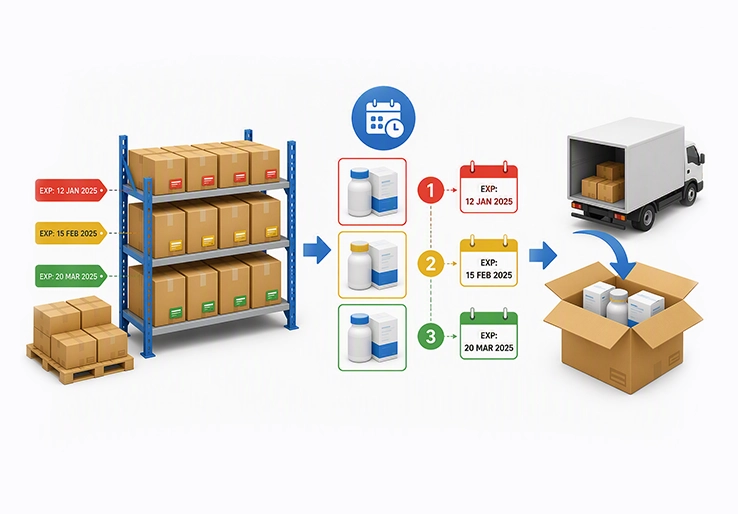
FEFO full form is "First Expired First Out" — an inventory management method that prioritizes dispatching products with the earliest expiration date before those with later dates, regardless of when they were received into the warehouse. In industries dealing with perishable goods, pharmaceuticals, and chemicals, FEFO inventory management is the difference between regulatory compliance and costly product recalls.
This guide covers everything supply chain professionals need to know about the FEFO method: its core definition, how it compares to FIFO and LIFO systems, where it's applied across business sectors, step-by-step implementation strategies, and the technology required to execute it effectively. The target audience includes warehouse managers, inventory specialists, pharmaceutical companies, food industry professionals, and supply chain leaders seeking to reduce waste, maintain product quality, and improve operational efficiency.
Direct answer: FEFO stands for "First Expired First Out." It is an inventory management system where products stored with the nearest expiration dates are picked and shipped first, ensuring that older stock moves through the supply chain before newer inventory — even if that older stock arrived more recently.
By reading this guide, you will gain:
The FEFO method is an inventory rotation strategy built on one fundamental rule: products with the shortest expiry date ship first. Unlike approaches that track when goods arrive at a facility, FEFO requires businesses to track expiration dates at the lot or batch level and use that data to drive every picking decision. FEFO prioritizes products with the nearest expiration dates first, which directly reduces the risk of distributing expired products to customers.
This approach evolved from traditional FIFO practices to solve a specific problem: when suppliers deliver stock late, or when different batches of the same product carry different shelf life durations, arrival-date-based rotation fails to prevent waste. FEFO ensures that expiration date — not receipt date — governs stock rotation, making it essential for any business handling products with defined expiration dates.
The FEFO principle operates on product prioritization based on expiration dates rather than receipt dates. When a warehouse receives multiple batches of the same SKU, the system identifies which batch has the earliest expiry date and queues it for the next order — even if a newer batch sits in a more accessible location. FEFO prioritizes products by expiration date, not arrival date.
This systematic approach serves two critical goals: minimizing waste by ensuring older stock is used first, and maintaining compliance with strict regulatory standards across the supply chain. FEFO minimizes waste by ensuring older stock is used first, which directly prevents unnecessary waste from expired products. Implementing FEFO requires accurate tracking of expiration dates at every stage — receiving, put-away, storage, and picking.
Key terminology within FEFO processes includes:
Understanding the key differences between inventory control techniques helps businesses select the right approach. FEFO differs from FIFO, which prioritizes products by arrival date rather than expiration date. Under the FIFO method, the first products received are dispatched first — a logical approach when shelf life is uniform, but a risky one when it isn't.
LIFO (Last In, First Out) uses the most recently received products first. This approach is primarily an accounting method and is rarely used in the pharmaceutical industry due to expiration risks. LIFO is rarely recommended for perishable products or any product categories with strict expiration dates because it virtually guarantees that older stock remains on shelves for extended periods.
Research into perishable goods shows that switching from FIFO to FEFO can reduce expiry-related waste by 25–40% in categories like dairy, bakery, and fresh produce. For ambient perishable SKUs, improvement tends to be 10–20%. These numbers matter when you consider that a $1 trillion loss occurs annually due to expired products globally.
With these foundational concepts established, the next step is understanding where FEFO delivers the greatest impact across specific industries.
Industries that commonly use FEFO include food, pharmaceuticals, cosmetics, and chemicals — any sector where product safety depends on proper stock rotation and where regulatory requirements demand complete lot traceability. FEFO is crucial for industries like food and pharmaceuticals, where distributing expired or degraded products carries serious health, legal, and financial consequences. FEFO is heavily used in industries dealing with perishable goods where product integrity degrades over time.
In pharmaceuticals, FEFO is not just a best practice — it is a regulatory mandate. Agencies like the U.S. FDA and the European Medicines Agency enforce strict requirements around shelf life, potency, storage conditions, and lot traceability under Good Manufacturing Practice (GMP) and Good Distribution Practice (GDP) guidelines. FEFO is crucial for compliance in pharmaceuticals and food distribution.
The impact on patient safety is direct: medicinal products that have exceeded their expiry date may lose potency or develop harmful degradation compounds. Pharmaceutical companies must maintain full serial, lot, and expiry data with documented audit trails. A pharma distribution ERP system that enforces FEFO logic during picking is essential for maintaining compliance.
A compelling real-world example: a nutraceutical brand onboarded with Dropp, a 3PL logistics provider that implemented FEFO logic automatically during picking along with temperature control and lot/expiry assignment. The result was audit readiness within 90 days and zero findings during the brand's first FDA audit.
FEFO is typically applied in food and beverage industries to manage perishable items where spoilage directly translates to financial losses and food safety violations. The food industry operates under regulations like the FDA's Food Safety Modernization Act (FSMA) in the U.S. and EU food safety directives, all of which require proper handling of perishable goods.
FEFO implementation integrates with cold chain management and perishable goods handling to ensure that products stored at controlled temperatures also follow expiration-based rotation. Many large grocery retailers specify minimum remaining shelf life requirements — failing these leads to rejections, chargebacks, and damaged customer satisfaction.
In a beverage distribution case involving approximately 400 SKUs, introduction of FEFO reduced expired-product write-offs by 61% in the first year and eliminated recurring customer complaints about short-dated deliveries. For businesses managing multi-store grocery operations, this kind of waste reduction is transformative.
In cosmetics and over-the-counter healthcare products, product potency, safety, and efficacy degrade past certain shelf life thresholds. Consumers expect products with limited shelf lives — such as sunscreens, serums, and topical treatments — to arrive with meaningful remaining shelf life. FEFO ensures these expectations are met while maintaining compliance with labeling and safety regulations.
In chemicals, hazards may actually increase past expiration, making proper stock rotation a safety imperative beyond a financial one. Across all these sectors, FEFO helps maintain compliance with batch traceability requirements — when a recall occurs, businesses must identify which lots, expiry dates, and customers were affected. FEFO maintains compliance by keeping these audit trails intact and accessible.
Moving from understanding FEFO applications to actually implementing FEFO in warehouse operations requires careful alignment of people, processes, and technology. Implementing FEFO enhances product quality and customer satisfaction, but only when execution is disciplined and systematic.
Before beginning FEFO implementation, assess whether your current inventory management software supports lot-level tracking and expiry-based picking logic. Here is the proven process:
Identify which product categories require expiration tracking. Pull historical data on waste, write-offs, and customer complaints related to expired products. Check for missing lot or expiry data across your supply chain. This baseline audit quantifies problem areas and establishes improvement targets. Operations without formal FEFO often experience spoilage rates of 8–12% of inventory value; with robust FEFO processes, spoilage drops to 1–3%.
At receiving, require lot numbers, production dates, and expiration dates for every inbound shipment. Standardize date formats (preferably YYYY-MM-DD) to avoid misinterpretation. Implement barcode scanning to enable automated tracking and minimize errors. Set protocols for rejecting or quarantining goods with missing expiry data — this is as critical as verifying count or condition.
In your ERP or warehouse management system, activate FEFO picking rules that prioritize the earliest expiration date. Define tie-breakers for same-expiry scenarios (e.g., earliest receipt date). Configure the system to generate alerts for goods approaching expiry. Set customer-specific shelf-life rules so compliant products ship with sufficient remaining shelf life.
Organize the warehouse so items with the shortest expiry date are closest to pick faces or shipping docks. Dynamic flow shelving optimizes warehouse storage for FEFO by naturally rotating stock. Use visual cues — color codes, signage, standardized labeling — to support proper storage discipline. Never store mixed-date pallets together in ways that hide expiry differences.
Employees must understand why expiration-based rotation matters — for regulatory compliance, financial performance, and customer satisfaction. Regular training reinforces FEFO procedures among warehouse staff. Training should cover how to read labels, understand date formats (best-before vs. use-by vs. sell-by), handle blocked stock, and escalate near-expired goods. Pair training with performance metrics tied to FEFO adherence.
Define and track metrics including FEFO adherence rate, expiration waste value, average remaining shelf life at shipping, and customer rejection rates. Use dashboards within your ERP system to surface early warnings. Take proactive action — discounts, promotions, donation, or disposal — before expiry occurs. FEFO improves inventory turnover rates and reduces carrying costs when monitored consistently.
Choosing between these inventory management methods depends on your product types, regulatory environment, and operational complexity:
| Criterion | FEFO | FIFO | LIFO |
|---|---|---|---|
| Primary Sorting | Earliest expiration date | Receipt date (first in) | Most recent receipt (last in) |
| Best For | Perishable goods, products with variable shelf life, regulated industries | Stable products with uniform shelf life, non-perishables | Accounting valuation under specific tax systems |
| Waste Reduction | Highest — 25–40% reduction vs FIFO in perishable categories | Moderate — effective when arrival aligns with expiry | Low — older stock stagnates, high expiry risk |
| Regulatory Compliance | Strong — required in pharmaceuticals and food distribution practices | Acceptable for non-expiring items | Insufficient for perishable or regulated goods |
| Data Requirements | High — batch tracking, expiry capture, lot handling, quality status | Medium — receipt date tracking | Low — simpler logging |
| Implementation Complexity | High — requires WMS/ERP integration, training, SOPs | Medium — standard warehouse procedures | Low — but operationally risky for physical goods |
FEFO reduces waste from expired items significantly compared to both alternatives. For certain industries — pharmaceuticals, food, cosmetics, chemicals — FEFO is the only compliant choice. FIFO remains suitable for raw materials and stable products where expiry variation is minimal. LIFO (last-in, first-out) has virtually no application in physical goods management for perishable products.
FEFO helps businesses comply with strict regulatory standards while simultaneously reducing waste and improving customer satisfaction — making it the clear choice for any organization handling products with defined expiration dates.
Even with the right strategy, FEFO implementation encounters predictable obstacles. Understanding these challenges upfront allows businesses to plan solutions into their rollout rather than react after problems emerge.
Many warehouse management systems support FEFO but require significant configuration. Older or basic systems may lack lot-level tracking, expiry-based pick logic, or automated alerts. When implementing FEFO across complex operations with thousands of SKUs, system performance can degrade if logic isn't optimized.
Solution: Start with a pilot deployment covering a limited set of product categories before scaling. Ensure your ERP platform — such as LOGIC ERP's warehouse management software — natively supports lot tracking, expiry-based picking rules, and configurable alert thresholds. Invest in barcode or RFID scanning at receiving to enable accurate tracking and inventory accuracy from day one.
Workers accustomed to the FIFO method or picking by location convenience often resist the additional complexity of FEFO. Mixed pallets create error risk when staff cannot easily distinguish between batches with different expiry dates. Without proper training, even the best-configured system fails at the point of execution.
Solution: Conduct extensive training that explains both the "why" (reducing waste, regulatory compliance, preventing financial losses) and the "how" (reading labels, following system-directed picks, handling blocked stock). Use physical signage and color-coded labels throughout the warehouse. Make system pick instructions unambiguous. Audit compliance regularly and tie performance incentives to FEFO adherence metrics.
Mis-shipment of expired or nearly expired products leads to recalls, fines, and legal liability. For pharmaceutical companies, failure to maintain lot traceability and FEFO discipline can violate GMP, Good Distribution Practice, DSCSA, or other regulatory frameworks. In the food industry, FSMA audits specifically examine how businesses handle perishable goods rotation.
Solution: Maintain complete serial, lot, and expiry data with full audit trails in your supply chain management software. Perform regular internal audits of FEFO adherence. Set customer-specific shelf-life thresholds so that only compliant products with sufficient remaining shelf life ship. Ensure cold chain and proper storage compliance documentation is maintained alongside FEFO records.
Additional challenges include data gaps — where missing lot numbers or inconsistent supplier labeling undermine the system — and alert fatigue, where too many low-priority notifications cause staff to ignore critical warnings. Address data gaps by standardizing supplier requirements and refusing goods without proper expiry information. Combat alert fatigue by creating tiered warning levels: early warning, action needed, and urgent, so staff can prioritize effectively.
LOGIC ERP offers a comprehensive FEFO software solution designed specifically to address the complexities of managing perishable and expiry-sensitive inventory. Our platform integrates advanced lot and batch tracking with expiration date prioritization, ensuring your warehouse operations consistently follow the First Expired First Out principle.
Key advantages of choosing LOGIC ERP FEFO software include:
By leveraging LOGIC ERP FEFO software, businesses can significantly reduce product waste, enhance customer satisfaction through fresher deliveries, and maintain robust compliance, all while improving operational efficiency. Our solution empowers supply chain professionals to implement FEFO flawlessly, transforming inventory management into a competitive advantage.
FEFO — First Expired First Out — is the most effective inventory management method for any business handling products with defined expiration dates. By prioritizing the earliest expiration date in every picking decision, FEFO minimizes the risk of distributing expired products, reduces financial losses from spoilage, maintains compliance with industry regulations, and delivers products to customers with meaningful remaining shelf life.
The data is compelling: FEFO implementation can reduce expiry-related waste by 25–40% in perishable categories, drop spoilage rates from 8–12% to 1–3% of inventory value, and, as demonstrated in real-world cases, cut expired-product write-offs by over 60% within a single year.
To begin your FEFO journey, take these immediate steps:
Call at +91-73411-41176 / +91-73411-41175 or send us an email at sales@logicerp.com to book a free demo today!
FEFO stands for "First Expired First Out," an inventory management method prioritizing products with the nearest expiration dates to be dispatched first, regardless of their arrival time. This approach minimizes waste and ensures compliance, especially for perishable goods.
FEFO prioritizes stock based on expiration dates, whereas FIFO (First In, First Out) prioritizes based on the arrival date of products. FEFO is essential for managing perishable goods with varying shelf lives, while FIFO suits products with uniform shelf life or non-perishables.
Industries such as food and beverage, pharmaceuticals, cosmetics, chemicals, and healthcare products benefit significantly from FEFO, as it helps maintain product safety, quality, and regulatory compliance by ensuring proper expiration-based stock rotation.
Implementing FEFO reduces waste from expired products, improves inventory turnover rates, minimizes storage costs, ensures regulatory compliance, enhances product quality, and increases customer satisfaction by delivering fresher products.
Effective FEFO implementation involves accurate tracking of expiration dates, optimizing warehouse layouts with dynamic flow shelving, staff training on FEFO procedures, and integrating Warehouse Management Systems (WMS) that automate picking based on expiration dates.
Yes, FEFO can be integrated with methods like FIFO to manage different product categories efficiently. For example, applying FEFO for perishable items and FIFO for stable goods, allowing flexible and optimized stock management.
Warehouse Management Systems (WMS) equipped with lot and expiration date tracking, barcode or RFID scanning, automated alerts for near-expiry items, and real-time inventory visibility are key technologies that support reliable FEFO execution.
Common challenges include integrating FEFO logic into existing systems, ensuring staff adherence, maintaining accurate expiration data, and meeting regulatory requirements. Solutions include thorough training, technology upgrades, supplier data standardization, and continuous monitoring.
By prioritizing the movement of expiring inventory, FEFO minimizes obsolete stock and excess inventory levels, reducing storage duration and associated carrying costs, thereby helping businesses minimize storage costs and reduce costs overall.
FEFO ensures products are distributed before expiration, maintaining safety and efficacy. It supports compliance with regulations such as FDA, GMP, GDP, and FSMA by enabling traceability and audit-ready stock rotation processes.
Stock rotation is the process of managing inventory so that products with the earliest expiration dates are used or shipped first. In FEFO (First Expired First Out), stock rotation ensures that perishable products are prioritized based on their expiry date, minimizing waste and improving operational efficiency across the supply chain.
FEFO prioritizes inventory based on expiration dates rather than arrival dates. This means products with the nearest expiry date are dispatched first, regardless of when they entered the warehouse. This approach is critical for managing limited shelf lives and reducing customer complaints related to expired or near-expired products.
FEFO is especially beneficial in business sectors dealing with perishable products, such as food and beverage, pharmaceuticals, cosmetics, and chemicals. These sectors require strict control over remaining shelf life to ensure product safety, regulatory compliance, and customer satisfaction.
The key differences lie in how inventory is prioritized. FEFO focuses on the expiration date, ensuring products closest to expiry are used first. LIFO (Last In First Out) prioritizes the most recently received stock, which can increase the risk of older products expiring unused. FEFO is preferred for managing limited shelf lives in perishable goods, while LIFO is rarely used in such contexts.
By systematically prioritizing products with the earliest expiration dates, FEFO reduces waste, prevents stock obsolescence, and ensures timely product turnover. This leads to better inventory control, fewer customer complaints about expired products, and optimized use of storage space, ultimately improving operational efficiency throughout the supply chain.
Managing remaining shelf life is crucial in FEFO inventory management because it ensures that products closest to their expiration dates are prioritized for dispatch, reducing waste and maintaining product quality.
FEFO specifically targets products with a limited shelf life by ensuring those with the earliest expiration dates are used or sold first, preventing spoilage and regulatory non-compliance.
FEFO is essential for perishable products as it minimizes the risk of distributing expired goods, maintains safety standards, and reduces financial losses due to spoilage.
By prioritizing the shipment of products with the nearest expiration dates, FEFO reduces the chances of customers receiving expired or near-expired items, thereby lowering customer complaints and improving satisfaction.
FEFO stands for First Expired First Out, an inventory method that prioritizes products based on their expiration dates rather than their arrival dates.
FEFO full form is First Expired, First Out. It is an inventory management method where products with the earliest expiry dates are used or sold first.
FEFO is an inventory management principle that prioritizes issuing or selling products based on their expiration dates rather than the date they were received. It helps reduce product wastage and ensures freshness.
FEFO meaning refers to First Expired, First Out, an inventory control method that ensures products with the nearest expiration dates are used first. It is widely used in industries dealing with perishable goods.
The FEFO method is an inventory management technique where products nearing expiration are dispatched or sold before those with later expiry dates. It is commonly used in food, pharmaceutical, and healthcare industries.
For businesses ready to deepen their FEFO implementation, these resources provide additional guidance:
Popular Products